Category Archives: Politics

Jim Allister and WI’s business plans

I noted here that Jim Allister, Traditional Unionist Voice MLA, had been asking questions about the “regularity” and “legality” of certain amounts granted to Waterways Ireland and the cross-border Language Body by the NI Department of Culture, Arts and Leisure. His two questions to the Minister for Culture, Arts and Leisure were answered last week.

AQW 35466/11-15: To ask the Minister of Culture, Arts and Leisure, in light of the Comptroller and Auditor General qualifying her Department’s Resource Accounts for 2013/14, whether she accepts that grant payments of over £8m made by her Department’s North/South Bodies were irregular; and if she will seek approval from the Department of Finance and Personnel for all such payments in accordance with the statutory requirements of the North/South Co-operation (Implementation Bodies) (Northern Ireland) Order 1999. [Priority Written]

Answer: The accounts for both agencies of the North South Language Body and Waterways Ireland for the 2013 and 2014 years have not yet been completed and audited.

My Department’s Accounting Officer reported that during the 2013/14 year, DCAL incurred irregular spend in respect of grants to the Language Body and Waterways Ireland as the business plans for these respective periods have not been approved. Draft business plans were in place against which the performance and budget of the bodies were monitored, and Corporate Plans for the period 2011- 13 for Waterways Ireland and both agencies of the Language Body, which were approved by Sponsor Department Ministers; both Finance Ministers and the NSMC Ministers were in place.

That’s a lesson in how to avoid answering the questions you were asked.

AQW 35541/11-15: To ask the Minister of Culture, Arts and Leisure whether she will place into the Assembly Library, a copy of the documentation received from the Department of Finance and Personnel (DFP), or otherwise recording DFP approval, which verifies the claim by her Department’s Accounting Officer in the Resource Accounts 2013/14 that DFP approval of grants to North/South Bodies was given for the amount of the grant at estimates or efficiency stage negotiations. [Priority Written]

Answer: The 2013/14 Main Estimate is published on the Department of Finance and Personnel’s website (http://www.dfpni.gov.uk/main-estimates-2013-14.pdf). My Department included within the 2013/14 Main Estimate on specific lines entitled “Language Body” and “Waterways Ireland” an estimate of the grants (before any efficiency savings were applied) my Department intended to allocate to the North South Bodies during 2013/14.

Estimates are prepared by departments and examined by DFP Supply to ensure that they meet Assembly propriety requirements and are consistent with the Executive’s expenditure plans.

After approval by DFP Supply the Estimates are presented and recommended (as required by Section 63 of the Northern Ireland Act 1998) to the Assembly by the DFP Minister who moves the Supply Resolution/s summing up the requests for Supply for each body.

On the basis of legal advice, the Department considers that the process and published Main Estimate document shows approval by DFP for the grants allocated to the North South bodies. DFP did not approve the final business plan which has resulted in the grants being deemed irregular.

It would be nice to see that legal advice.

Last week’s Phoenix magazine had an article headed “Flanagan falls flat on face” [not online] about severe constipation in the business of the Northern Ireland Executive. It includes this paragraph:

The DUP have plunged the [NI] institutions into a blast freezer since May when unionist ultra Jim Allister, staunch opponent of the GFA [Good Friday Agreement], got 75000 votes in the Euro elections. His party won thirteen council seats the same day. That sent a high voltage chock through the party. They stopped doing business with Sinn Féin, fearful of losing votes in next year’s British election.

But the WI/Language Body business plans problem surely began before May 2014.

NI21 and waterways charges

Basil McCrea is MLA for Lagan Valley and leader of NI21. He is a member of the NI Assembly’s Committee for Culture, Arts and Leisure. He has asked two questions of the Minister for Culture, Arts and Leisure:

AQW 35965/11-15: To ask the Minister of Culture, Arts and Leisure to detail the Department’s total expenditure to Waterways Ireland in (i) 2012; (ii) 2013; and (iii) 2014 to date.

AQW 35966/11-15: To ask the Minister of Culture, Arts and Leisure whether there is legislative provision for her Department to impose a charge on users of waterways.


A puzzle in waterways history

According to the Lagan Canal Trust,

The Lagan Navigation also forms part of a wider all Ireland waterway network. This network of waterways once traversed through the towns and cities of Ireland delivering goods and produce, helping to shape the economic fortunes of the country.

I would be grateful for information about any goods or produce that were ever carried from the Shannon, or from the Royal or Grand Canals or the River Barrow via the Shannon, through the Junction Canal in the Ballinamore & Ballyconnell Drainage District [later called the Ballinamore & Ballyconnell Canal and later still the Shannon–Erne Waterway] and then the Ulster Canal to Lough Neagh or any of the waterways connected therewith. Or, of course, in the opposite direction.

As far as I can tell, outside the sales blurbs written by engineers seeking employment and waterway owners seeking subsidies, there was never a connected all-Ireland waterways network; nor was there ever any need or demand for such a thing.

Any more than there is now.


The delays in approving WI business plans

I wrote on 26 November 2013, and again on that date, on 22 January 2014 and on 7 April 2014 about the extraordinary delays in having Waterways Ireland’s business plans approved by The Powers That Be. I saw it as poor practice that would make management’s job harder, with plans not being approved until very late in the year or even until after the end of the year to which they applied.

But, thanks to a statement by Jim Allister of Traditional Unionist Voice, I have been alerted to the possibility that the problem might be even greater than that. He points out that the NI Comptroller and Auditor General qualified the Resource Accounts of the Department of Culture, Arts and Leisure [DCAL] for y/e 31 March 2014 because the business plans for Waterways Ireland and the North/South Language Body were not approved in time. Jim Allister’s interpretation is perhaps a little overheated — the C&AG’s “irregular” becomes “illegal” and “unlawful” — so it’s worth looking in detail about what the C&AG actually said.

Sources

It’s very hard to find the DCAL Resource Accounts on the departmental website (which has a dreadful search engine) so here is a link [PDF]. I quote from them under the [UK] Open Government Licence [the link in the accounts omits a backslash].

Summary

In his Certificate of the Comptroller and Auditor General to the Northern Ireland Assembly on page 83 of the accounts, the C&AG, K J Donnelly, says:

Basis for qualified opinion on regularity

The Department is responsible for providing Annual Business Plans to the Department of Finance and Personnel in sufficient time to allow approval by the Minister of Finance and Personnel and the North South Ministerial Council prior to the commencement of the financial year to which the plan relates. As business plan approvals were not in place the Department has incurred irregular spend in 2013-­‐14 in relation to grants amounting to £3,213,000 paid to Waterways Ireland and £5,258,000 paid to the North/South Language Body.

The detailed account

The C&AG writes about this in more detail on pages 120 and 121:

2. Irregular Spend

2.1 The Department, along with the Department for Arts, Heritage and the Gaeltacht jointly sponsors Waterways Ireland and the North/South Language Body; both are North South Implementation Bodies set up under the North/South Co-operation (Implementation Bodies) (Northern Ireland) Order 1999 (the legislation).

2.2 The legislation requires each body to prepare an annual business plan that is subject to the approval of both Finance Ministers and the North South Ministerial Council. The legislation also states that the department may make grants to the body out of money appropriated by the Act of the Assembly and that such grants shall be of amounts and made on such terms and conditions as the department may, with the approval of the Department of Finance and Personnel, determine.

2.3 In order to comply with the legislation, sponsor departments are responsible for providing Business Plans to the Department of Finance and Personnel in sufficient time to allow approval by the Minister of Finance and Personnel and the North South Ministerial Council prior to the commencement of the financial year to which the plan relates.

2.4 Due to delays in the provision of Business Plans for some bodies, the Department of Finance and Personnel sought legal advice on the legitimacy of grants paid to the bodies prior to the approval of the plans. The Department of Finance and Personnel wrote to Accounting Officers on 23 May 2014 pointing out that failure to follow the outlined approval process in relation to grants made to North/South bodies has resulted in irregular spend.

2.5 The Department has advised me that given the timing of business plan approvals it has incurred irregular spend of £8,471,000 in 2013–14. This is made up of £3,213,000 in relation to Waterways Ireland and £5,258,000 in relation to the North/South Language Body.

Conclusion

2.6 As Business Plans have not received the required approval, there was no authority for this expenditure. I have therefore concluded that the expenditure was not in conformity with the authorities which govern it and qualified my audit opinion on regularity in this respect.

2.7 The Department of Finance and Personnel also indicated that if a department pays a cash grant to a North/South Body without the prior approval of the Department of Finance and Personnel then the department will have breached the provisions of the legislation and the expenditure is thus unlawful. However, there is conflicting legal advice on whether Department of Finance and Personnel approval has been provided in this regard. This is an issue which affects a number of departments and I would encourage this Department and others affected to further engage with the Department of Finance and Personnel to recolve this matter. I intend to keep this matter under review.

The Accounting Officer’s response

Peter May, the department’s Permanent Secretary, is its Accounting Officer. In his report he wrote about Governance Divergences arising in the Current Year on pages 79 and 80:

N/S Bodies

On 23 May 2014 DFP alerted departments which sponsored North South Bodies of concerns it had around the regularity and legality of grant payments made to these Bodies.

Regularity of payments — The Department accepts that N/S Bodies business plans  must be approved by the North South Ministerial Council in order for expenditure to be regarded as regular.

During 2013–14 DCAL incurred irregular spend in respect of grants to Waterways Ireland and the Language Body as business plans for these respective periods  have not been approved. It should be noted that draft business plans were in place against which the performance and budget of the bodies was monitored, and an approved Corporate Plan was in place for the period 2011–13.

Legality of payments — DFP has also raised concerns about these grants because they insist there is no record of formal DFP approval for the amounts of these grants or the terms and conditions under which they were made.

On the basis of legal advice, the Department considers the Estimates process and the negotiations between Finance Ministers on the efficiency savings show approval for the amount of the grant, while the Financial Memorandum provides the terms and conditions, which have not changed since 2005. This approach has been followed in good faith by DCAL on the basis of advice provided by DFP in 2009.

Full details of this spend is given Note SOAS 8.

SOAS8, on page 90, adds no useful information.

Jim Allister follows up

Jim Allister has two Priority Written Questions down on the matter:

AQW 35466/11-15 Mr Jim Allister (TUV – North Antrim): To ask the Minister of Culture, Arts and Leisure, in light of the Comptroller and Auditor General qualifying her Department’s Resource Accounts for 2013/14, whether she accepts that grant payments of over £8m made by her Department’s North/South Bodies were irregular; and if she will seek approval from the Department of Finance and Personnel for all such payments in accordance with the statutory requirements of the North/South Co-operation (Implementation Bodies) (Northern Ireland) Order 1999. [Priority Written] [04/09/2014 Awaiting Answer]

AQW 35541/11-15 Mr Jim Allister (TUV – North Antrim): To ask the Minister of Culture, Arts and Leisure whether she will place into the Assembly Library, a copy of the documentation received from the Department of Finance and Personnel (DFP), or otherwise recording DFP approval, which verifies the claim by her Department’s Accounting Officer in the Resource Accounts 2013/14 that DFP approval of grants to North/South Bodies was given for the amount of the grant at estimates or efficiency stage negotiations. [Priority Written]  [05/09/2014 Awaiting Answer]

WTF?

If I have understood him correctly, Jim Allister is most interested in whether DCAL was engaged in illegality; the department is, I think, rather defensive about the matter, but they can fight it out between themselves.

What interests me, though, is why DCAL could not approve the business plans in good time. Had it done so, and pushed them through the remaining regulatory hoops, it would have had no problem with either regularity or legality. Neither Corporate Plans, which cover three-year periods, nor draft business plans are acceptable substitutes for having the annual business plans approved in good time.

I don’t see, in either the C&AG’s or the Accounting Officer’s coverage, any explanation for the inordinate delays; they don’t say whether the problem is within DCAL, between DCAL and DFP or between DCAL and its southern counterpart, the Department of Arts, Heritage and the Gaeltacht. Wherever it lies, it needs to be sorted out.

 

The Royal under the Railway

A new, short book, on aspects of the history of the Royal Canal, published by the Railway and Canal Historical Society, will be launched at the Clinker Lecture on 18 October 2014. The title is The Royal under the Railway: Ireland’s Royal Canal 1830–1899 and it covers a number of topics, mostly about the canal after it was bought by the Midland Great Western Railway. From the Introduction:

The accounts of the Midland Great Western Railway for the half year ending 31 December 1849, four years after it bought the Royal Canal, showed its gross income from the railway as £23,773 and its income from the canal as £7,677, roughly a quarter of the total. By 1899, though, income from the railway was £264,393 and that from the canal £2,220, less than one per cent of the total. The Royal Canal, never particularly successful, had declined into utter irrelevance.

It may seem perverse, therefore, to offer even a short book on the canal’s history in that period, especially as there exist two full histories, by Peter Clarke and by Ruth Delany (with Ian Bath in the most recent edition). This, though, is not a full history, even of the limited period, roughly 1830–1899, from just before the railway took over until the end of the nineteenth century. This is rather a complement to those histories, providing just enough background information to  enable the book to stand alone while covering some new topics and providing new or extra information on others. The topics include:

  • the 120-foot steam-powered narrowboat
  • the Midland Great Western Railway’s early attempts at running canal boats
  • the ingenious Mr Mallet’s moveable bridge
  • the whore who held the mortgage on the canal
  • the competition between the roads of Roscommon and the Royal Canal
  • the reconstruction of Dublin bridges over the canal
  • the horses who slept on board their boat.

[…] this book is not intended to be the last word on any of those topics. I hope that it might encourage others – those researching local, family, social, industrial, transport, economic or technological history – to record and transmit anything they might learn about the history of the Royal Canal. To take just three topics, we know very little about canal employees, the operations of canal traders or the management of the horse-drawn canal boats. On any one of those, useful information could just as easily be found by a local or family historian as by a canal specialist.


Steam, the Shannon and the Great British Breakfast

That is the title of the Railway and Canal Historical Society‘s 2014 Clinker Memorial Lecture, to be held at the Birmingham and Midland Institute, Margaret Street, Birmingham B3 3BS, at 1415 on Saturday 18 October 2014.

The lecture will concentrate on the period before 1850 with such interesting topics as

  • Shannon steamers
  • the Grand and Royal Canals
  • the first Irish turf (peat) to reach the USA (possibly)
  • port developments in Dublin, Limerick and Kingstonw
  • the Dublin and Kingstown Ship Canal
  • the Midland Great Western Railway
  • what “cattle class” really means
  • bacon and eggs.

Admission is free and booking is not required. However, if you plan to attend, it would be helpful if you could e-mail […] to this effect.

The Clinker Memorial Lecture is named for Charles R Clinker, an eminent railway authoe and one-time historian of the Great Western Railway, who died in 1983.

If you would like the contact email address, leave a Comment below and I’ll get in touch with you direct.


The monsoon is coming …

… perhaps. The water depth at Banagher has stayed at around 2.1 metres but that at Athlone has gone down to about 2.0 metres. Are TPTB lowering Lough Ree so that it can store the water from the autumnal rains? Information welcome.

Shannon traffic figures to July 2014

I am grateful to Waterways Ireland for letting me have the Shannon traffic figures for July 2014. All the usual caveats apply:

  • the underlying figures do not record total waterways usage (even for the Shannon) as, for instance, sailing, fishing or waterskiing on lakes or river stretches, which did not involve a passage through a lock or Portumna Bridge, would not be recorded
  • the passage records would not show, for instance, a change in the balance of types of activities from those in larger cruising boats to those in smaller (sailing, fishing, waterskiing) boats
  • figures like these, for a small number of months, will not necessarily be representative of those for the year as a whole. The winter months, January to March, see little traffic in any year; for April, May and June, the weather can have a large influence on the amount of activity especially, I suspect, in private boats.

On the other hand, the figures do include the Shannon’s most significant tourism activity, the cruiser hire business. And they are our only consistent long-term indicator of usage of the inland waterways.

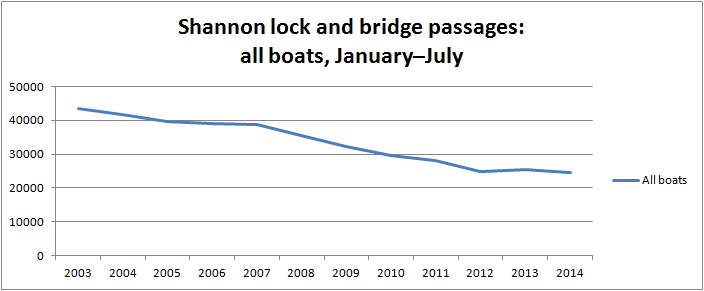
Shannon all boats Jan to Jul 2014

Total (private + hired) traffic for the first seven months of each year

Traffic in 2013 was up a bit on 2012; 2014 is down slightly below the 2012 level. It’s the lowest seven-month figure in the series (ie since 2003), which is a bit of a surprise: I thought that the good weather would encourage more boating.

The changes are small, so their importance must not be exaggerated, but they’re not cause for celebration. Let’s see whether the drop was amongst private or hired boats (or both).

Shannon private boats Jan to Jul 2014

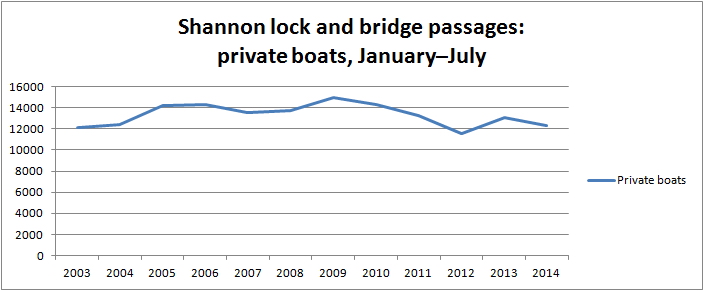
Private-boat traffic for the first seven months of each year

Private traffic is up a bit on 2012 but down on 2013.

Shannon hired boats Jan to Jul 2014

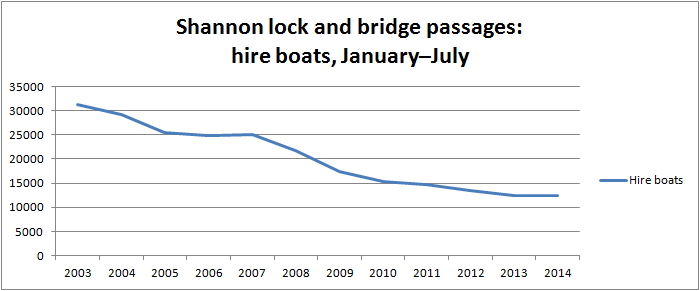
Hire-boat traffic for the first seven months of each year

Hire-boat traffic is down on both previous years, but the pace of decline seems to have slowed.

Shannon private and hired -v- 2003 Jan to Jul 2014

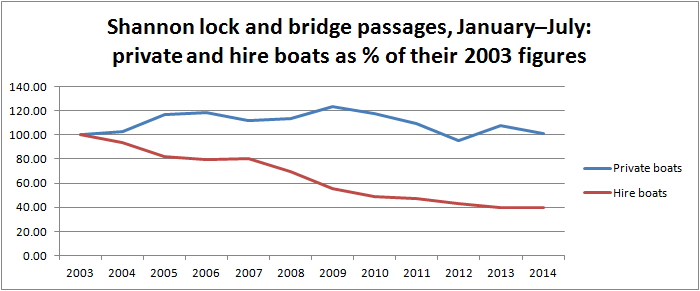
Changes since 2003: private and hired boats

Hire-boat traffic seems to be levelling off at 40% of its 2003 figure: a massive loss of business. I do not know whether anyone is trying to, or could, recover that amount of business. I am not aware of any new Shannon-based tourism business that could compensate for the losses in the cruising (hire-boat) business, but I would be glad to hear from anyone who knows of such projects. Something with high growth potential is required.

Private traffic is wobbling either side of its 2003 figure: the increases during the Celtic Tiger years have been lost.

Shannon private -v- hired boats Jan to Jul 2014

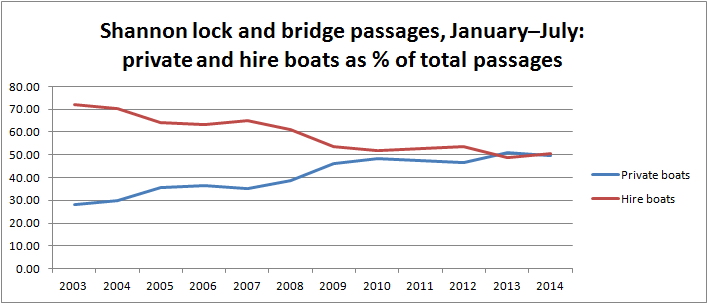
Still roughly 50/50

In the year to July 2014, hire-boat traffic was just above private traffic, but there is very little in it. Private traffic is now comparatively more important to Waterways Ireland [which may be why it is now trying to establish its economic importance] but it does not bring in much money from outside the two jurisdictions, so the case for public spending on waterways becomes much weaker.

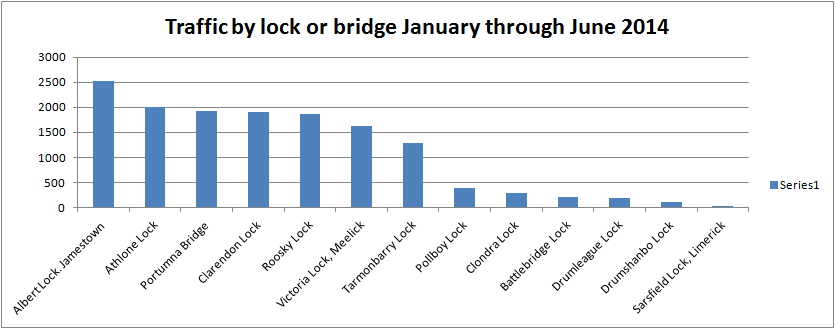
And, quite clearly, opening more waterways doesn’t work: as this chart showed last month, the branches off the main lines of the Shannon, Erne and SEW are little used. The Lough Allen Canal, the Suck and the navigation to Limerick are very little used and I see no sign that the reopened Royal Canal has attracted many visitors to Ireland. What is needed is more intensive usage of the main waterways, not further dilution by the opening of more branches [to Clones or anywhere else].

SnnNav JanJun 6

High and low usage

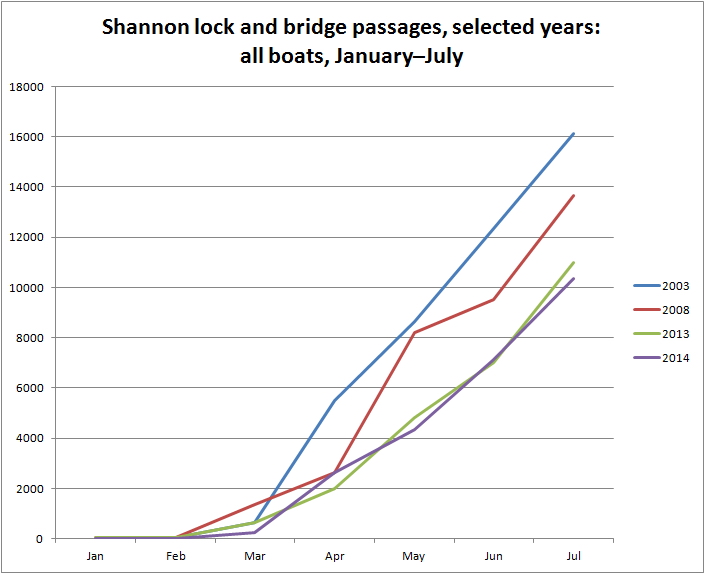
Finally, I thought it might be interesting to see whether the monthly pattern of usage has changed since 2003. To avoid an over-cluttered chart, I included only four years: 2003, 2003 +5, 2003 + 10 and 2014. The chart is for all boats, private and hired.

Shannon all boats by month selected years Jan to Jul 2014

Monthly traffic, selected years

The season seems to have got going earlier in 2003 and even in 2008. Was the weather better in those years?


Sliabh Aughty Furnace Festival

I don’t know how many people are aware that there were once extensive ironworks [which used water transport] along the lower western shore of Lough Derg and in the foothills of Sliabh Aughty. The existence of a townland called Furnace, near Whitegate, might be a clue, I suppose. Ger Madden had an article on “The Iron Works of Sliabh Aughty” in Sliabh Aughty: East Clare Heritage Journal No 7 [1997]; he told me the other day that the works burned an acre of oak every day during the season. That bears out what J H Andrews said in “Notes on the Historical Geography of the Irish Iron Industry” [Irish Geography: bulletin of the Geographical Society of Ireland Vol III No 3 1956]:

[…] the Irish woods were exploited [for charcoal] with an extravagant disregard for the future supply position, although at first the conversion of woodland to permanent pasture could have been justified in many cases as a rational long-term economic decision. […] [Cpppicing was] never adopted in Ireland, even by such enlightened land owners as Sir William Petty, so that even a small forge or furnace could despoil its woods at an alarming rate.

Ger and others in Mountshannon have now organised the Sliabh Aughty Furnace Festival, to be held in Mountshannon on 20 and 21 September 2013. The leaflet says:

In the 17th and 18th century, the western shores of Lough Derg were the setting for an intensive iron industry. Although little known, it has left many traces in the landscape and various archives.

The Sliabh Aughty Furnace Project is hoping to safeguard these monuments for the future, research the history and develop the story as a touristic attraction. […]

The festival caters both for those with a deep interest in the subject and for those who might like a lighter approach. For the first group, there is a series of talks in the Mountshannon Hotel, running from 1030 to 1630 (with an hour for lunch):

1030 Paul Rondelez “Iron production in the Sliabh Aughty mountains”
1100 Mary Sleeman “Heritage and the law”
1200 Gerard Madden “The Emmerton Papers” [an archive with valuable
information about the Clare ironworks]
1230 Professor Audrey Horning “Archaeology and early industry in Ireland and
the Americas” [yes, there is a direct link]
1400 Dr Colin Rynne “Industry on the Shannon”
1430 Dr Christy Cuniffe “An elusive foundry in the Slieve Aughty foothills: the
work of T Clarke”
1530 Sean Spellissy “Expanding on Slieve Aughty”
1600 Ewelina Rondelez “The Sliabh Aughty Furnace Project”

The Aistear Iniscealtra Park [the maze] will have events including blacksmithing, charcoal production, a living history tent, sword-fighting demonstrations, 17th century games, a knitting demonstration, an exhibition on the ironworks, stalls with local produce and a barbecue.

All of that for €10 (adult rate; under-16s €5, toddlers free).

On the Sunday there is a guided tour of the remaining furnaces, leaving the harbour at 10.30am: free if you use your own transport, €20 by bus.

There is a website here with full details including information about accommodation in the area.


Luddite loons

I have commented from time to time on the reluctance of some Irish folk to move beyond the technologies of the eighteenth century. Thus we find Shinners wanting canals all over the place and folk in Leitrim determined that, if Ireland has oil and gas, they must never be used. [That’s the Leitrim that had both a coal and an iron industry, by the way, as well as hydroelectricity, railways, a brickworks and a dockyard, to name but a few industries that come to mind.]

The latest target of the ire of the Luddites is that newfangled invention, the bicycle. Waterways Ireland might like to provide for folk to cycle along the trackway on the Barrow Navigation; some folk want to keep the dreaded bicycle, and presumably its Lycra-clad users, away from the trackway along which they like to walk.

Happily, some sane folk have written letters to the blatts and IndustrialHeritageIreland has a sensible comment.

I presume that the Luddites insist that the grass be cut using scythes, thus creating much local employment.