Category Archives: Rail

Sarah Kelly and the Royal Canal

Quite the most remarkable story I’ve come across about the Royal Canal and the Midland Great Western Railway ….
Henn, cheese, pickles and Guinness

An Affecting Charge

The following case lately came for trial before Mr Henn QC, the new Recorder of Galway:— George Hamilton, who for twenty-five years had been in the employment of the Midland Great Western Railway Company as station-master, was indicted for stealing from a hamper some goods, the property of Sir Arthur Guinness, which were addressed to Cong, in the county Mayo. For some time a course of pilfering had been carried on, and the directors, in order to find out who were the guilty parties, employed two Dublin detectives, named Stookman and Healy, who arrived in Galway on Aug 31st, and, concealing themselves in the goods-store in empty barrels, remained on the watch all night. About one o’clock next morning they heard a noise, and observed the prisoner entering the place. Having satisfied himself that he was unseen, he took out his penknife and proceeded deliberately to cut the cords of the hamper and extract some of its contents. The detectives waited until he had taken out a bottle of vinegar, a bottle of pickles, and some cheeses, and then tied up the hamper again. They then issued from their hiding-place and seized him. He begged them for God’s sake to have mercy on his wife and family, and to leave the matter between himself and the manager, but they refused to do so, and, having called the police, gave him into custody. About twenty witnesses were examined for the prosecution, and among them the clerk of the goods store, who swore that it had been locked and the key left with the prisoner.

Mr M’Laughlin QC appealed to the sympathies of the jury, and, pointing out some alleged discrepancies in the evidence, pressed them, if they had a doubt that the prisoner took the articles with a guilty intent, to give him the benefit of it.

The Recorder, in his charge, showed that the discrepancies only proved the truth of the charge, and expressed the deep pain he felt at seeing in such a position a man who had held a respectable position, with a salary of £300 a year, and had young ladies whom he saw in court dependent upon him. He finally burst into tears.

The jury retired, and after three hours’ deliberation returned into court and stated that there was no chance of an agreement. His worship sent them back to their room, and, after being absent for another hour, they brought in a verdict of not guilty, which the Recorder stated he could not endorse, but characterised as monstrous.

The Leeds Times 12 October 1878

The Recorder, Mr Henn, was the father of T R Henn and later lived in Paradise. Sir Arthur Guinness, a stout fellow, was a descendant of this chap and had a small holiday house at Cong on Lough Corrib, where his family had many boats.

Newcomen Bridge again

Last month I wrote about the lock at Newcomen Bridge on the Royal Canal:

Industrial Heritage Ireland has created a page giving the history of the railway crossing at Newcomen Bridge. However, it would be nice to have some documentary evidence about the resiting of the lock — and about the headroom under the bridge before the lock was moved.

Here it is, from the Freeman’s Journal of 12 April 1873, in an article about the new Spencer Docks:

Above the new metal bridge there is a basin for Canal boats, with a quayage of 450 feet at either side and a depth of six feet. In connection with the new works, the lowering of Newcomen-bridge on the Clontarf-road must be alluded to. To effect this the old lock had to be moved higher up, and the old bridge replaced by one suited for the requirements of the tramway traffic. The arch of the bridge crossing the Canal was lowered five feet, and a new girder iron bridge crosses the railway at the same level. The Main Drainage Board wisely took advantage of the opportunity of the Canal being drained to make a main sewer under the canal and the railway above Newcomen-bridge at the low level required.

Happy, Mick?

One for the Phizzers

Quite a few visitors to this site come to read about the Broadstone. Here is a piece about the pontoon bridge used at the Broadstone between (AFAIK) 1847 and 1877. It was designed by Robert Mallet and it is interesting to see how an inventive engineer solved the peculiar problems of the Broadstone site.

An early narrowboat on the Royal Canal?

This photo, which is used in Ruth Delany’s Ireland’s Royal Canal, shows the Royal Canal harbour in Mullingar, from the bridge. Note the very large amount of timber lying around (could some of it belong to Russells of Portarlington?). The wooden barge in the foreground has had its tiller unshipped, but what’s all that kit on deck and in the hold?

Then look at the vessel in front of it, which seems to be more the sort of beam we’d expect on an English narrowboat. It’s very hard to see any details, but could it be a steam tug?

Carrying on the Royal Canal

This is a point I’ve come across in passing. It’s not central to my main concerns so I won’t pursue it further for the moment, but I’m posting it here in case it helps anyone else researching the subject.

It will be recalled that, until the passing of the Canal Carriers Acts 1845 and 1847, most canal companies carried passengers but not freight on their own canals. After the passing of those acts, the Grand Canal Company set out to take over the bulk of the freight business on their own canal (and, in consequence, on the rivers connected thereto). But what of the Royal Canal, which had been taken over by the Midland Great Western Railway in 1845?

Ruth Delany, in Ireland’s Royal Canal 1789–2009 [with Ian Bath; The Lilliput Press, Dublin 2010], says on page 192:

In 1871, despite its failure to show a profit on the Grand Canal lease, the MGWR decided to try acting as carriers on the Royal, which had been permitted by legislation since 1845. Horse-drawn boats were used until 1875 when five steamers were purchased: Rambler, Rattler, Mermaid, Conqueror and Pioneer.

In a note, she says

For this period, 1849–1906, the principal source of information is found in the minutes of evidence to the Shuttleworth Commission, HC 1907 (Cd 3717), XXXIII, Part 1, 9.

Peter Clarke, in his The Royal Canal: the complete story (ELO Publications, Dublin 1992), says:

It is important to recall that at this time, the carriage of goods on the canal was undertaken by a number of boat owners who paid tolls to the railway company. The failure to have these tolls increased was what most probably prompted the railway company to establish themselves as carriers on the canal in 1870. […] Until 1876 an unknown number of railway owned horse drawn barges were used. In that year, the service was expanded when four new screw propelled boats were purchased at a cost of £5000.

His source is the Waterways Commission of 1923, Minutes of Evidence nineteenth day, p13.

Ernie Shepherd in The Midland Great Western Railway of Ireland: an illustrated history (Midland Publishing Ltd, Leicester 1994), says

The MGW decided to operare its own carrying trade in 1871 and this lasted until 1886. Horse drawn boats were used until 1875 when steamers were purchased.

On 15 August 1853 The Freeman’s Journal and Daily Commercial Advertiser of Dublin carried this notice in the Railways column.

Midland Great Western Railway (Ireland) Company — Royal Canal

Haulage of boats

The Directors will receive Proposals for the Haulage of their Trade Boats to and from Dublin and Longford and the River Shannon, from and after the 12th November next. Parties are at liberty to tender for a part or the whole of the work. Security will be required for the fulfilment of the Contract; and further particulars may be had on application at this Office.

Tenders to be sent in on or before 10th September next.

By order, Henry Beausire, Secretary.
Dublin Terminus, 10th August, 1853

This suggests that, in 1853, the MGWR had its own trade boats (lumber boats, freight-carrying barges) at work on the Royal Canal. It would be nice to know more. I have said before that we do not know anything like the full history of the Royal Canal.

Newcomen Bridge

Mick Farrell of the HBA has pointed out that, on the Historic 6″ Ordnance Survey map (~1840), the first lock on the Royal Canal is downstream of Newcomen Bridge whereas on the Historic 25″ (~1900) the lock is upstream of the bridge.

Industrial Heritage Ireland has created a page giving the history of the railway crossing at Newcomen Bridge. However, it would be nice to have some documentary evidence about the resiting of the lock — and about the headroom under the bridge before the lock was moved.

Waterways Ireland asset disposals

I was interested in Waterways Ireland’s programme for disposal of assets. I wrote asking for:

  • a list and details of the assets disposed of since 1 January 2010, including the amounts realised. I said that I was particularly interested in disposals of land and built assets (as opposed, say, to old machinery)
  • a list and details of the assets planned to be disposed of between the date of my enquiry and 31 December 2012
  • an account of the uses to which the funds realised have been, are being or will be put
  • a list of land and built assets being leased or rented out by Waterways Ireland.

I had mentioned some of these disposals here when the North/South Ministerial Council [NSMC] approved them, but I had no information on their value.

WI very kindly provided the information; it’s easier to deal with it in reverse order.

Land and built assets being leased or rented out

WI said:

Waterways Ireland currently leases a total of 233 properties, comprising (1) land, (2) buildings and (3) land and buildings. Of these properties, 121 are on the Grand Canal, 50 on the Royal Canal, 3 on the Barrow Navigation, 2 on the Lower Bann Navigation, 2 on the Shannon Erne Waterway and 55 on the Shannon Navigation. The compilation of the full list will take some time due to pressure of work coming up to the end of year. However, if there are specific areas, navigations or regions of particular interest, every effort will be made to provide the information as quickly as possible.

That’s quite a lot of leases, so I said that I was happy to wait.

The application of funds

WI said:

The funds raised are principally used for capital works in the relevant jurisdiction.

So if something is sold in NI, the money is used there. That is consonant with WI’s funding arrangements for capital projects (other than the Clones Sheugh). As far as I can see, all the property disposed of was in the republic.

Note that the disposals (rightly) do not go to supplement grant income for current expenditure.

Disposals 1 January 2010 to 31 December 2012

WI very kindly sent me an Excel file listing the disposals, only one of which fell into the category covered by my second question (planned to be disposed of between the date of my enquiry and 31 December 2012), so I’m dealing with both questions under one heading. WI said:

The 2010 & 2011 figures have been extracted from Waterways Ireland’s Audited Accounts and represent the Gross amount received i.e. before costs. The 2012 figures have not yet been audited.

The first point to be made is that the total value of property disposals over three years was only €529,557.19: a little over half a million euro in the context of capital expenditure for the three years of about €30,000,000: €21m in 2010 and €5m in 2011, according to WI’s annual accounts, and an amount slightly smaller than 2011’s budgeted for in 2012. So the asset disposals are not very important in WI’s overall capital spending.

disposals to public bodies

Several of the disposals were to other public bodies, allowing them (I imagine) to build bridges, lay pipes and so on. There may also (I imagine) have been disposals of small parcels of land that WI didn’t need but the other body could use. Here are the disposals that seem to fall into that category:

  • Long Lease of Property at Ballyconnell to Cavan County Council: €18,100.00
  • Long Lease of Property at Reilly’s Bridge, Dublin to Iarnrod Eireann: €23,000. This was, I think, what the NSMC called “granting of a 99 year lease to Córas Iompair Éireann for the proposed construction of a road bridge, crossing the Royal Canal at Ratoath Road, Dublin”
  • Long Lease of Property at Lesson Street, Dublin to Dublin City Council: €5,100.00. This may have been what allowed the Council to bury utility ducts under the towpath
  • Long Lease of Lands at Tullamore re: N52: €25,000.00
  • Grant of Easement at Ballygoran to Kildare County Council: €7,500. This may have been to allow Kildare County Council to run water pipes across the Royal Canal near Pike Bridge
  • Long Lease of Lands at Kilkenny re: N9/N10: €41,791.50
  • Long Lease of Lands at Fingal re: M50/N3: €48,582.62.

There was also a Grant of Right of Way at Ballyleague, Co. Roscommon (presumably at WI’s harbour on the west of the Shannon, opposite Lanesborough) for €5,000. No further information is provided but this looks like another pro forma grant of access, perhaps to the local authority. If you know more, please leave a Comment below.

Delwood

Delwood Park is in Castleknock, Dublin 15, and part of it backs on to the Royal Canal. Delwood Close is east of Delwood Park and runs towards the canal.

In 2010/11 WI sold “two parcels of land at Delwood Close, Castleknock” for €60,000 and in 2012 it sold “9 Plots to rear of Delwood Park, Castleknock” for €36,000. I don’t know who bought them so I don’t know whether the residents were extending their gardens or Iarnród Éireann wanted to build a new platform or provide a bridge over the canal from Delwood to the railway …. Local info welcome.

In the bogs

In 2010/11 WI sold property at Ferbane, Co Offaly, on the Grand Canal, for €100.00. In 2012 it sold three properties at Derrycooley, south of Pollagh, which is also on the Grand Canal, for €587.00, 750.00 and €750.00 respectively, and it expects to sell property at Pollagh for €6,750.00 before the end of 2012. That’s a total of less than €9,000.00. I don’t know what land this is, or why WI owns it, but at the prices I suspect it’s bog. Could it have been associated with Turraun?

The rest

The lowest price achieved was for “Long Lease of Property at Lough Ree”, which earned “No Premium”, which I take it means that there was no charge. I don’t know what property that was for; did WI support any charitable or similarly worthy endeavour on Lough Ree in 2012?

The highest price was €150,000.00 for “Sale of Freehold Interest of Property in Salins, Co. Kildare”. Again, I would welcome information on the property. In fact, that applies to all of these, so I won’t repeat it.

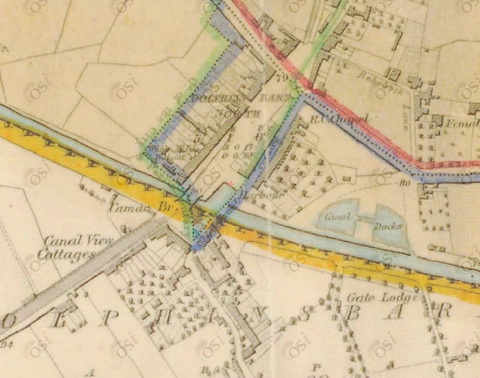
The second highest price was €87,500.00 for “Sale of Lots at Derrymullen, Robertstown, Co. Kildare”, which is where Lowtown is. And the final two were €19,046.07 for “Sale of Lands at Albert Lough [presumably that should be Lock], Drumsna” and €19,000 for “Sale of Freehold Interest in Properties at Dolphins Barn, Dublin”, which may have been land underlying the two harbours formerly to be found there.

Dolphin's Barn

Dolphin’s Barn

My OSI logo and permit number for websiteWasn’t that fun?


Irish galleries please copy

I have often lamented the poor classification methods used by those who look after collections of paintings. They focus on the name of the painter, the date and the school to which he or she belonged, rather than on the really important facts: whether or not a painting shows a steamer, barge, canal or other object of industrial heritage interest. Thus, as I pointed out here, you get titles like “View looking down on a jetty and boats on a lake with a church in the distance” that ignore the most important aspect: that the pic shows a steamer on Lough Erne.

The other problem is that the paintings are in galleries scattered hither and yon, which means that a serious search for steamers, barges and canals would require hours of driving followed by hours of rummaging through archives, even though each pic would require only a few seconds’ attention to determine whether or not it is worthy of notice. The cost-benefit ratio is all wrong, but the use of technology can solve the problem.

I was delighted therefore to learn that, in HM Realm, the BBC and the Public Catalogue Foundation have put online tagged images of [almost] all the 200,000+ oil paintings in public ownership in the UK at the Your Paintings site. The collection is searchable: the search will return artists, painting titles and tags. And you can help by adding tags, if you have more information about a painting.

There is not much of Irish waterways interest, which is scarcely surprising, but there is an interesting illustration of the use of a pole on the Lagan [I’d welcome comment on what’s happening in that pic] and the barge at Edenderry. There is also some material for steam men.

It would be nice if Irish galleries would now do the same. The cost could be met by selling off the originals, which would no longer be necessary, and closing the galleries, at a saving to the public purse.

Christmas caption competition

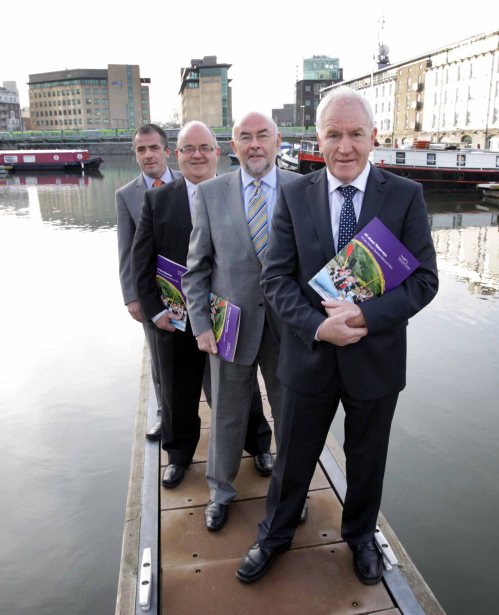
The usual prize of a glass of something or other [and I know the last two prizewinners still have a claim on me] for the best non-libellous caption for this photo, taken today at the launch of WI’s education programme for primary school children. I understand that the materials on WI’s e-learning page are complemented by “an off-line teachers resource pack”, which is what the besuited ones are clutching.

No lifejackets. Photo courtesy of Waterways Ireland, who are not to blame for my decision to use it for a caption competition

Starting at the back, the four chaps are Éanna Rowe, Waterways Ireland’s Marketing Honcho; John Martin, Heid Fector o’ Waterwyes Airlin [as we say in Ulster Scots]*; Ruairi Quinn, Minister for Education and Skills; Jimmy Deenihan, Minister for Arts, Heritage and the Gaeltacht but, on the other hand, a strong personal supporter of the Lartigue Monorail, which is a point in his favour.

Update 4 December 2012: the press release is now on the WI site.

* In its 2008 Annual Report, Waterways Ireland was, in Ulster Scots, Watterweys Airlann on the cover but Watterwyes Irelan in the Foreward bae the Cheif [sic] Executive, who signed himself as Chief [sic] Executive. By 2009, though it was still Watterweys Airlann on the cover, it was Waterwyes Airlan in the Foreward bae the Chief [sic] Executive, who signed himself as Heid Fector, a title I rather like. By 2010, though the cover remained unchanged as Watterweys Airlann, the body was Watterwyes Airlan in the Foreward, but the Heid Fector title had been dropped, alas, and John Martin was Chief Executive in two languages.

But 2008 was not the Heid Fector’s first appearance: in 2007 John Martin signed himself thus, though the foreword was called Twarthy words bae tha heid yin and the body was referred to in the text as Wattherweys [sic] Irelan.

Back in 2006, the foreword was Innin wi tha Heid Fector, and the body was Watterweys Airlann, with an accent, which I can’t reproduce, over the first e. That was the same as in 2005; in both years John Martin signed himself as Heid Fector.

I’m not sure whether I prefer Heid Yin or Heid Fector, but either seems better than Chief or Cheif Executive. But the real problem is the difficulty that this inconsistency causes for us eager students of Ulster Scots. I realise that change is inevitable in a thriving, developing language or dialect, but perhaps the cross-border bodies could give a lead in standardising the vocabulary and spelling.