Category Archives: Restoration and rebuilding

Shannon traffic to May 2014

I am grateful to Waterways Ireland for letting me have copies of the recorded numbers of boat passages through Shannon locks and Portumna Bridge for the first five months of 2014. All the usual caveats apply:

  • the underlying figures do not record total waterways usage (even for the Shannon) as, for instance, sailing, fishing or waterskiing on lakes or river stretches, which did not involve a passage through a lock or Portumna Bridge, would not be recorded
  • the passage records would not show, for instance, a change in the balance of types of activities from those in larger cruising boats to those in smaller (sailing, fishing, waterskiing) boats
  • figures like these, for a small number of months, will not necessarily be representative of those for the year as a whole. The winter months, January to March, see little traffic in any year; for April and May, the weather can have a large influence on the amount of activity especially, I suspect, in private boats.

On the other hand, the figures do include the Shannon’s most significant tourism activity, the cruiser hire business. And they are our only consistent long-term indicator of usage of the inland waterways.
Shannon passages May 2014 01


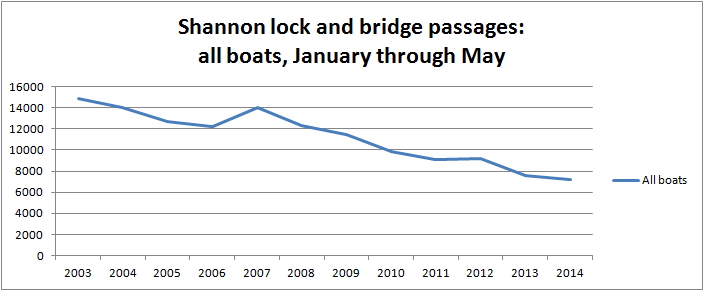
The total amount of traffic continues to decline.
Shannon passages May 2014 02

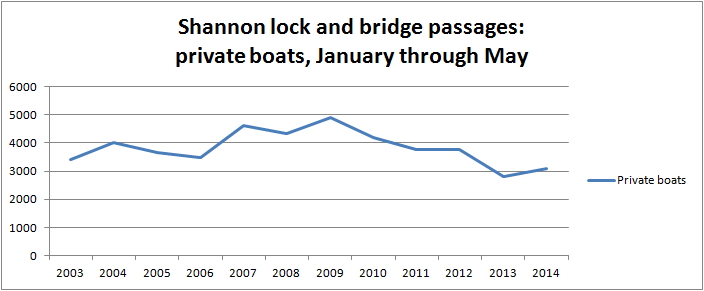
Private-boat traffic is still below its average for the period but increased slightly on the same period of the previous year [but see the third caveat above].
Shannon passages May 2014 03


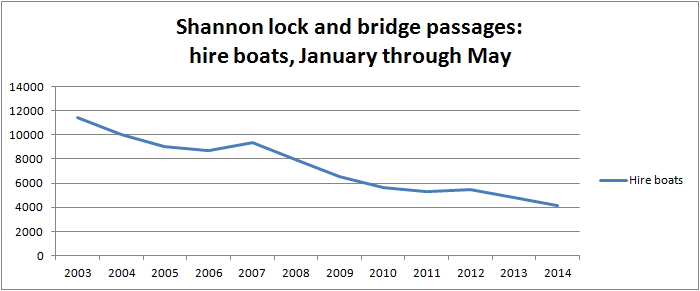
Hire-boat traffic is just over one third of its 2003 level.
Shannon passages May 2014 04


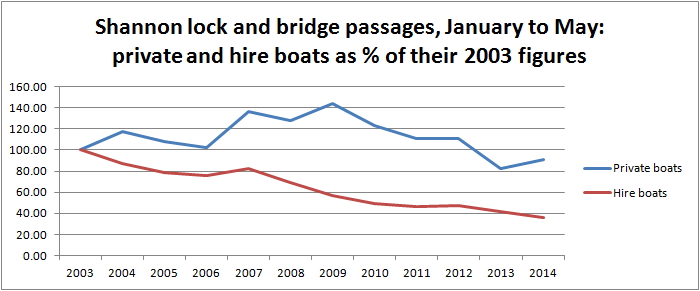
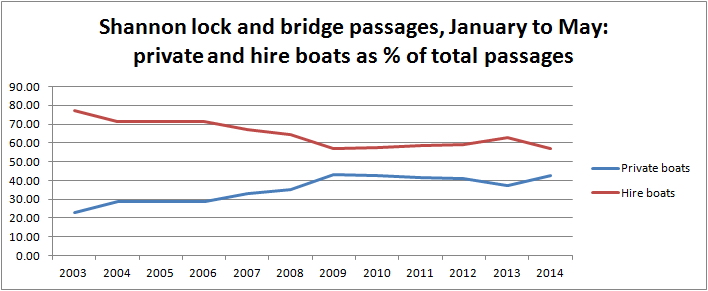
Since 2003, both private and hired traffic have fallen, from the highest figures attained within the period, by about 60% of the 2003 figure. But private traffic first rose by 40% of the 2003 figure, so it is now only about 20% below that figure. Hire traffic has fallen pretty consistently since 2003.
Shannon passages May 2014 05


Hire traffic is usually greater than private traffic between April and October (roughly speaking), but the gap is closing.

Carál Ní Chuilín, NI’s [SF] waterways minister, said the other day:

Waterways Ireland delivered a presentation to Ministers entitled ‘Ireland’s Inland Waterways — Building a Tourism Destination’. The presentation provided an overview of the progress that Waterways Ireland is making in placing waterways and the waterway experience at the centre of the tourism offering in Ireland and internationally.

And a good thing too, but the waterways need new water-based tourism products to complement, and perhaps to replace some of, the hire-boat cruising business. Opening new waterways — Royal Canal, Longford Branch, Ulster Canal, Kilbeggan Branch or anything else — is a waste of money until demand, domestic and visitor, private and hired, exceeds existing capacity.


NSMC explained

I reported here on April’s meeting of the North-South Ministerial Council (inland waterways flavour). I wasn’t there, though, and Carál Ní Chuilín was. Here is her account of the meeting, as explained to the Northern Ireland Assembly yesterday. There is much of interest, including the prospect of new byelaws on the Erne.

Members of the free state parliament don’t, as far as I know, get similar briefings.

It is slightly disconcerting to note that Jim Allister, the Traditional Unionist Voice MLA, seems to be the only person on the island, apart from me, to worry about delays in approving Waterways Ireland’s budgets.


Euroloot for the Clones Sheugh?

According to today’s Irish Times [which will disappear behind a paywall at some stage]

EU seeks feedback on plans to invest €500m in North and Border counties.

For full information, go to the SEUPB website. The Consultation Information Document [PDF may open or download as soon as you click] is the more useful and most readable document, but there are several others, including drafts of the PEACE and INTERREG Cooperation Programmes.

I have not myself been initiated into the Mystical Brotherhood of Euroloot Interpreters, so I can’t be sure, but I don’t think that either of these programmes contains, or could contain, anything that could fund the Clones Sheugh. It is difficult to see how a Sheugh-related action could be made to fit any of the objectives of either programme. But who knows what Fine Gael’s desperation might drive it to do? It faces the threat, in Monaghan, that the Shinners might arrive from Stormont bearing money from Her Majesty’s Treasury [NI branch office].


UK considers business case for investing in Ireland [updated]

DCAL, the Northern Ireland Department of Culture, Arts and Leisure, is still considering investing in the Clones Sheugh, as the Northern Ireland Assembly heard on 27 May 2014 [h/t TheyWorkForYou.com]:

Dolores Kelly [SDLP] asked the Minister of Culture, Arts and Leisure how many business cases are with her Department and awaiting a decision.

Carál Ní Chuilín [SF; Minister]: I thank the Member for her question. DCAL is considering five business cases. They are at various stages, and my officials are continuing to work with the relevant organisations to ensure that each case is of sufficient quality to facilitate a timely decision on the investment of public funds.

In addition, DCAL has provided feedback on two further business cases and is awaiting the submission of revised drafts. Work is also ongoing in the Department on the development of a further four business cases for projects that we hope to progress in the near future.

Dolores Kelly: I thank the Minister for her answer. I take it that there are nine business cases in total: the five plus the four. Will she give us a flavour of the business cases, the impact on the budget and whether the spend will be met? Indeed, what does that mean if some are to be spent within the school term timetable?

Carál Ní Chuilín: I am not sure about the school term timetable; I am going by own timetable. As for the flavour of the business cases, although there are nine cases today, I could go in next week, and there could be a further two. That is the nature of the progression, which is good because it means that we are moving in the right direction.

We are looking at the refurbishment of Coleraine library at a cost of over £2 million; the Arts Council gifting of musical instruments at almost £60,000; Tollymore National Outdoor Centre at almost £2·5 million; Dungiven sports provision; Omagh Riding for the Disabled Association; the Ulster canal; T: BUC; and the strategic outline business cases for the subregional stadia programmes.

I have asked for a copy of the Ulster Canal business case, although it is not clear whether it has yet been completed.

Update

DCAL says:

Thank you for your email on 30th May 2014 to DCAL Communications Office requesting a copy of the business case for the Ulster Canal.

Your request is being treated as a Access to Information request and will be handled under either Freedom of Information Act 2000 or the Environmental Information Regulations 2004.

As per either legislation, you should receive a response from the Department on or before 27 June 2014.

Please use reference number DCAL/2014-0292 on any further correspondence relating to this request.

Well I never.


Who writes this stuff?

The National Inventory of Architectural Heritage on the Black Bridge at Plass[e]y and on Baal’s Bridge in Limerick.

It would be nice if the NIAH provided reliable historical information.


Sallins

Houseboat facility starts again.

Not the end of the Tralee Ship Canal [updated]

I am grateful to Holger Lorenz of Tralee for alerting me to the removal of one of the gates of the Tralee Ship Canal. Holger’s photos of the lock and gate are here:

Photo 1    Photo 2    Photo 3    Photo 4    Photo 5    Photo 6

According to a Radio Kerry story, the gate had to be removed for maintenance and Tralee Town Council had “no time frame” for replacing it.

It seems to me, from Holger’s photos, that only one gate of the upper pair was removed. If the lower gates were working properly, surely they should be able to keep the canal in water.

It is some years since I visited Tralee. At the time, there was a largeish barge moored on the canal at the bridge. If it hasn’t been moved, I presume that its occupants are now unhappy.

I do not know what Tralee Town Council, or whoever it was, hoped to achieve by restoring the canal (or, for that matter, why whoever it was built the Jeanie Johnston, which was a huge waste of money). But whatever they hoped to achieve, I suspect that the canal failed to meet expectations. I do not know whether there has ever been a formal review of the project but I cannot imagine that it provided a reasonable return on investment.

The best thing to do with it now would be to seal up the seaward end with a fixed wall, forget about opening the bridge, maintain some flow through the canal to keep the water from becoming overly offensive and let the rowers take over the canal.

Addendum February 2015

This story from The Kerryman in November 2014 escaped my notice; it says that the damaged gates were replaced. It also says that the gates “now have a new motorised opening system that replaces the old crank mechanism”, which may reflect some confusion on the Kerryman‘s part as the gates were hydraulically operated.

I still don’t understand why the lower gates, or stop planks, could not have been used to maintain the level in the canal.

Addendum March 2015

Kerry County Council confirms that the lock has been restored and that the canal is fully operational.

See also comments below.

Construction

The government’s new election manifesto construction strategy has just been published and can be downloaded here. I wouldn’t bother, though: there’s nothing in it about the Clones Sheugh and it’s written in the sort of turgid prose that won’t fry your brain: it will instead submerge your brain in a slurry pit and hold it under, providing a slow, choking, unpleasant death.

Anyway, the doughty Rob Kitchin has waded through it on our behalf and gives his conclusions here. I don’t share his enthusiasm for National Spatial Strategies and National Development Plans, but I have some sympathy for him when he says

I would have preferred something a bit more holistic, rather than trying to frame a whole bunch of stuff as a coordinated plan.

Michael Hennigan uses the B word.

If we had eggs …

… we could cook bacon and eggs, if we had bacon.

What with one thing and another, I haven’t recently been paying much attention to the campaign to keep the decayed former Aran Islands ferry Naomh Éanna from being scrapped. I gather that there is a proposal for spending €1.86 million on the vessel but I found little information online, especially about the proposed sources of capital or the expected return on investment; if the full plan is available anywhere online, I’d welcome a link.

None of the proposed onboard activities seem to require a floating home, none seems to have anything much to add to the heritage or historic value (if any) of the vessel and the only purpose of the heritage tag seems to be to enable the proposed tourism complex to get a berth from Galway Port Company. There is a cheaper floating hotel available elsewhere, which might require less expense; it could be renamed Naomh Éanna II.

I see that the fans of the existing vessel are trying to raise €15000 to have it surveyed. As far as I can gather from a Facebook page, the total raised so far is €1965: €1835 by 16 April and €139 at a beer-tasting. There seems to have been an update on 23 April but, as far as I can see, access is confined to Facebook subscribers.

Of the €1835, €500 came from the Dublin Branch of the Inland Waterways Association of Ireland. I do hope that such a donation is not ultra vires: the preservation of old seagoing vessels does not seem to be within the objectives set out in IWAI’s Memorandum of Association, at least as described under “Goals of the Inland Waterways Association of Ireland” on the IWAI website. Perhaps the page needs updating?

I note that folk have been sending in photos of and other information about the vessel. Now, my interest in this vessel is not in possible uses as a floating brewery or as a tourist attraction in Galway.

First, I want this albatross to be lifted from Waterways Ireland’s neck and, if Galway Port wants to house it, that’s fine by me, as long as they get it out of the inland waterways (and the taxpayer doesn’t have to pay for it).

Second, I want to counter the notion that, because the vessel is old, it is worth preserving. As I wrote here:

Yes, it had some interesting (if minor) historical associations, but the best way of recording them would be to write a book, or create a website, or even make a movie, about the ship’s history. Money spent that way would be a far better investment than money spent on keeping the Naomh Éanna afloat. Its heritage or historical value lies in the associated information, not in the steel.

National Historic Ships UK says:

As with all man-made structures, ships and boats were not built to last forever. However, the issue of dilapidation is especially acute for vessels. Unlike buildings, the accepted working life for most vessels is only some 30 years: they were not and still are not built for the long term. For many vessels of intrinsic historical importance, there will come a time when the cost of conserving or even simply repairing them becomes unaffordable. Unless the burden can be passed to another willing organisation, such vessels have no sustainable future.

That’s from one of the three volumes of its series Understanding Historic Vessels. The first two volumes are published as free PDF downloads from this page:

  • Recording Historic Vessels
  • Deconstructing Historic Vessels [from which I quoted].

Both are well worth reading and the first, in particular, might guide anyone who is actually interested in the heritage or historic value of the Naomh Éanna; it suggests that recording should be done before deconstruction [aka scrapping] but further information can be recorded during the latter process.

The authors suggest drawing up, for each vessel, a two-page Statement of Significance. I note that I have not seen such a statement, or any equivalent, for the Naomh Éanna, which makes me sceptical about the vessel’s value. And, using the National Historic Ships Criteria and Scoring System (which is included in both documents), I fear that the Naomh Éanna would not score highly.

I accept, though, that I do not have complete information about the vessel. It may be that some of the Naomh Éanna enthusiasts are engaged in a structured recording of information about the vessel and that they are building a case — the equivalent of a Statement of Significance — for its preservation on heritage or historic grounds. However, I haven’t yet come across their work; if it exists, I would welcome a link. As it is, though, the preservation campaign seems to me to be based more on sentiment rather than on fact or logic.

Finally, the third volume of Understanding Historic Vessels, called Conserving Historic Vessels, has now been published on dead trees and can be bought through the Royal Museums Greenwich online shop at STG £30; P&P to Ireland is STG £15. Other reference sources are listed here. And here is information about the Dunleary lifeboat.


Shannon history

The African Queen, formerly the first Shannon Princess, is up for sale.