Category Archives: Restoration and rebuilding

It hasn’t gone away, you know …

Yes, the Clones Sheugh, one of Sinn Féin’s favourite inland waterways, hasn’t gone away, although SF is now allowing FF to make the running. From the invaluable KildareStreet.com:

Brendan Smith [FF, Cavan-Monaghan]: To ask the Minister for Arts, Heritage and the Gaeltacht the stage of the proposal to restore the Ulster Canal; the funding provided in her Department estimates in 2016 for this project; when this project will proceed to the next stage; and if she will make a statement on the matter.

I suppose he could have read the Estimates himself, but maybe that would be too much to ask. Anyway, his constituency colleague [Heather Humphreys, FG, Cavan-Monaghan] replied:

Government approval to restore a 2.5km stretch of the Ulster Canal from the Shannon-Erne Waterway to the International Scout Centre at Castle Saunderson, Co. Cavan, was granted on 24 February 2015. The project, which comprises three work phases, is being undertaken by Waterways Ireland.

Phase 1, the site investigation work, has been completed. Phase 2, dredging of the River Finn, is in progress. I have been informed by Waterways Ireland that completion of this phase has been delayed as a result of contractual issues but that efforts to resolve these matters are ongoing. It is intended that Phase 3 of the restoration work, the construction of a new bridge and canal section, will proceed following completion of phase 2.

Waterways Ireland has an allocation of €2.7m in its 2016 budget for the Ulster Canal project. This is comprised of €1m from my Department’s capital allocation to Waterways Ireland of €2.689m for 2016, with the balance coming from the organisation’s own resources.

We are, it will be recalled, pretending that the River Finn is part of the Ulster Canal, and that Castle Saunderson, that shrine of Ulster Unionism, was on the canal’s route: we don’t want to upset the shinners, so say nothing to them.

Quite why folk are expected to want to visit the scouting establishment now on site I do not know; boating does not seem to be amongst the activities offered.

Tralee Ship Canal

The principal export trade of Tralee is in grain, cattle, and pork; they are sent to Cork by land. The harbour is exceedingly bad and dangerous, and, at the time of my visit, a ship-canal was in process of cutting from the bay. By some men of intelligence and experience, a railway was considered preferable.[1]

[1] Jonathan Binns The Miseries and Beauties of Ireland Longman, Orme, Brown and Co, London 1837

Thon Sheugh and WI’s budget

A Sinn Féin MLA, whose party colleague is one of two ministers responsible for Waterways Ireland, has expressed concern about WI’s financial position:

Phil Flanagan: Is the [North South Ministerial] Council aware of the stark financial difficulties facing Waterways Ireland as a result of not only sustained budget cuts but the currency fluctuation because of the weakened euro? Let me point out some of the figures: compared with 2013, the 2014 budget was down by €290,000; and, in 2015, it was down by €875,000, solely because of the weak euro. Was that matter discussed? What potential solutions may ensure that Waterways Ireland is returned to a sustainable financial footing?

I had not realised the extent of the problems caused by the euro.

Replying, Martin McGuinness — also Sinn Féin — said

The fluctuation of the euro was not discussed at the meeting.

Obviously, it does represent a serious challenge, given the fact that the euro has been very weak over recent times. I note that it has strengthened over recent days. Certainly, on foot of the Member highlighting this, we can give it further consideration.

Mr McGuinness went on to provide some information about Saunderson’s Sheugh (which we’re pretending is the Ulster Canal):

It is important to point out that the work of Waterways Ireland is nearing completion, including the dredging of the River Finn between Upper Lough Erne — that will be of interest to the Member — and Castle Saunderson as part of phase 1 of the restoration of the Ulster canal.

Design plans for the new bridge at Derrykerrib are also at an advanced stage. I understand that there are some contractual issues with the site that, combined with high water levels, have led to delays.

However, Waterways Ireland is working with local councils and other interested parties to secure EU funding under the INTERREG sustainable transport programme. The proposed greenway would run from Smithborough village to the Monaghan town greenway and on to Armagh. The point that the Member raised is important and will be considered by the Council.

Given that that was irrelevant to the question, I presume that Mr McG wanted to get this information on the record.

I would like to know more about the “contractual issues with the site”. I do hope they won’t mean that we miss getting photos of the northern and southern ministers, wearing yellow hard hats and lifejackets, claiming credit for the work. After all, there is an election coming up.


How true these words are …

… even today:

The swivel bridges at Portumna and Banagher seem to have been badly situated with regard to the passage of vessels, both being placed in the concave bend of the river which makes it difficult, in blowing weather, and going down stream, to shoot the bridge safely.

From the BNA

That is from the Clare Journal, and Ennis Advertiser of 12 September 1850. The swivel bridges of yesterday are the navigation arches of today. The deficiencies of the Shannon Commissioners’ work were evident as soon as they had completed it.

However, although the article from which the sentence was taken is a condemnation of the Shannon Commissioners, the Journal was mistaken in blaming them for Portumna: that bridge was not built by the Shannon Commissioners.

The sinking of the Longford 6

Here is the sixth and final page on the sinking of the passage boat Longford on the Royal Canal on 25 November 1845. This page is about who was steering the boat and why the steerer was unable to avoid the accident.

The price of fifteen lives was 1p.


The sinking of the Longford 4 and 5

Here are the fourth and fifth pages [I split one long page] in the sequence of articles about the sinking of the passage boat Longford on the Royal Canal in 1845. They discuss some of the evidence of corporate incompetence and farcical laxity that may have persuaded the inquest jury to award a deodand against the vessel (and thus against the Royal Canal Company).

Amongst other gems, the footnotes explain what a crapper is.

The sinking of the Longford 1

Here is the first of several articles about the sinking of the Royal Canal passage-boat Longford on 25 November 1845.

Royal Canal November

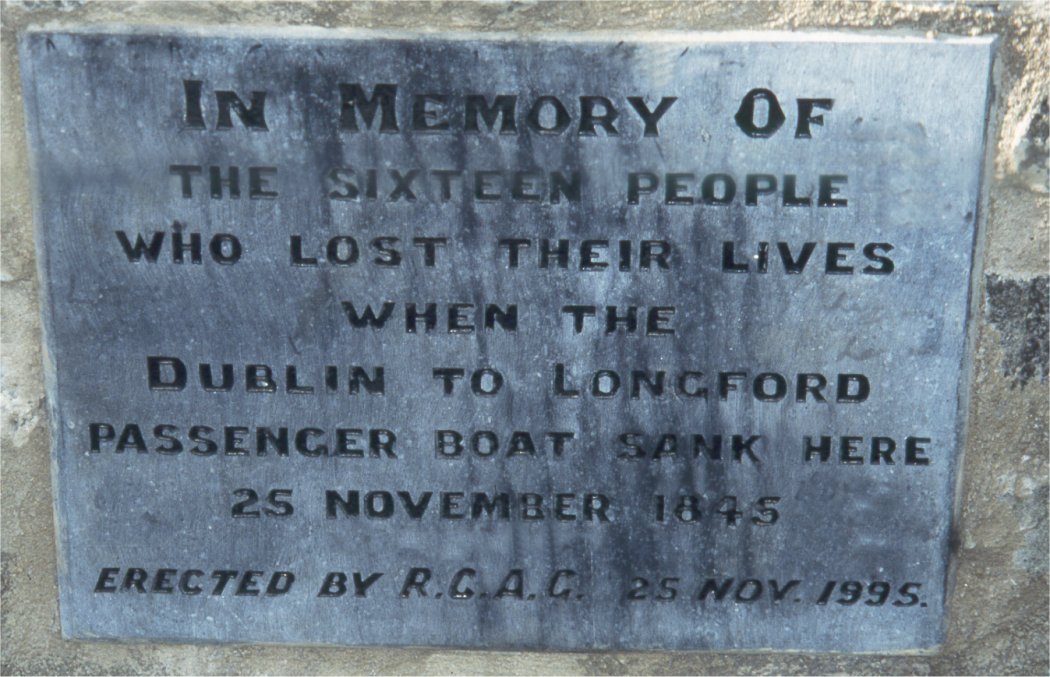
I said here that I did not know whether there was a plaque to commemorate the drowning of fifteen people on the Royal Canal in 1845. I am grateful to both Ewan Duffy and Niall Galway for telling me that there is a plaque and for sending photos of it. Ewan’s, which I show below, was taken in 1997.

Porterstown Plaque

The plaque in 1997 (copyright industrialheritageireland.info)

Niall has sent on a message from the Royal Canal Amenity Group chairman:

A Mass in memory of the 16 people who lost their lives on 25 November 1845, when a passenger boat sank on the Royal Canal at Clonsilla, will be
held in St Mochta’s Church, Porterstown Road, at 10.00 am on Friday next 27 November 2015. After the mass you are invited to Porterstown (Kennan) bridge to lay a wreath and afterwards to the Clonsilla Inn for a tea/coffee.

I know that Ruth Delany gives the figure of 16 deaths, but all the newspaper reports that I have read say that 15 people died: 7 men, 6 women and 2 children, all from the second-class cabin.

Addendum 23 November 2015: I have now read some more newspaper reports and I think the discrepancy arises because early press reports of the accident itself, notably that carried in the Freeman’s Journal, said that sixteen people had died, but reports of the inquest gave the number as fifteen. The pre-inquest reports were inaccurate in other respects too: the total numbers of passengers were wrong and the chain of events that led to the accident was not properly described.


Remember, remember the twenty-fifth of November

25 November 2015 will be the 170th anniversary of the sinking of the Royal Canal passage-boat Longford and the deaths of fifteen people.

This was not (pace Ruth Delany in Ireland’s Royal Canal 1789–2009 Lilliput Press, Dublin 2010) “the worst accident ever to happen on the Irish waterways”: that melancholy distinction belongs to the drowning at Carrick-on-Suir of about 111 people in 1799 [see “The cries at the bridge” on this page], while the second-worst was the drowning of twenty people on Lough Corrib in 1828, the event commemorated by Antoine Ó Raifteiri in his poem Eanach Dhúin.

But the 1845 accident, between Porterstown and Clonsilla Bridges, was the worst to occur on an Irish canal. Evidence at the inquest and subsequent trial suggests great laxity in the management of the Royal Canal Company’s affairs, even if the immediate cause was an act of insane irresponsibility on the part of the boat’s temporary steerer.

I do not know whether any plaque or other artefact commemorates the event.

Aw sheughs

On 6 November 2015 there was a meeting of the Inland Waterways flavour of the North South Ministerial Council, whereat the Minister for Fairytales (RoI) and the Minister for Marching Bands (NI), each with a sidekick, discussed waterways matters. The joint communiqué, artfully written to provide outsiders with as little information as possible, is available here [PDF], but here’s a summary:

  • WI’s “capital expenditure focused on infrastructure repairs”, presumably because it has no money for any improvements or extensions, except a bit of dredging in or near the constituency of the Minister for Fairytales
  • yes, that means the River Finn, Saunderson’s Sheugh, which we’re pretending is or was part of the Clones Sheugh or Ulster Canal
  • WI has managed to get “third party funding” of over €1 million for waterside developments, which is good: much better than transferring WI money to other bodies. WI is trying to nab euroloot but, as there were no announcements of success, we must assume that this is work in progress. Mind you, the ministers would probably claim the success (and the photoshoots) anyway
  • WI may sell some unspecified property
  • the important one:

LEGACY SCALE LINKAGES FOR NORTHERN BASED WATERWAYS IRELAND STAFF

The Council approved the determination made by Waterways Ireland regarding legacy scale linkages for northern based staff.

I knew you’d want to know about that. Whatever it means.

On 17 November 2015 the latest attempt to get the boys and girls of the Northern Ireland Assembly to be nice to other reached some sort of conclusion, which you can read about in the Irish Times (until it disappears behind a paywall) and the Manchester Guardian. But of course the important question is whether we southron loons have to buy sweeties (sheugher candies) for our northern brethren to persuade them to be polite. For that, gentle reader, you must turn to the inspiringly-titled A fresh start — the Stormont Agreement and implementation plan, available here [PDF].

You will not, of course, want to bother reading most of it, so we can skip straight to Section E Irish Government Financial Support on page 30. New readers may wish to know that, many NI disagreements ago, the Irish government, led at the time by a group of leprechauns who believed they possessed a pot of gold, resolved to impress the poor benighted northerners with a display of southern wealth and power. Accordingly, it promised to pay for all sorts of transport infrastructure, provided that it could be claimed to have some sort of cross-borderality and preferably looked iconic. Whether there was any point to any of the schemes was a matter omitted from consideration.

The three main proposals, IIRC, were

  • the A5, a road in Northern Ireland
  • the Narrow Water Bridge, which would cross the Newry River in the middle of nowhere (whereas a south-eastern bypass of Newry might actually be useful). And it would have an opening span for the many vessels that visit Newry by the Ship Canal
  • the Clones Sheugh, a short section of the Ulster Canal.

Unfortunately the hardheaded northerners have long memories and they keep looking for their three sweeties long after the Free State realised that it couldn’t afford them. So has this latest throwing of their toys out of the pram forced the Free Staters to give in and buy them the A5, the iconic bridge and the Clones Sheugh?

Up to a point, Lord Copper.

The Irish government says it’s all in favour of, er, “investing” in infrastructure “to support North-South co-operation to help unlock the full potential of the island economy”, where no doubt eighteenth century transport methods will prove to as important as they were in the time of Grattan’s Parliament. But with that, and all the other waffle and irrelevancies shoved in at the start of the section, it is clear that the Irish government is trying to big up a small contribution. It drags in the European Union, the Dublin to Belfast railway, flood relief, energy, communications and health, which have nothing to do with the case, but which between them fill almost the whole of the first page.

From there, though, it has to get specific, or at least look as if it’s doing so. Accordingly, each of the three white elephants gets a subsection to itself, with numbered paragraphs, from which we learn that:

  • the Free State government “remains supportive of the commitment under the St Andrews Agreement” to co-fund the A5. It’s going to pay more (I think): £25 million a year in the years 2017–2019, up from a total of £50 million
  • the Free State government “remains committed to the concept of the Narrow Water Bridge”, which has “potential to provide jobs” [how?]; it will review the plans with the NI Executive and think about it by June 2016. It says nothing about the disappearance of funding
  • the Free State government does not say that it “remains supportive of the commitment under the St Andrews Agreement” to fund the Clones Sheugh. Nor does it say that it “remains committed to the concept”. What it does say about the sheugh is that it is funding Saunderson’s Sheugh (see above), it will think about more cross-border greenways and blueways including the Ulster Canal and it and the NI Exec will identify “options for jointly developing future phases of the Ulster Canal restoration project”, which I take to mean that the southron taxpayer won’t be stuck with the entire bill. Oh, and it’s going to think about funding a bleeding sail training vessel, another exercise in pointlessness and nitwittery.

That’s almost it: there is something about a north-west thingie, senior officials will meet and there will be progress reports.

These documents are not necessarily constructed to provide information to outsiders, but my sense is that the Clones Sheugh danger to the southron taxpayer has receded for the moment, although the Narrow Water Bridge and the sail-training nitwittwery need to be blown out of the water (or into it). The A5 road is to go ahead: I don’t know much about it but it might be the least objectionable of the lot.