Category Archives: Scenery

Royal water

The Royal Canal water supply applications have been approved by An Bord Pleanala. There were two separate applications [see here and here] but they were in effect treated as one. There are five PDFs available on each page and I haven’t read all of them yet. However, on a first glance, I note that:

2. The proposed development shall be operated as follows:

(a) Rates of abstraction from Lough Ennell to the Royal Canal shall be as specified  in the public notices and, in particular, shall not exceed 43,636 cubic metres of water in any 24 hour continuous period and subject to a total maximum abstraction of 6,586,363 cubic metres per annum.

(b) Abstraction from Lough Ennell to supply the Royal Canal shall cease when the  lake level reaches 79.325 mOD Malin Datum, being the crest level of Clonsingle weir, measured at Clonsingle weir by continuous monitoring.

(c) The fish pass at Clonsingle weir shall incorporate a minimum flow of 0.29m3/second.

(d) A minimum flow of 682 m3/day (0.5MGD), taken directly from Lough Owel, and excluding water from the fish farm, shall be retained in the original canal feeder.

Reason: In the interest of protecting the integrity of the Lough Ennell Special Area of Conservation and the ecological interest of the River Brosna and the canal feeder, and in the interest of protecting material assets at Lough Ennell and the River Brosna.

If I remember correctly, the amount of water available from Lough Ennell will not always provide enough (eg in a dry season) to keep the canal full. Still, this is a significant advance for Waterways Ireland and for Royal Canal enthusiasts.
The Park Canal

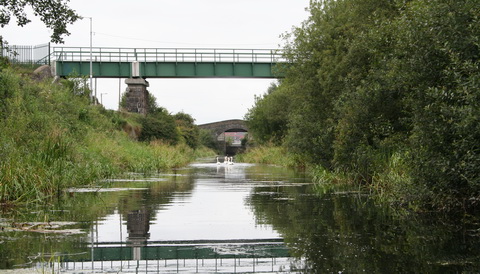
I wrote here about the Park Canal and why it should not be restored. I did not include, because I had not then seen it, a link to this report in the Limerick Post. It shows why the gates on the second lock were not replaced. The core problem is that the banks in the upper section of the canal slope too steeply to be stable.

The slope of the banks above the railway bridge (from a boat)

Happily, this deficiency in the original construction has saved us from another foolish restoration.


Commercial operations

An example I hadn’t come across before.

Dept Ag

Big it up for the Lands Branch (who knew?) of the Dept of Ag, which responded immesiately to tell me that the fishing rights in my garden are owned by the Central Fisheries Board, which is called something else these days, so we know it’s much more efficient.

If only the DeptAg folk in charge of Section 46 of the Merchant Shipping (Investigation of Marine Casualties) Act 2000 were as quick to respond as their Lands Branch colleagues.

Eeyore’s Gloomy Place

Here is an article, perhaps by Philip Dixon Hardy himself, from his Dublin Penny Journal of 1835. It is about the Bog of Allen, and the turfcutters living thereon, seen from the Grand Canal in 1835.

He visited a turfcutter’s hovel in the bog while stopped at a double lock about twenty miles from Dublin. What lock could that have been?

Note that Kildare is not among the counties mentioned in the article.

A Winn for the Grand

In today’s Sunday Business Post Jasper Winn, the paper’s Hardy Outdoor Correspondent, describes a five-day walk along the Grand Canal, from Harold’s Cross to Shannon Harbour. He did it in winter, camping out on the bank overnight despite its being so cold that the canal froze over, and finishing some of his days’ walks in the dark.

The SBP operates a paywall so you may not be able to see the page, but this is the link in case you want to try.

For the record

The Limerick Leader article about a proposed Limerick river bus has some statements that do not accord with my understanding.

The venture will see the river bus depart Guinness Pier – across from Athlunkard Boat Club at O’Dwyer Bridge – every two hours, bound for the power station […].

As far as I know, the pier in question was the Ranks jetty and was not used by Messrs Guinness. The Eclipse Flower, and other vessels owned by Ranks and their predecessors, sailed up the Shannon from there rather than attempt the stretch from Baal’s Bridge to Custom House Quay.

The boat will follow the route taken by barges of old – both passenger and commercial – some of which historically transported Guinness to the city up until the mid-1960s.

“It is a tried and tested route,” said Mr Flynn, stressing the viability and safety of the route, which passes Long Pavement – the edges of which have been repaired and grassed over – and finishes at the hydro-electric plant.

“Every passenger and commercial barge that came to Limerick for 50 years used that stretch of water. It is very safe. It was navigated by all the barges,” he said.

The route to Limerick through Ardnacrusha came into use only after the construction of the power station in the 1920s and was used for a little over thirty years. To the best of my knowledge, there were no passenger services in those years: passenger carrying stopped in the first half of the nineteenth century, when traffic was still using the old Limerick Navigation. There have been some trip-boats in recent years, but they did not (and do not) use “barges of old”. Some old barges, now converted and with more powerful engines, have safely navigated that stretch, but they do it when conditions are right.

During the final phases of Ardnacrusha’s construction, both old and new navigations were closed; the Grand Canal Company (GCC), the main commercial carrying company, ran to Killaloe and had its cargoes carried onward by rail to Limerick. When the new route through Ardnacrusha was opened, the GCC thought it was so dangerous that it refused to use it for about a year. It resumed operations only when a boom was put across the river above Baal’s Bridge and posts were provided upstream of O’Dwyer Bridge to which barges could tie while waiting for suitable states of the tide.

I accept that the proposed river bus will not be going downstream as far as Baal’s Bridge, but it will still be navigating on a stretch of water where Waterways Ireland advises that boats should not navigate when more than one turbine is running at Ardnacrusha. The ESB can run up to four turbines, each of which is said to add a knot to the current, and it can switch them on immediately, with no warning to any boat using the river.

Other pages on this site make it clear that I share the promoters’ enthusiasm for Ardnacrusha and the canal and river thence to Limerick. I do not say that the difficulties of that stretch cannot be overcome, but I do not think that they should be dismissed.


Nimmo’s non-existent bridge

Here is an account of the building of the old bridge across the Blackwater at Youghal.

Kilgarvan Quay

On 3 October 1906 Mr Hugh Delaney of Borrisokane, Co Tipperary, gave evidence to the Royal Commission appointed to enquire into and to report on the canals and inland navigations of the United Kingdom. Tipperary (North Riding) County Council had asked him “to give evidence on behalf of the quay at Kilgarvan.”

His evidence became rather confused, as he and his interlocutors misunderstood each other. The source of the problem seems to have been his using the term “the canal” to refer both to the Grand Canal Company and to the canal itself. The main points of his evidence were these:

  • Kilgarvan Quay was “only of recent date: it was only opened in [October] 1891 and it has had an extraordinary effect on the traffic of the district and brought down the railway rates [from Cloughjordan] very considerably”
  • there had been no quay at Kilgarvan before that; there was deep water at the quay
  • the grand jury of the North Riding of Tipperary gave £230 towards the cost and the Grand Canal Company paid the rest, about £579
  • although it was only 104 miles from Kilgarvan Quay to James Street harbour, it took five or six days for barley to reach Dublin
  • he felt that the trip should be done in two days, using steam launches
  • he thought that transhipment at Shannon Harbour caused undue delay
  • people at Terryglass had built a quay and it made a port of call for the Grand Canal Company.

The present quay at Kilgarvan is not on the ~1840 OSI map (though there is a smaller quay near the bend in the road) but it is on the ~1900. I have a photo of the crane on my page about Shannon cranes; I’m no expert, but I wonder whether the crane might be older than the quay.

The Repealer

Here is a brief account of a trip from Waterford to new Ross by steamer in 1842.