Category Archives: Scenery

River Suir showcase seminar

Information from South Tipperary County Council

River Suir Showcase Seminar

Tuesday 31st January, Carrig Hotel, Carrick-on-Suir. Time: 3-7pm

Do you have an interest in or love for the River Suir? If so, you are invited to come along to this first River Suir Showcase seminar in Carrick-on-Suir. As well as short talks on a range of river-related topics, there will be specialists from the various bodies that have responsibility for different aspects of the river on hand to answer any queries. Topics include inland waterways, boating on the Suir, fisheries, water quality, water safety, wildlife, the river navigation, invasive species, community and voluntary activities, and heritage survey projects on the Suir and the Nore.

Everyone is welcome to attend the entire seminar or to drop in for a short time. So come along and meet other river people and find out what activities are going on along the river.

This event is a follow up to requests from local people during the Suir River Cafe during Clonmel Junction Festival and community workshops in Ardfinnan, Cahir, Clonmel and Carrick-on-Suir over the summer undertaken as part of the Waterways Forward project.

It is an opportunity to share river information or just to hear about all the projects that are underway.

To book a free place: please contact: Margo Hayes, Tel: 051 642109 or margo.hayes@southtippcoco.ie

For further details on River Suir projects see [the website]: http://www.southtippheritage.ie/riversuir or contact Labhaoise McKenna, Heritage Officer, South Tipperary County Council heritage@southtippcoco.ie


Prothero on the Erne

The Erne in the 1890s, from the Cruising Club Manual.

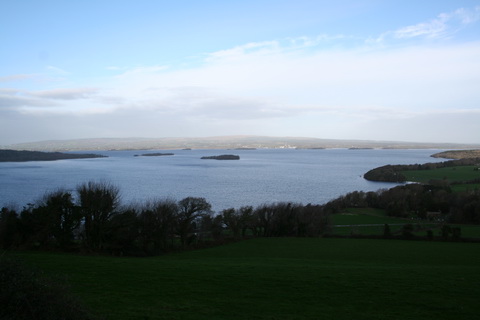
Lough Derg from The Lookout

Portarlington and Mountmellick

I have added some photos and maps to the page about the Mountmellick Line of the Grand Canal. Thanks to Martin O’Shea for two of the photos.

Limerick bridge

Just as Killaloe is to have a new bridge, so too is Limerick. Or perhaps more than one …. This page (on a site whose ownership I do not know) has a map of proposed routes for the proposed Limerick Northern Distributor Road, which is to provide a northern bypass of Limerick. You can read about it on the websites of the promoters, Limerick County Council, Clare County Council and Limerick City Council. You can download stuff. And you will be pleased to hear that there are to be consultations (only not many of them).

This road is to be built in two phases, the first covering the area from west of the city to Parteen and the second from there to the old Dublin road (N7 as was, now demoted to the status of boreen). There are (or were) several options for each section, but the decision to cross the navigation at the Ardnacrusha tailrace, between the power station and the existing bridge, seems to be set in, er, concrete: that is, it seems, where the ESB wants it.
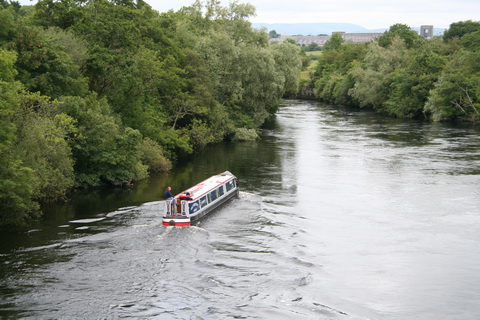
Ardnacrusha and the tailrace seen from the existing bridge at Parteen

The current consultation is about Phase 2, south-east from Parteen. There are several possible routes.

Two of them, B1 and B2, would cross the Shannon downstream of Plassey and the Black Bridge; they would not cross the Plassey–Errina Canal. It would be important to ensure that they did not further damage the towing-path and its artefacts on the Limerick side.
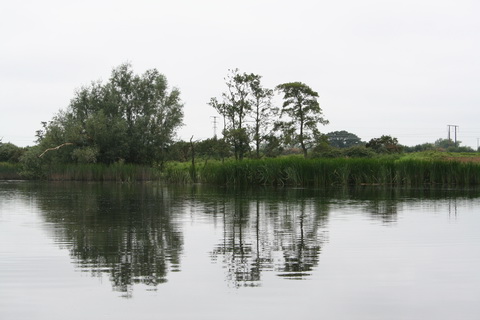
The west bank below Plassey

Four other routes — C1, D1, D2 and E1 — would cross the Plassey–Errina Canal between Gillogue and Wooden Bridge; they would cross the non-navigable Shannon upstream of Plassey, between there and a point just above the confluence of the Mulcair. C1 seems to run very close to Gillogue Lock, although that may be an effect of the scale of the route markings.
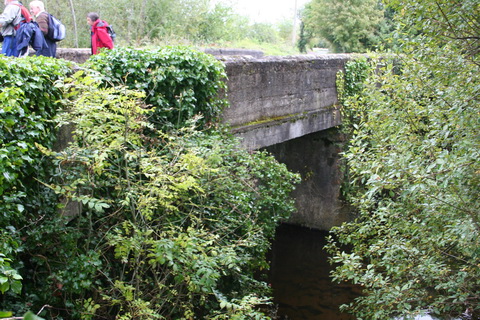
Woodenbridge (which isn't)

I am sure that the ESB will look after the interests of the existing navigation (through Ardnacrusha) and that Waterways Ireland will look after those of the former navigation (the river to Plassey and the canal thence to Errina). However, it might be worthwhile lobbing in a comment to TPTB, first to sttress the heritage value of the abandoned navigation and second to suggest that a new road near Plassey might improve rather than diminish access to that area.

One final thought: this new road seems likely to put the final nail in the coffin of the Limerick Tunnel under the Shannon estuary downstream of Limerick. I very much enjoy using the tunnel, but many folk are deterred by the charges and they drive through the city instead — or, worse, cross the Shannon at O’Briensbridge. As a result, revenue is less than expected, so the traffic guarantee mechanism means that the National Roads Authority has to compensate the tunnel operators.

So now that a new, free, presumably fast road is to link the east and west sides of the city, what will happen to the numbers of vehicles using the tunnel and to the taxpayers who are ultimately paying the compensation? They’ll pay more. The tunnel is on a national primary route, so it’s the NRA’s problem, whereas the new bypass is a regional or local route, which is in the hands of the local authorities.


=p-po-

The Strabane Canal and the Foyle

Here is a short account of the Foyle and the Strabane Canal in the 1890s.

From the Corrib

Padhraic Conneally left a comment on my third page about the Rockville Navigation. He made an interesting suggestion that caused me to look at the OSI maps around the Corrib. It seems that there might be another small navigation to the west of Lough Corrib and, because further information would be welcome, I reproduce Padhraic’s comment and my response here.

There is supposed a similar [ie similar to the Rockville] navigation on the Corrib from the old river to Ross lake via Moycullen lake.

I have been up a channel from the old river in a cruiser almost up to the realigned main road but never further. Fr O’Reilly SJ who was a companion of Maurice Semple author of the series of books on the Corrib was reputed to [have] made the trip in a canoe cutting lots of farmers’ barbed wire on the way!

My response:

Looking at it on the OSI maps, the ~1840 (or thereabouts) Historic 6″ map has a quay at the south end of Ross Lake. From there it seems to be possible to get as far as Lough Down, north of Cloghaun. A lot of the channels are straight, suggesting that they’re artificial.

The later ~1900 Historic 25″ then shows another straight channel from Lough Down, through Cloghaun to Moycullen (Ballycuirke) Lough. From the far side of the lake, an artificial-looking channel curves to the Corrib, joining it at this point. So it might be that the system was developed in the early nineteenth century but linked to the Corrib only in the later part of the century. It might have been constructed for drainage, but that wouldn’t stop it being used for navigation as well.

I hadn’t heard of Fr O’Reilly but I do have two of Maurice Semple’s books. I must have a look in them. If anyone else has information about this, it would be very welcome.

If you know anything about this, please leave a Comment below.


Pollardstown Fen

Pollardstown Fen is the source (via the Milltown Feeder) of much of the Grand Canal’s water supply. Here is a BBC programme about the sounds of the Fen (h/t John McCormack) and other aspects of the magical area close to Robertstown, Lowtown and the Hill of Allen.

Lock your door, turn off your telephone and spend half an hour listening. Shoot anyone who interrupts.

Since the programme was made, the sound recordist Tom Lawrence has died. His website is still up here.

Water feature

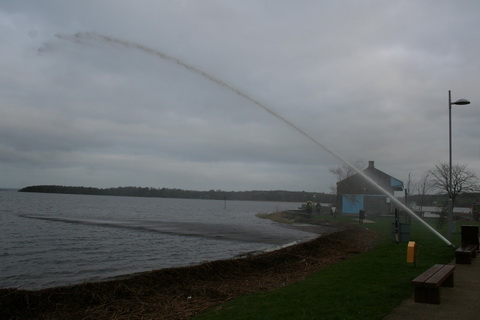
As part of the tourism-oriented improvements at Dromineer, a new water feature is being tested.

Dromineer water feature


Annoying the neighbours

It would be unfair to condemn the proposed opening of a canal to Clones without also condemning the proposed reopening of the Park Canal in Limerick (and the Newry, when I get around to it). The link is to a top-level page; the first substantive page has a lead to the second, the second to the third and so on up to the fifth.