Category Archives: shannon estuary

Mark Twain and the Cammoge drownings of 1849

Mark Twain wrote:

There is something fascinating about science. One gets such wholesale returns of conjecture out of such a trifling investment of fact.

I have indulged in just such conjecture about the design of the ferry boat in use at Cammoge in 1849, crossing the outlet from Poulnasherry Bay, west of Kilrush on the Shannon estuary. The news reports of the time give very little information about the design of the boat, and the reliability of that information is questionable, which makes my speculation even more dangerous. Nonetheless, I thought it might be useful to set out some thoughts on the subject in the hope that other folk, who know more about the background, the location or naval architecture than I do, might be able to help to clarify the design.

CWW bridge

Paul Quinn’s photos showed the new Marlborough Street Bridge being constructed across the Liffey. Last Saturday’s Irish Times reported that Dublin City Council would soon be advertising to seek suggestions for naming the bridge; it said that a body called Labour Youth [whose members may be socialists, I fear] wanted it named after one Rosie Hackett, who went on strike  many years ago. It did not report that there is another campaign to have the bridge named after E T S Walton, a physicist.

The north-eastern corner of the bridge features the site of the offices of the City of Dublin Steam Packet Company, whose crest still adorns the walls. I suggest that the bridge be named after the company’s founder, the remarkable Irish entrepreneur Charles Wye Williams: the father of the Shannon, the master of scheduled steam shipping, the founder of the CoDSPCo and a founder director of the Peninsular and Oriental Steam Navigation Company, godparent of the Irish livestock industry, innovator in marine safety, promoter of the turf industry, writer and experimenter on steam technology, tireless campaigner ….

Apart from his company’s crest on Eden Quay, and his name on a bridge he caused to be built in Limerick, there is no monument to this remarkable man. Name the bridge after him and move the plaque to it (and protect it adequately).


Henn, cheese, pickles and Guinness

An Affecting Charge

The following case lately came for trial before Mr Henn QC, the new Recorder of Galway:— George Hamilton, who for twenty-five years had been in the employment of the Midland Great Western Railway Company as station-master, was indicted for stealing from a hamper some goods, the property of Sir Arthur Guinness, which were addressed to Cong, in the county Mayo. For some time a course of pilfering had been carried on, and the directors, in order to find out who were the guilty parties, employed two Dublin detectives, named Stookman and Healy, who arrived in Galway on Aug 31st, and, concealing themselves in the goods-store in empty barrels, remained on the watch all night. About one o’clock next morning they heard a noise, and observed the prisoner entering the place. Having satisfied himself that he was unseen, he took out his penknife and proceeded deliberately to cut the cords of the hamper and extract some of its contents. The detectives waited until he had taken out a bottle of vinegar, a bottle of pickles, and some cheeses, and then tied up the hamper again. They then issued from their hiding-place and seized him. He begged them for God’s sake to have mercy on his wife and family, and to leave the matter between himself and the manager, but they refused to do so, and, having called the police, gave him into custody. About twenty witnesses were examined for the prosecution, and among them the clerk of the goods store, who swore that it had been locked and the key left with the prisoner.

Mr M’Laughlin QC appealed to the sympathies of the jury, and, pointing out some alleged discrepancies in the evidence, pressed them, if they had a doubt that the prisoner took the articles with a guilty intent, to give him the benefit of it.

The Recorder, in his charge, showed that the discrepancies only proved the truth of the charge, and expressed the deep pain he felt at seeing in such a position a man who had held a respectable position, with a salary of £300 a year, and had young ladies whom he saw in court dependent upon him. He finally burst into tears.

The jury retired, and after three hours’ deliberation returned into court and stated that there was no chance of an agreement. His worship sent them back to their room, and, after being absent for another hour, they brought in a verdict of not guilty, which the Recorder stated he could not endorse, but characterised as monstrous.

The Leeds Times 12 October 1878

The Recorder, Mr Henn, was the father of T R Henn and later lived in Paradise. Sir Arthur Guinness, a stout fellow, was a descendant of this chap and had a small holiday house at Cong on Lough Corrib, where his family had many boats.

The fear of Baal’s Bridge

In May 1895 the fear induced by the prospect of a passage under Baal’s Bridge, on the Abbey River in Limerick, as revealed in the commercial court in London before Mr Justice Mathew and reported by the Freeman’s Journal of 20 May 1895.

Arthur George Mumford of Colchester, Essex, was described as an agent, but was actually a marine engineer and manufacturer of steam engines. He owned a 25-ton steam yacht called Gipsy, which he decided to sell through Messrs Cox & King, the well-known yachting agents (their 1913 catalogue is here).

The buyer was Ambrose Hall, the man responsible for the statue of Patrick Sarsfield. A former mayor of Limerick, he was an alderman and a “house and land commission agent”; his address was given as Mignon House, Limerick, which I have not so far found.

Hall bought the boat for £500; it was to be delivered to him at Limerick. The original plan was to sail it around the coast of Ireland and up the Shannon estuary, but bad weather in late 1894 caused Cox & King to suggest taking it to Dublin and then down the Grand Canal and the Shannon to Limerick. Hall agreed; the boat left Dublin in January 1895. It reached Killaloe on 19 January and Limerick “a day or two afterwards”, where it was moored in the canal harbour.
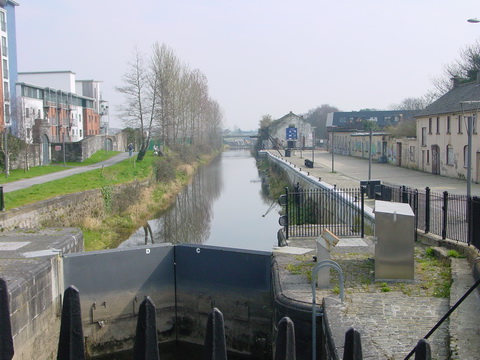
25 Grand Canal Harbour Limerick March 2007 01_resize

Canal harbour, Limerick in March 2007

Hall refused to accept the boat in the canal, saying that it should have been delivered to Limerick dock, a short distance downstream. Mumford and Cox & King sued him and the National Bank.
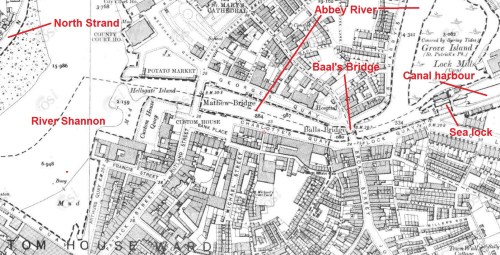
Hall and Baal

Ordnance Survey ~1900

Hall, an alderman and a former mayor, who had lived at North Strand, presumably knew the river and its difficulties.
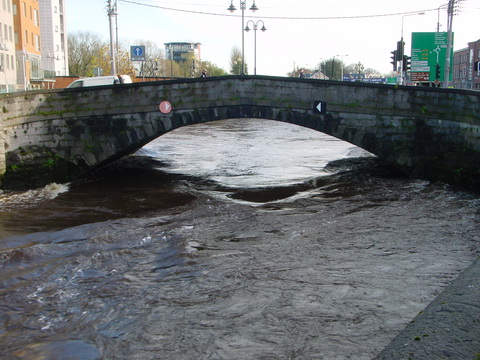
Baal's Bridge 20091128 1_resize

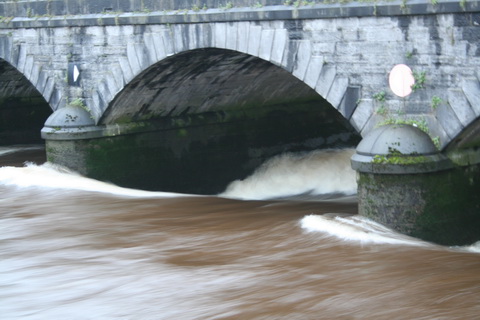
Baal’s Bridge looking upstream towards the canal harbour in the floods of 2009
Navigation arch at Mathew Bridge 20091122_resize

The navigation arch at Mathew Bridge looking downstream in the floods of 2009

It was contended by the defendant that to get the vessel from the canal into the estuary of the Shannon there was a considerable risk involved. The passage was only a few hundred yards, but it was stated it could only be effected at certain states of the tide when it would be possible to get through Ballsbridge.

The judge sensibly suggested that it should be possible to insure the boat for the journey; the plaintiffs agreed to deliver it; Hall agreed to accept delivery and to pay £15 for the cost of the caretaker who had been looking after the boat since 23 January; the case was settled.

Clearly Ambrose Hall didn’t know Pat Lysaght.

My OSI logo and permit number for website

The 120′ Irish steam-powered narrow boat

Read about it here.

Dredgers

I’ve moved my pics of dredgers to a new page and added a few more.

Rescue boats on Irish inland waterways

I’ve moved my photos of rescue boats to a new page and added photos of some more services. Still a lot missing, though.

The Fergus estuary

I have a page about the Fergus estuary here with links from that page to others about places on the estuary (including Paradise).

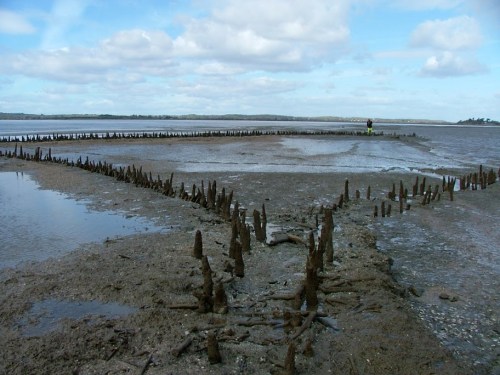
Mediaeval fishweir at the Boarland Rock in the Fergus Estuary © Dr Aidan O’Sullivan, UCD 2008

Mediaeval fishweir at the Boarland Rock in the Fergus Estuary © Dr Aidan O’Sullivan, UCD 2008

The UCD School of Archaeology has, for many years, been investigating the Fergus estuary and has found remarkable evidence of settlement and activities on the estuary stretching back to the Iron Age (about 100 BCE) and the Bronze Age (almost 800 BCE). Read about the project here and see more photos of mediaeval fishweirs and earlier artefacts here.

The photo above is used in accordance with the terms set out here.

The end of an era

Ger Reid, the Ardnacrusha lockkeeper, retired at the end of December 2012. Ger has guided many boats through the locks over the years and has always been cheerful and reassuring as well as informative, helpful, reliable and competent. He will be sadly missed but I wish him well in his retirement.

Meanwhile, I have heard that Limerick City Council has decided not to renew Pat Lysaght’s contract for work on the river and has suggested that Waterways Ireland should retain him. Pat’s most important role, though, in assisting boats passing through Limerick (220 in 2012), has always been voluntary. Were Pat to cease to provide that service, I think the number of boats visiting Limerick would be greatly reduced.

Around the world with Irish waterways

Yesterday was one of those days: I managed to track down sources for several pieces of information I’ve been hunting for some time, but in the process I came across a few interesting links, from Gordon of Khartoum to the War between the States.

The starting point was William Watson, manager of the Inland Department and later Chairman of the City of Dublin Steam Packet Company. He worked with Robert Mallet on the design of an innovative boat for use on Irish inland waterways. Robert Mallet married a Cordelia Watson in 1831. (I thought that might be a daughter of William of the CoDSPCo but it’s pretty clear from the excellent Mallett Family History site that that was not so.)

One of Mallet’s inventions was a large mortar designed for use in the Crimean War. And one of Mallet’s sons, John William Mallet, went to the USA and became professor of chemistry at the University of Alabama. He joined the Confederate forces, rising to the rank of lieutenant-colonel in the artillery and superintendent of the Confederate ordnance laboratories.

Meanwhile Watson’s son Charles Moore went east rather than west. Colonel Sir Charles Moore Watson KCMG, CB, MA, of the Royal Engineers, Watson Pasha, was a general in the Egyptian Army and Governor-General of the Red Sea Littoral. Watson’s base was at Suakin on the Red Sea. The Dubliner was succeeded in that post by a Kerryman, Horatio Herbert Kitchener, from Ballylongford near Saleen on the Shannon Estuary, on which the City of Dublin Steam Packet Company operated.

Watson was “Gordon’s principal friend in Egypt”:

It is certain that Watson was, above all others, the one man in Cairo whom Gordon cared about most, and that he was the last to see Gordon off when he started [for Khartoum].

Gordon died at Khartoum; the relief expedition, led by another Irishman, Sir Garnet Wolseley, arrived two days too late.

A younger brother of Sir Garnet, Frederick Wolseley, went to Australia. His Sheep Shearing Machine Company made a brief expedition into the manufacture of motor-cars, under one Herbert Austin, who later founded his own company. Austin and Wolseley both ended up in British Leyland Motor Corporation, which made diesel engines, some of which were marinised and used in boats on the Irish inland waterways … which brings us back to where we started.