Category Archives: Shannon

The corncrake and the decline of religion

On 13 February 2013 the Irish Times reported that a farmers’ representative had told politicians that

Farmers in the Shannon callows are facing extinction along with the corncrake and wading birds […].

He wanted taxpayers’ money to be spent on stopping the river flooding its flood plain.

Back in the days when people believed in gods, they would have known what a flood meant: it was a message from a deity, telling them to stop whatever they were doing. On the Shannon, either people have stopped believing in gods or they are having some difficulty in interpreting the message, despite its having been delivered over and over again for hundreds of years. If it were interpreted properly, or even if landowners had a modicum of common sense, they would realise that they should either cease trying to earn a living along the banks of a river that floods regularly or adapt their expectations or their activities to take account of the floods (one thinks of rice paddies …).

In the years 2009–2011 net subsidies to agriculture in the Midland region were 114.4% of the operating surplus. For the Border, Midland and Western region as a whole, the figure was 110.4%. In other words, agriculture in those regions is, on balance, a form of outdoor therapy for landowners: it is not an economic activity, and there is no point in taxpayers’ spending any more money on it.
 

All this excitement …

… can’t be good for me.

Last week Their Excellencies the Revenue Commissioners published two versions of their list of holders of marked fuel trader’s licences, the second [.xls] dated St Valentine’s Day. I was so excited I almost spilt my Ovaltine.

And what’s more, there are now two more candidates for haloes and wings. Step forward Emerald Star Portumna and Carrick-on-Shannon, becoming the fourth and fifth members of the Elect and lengthening the stretch of the Shannon where green diesel can legally be sold. No sign of anyone in Belturbet, though, and I can think of a couple of other places on the Shannon where it would be nice to be able to buy diesel, but we don’t want too much excitement all at once.

Alas, no more!

I can find no additions to the list of Shannon-based holders of licences to sell marked fuel. Could it be that there is some delay in processing the applications of, for instance, some hire firms and marinas? As it stands, only three sellers are listed as being licensed, at Killinure, Lanesborough and Rooskey; the rest of the Shannon has no licensed traders.

Lismore to Fermoy

A meeting was held in Fermoy in 1844 to promote a proposal to make the Blackwater navigable from Lismore upstream to Fermoy. Here is the Cork Examiner‘s account of the meeting.

Fermoy railway station opened in 1860.

Big it up for Hanley’s Marina

Yes, folks: the high point of your week — the inspection of the updated list of holders of Marked Fuel Trader’s Licences [.xls] — will be even more exciting this week, with a 50% increase in the number of traders licensed to sell green diesel along the Shannon. Welcome Hanley’s Marina at Ballyleague, Lanesborough, to the fold: there are now three places on the Shannon where you can buy green diesel.

Mind you, there are still none south of Killinure, none in Carrick-on-Shannon, none on the [RoI] Erne ….

The fear of Baal’s Bridge

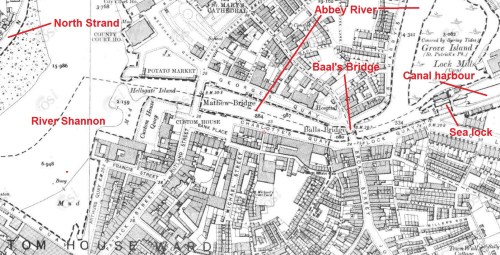
In May 1895 the fear induced by the prospect of a passage under Baal’s Bridge, on the Abbey River in Limerick, as revealed in the commercial court in London before Mr Justice Mathew and reported by the Freeman’s Journal of 20 May 1895.

Arthur George Mumford of Colchester, Essex, was described as an agent, but was actually a marine engineer and manufacturer of steam engines. He owned a 25-ton steam yacht called Gipsy, which he decided to sell through Messrs Cox & King, the well-known yachting agents (their 1913 catalogue is here).

The buyer was Ambrose Hall, the man responsible for the statue of Patrick Sarsfield. A former mayor of Limerick, he was an alderman and a “house and land commission agent”; his address was given as Mignon House, Limerick, which I have not so far found.

Hall bought the boat for £500; it was to be delivered to him at Limerick. The original plan was to sail it around the coast of Ireland and up the Shannon estuary, but bad weather in late 1894 caused Cox & King to suggest taking it to Dublin and then down the Grand Canal and the Shannon to Limerick. Hall agreed; the boat left Dublin in January 1895. It reached Killaloe on 19 January and Limerick “a day or two afterwards”, where it was moored in the canal harbour.

25 Grand Canal Harbour Limerick March 2007 01_resize

Canal harbour, Limerick in March 2007

Hall refused to accept the boat in the canal, saying that it should have been delivered to Limerick dock, a short distance downstream. Mumford and Cox & King sued him and the National Bank.

Hall and Baal

Ordnance Survey ~1900

Hall, an alderman and a former mayor, who had lived at North Strand, presumably knew the river and its difficulties.

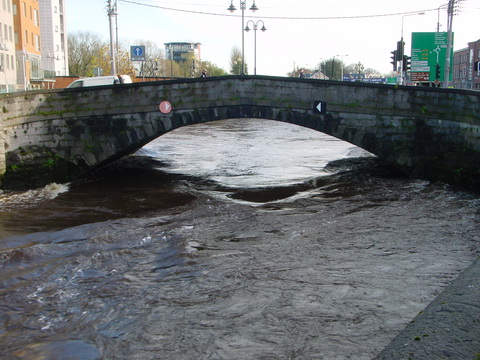
Baal's Bridge 20091128 1_resize

Baal’s Bridge looking upstream towards the canal harbour in the floods of 2009

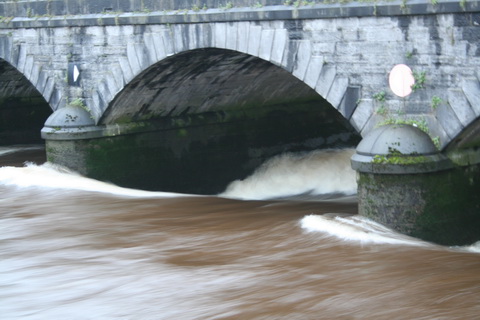
Navigation arch at Mathew Bridge 20091122_resize

The navigation arch at Mathew Bridge looking downstream in the floods of 2009

It was contended by the defendant that to get the vessel from the canal into the estuary of the Shannon there was a considerable risk involved. The passage was only a few hundred yards, but it was stated it could only be effected at certain states of the tide when it would be possible to get through Ballsbridge.

The judge sensibly suggested that it should be possible to insure the boat for the journey; the plaintiffs agreed to deliver it; Hall agreed to accept delivery and to pay £15 for the cost of the caretaker who had been looking after the boat since 23 January; the case was settled.

Clearly Ambrose Hall didn’t know Pat Lysaght.

My OSI logo and permit number for website

The 120′ Irish steam-powered narrow boat

Read about it here.

Still only two

For most people, I imagine, the high point of the week is the publication by the Revenue Commissioners of the updated list of those holding Marked Fuel Trader’s Licences [.xls rather than .xlsx this week]. Alas, although the list is now up to 178 pages, there are still (as far as I can see) only two licensed traders along the Shannon. None south of Killinure and no more IBRA members, unless my eyes deceive me.

_ _ _ E _ _ A T

Thanks to Giles Byford for some photos of the RNLI Lough Ree lifeboat, now on this page.

A load of old bollards

Our London Correspondent reports that the latest and most fashionable souvenir to go on sale there is a reproduction cast-iron “paperweight/doorstop/bookend based on the mooring bollards of Regents Canal”. Available in black or fluorescent red, these items were designed by a designer who was being worked with by another chap who was commissioned by a Creative Agency. The result is a “desirable antidote to the overly-commercial, tacky souvenirs” available elsewhere, it says here.

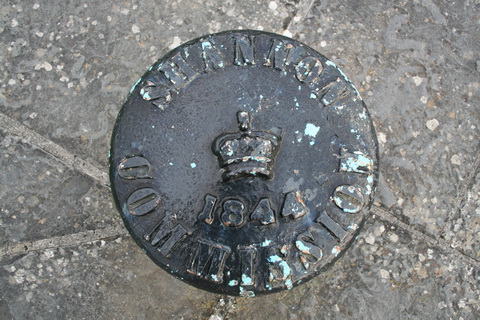
Shannon Commission bollard 1844_resize

A bollard at Meelick

Well, that’s nice. Maybe Waterways Ireland could commission the same creative types to design a range of reproductions of Irish waterways bollards; folk could be encouraged to collect the entire set.

But one minor drawback does strike me. The artistic merits of these reproduction bollards are of course obvious, but as souvenirs they have one minor drawback. A souvenir is something you buy, while on holiday, to take home to someone else. Nowadays, the steamer services are not what they once were and many folk travel on these new-fangled flying-machines. But according to that nice Mr O’Leary, who operates some such machines, you may take only 10 kg of cabin baggage. These bollards, though, weigh about 1.5 kg each, which rather limits the number of bollards you can carry as souvenirs.