Category Archives: Steamers

Where is this?

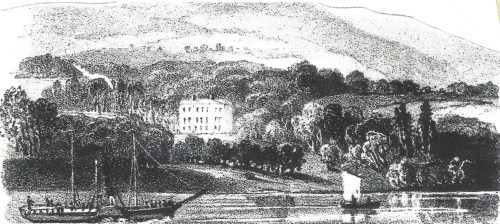
Paul Gauci's 1831 drawing of a Shannon steamer

Paul Gauci’s 1831 drawing of a Shannon steamer

This drawing of a steamer is from an 1831 book called Select Views of Lough Derg and the River Shannon by Paul Gauci. I haven’t seen the book myself, but this illustration is used in a couple of places, including Ruth Delany’s book The Shannon Navigation [The Lilliput Press Ltd, Dublin 2008]. Andrew Bowcock, in his article “Early iron ships on the River Shannon” in The Mariner’s Mirror Vol 92 No 3 August 2006, says of the steamer shown that

The funnel looks to be almost over the paddle shaft, which is artistic license.

But my question is not about the vessel but about the house in the background. If it is drawn without artistic licence, where is it?

It is a very large house, seven bays by three storeys, quite close to the water. Using the Historic 6″ Ordnance Survey map [~1840], I have followed the banks of the Shannon from Shannon Harbour down Lough Derg to Killaloe, then from Limerick down the estuary as far as Tarbert, across the estuary to Doonaha and back up on the Clare side to Limerick, then from Killaloe up the Clare and Galway shores back to Shannon Harbour. Anywhere I found a large house within what seemed the right distance of the shore, I looked it up in the Landed Estates Database and in the National Inventory of Architectural Heritage, with some supplementary googling.

I haven’t been able to find images of all the houses marked on the OSI map, but I found enough to show that houses of the size shown by Gauci were very rare. Within those few, I ruled out some (like Tervoe) because they didn’t seem to match Gauci’s drawing (although alterations could have accounted for that). I ended up with only one house that looked at all like Gauci’s, but the background may not match.

If you can identify the house, I would be glad if you could leave a Comment below.
The music of the Shannon steamers

On my page about PS Erin-go-Bragh I’ve provided a link to a performance of the song of that name. It would be wrong, therefore, to omit Garryowen. There is a “Fantasy on Dover Castle” by David Fanshawe, the African Sanctus chap, but I can’t find a free legal recording.

Dick Gaughan and John Grantham …

… both had an interest in Erin-go-Bragh,

Some new things arise

First, I’ve checked all the linked sites listed at the bottom of the right-hand column and removed some that have died. If you know of others to which I should provide a link, do please let me know.

Second, I’ve added a link to the excellent Grace’s Guide to British Industrial History, and I take the opportunity to draw it to the attention of folk interested in who made what. I have received much useful information from its volunteers and I have been able to contribute photos of a few artefacts. It’s well worth exploring. I have also added a link to the Railway and Canal Historical Society.

Third, I am glad to see that the Irish Times‘s conversion to the benefits of civilisation continues: yesterday it featured an Intel Pentium chip from 1994, which provided the basis for an essay on Ken Whitaker’s 1950s report, globalisation, television, women, Northern Ireland and Viagra. If only some more of the nineteenth century industrialists, entrepreneurs, engineers and modernisers had been covered.

That, fourth, reminds me that I came across a couple of interesting articles by Roy Johnston on the Victorian Web site: they’re under the heading Science, Technology, and Politics, on this page, which has several articles about Ireland. They include articles on whether Ireland was a colony, although I must confess that I have yet to be persuaded that that is a question in which I should take an interest.


The Rideau Canal

The Cedar Lounge Revolution has an article about those who worked on the construction of the Rideau Canal in Canada in the 1820s and 1830s. Readers will, of course, recall that Charles Wye Williams compared the Rideau and the Shannon in his 1835 […] speech on the improvement of the Shannon: being in continuation of the debate in the House of Commons, 12th May, 1835, giving a comparative view of the navigation of the Rideau Canal, in Canada, and the River Shannon in Ireland, with observations on the value of a connection by steam packets, with British America.

SESIFP

Read about the draft Strategic Integrated Framework Plan (SIFP) for the Shannon Estuary here. You can comment on it up to 15 February 2013.

Newcomen Bridge

Mick Farrell of the HBA has pointed out that, on the Historic 6″ Ordnance Survey map (~1840), the first lock on the Royal Canal is downstream of Newcomen Bridge whereas on the Historic 25″ (~1900) the lock is upstream of the bridge.

Industrial Heritage Ireland has created a page giving the history of the railway crossing at Newcomen Bridge. However, it would be nice to have some documentary evidence about the resiting of the lock — and about the headroom under the bridge before the lock was moved.

Errina Bridge

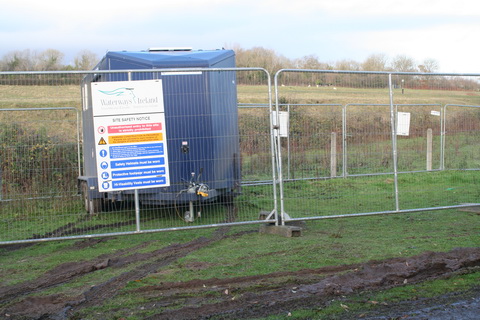
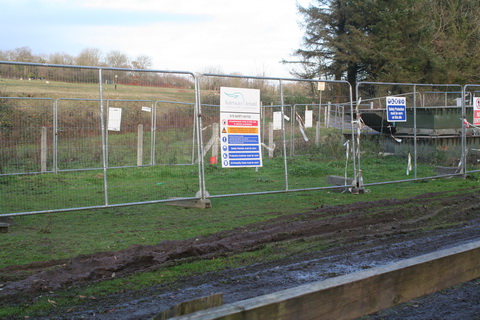
I remarked in November 2012 that Waterways Ireland had parked a canteen trailer and some pontoons at Errina Bridge, the uppermost bridge on the Plassey–Errina Canal, which is part of the old Limerick Navigation.

WI pontoons

WI pontoons

WI canteen

WI canteen

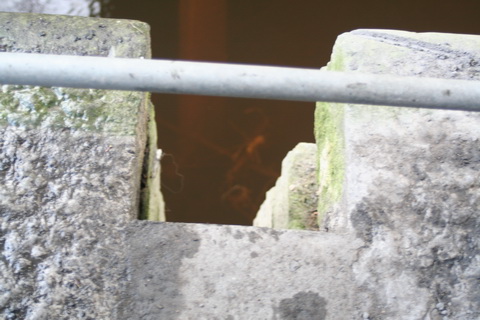
I wondered what was to be done; I noted that a stone at the top of one of the stop-plank grooves under the bridge had been removed (the stone on the far side was removed some time ago).

So I asked Waterways Ireland what was happening. They said:

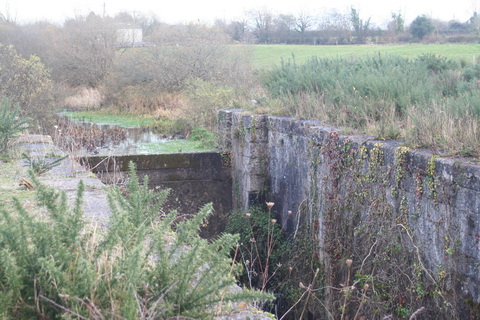
The works in Clonlara are Flood relief works to protect Errina Lock from catastrophic failure. After the flooding in 2009, during which the dam in Errina Lock was overtopped by approximately 0.5 metres, it was decided to protect it from this happening again.

It has happened before too: in February 1809 the lock was destroyed by floods when heavy snows melted.

Errina Lock (looking upstream)

Errina Lock (looking upstream)

I asked WI about the nature of the works. They said:

Stop logs are to be put into the grooves under the bridge forming a dam with the same size opening as that in the concrete dam in Errina Lock. As for the stone which is removed to facilitate the installation of the timbers, this will be replaced once the timbers are in place.

That is good to know.

Errina Bridge stop-plank grooves (towing-path side, with uppermost stone removed)

Errina Bridge stop-plank grooves (towing-path side, with uppermost stone removed)

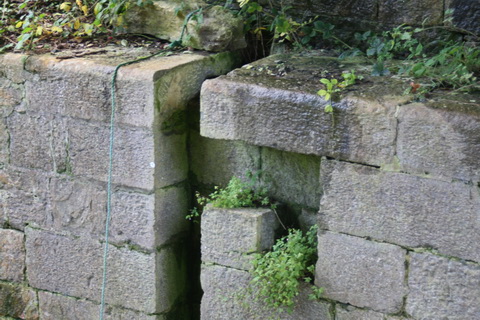
Errina Bridge stop-plank grooves (off side)

Errina Bridge stop-plank grooves (off side)

An authority on waterways has suggested that the curious shape of the grooves was designed to allow planks to be inserted from boats rather than from land.


Irish galleries please copy

I have often lamented the poor classification methods used by those who look after collections of paintings. They focus on the name of the painter, the date and the school to which he or she belonged, rather than on the really important facts: whether or not a painting shows a steamer, barge, canal or other object of industrial heritage interest. Thus, as I pointed out here, you get titles like “View looking down on a jetty and boats on a lake with a church in the distance” that ignore the most important aspect: that the pic shows a steamer on Lough Erne.

The other problem is that the paintings are in galleries scattered hither and yon, which means that a serious search for steamers, barges and canals would require hours of driving followed by hours of rummaging through archives, even though each pic would require only a few seconds’ attention to determine whether or not it is worthy of notice. The cost-benefit ratio is all wrong, but the use of technology can solve the problem.

I was delighted therefore to learn that, in HM Realm, the BBC and the Public Catalogue Foundation have put online tagged images of [almost] all the 200,000+ oil paintings in public ownership in the UK at the Your Paintings site. The collection is searchable: the search will return artists, painting titles and tags. And you can help by adding tags, if you have more information about a painting.

There is not much of Irish waterways interest, which is scarcely surprising, but there is an interesting illustration of the use of a pole on the Lagan [I’d welcome comment on what’s happening in that pic] and the barge at Edenderry. There is also some material for steam men.

It would be nice if Irish galleries would now do the same. The cost could be met by selling off the originals, which would no longer be necessary, and closing the galleries, at a saving to the public purse.

A gratifying display of loyalty

His Excellency the Lord Lieutenant took a trip on the Shannon Estuary in July 1856 on the City of Dublin Steam Packet Company’s vessel Erin-go-Bragh. He was greeted by demonstrations of loyalty from the populace, had dejeuner on board off Scattery Island and heard an address from the proprietary, clergymen, merchants, traders and inhabitants of Kilrush, read to him by Colonel Vandeleur. Here is the Freeman’s Journal‘s account of the trip.