Category Archives: The cattle trade

The Black Bridge at Plassey

I am repeating here a point I made in response to a comment on this page. I do so because the point is, I think, an important one: some readers don’t check the comments and might miss this.

I have an imperfect copy [with some lines missing] of an indenture made on 8 July 1949 between the Minister for Finance and Limerick County Council under which the Council leased from the Minister

… all that those parts of the lands of Garraun and Sreelane on which Plassey Bridge abuts on both banks of the River Shannon and the site and piles of said Plassey Bridge together with said Plassey Bridge […].

I am not a lawyer, so my interpretation may be misleading, but I think that there are two points of interest.

The first is that, under the indenture, the Council is obliged to “well and sufficiently repair cleanse maintain amend and keep the hereby demised premises”, which includes the bridge. The Council is also required to “use the said demised premises as a public highway”.

The second is that, if the Council fails to do so, the Minister, and his agents the Commissioners of Public Works in Ireland, are entitled (after giving due notice) “to enter upon the hereby demised premises and to execute and to do the necessary repairs and works and the Lessees [ie Limerick Councy Council] shall repay the expenses of such repairs to the Lessor on demand […]“.

As far as I can see, Limerick County Council is in breach of its agreement with the Minister for Finance, and that Minister is entitled to repair the bridge and charge the Council for the cost.

If only there were a Minister for Finance who had an interest in Limerick (or in bridges) ….
A puzzle in waterways history

According to the Lagan Canal Trust,

The Lagan Navigation also forms part of a wider all Ireland waterway network. This network of waterways once traversed through the towns and cities of Ireland delivering goods and produce, helping to shape the economic fortunes of the country.

I would be grateful for information about any goods or produce that were ever carried from the Shannon, or from the Royal or Grand Canals or the River Barrow via the Shannon, through the Junction Canal in the Ballinamore & Ballyconnell Drainage District [later called the Ballinamore & Ballyconnell Canal and later still the Shannon–Erne Waterway] and then the Ulster Canal to Lough Neagh or any of the waterways connected therewith. Or, of course, in the opposite direction.

As far as I can tell, outside the sales blurbs written by engineers seeking employment and waterway owners seeking subsidies, there was never a connected all-Ireland waterways network; nor was there ever any need or demand for such a thing.

Any more than there is now.


The Royal under the Railway

A new, short book, on aspects of the history of the Royal Canal, published by the Railway and Canal Historical Society, will be launched at the Clinker Lecture on 18 October 2014. The title is The Royal under the Railway: Ireland’s Royal Canal 1830–1899 and it covers a number of topics, mostly about the canal after it was bought by the Midland Great Western Railway. From the Introduction:

The accounts of the Midland Great Western Railway for the half year ending 31 December 1849, four years after it bought the Royal Canal, showed its gross income from the railway as £23,773 and its income from the canal as £7,677, roughly a quarter of the total. By 1899, though, income from the railway was £264,393 and that from the canal £2,220, less than one per cent of the total. The Royal Canal, never particularly successful, had declined into utter irrelevance.

It may seem perverse, therefore, to offer even a short book on the canal’s history in that period, especially as there exist two full histories, by Peter Clarke and by Ruth Delany (with Ian Bath in the most recent edition). This, though, is not a full history, even of the limited period, roughly 1830–1899, from just before the railway took over until the end of the nineteenth century. This is rather a complement to those histories, providing just enough background information to  enable the book to stand alone while covering some new topics and providing new or extra information on others. The topics include:

  • the 120-foot steam-powered narrowboat
  • the Midland Great Western Railway’s early attempts at running canal boats
  • the ingenious Mr Mallet’s moveable bridge
  • the whore who held the mortgage on the canal
  • the competition between the roads of Roscommon and the Royal Canal
  • the reconstruction of Dublin bridges over the canal
  • the horses who slept on board their boat.

[…] this book is not intended to be the last word on any of those topics. I hope that it might encourage others – those researching local, family, social, industrial, transport, economic or technological history – to record and transmit anything they might learn about the history of the Royal Canal. To take just three topics, we know very little about canal employees, the operations of canal traders or the management of the horse-drawn canal boats. On any one of those, useful information could just as easily be found by a local or family historian as by a canal specialist.


Steam, the Shannon and the Great British Breakfast

That is the title of the Railway and Canal Historical Society‘s 2014 Clinker Memorial Lecture, to be held at the Birmingham and Midland Institute, Margaret Street, Birmingham B3 3BS, at 1415 on Saturday 18 October 2014.

The lecture will concentrate on the period before 1850 with such interesting topics as

  • Shannon steamers
  • the Grand and Royal Canals
  • the first Irish turf (peat) to reach the USA (possibly)
  • port developments in Dublin, Limerick and Kingstonw
  • the Dublin and Kingstown Ship Canal
  • the Midland Great Western Railway
  • what “cattle class” really means
  • bacon and eggs.

Admission is free and booking is not required. However, if you plan to attend, it would be helpful if you could e-mail […] to this effect.

The Clinker Memorial Lecture is named for Charles R Clinker, an eminent railway authoe and one-time historian of the Great Western Railway, who died in 1983.

If you would like the contact email address, leave a Comment below and I’ll get in touch with you direct.


Archives workshop: a reminder

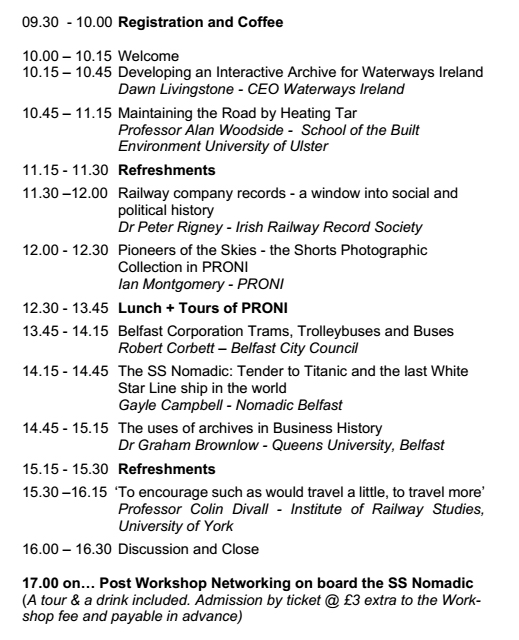
I mentioned, back in April, that an interesting-looking workshop is scheduled for Belfast on 8 September 2014. It’s being held in the Public Record Office of Northern Ireland [PRONI] in the Titanic Quarter and there’s an optional extra tour and reception on the SS Nomadic afterwards. This post is a reminder.

The programme covers waterways, roads, railways and flight. For this site, the opening session is of great interest: Dawn Livingstone, CEO of Waterways Ireland, is to talk about an interactive archive for Waterways Ireland.

By air, sea and land

By air, sea and land

The workshop is being organised for PRONI by A²SN, the Archives and Artefacts Study Network, supported by the Historical Model Railway Society, the Business Archives Council and the Postal History Society.

The [two-page PDF] brochure is downloadable here PRONI transport archives workshop. The workshop fee is £20/€25 with an extra £3/€3.50 for the SS Nomadic visit. Sterling cheques are accepted; there is provision for paying in euro by online banking.


Ballinasloe footbridge

Here is a new page with a brief account of the Ballinasloe Line of the Grand Canal and some photos of a footbridge that seems to have been built across it in the twentieth century.

The OPW’s 1969 restoration of Richmond Harbour and the Clondra Canal

Read about it here.

Who writes this stuff?

The National Inventory of Architectural Heritage on the Black Bridge at Plass[e]y and on Baal’s Bridge in Limerick.

It would be nice if the NIAH provided reliable historical information.


And I’m like wow …

… as the young folk say nowadays. Searching the National Library catalogue for prints and drawings of the Royal Canal before 1900 brought up the usual suspects but also a very interesting map and this stunning view of Dublin in 1853. Viaducts! Railways! Steamers! Barges being propelled by sweeps!

I couldn’t find the Royal Canal, though.

Shannon history in Birmingham

According to the Railway & Canal Historical Society’s Events page, its annual Clinker Memorial Lecture, to be held in Birmingham in October 2014, will be about River Shannon steamers in the second quarter of the nineteenth century:

The 2014 Clinker Memorial Lecture will be held in Birmingham on the afternoon of Saturday 18th October 2014. The speaker will be Brian Goggin, BA (Mod), MA.

Brian graduated from Trinity College, Dublin in Economics and Politics, and spent some years as honorary Editor of the quarterly magazine of the Inland Waterways Association of Ireland. He and his wife Anne have been boating on Irish inland waterways since the late 1970s. He is currently working on a book on the Shannon steamers of the 1830s and 1840s, and the Clinker Lecture will draw on his research.

Before lunch (and independent of the Lecture) there will be a walking tour of central Birmingham, focusing on sites of waterway and railway interest.