Category Archives: The fishing trade

The grunts of Lough Neagh

In The Cookin’ Woman: Irish country recipes (Blackstaff Press, Belfast and Dover New Hampshire, facsimile edition 1986), Florence Irwin says of Lough Neagh:

This lake, 153 square miles, has always provided much sea-food. Eeels [sic], pollan, trout, grunts and their elderly relatives, perch, to mention the most common fish eaten by the loughsiders and sold by them.

No doubt that is true for certain values of “sea”.

She says that the (Irish) pollan is found only in Lough Neagh, but that does not seem to be true. I had not come across the grunt before: earlier, in her chapter on soups, Ms Irwin has a recipe, from Moortown, for grunt soup, which requires 1 dozen grunts; she explains that

Grunts are the young of perch.

Seamus Heaney says

Perch we called “grunts” …

which suggests that perch are grunts or vice versa. Wikipedia says

The grunts are a family, Haemulidae, of fishes in the order Perciformes.

The taxonomy set out on its page about Perciformes suggests a relationship between grunts and perch that is more complex than either Ms Irwin or Mr Heaney allows, but says

Classification is controversial.

I am left wondering whether there are still grunts in Lough Neagh and, if so, whether they are of the Haemulidae family or whether the name is simply used locally for perch, young or old.

Here is a page about the Lough Neagh fisheries.

Eel update

Thanks to KildareStreet.ie for drawing our attention to a useful update, in a Dáil written answer, on the state of Ireland’s eels and the eel management plan.

Two brief notes about eels

Fr Oliver Kennedy, of the Lough Neagh Fishermen’s Cooperative Society, which ran the eel fishery [PDF], has died at the age of 83.

The ESB eel-catching apparatus at Killaloe Bridge is being renewed (and not, as I feared, removed). Eels are caught now only to be transported around Ardnacrusha. Read about the fishery here and, at greater length, here.

Pumping algae

Do algae pass through pumps? I don’t know, but I ask because boating, bathing and animals have been banned in Lough Ennell where blue-green algae have been found. Lough Ennell is to supply water to the Royal Canal, although I presume it will take some time before it begins to do so. But perhaps, even if algae made it through the pumps, they would die in the Royal. If you know, Gentle Reader, do please leave a Comment below.

Inland lifeboats to be exempt from VAT

Irish Water Safety has issued a press release [PDF] saying that the government is to introduce (or launch or make or pass or something) the Value-added tax (refund of tax) (rescue boats and related equipment) order 2013 which will allow inland community rescue boats to reclaim VAT on their purchases. Under the Value-Added Tax (Refund of Tax) (No 18) Order 1985, coastal community rescue boats have been able to reclaim VAT [PDF] but inland boats have not.

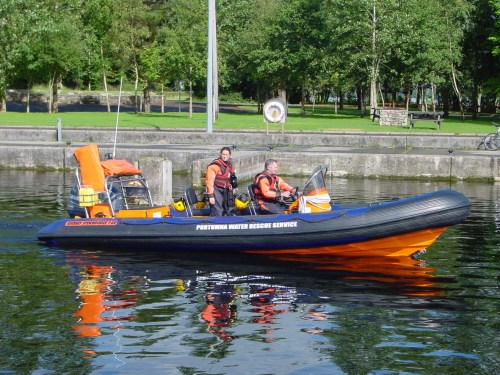
Portumna Water Rescue Service

Portumna Water Rescue Service

Irish Water Safety has a defined role in assessing the eligibility of community rescue boats for VAT exemptions; indeed its checklist and guidelines for community rescue services [PDF] are rather surprisingly headed Inspection for VAT Refund Certificate. The background is explained in another document Inshore Rescue Guidelines [PDF], which will presumably now be amended to include provision for inland boats. The “Declared Facility” boats [those approved and able to claim the VAT exemption] are listed here; there is also a list of other known rescue boats, some of which, being on inland waters, will now presumably apply to IWS for approval. Thus what is already a large rescue service will become even larger and more important.

I have photos of some of these boats on this page. I have none of the Corrib & Mask Rescue service, which I regret as today’s announcement was made on their turf and with their assistance. IWS says:

They will be the first Community Rescue Boat Ireland Lifeboat to be in a position to avail of this financial incentive.

Incidentally, I do not know whether the existing inland lifeboats operated by the Coast Guard and RNLI are affected by this or whether they could already reclaim VAT. If anyone can tell me, I’ll be glad to add the information here.

Bock goes boating …

… on the Shannon Estuary, the second most interesting coast of Clare (the inland coast is the most interesting, the north-west coast the least). Includes nice pics of the Scattery battery.

The Washington gandalow

See here.

Bottles in Limerick

Limerick has a new Economic and Spatial Plan, with lots of downloadable files and the general tone of a letter to Santa Claus. It has lots of adjectives, though, and fashionable concepts; all it lacks is money.

It wants a renaissance of the Limerick waterfront. It seems, though, that that doesn’t mean lots of dockers unloading timber, turf boats from Poulnasherry Bog, ships taking the ground at low tide, gales throwing vessels against the bridge, mills at Curragour, tolls on the bridges or other features of past life along the quays. Instead there will be things like this:

A New Public Waterfront

 Arthur’s Quay Park will be transformed into a signature Waterfront public space that draws visitors, hosts special events and provides a key stopping point within the City Centre and along the Waterfront and Riverwalk;

 This new Riverside Park will run the length of the City Centre from Sarsfield Bridge through where Sarsfield House currently stands, along between the Hunt Museum and the River and over a new pedestrian bridge into a pedestrianised Potato Market area linking up to the upgraded King John’s Castle tourist attraction;

 A new appropriately sized iconic building could be developed in the new Riverside Park on the former Dunnes Stores Site to accommodate tourism/cultural uses;

 New landscape, trees, surfaces, lighting, furniture, public art and interpretation should be structured to create a landmark WaterfrontPark, designed to international standards reflecting the prominence of this location within Limerick;

 A new space should be defined to host public events including celebrations, performance, festivals and start and finish points to Limerick based marathons and races;

 Clear, high quality pedestrian connections from Patrick Street and O’Connell Street and Henry Street would draw people to the Park;

 Signage and materials should identify the water’s edge as part of the continuous Riverwalk linking bridges across the Shannon and the two sides of the Shannon River;

 A new public open space should be created at the Sarsfield House site in the event of government office relocation, to reveal the view north along the Shannon to King’s Island from the City Centre and extend Arthur’s Quay Park;

 The Waterfront and public space at the Hunt Museum should be strengthened to provide an intimately scaled green space with external seating from the Hunt Museum restaurant and destination in its own right along the Riverwalk.

What is being proposed here (page numbered 99; page 124 of 172 in An Economic and Spatial Plan for Limerick [PDF]) is that Sarsfield House should be demolished and the area above the Custom House moorings would be opened up, with citizens not just permitted but encouraged to enter. Later on (page 108; PDF page 133 of 172) we read this:

Limerick Quays will be defined as the principal visitor and entertainment zone in the City  Centre – passive and active – accommodating a new visitor destination, walking, as well as eating and drinking in bars and restaurants that will activate the quays overlooking the River. This will be fully pedestrianised.

Now, that’s all very nice in theory, but what it means in practice is that any boats moored at the only safe moorings in Limerick, at Custom House Quay, will be within range of any bottles that may be thrown by the less domesticated portion of the citizenry, on their way home from getting tanked up in the bars and restaurants.

But perhaps the planners have thought of that and solved it in their own way. Figure 36: City Centre Proposals – Aerial View 1 on page 116 (141/172) is an aerial photo with coloured bits added; it shows the Custom House moorings. But Figure 37: City Centre Proposals – Aerial View 2 on page 117 (142/172), taken from a different angle, shows the pontoon at the corner of the weir, and the water space in the corner behind the Custom House, but the mooring pontoons have disappeared.

 

Spot the canal

People whom I’ve told where I was going today are barred from this quiz ….

IMG_6880_resize

Upstream end

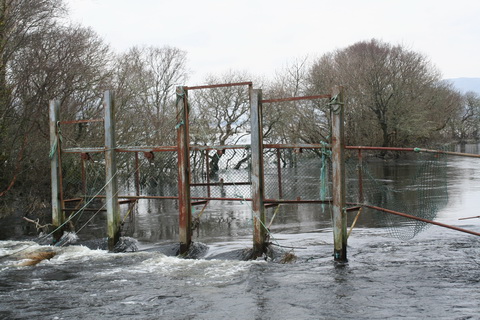
Of which Irish canal is this the upstream end? (The structure is a now-disused eel weir.)


Wexford

Here is a great account of the development of Wexford Harbour, with a history of its shipping here.