Category Archives: The turf trade

Killaloe to Limerick Docks via Ardnacrusha

Join the ex-Grand Canal Company motor-barge 68M on its trip from Killaloe to Limerick Docks, carrying barrels of stout for Dolan’s Pub. The trip marked two occasions: Arthur’s Day, the annual Guinness marketing opportunity, and the fiftieth anniversary of the last commercial cargo on the Grand Canal and the Shannon, which was a shipment of stout to Limerick.

This page provides a slide-show of 300 photos taken from 68M on its journey. If you can’t make the trip in person, do it this way.

Note that the page takes some time to load. And, even clicking through pretty fast, the show is likely to take at least ten minutes.

Click on the first photo to bring up the controls. If you have any problems with it, leave a Comment to let me know. I haven’t done this before. I may not be able to fix any problems, but I can at least look into them.
From the hearts of cranes

Several ports on the Shannon Navigation have old cranes (or parts thereof), most of them nicely painted. Their age may not be apparent, but it is possible that they date back to the days of the Shannon Commissioners in the 1840s; at least one of them may be even older than that.

This page shows photographs of those cranes I know of, and discusses their possible ages. But there is much that remains unknown, and readers may be able to cast light on some of the mysteries.

Down the Rockville

Some time ago I wrote three pages about the Rockville Navigation, which is linked to Grange on the Carnadoe Waters in Co Roscommon.

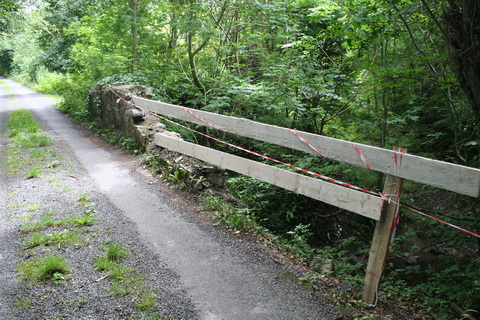
I recently revisited the area. I was horrified, first, to find that the bridge — built in June 1765 — has been severely damaged, with large chunks of masonry in the cut beneath and with a crude wooden repair. How many bridges of that age are there in Co Roscommon? How many that are associated with one of the oldest navigations in the country? Please, someone, restore the bridge!

Damage to the bridge

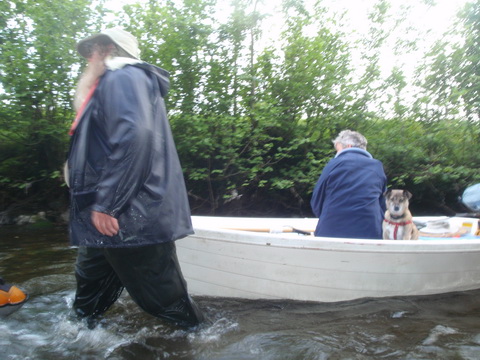
Anyway, the more pleasant part of the day was the four hours that we spend descending, by dinghy and kayak, from the bridge to Grange. The route took us through artificial cuts, small lakes and sections of river, with very clear water and an extraordinary abundance of vegetation. This route would have been easily navigated by large wooden cots or similar boats, and it should be developed today as a canoe-and-small-boat trail. Even with very low water levels, we had no real problems, although someone has to end up with wet feet …. Here is an account of the trip.

Wading in the water

Saleen Pier

It’s a long way from Trinity College, Dublin to the pier at Saleen on Ballylongford Creek, on the south side of the Shannon Estuary. But the college owned large amounts of land in the area, including bogs, and turf was one of the cargoes exported from Ballylongford. There was a battery on Carrig Island at the mouth of the creek and a Coast Guard Station at Saleen Pier, which was built by the Commissioners for the Improvement of the Navigation of the Shannon. Read more about Saleen here.

Nimmo’s non-existent harbour

Beginning a section about the piers, quays and harbours of the Shannon Estuary, especially those noticed in the mid-nineteenth century. At that time, and while the Shannon Commissioners were at work, the estuary was seen as a part of the river, just as Lough Derg was, although nowadays the Shannon Foynes Port Company controls the estuary and Waterways Ireland (and the ESB) the river upstream from Limerick.

Noel P Wilkins, in his recent biography of the engineer Alexander Nimmo (Irish Academic Press 2009), says that Kilbaha was the only place where Nimmo selected an unsuitable site for a harbour. Within a couple of years it had been abandoned and replaced by a pier.

Kilbaha is the westernmost harbour on the north side of the Shannon Estuary and the closest to Loop Head. It exported turf (peat) and imported sea-manures; it was also a pilot station. A lot of activity for a small place. Read about it here.

Sailing directions: Shannon Estuary and Loughs Derg (1838-9), Ree (1837) and Erne (1835-6)

Here are the Sailing Directions for the Shannon Estuary (completed before 1848) and for Lough Erne (1835-6), Lough Ree (1837) and Lough Derg (1838-9). They were compiled by Commander James Wolfe RN, who was one of those who drew up the relevant Admiralty Charts. Like the Charts, these Directions have not been updated, so boaters should not rely on them for navigation.

The Google Books Team have kindly permitted me to extract these from a larger document, which was one of those they had scanned and placed online, and to make them available (free, of course) to visitors to this site. Note that I have omitted part of the description of the smaller Lough Derg, which is not part of the connected waterways system.

Shannon & Erne sailing directions

Online maps

Much of what I’ve learned about old Irish waterways has come from studying the Irish Ordnance Survey maps of the ~1830s and ~1900s (the tilde shows that the dates are approximate: individual sheets were surveyed and published on different dates). However, I had to pay a subscription to get access to them online, so I couldn’t refer visitors of this site to them. Instead, I suggested that visitors consult the free Google Maps and the Griffiths Valuation online maps.

Now, however, the Ordnance Survey maps are available, free of charge, online. “Historic” is the ~1830s maps in colour and “Historic 25i” is the ~1900s maps. Contemporary orthophotographic maps are also available and, best of all, you can overlay a modern map on an old one. Hours of innocent enjoyment and highly recommended.

The Shannonbridge chimneys

The chimneys of the power station at Shannonbridge, on the river Shannon between Lough Ree to the north and Lough Derg to the south, have for many years been a landmark: visible from a long way away in both directions on the Shannon and on its tributary the Suck as well. They were demolished last week. I have put up a page of photographs as a reminder of what they looked like and to mark their passing.

John’s Canal in Macnab’s Bog, Castleconnell, Montpelier and O’Briensbridge

Here is a page about John’s Canal, which was used to extract turf from Macnab’s Bog at Mona Lodge, Portcrusha, between Castleconnell and Montpelier in Limerick (Montpelier is at the other end of the bridge at O’Briensbridge).

The bog seems to have been opened by John Brown (or Browne) of the Stein Brown(e) Distillery at Thomondgate in Limerick. Turf was carried by water from the bog to the distillery, where it was used to fuel the first steam engine in Limerick. The bog was managed by James Macnab, who took over the lease in 1841; after his death his son Alexander Allen Macnab took over. The bog was an early operation of a managed industrial extraction and production enterprise, operating throughout most of the year and drying the material to produce “stone turf”. About 5000 tons were produced each year.

The canal system had a wooden bridge (now vanished), several branches (some still visible), a lock gate (gone) and a stone pier/quay (still visible).