Category Archives: Uncategorized

Waterways Ireland’s purpose in life

Waterways Ireland is currently (I presume) implementing its Corporate Plan 2011–2013 [PDF], which still has a month to run. That plan set out, inter alia, a mission:

Our mission is to provide a high quality recreational environment centred on the inland waterways in our care, for the benefit of our customers.

It also had core values, which is nice, and a vision:

Our long term vision is to create an interrelated waterways network which will provide accessible recreational benefits and opportunities for all.

We wish to create facilities and services which will attract and impress visitors from home and aboard, supporting and encouraging the tourism and recreational industries in Northern Ireland and Ireland and promoting sustainable economic growth across the island of Ireland. We seek to protect and enhance the natural environment in and along our waterways for the enjoyment of future generations.

For the period of this plan we intend to focus on the consolidation, improvement and promotion of existing waterways in order to maximise their use. We will progress toward our long term vision by focusing development on the Ulster Canal.

And it had strategic objectives:

To deliver the benefits and opportunities the waterways can provide across a range of areas, Waterways Ireland has identified 6 strategic objectives which will drive the delivery of our Mission and Vision and the objectives set out in this Corporate Plan. These Strategic Objectives are to:

1. Manage and maintain a reliable and high quality waterways network.
2. Develop and restore the waterways network.
3. Enhance the existing waterways network to widen its appeal to users.
4. Promote increased use of our waterways resource principally for recreational purposes.
5. Assess, manage and develop the assets of Waterways Ireland.
6. Develop an organisation of excellence.

Reading that lot, it seems to me that the focus was inward rather than outward, perhaps more in line with traditional engineering-led waterways management than with the new and exciting marketing-led organisation of the future.

The mission is de haut en bas, with waterways coming before customers, and the first sentence of the vision continues the theme. The second sentence does mention economic affairs, but “supporting and encouraging the tourism and recreational industries” suggests that tourism and recreation are something that other people do, not something that WI does: it does not seem to see itself as part of the “tourism and recreational industries”.

The intro to the strategic objectives is pure management gobbledegook, but the really revealing bit is the list of objectives. The last two are inward-looking, but note the ordering of the first four and what the balance of elements says about the corporate focus: WI is going to

  • manage and maintain the waterways network
  • develop and restore the waterways network
  • enhance the waterways network
  • and after that promote increased use.

This is what used to be called a sales model: design and build your widgets first; then go and flog them to the punters. There is an alternative approach: start by finding out what the potential punters might want and then design and build your widgets to meet their needs. In reality, of course, you do something in between, because you’re not starting with a blank slate: your factory can make one particular kind of widget, not all possible kinds. And, similarly, WI’s main asset is a collection of waterways, not of (say) amusement parks or bookshops.

But a marketing focus could help an organisation to think about how its widgets are to be used. The result doesn’t have to be as crude as adding the word “solutions” to everything; it can be used to shape how the organisation presents its widgets and to whom it presents them. And, in my view, WI needs to do that because, according to the only reliable (and admittedly inadequate) measure we have, the Shannon traffic figures, waterways usage has been declining for at least ten years. [I know that there are other waterways, and many other types of activities thereon, but I don’t know of any published statistics about the extent of usage.] WI needs to reimagine the waterways.

When Jimmy Deenihan spoke in the Dáil on 16 October 2013, he said:

The [budgetary] provision will enable Waterways Ireland to deliver on its core activities and targets, which include keeping the waterways open for navigation during the main boating season and promoting increased use of the waterways resource for recreational purposes. This expenditure should also assist in developing and promoting the waterways, attracting increased numbers of overseas visitors and stimulating business and regeneration in these areas. Capital funding of almost €4 million will be made available to Waterways Ireland to facilitate the ongoing maintenance and restoration of Ireland’s inland waterways, thereby increasing recreational access along the routes of waterways.

My attention was attracted by the phrase about keeping waterways open “during the main boating season”, which suggests a new, restrictive policy. However, the rest of the list is pretty much in line with the existing objectives. I hope that something more radical will come out of the corporate planning process in which WI tells me it is currently engaged.

By the way, note that there was no mention of either heritage, which was the excuse for nicking the waterways from the OPW, or northsouthery.
Waterways budgets: cut by one third in six years

I wrote here and here about the RoI budgetary allocations to Waterways Ireland for 2014, here about the difficulty of establishing exactly what WI’s budget is and here about some questions I have put to the Department of Arts, Heritage and the Gaeltacht on the matter.

But, while a focus on the procedural woods is important, I may have been neglecting the implicational trees. I am recalled to a consideration of the details by two written Dáil questions asked by Gerry Adams [SF, Louth] on 19 November 2013, one of Brendan Howlin, Minister for Public Expenditure and Reform, and the other of Jimmy Deenihan, Minister for Arts, Heritage and the Gaeltacht. Reading the runes is reminiscent of Kremlinology, but it seems to be possible that Waterways Ireland will have to make significant cuts in its spending, cuts that will reduce the services it provides to waterways users.

The questions and the answers

This is what Gerry Adams asked Brendan Howlin:

To ask the Minister for Public Expenditure and Reform the total budget for each All Ireland Body established under the Good Friday Agreement for the years 2010 to date in 2013; and any proposed budget reductions to the these bodies currently being considered.

And this is what he asked Jimmy Deenihan:

To ask the Minister for Arts, Heritage and the Gaeltacht the total budget for each of Waterways Ireland, Fóras na Gaeilge and Ulster-Scots Agency for the years 2010 to date in 2013; and any proposed budget reductions to these bodies currently being considered.

Ignoring the details given for bodies other than Waterways Ireland, we learn that its allocations from its two “sponsor departments”, DCAL in NI and DAHG in RoI, were:

2010 €38.99 million
2011 €35.18 million
2012 €31.15 million

These figures appear to include capital and current expenditure.

For some reason,

The 2013 Budget allocation to the Body are subject to on-going discussion by the two Sponsor Departments.

But Jimmy Deenihan said

My Department’s REV provision for Waterways Ireland for 2013 is €25.463m, a 6% efficiency saving on 2012. My Department’s Estimates provision for 2014 is €24.183m, a 5% efficiency saving on 2013.

The extent of the cuts

I don’t know how to get from a REV provision, or indeed an Estimates provision, to WI’s total budget for 2013 or 2014. One possibility is that the figures include capital and current expenditure. In that case, the RoI contribution to WI’s 2013 budget would be €21.383 million current and €4.080 million capital [PDF; see p160]; adding the NI 15% contribution to current would bring that to about €25.156 million; the €4.080 million capital makes €29.236 million. Perhaps there might be a small amount extra for NI capital spending. By the same logic [and I repeat that I don’t know whether this is the way to do it], the 2014 Estimates provision gives €27.752 million plus NI’s capital spending. Without NI capital spending, the total is 71% of the 2010 figure, so WI will have had its total spending cut by 29% in four years.

Another crude calculation is that the 2012 figure of €31.15 million is 80% of the 2010 figure. Knock off Jimmy Deenihan’s 6% in 2013 and 5% in 2014; the 2014 total comes out again at 71% of the 2010 figure.

But that’s not all. Brendan Howlin said:

In common with other public sector bodies North and South, the North South Implementation Bodies are expected to deliver their objectives in a cost effective and efficient manner. In order to provide a framework for this, my Department and the Department of Finance and Personnel, have issued guidance to the North South Implementation Bodies requiring them to achieve a minimum of 4% efficiency savings per annum in 2014, 2015 and 2016.

So we have to cut another 4% in 2015 and 4% in 2016, by which stage the total will be just under 66% of the 2010 figure: a cut of one third in six years.

Coping

The brunt of the cuts has been borne by the capital budget; we have no figures for expected NI capital spending from 2013 onwards, but on the RoI figures capital spending by 2016 will have been cut by 70%. That seems to have been the general pattern in the Irish public service: cut capital spending first, cut staff costs last.

WI’s operating income is negligible: in 2011 it was €71,000 from licences, €120 from property and €193,000 from permits, lock charges etc, as well as a few other bits and pieces; it is almost entirely reliant on its sponsor departments. So if it is to cope with reduced departmental income, it must either devise new and significant earning opportunities quickly or make serious cuts to its services.

WI’s spending is categorised under five headings, one of which (currency gains or losses and interest) involves a tiny amount. The other four are depreciation, which can’t readily be cut, staff costs, “programme costs” and “other operating costs”.

The “other operating costs” are:

Travel
Recruitment costs
Training and conferences
Contracted in services
Compensation/provision for liability claims
Premises running costs including utilities
Health and safety
Communications
Other operating lease rental
Printing and stationery
Computer running costs
Rent
Audit fee
Marketing and promotions
Insurance and legal fees
Pension administrator costs
General expenditure.

The 2011 total was €5,026,000. None of the individual items looks as if it could provide huge savings, although I imagine each category is being shaved.

The programme costs are allocated to individual waterways; in 2011 (the latest available accounts) the total was €8,082,000, and 63% of those were incurred on the Grand, Royal and Barrow. The Royal’s programme costs were up in 2011, with the reopening, but the Grand’s were cut by 25% and the Barrow’s by 17%. You can’t keep cutting at that sort of rate every year, but I suspect that the Grand, Royal and Barrow will continue to be cut more than the Shannon, Erne and SEW (the Lower Bann cost is tiny).

WI’s main cost is staff: €21,903,000 in 2011, up very slightly on the previous year. I don’t know what cuts have been made in hours or rates (I have heard that there is an overtime ban) but I suspect we haven’t seen the last of them.

At this stage, I imagine that the easy cuts have been made; further cuts may require some combination of

  • reductions in services to users
  • major changes in work practices
  • cuts in staff costs.

There are interesting times ahead.

One small pointer

I noted that, when Jimmy Deenihan spoke in the Dáil on 16 October 2013, he said that WI’s “core activities and targets” included

… keeping the waterways open for navigation during the main boating season.

The last five words [emphasis mine] may be significant: Mr Deenihan may have been hinting that boating is no longer to be regarded as a year-round activity.

What is WI’s budget?

Every year, when the budget is published, I write about its implications for Waterways Ireland. But it is not easy to say exactly how much money WI will be getting.

The first problem is that the figures for the Department of Arts, Heritage and the Gaeltacht don’t actually say how much it intends to give to Waterways Ireland: it’s subsumed under northsouthery, along with An Foras Teanga, which is Foras na Gaeilge plus Tha Boord o Ulstèr-Scotch. The last time there was a breakdown was in 2011, when WI got 60% of the total northsouthery amount for current expenditure and 100% of the total for capital expenditure. In commenting on later budgets, I have assumed that the same ratios applied, but could not be sure that that was so.

The second problem is that the figures given in the RoI budget represent only 85% of WI’s total current budget; the remaining 15% is paid by the NI Department of Culture, Arts and Leisure. Furthermore, each department pays for capital works in its own jurisdiction, and there is no fixed relationship between the amount to be spent in one jurisdiction and that to be spent in the other.

The third problem is that ministers, speaking about the matter, don’t necessarily make it clear which portion of WI’s budget they’re talking about.

The fourth problem is that, at least in theory, the budget has to be approved by the North/South Ministerial Council, so it’s not official until that has happened. From what I can gather — in other words, if I’m correctly interpreting the Joint Communiqué of the NSMC Inland Waterways meeting of 19 June 2013 — budgets are not approved until after the end of the year in which the money is spent:

Ministers approved Waterways Ireland Business Plan for 2012 and recommended the Budget provision of €31.15m (£27.10m).

I’m not clear to whom that recommendation was made, and whether or when the recommendation was accepted or approved; I can’t find anything about it in the Joint Communiqués of the NSMC Plenary Meetings of 5 July 2013 or 8 November 2013. I have emailed the NSMC to seek enlightenment.

The fifth problem is that little information comes from WI’s end: it doesn’t publish an annual plan, and it seeks likely that its medium-term plan won’t be published until after the current plan expires at the end of 2013. The NSMC waterways meeting of 20 November 2013 said:

Ministers noted that Sponsor Departments are working together with Waterways Ireland to finalise the Business Plan and Budget 2014 and the Corporate Plan 2014-2016 and will bring forward for approval at a future NSMC meeting following approval from both Finance Departments.

And even looking backwards involves a delay: Waterways Ireland’s annual report and accounts for 2012 have not yet been published.

All of that is by way of background to another note about WI’s financial prospects in 2014 and beyond.

Shannon traffic figures to September 2013

The current (November 2013) issue of the British magazine Waterways World (available online only to subscribers) has an interview with Dawn Livingstone, new CEO of Waterways Ireland. There was a question about visitor numbers:

How are boating visitor numbers holding up in the recession?

The type of boating is changing — more sports boats for example, and numbers, after an initial decline, have held steady in the cruiser hire and private boat fleets. But more customers are investing in active recreation — canoeing, sailing, rowing, and these clubs and holiday types are growing rapidly.

My sense of the types of boating is the same, but I do not know of any source of reliable data. I think it would be useful if Waterways Ireland were (somehow) to collect and then to publish data on these activities and their economic costs and benefits.

But I was amused by the statement that …

[…] numbers, after an initial decline, have held steady in the cruiser hire and private boat fleets.

I’m not sure what useful data there are for the Lower Bann, Shannon–Erne Waterway, Grand, Royal and Barrow, though perhaps enhanced enforcement of the regulations will improve the data for the last three of those waterways. For the Shannon and Erne, the numbers in the fleets are, I presume, derived from the numbers of registered vessels, but there is no annual re-registration and I am not clear how many boats that are removed from the navigation are removed from the registers.

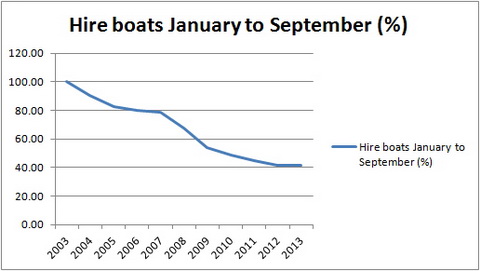
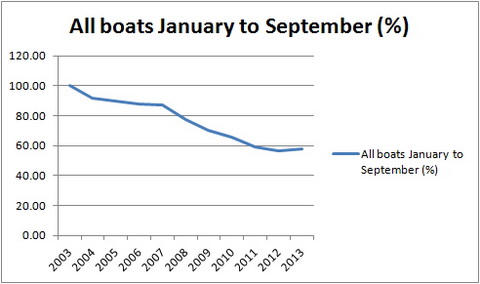
The other, indirect, measure, which applies only to the Shannon, is of passages through locks and moveable bridges. And, for hire boats, the “initial decline” has been 60% since 2003. If the numbers are now holding steady, it is at a very much lower level than ten years ago.

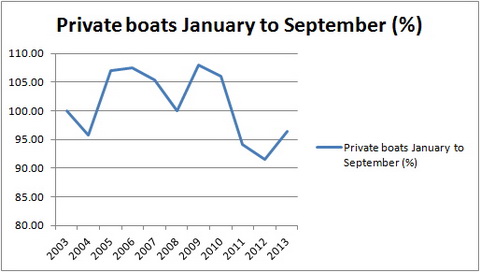
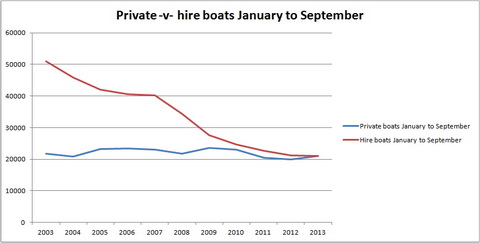
I was able to report in August that the better weather in July seemed to have led to an increase in the number of passages by private boats [the usual caveats apply]. Furthermore, for the first time that I knew of, the number of passages by private boats in the first seven months of the year exceeded the number of passages by hire boats in the same period.

I now have the figures for two more months, August and September, kindly supplied by Waterways Ireland, who are not to blame for my delay in getting the information up here.

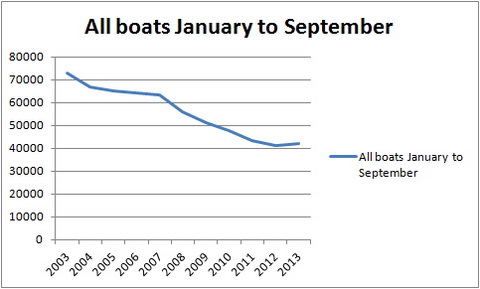
All boats JanSept nos_resize

Look! An increase!

All boats JanSept percent_resize

Total passages are now almost back up to 60% of the levels of ten years ago

Hire boats JanSept percent_resize

Hire boat numbers are down by only a tiny amount

Private boats JanSept percent_resize

Private boat numbers are up

Private -v- hire JanSept nos_resize

Hire boat numbers are slightly above private boat numbers

Private boat numbers are ahead of hire in the three main summer holiday months of June, July and August and, although the numbers are tiny, in the winter months as well; hirers are ahead in spring and autumn.


Effin stats

I wrote here about Maureen O’Sullivan’s questioning of ministers about Effin Bridge, the lifting railway bridge below Newcomen Bridge on the Royal Canal in Dublin. It seems that she would like a drop-lock to replace the bridge, thus enabling boats to pass under the railway at any time without interfering with the operation of the trains. Which would be very nice, but that it would cost over €5 million and cause significant disruption to the railway during construction.

I was distressed by Ms O’Sullivan’s failure to make any sort of economic case for the drop-lock or for any other measure that might allow for free movement of boats on that section of the Royal Canal. I said:

As the expenditure on reopening the Royal Canal is a sunk cost, I am all in favour of making its use easier — provided that it can be demonstrated that (a) there is a demand for increased use, (b) such increased use will have benefits that outweigh the costs of any improvements and (c) no alternative investment offers better returns. As far as I can see, Ms O’Sullivan has demonstrated none of the three: indeed I see no evidence that she has even considered them.

Ms O’Sullivan’s position might be described as favouring an increase in the supply of possible passages along that section of the canal, but I thought it might be interesting to know what the demand for such passages was, so I asked Waterways Ireland how many boats had passed under Effin Bridge in 2013.

I was wrong about the number of days on which the bridge was lifted: nine lifts were available altogether. Six were on Tuesdays, two on Saturdays and one on a Sunday (to facilitate the Dublin boat rally):

Tuesday 16 April 2013:           0 boats
Tuesday 30 April 2013:         10 boats
Sunday 5 May 2013:            24 boats
Tuesday 21 May 2013:           0 boats
Saturday 1 June 2013:           8 boats
Tuesday 18 June 2013:           2 boats
Saturday 20 July 2013:          3 boats
Tuesday 13 August 2013:       7 boats
Tuesday 17 September 2013:  4 boats

So that’s 58 boats in a year.

I asked what the cost was: I was told that Irish Rail charges €1200 per weekday lift and €2000 per weekend lift. I presume that Waterways Ireland itself incurs other costs, perhaps overtime at weekends, but I don’t know what they are. The cost per boat for each lift was:

Tuesday 16 April 2013:           0 boats: lift cancelled as no boats wanted it
Tuesday 30 April 2013:         10 boats: €120.00 per boat
Sunday 5 May 2013:            24 boats: €83.33 per boat
Tuesday 21 May 2013:           0 boats: lift cancelled as no boats wanted it
Saturday 1 June 2013:           8 boats: €250.00 per boat
Tuesday 18 June 2013:           2 boats: €600.00 per boat
Saturday 20 July 2013:          3 boats: €666.67 per boat
Tuesday 13 August 2013:       7 boats: €171.43 per boat
Tuesday 17 September 2013:  4 boats: €300.00 per boat

The total charged to Waterways Ireland (not to the boaters) by Irish Rail was €10800.00.

Suppose that a drop-lock had been built for €5000000. Would it be worth investing that amount to save an annual expenditure of €10800? I suspect not, although I am open to correction by anyone capable of calculating NPVs or other relevant measures.

It seems to me, though, that the case for any capital expenditure is weak while demand for passages is lower than supply. Perhaps Royal Canal enthusiasts might work on attracting more boats to the Dublin end, whether from the Shannon end or from the Grand and Liffey.


Bolshevism, boats and bridges

The balance bridge crossing the canal, near Newcomen-bridge, as designed and erected under the superintendence of Mr Bindon Stoney, engineer of the Dublin Port and Docks Board, has been completed, and adds considerably to the facilities for carrying on the traffic. This bridge has been erected in substitution of a lift-bridge, constructed in 1872, but to which an unfortunate accident occurred in February, 1878.

Ralph S Cusack, Chairman, in the report of the Directors of the Midland Great Western Railway, 19 February 1879, quoted in the Freeman’s Journal 27 February 1879

In mid-October I mentioned that Maureen O’Sullivan [Ind, Dublin Central] had asked the unfortunate Jimmy Deenihan [FG, Kerry North/West Limerick, and minister for waterways] about Effin Bridge, the lifting railway bridge below Newcomen Bridge on the Royal Canal in Dublin. The bridge is lifted, to allow boats through, on [IIRC] one Saturday each month in the summer, making five lifts a year. Waterways Ireland says on its website [click Bridges if necessary]

The Newcomen Lift Bridge in Spencer Dock is owned and operated by Irish Rail, and requires a rail possession to be lifted. It can only be lifted for boats at limited prearranged times organised with Waterways Ireland. For details of opening times and to arrange passage contact the Eastern Regional Office on 01 868 0148.

Maureen O’Sullivan wanted

… a meeting of interests concerned with the operation of the lifting bridge with a view to devising a management and operational system that is less hostile to the use of the waterway as currently it is an impediment and discouragement to navigation on the Royal Canal and an obstacle to navigation-communication between the Royal Canal and River Liffey and between Royal Canal and Grand Canal at their eastern reaches […].

Jimmy Deenihan said

The bridge is operated by Irish Rail staff on a request basis at Waterways Ireland’s expense.

However, he wasn’t giving any hostages to fortune by making rash promises or even by commenting on whether the bridge was an impediment to navigation. But Ms O’Sullivan was undeterred: she returned to the topic with two written questions on 5 November 2013 and a priority question, no less, on 7 November 2013 [for certain values of “priority”]. On 5 November she asked two questions of Jimmy Deenihan

To ask the Minister for Arts, Heritage and the Gaeltacht further to Parliamentary Question No. 59 of 16 October 2013, the extent of railway track that needs to be closed by Irish Rail in order for a vessel on the Royal Canal, Dublin, to be given access between the First and Sea Levels of the Royal Canal; if there has been an assessment of whether the extent of track closure could be reduced to facilitate greater ease of navigation on the Royal canal; and if he will make a statement on the matter.

To ask the Minister for Arts, Heritage and the Gaeltacht further to Parliamentary Question No. 59 of 16 October 2013, if the option of a introducing a drop lock to replace the need of the lifting bridge has been considered since the establishment of Waterways Ireland or if that assessment was made by Waterways Ireland’s predecessors; the level of use of the sea level assumed in relation to the assessment; if the impact of the Spencer Dock Greenway was taken into account and vice versa, was account taken of the impact on the Greenway were the sea level to be made accessible to navigation by replacing the lifting bridge; if the assessment includes analysis of whether the effective re-opening of the sea level of the Royal Canal to meaningful levels of year-round traffic would be consistent with the EU’s commitment to the ‘protection and preservation of cultural heritage, in view of the fact that Dublin’s waterway’s heritage is part of the cultural infrastructure of Europe, contributing to economic attractiveness, job opportunities and quality of life; and if he will make a statement on the matter.

The ever-patient Mr Deenihan replied:

I am advised that the option of constructing a drop lock to replace the need for the lifting bridge at the location in question has been considered by Waterways Ireland but it was not deemed viable due to the estimated costs involved, given that the minimum cost for a drop lock to replace the bridge would be of the order of €5m. Work to install a drop lock at this location would also involve considerable temporary works, the extent of which would be unknown until ground conditions were assessed in detail.

I am also advised that there have been no assessments or analyses undertaken by Waterways Ireland in respect of the level of use or impact on the Spencer Dock Greenway.

I can inform the Deputy that the length of railway track disconnected from the rest of the loop line from the station when the bridge is in the ‘up’ position is approximately 16 metres. However, as the control and operation of the railway line in the vicinity of the lifting bridge lies entirely with Irish Rail, only it can indicate the extent of the permanent rail line that needs to be closed when the bridge is opened.

He might also have pointed out that €5m is more than WI’s entire capital budget, which is under €4m for all southern waterways for 2014. And if he were an argumentative chap, he might have pointed out that there is no evidence of a demand for

… the effective re-opening of the sea level of the Royal Canal to meaningful levels of year-round traffic …

and no evidence that it would be of any economic benefit to anyone, least of all the residents of Dublin Central, even if boats were travelling that way every day of the week.

He might, if he were an impatient sort of chap, have pointed to the idiocy of the “cultural heritage” argument: with one or two minor exceptions, pleasure craft were not part of the “cultural heritage” of the Royal but, even if they were, such “heritage” wouldn’t be worth millions that might be spent instead on bringing soup to the deserving poor of Dublin Central.

Ms O’Sullivan was back with more on 7 November, this time trying to get Leo Varadkar [FG, Dublin West] to get the National Transport Authority to include Effin Bridge and the Sheriff Street non-lifting bridge (not a Scherzer) included in a National Transport Authority study of “the management and movement of people and goods to, from and within Dublin city centre”. Ms O’Sullivan’s rather confused and confusing case seemed to be that there was a greenway, and there were walking and cycling routes along the canal, so a road bridge (that works perfectly well for carrying a road) and a railway bridge (that works perfectly well for carrying a railway) should be included  in the study because the canal has navigational potential.

Or something. She even managed to bring water polo [does she mean canoe polo?] into the argument.

As far as I can see, walking, cycling, road travel and rail travel — and even water polo — are not in any way adversely affected by the current arrangements, while the canal is of negligible importance in the movement of people and goods. Boating on the canal is a leisure activity for a small number of people who are sufficiently well heeled to own pleasure-boats; I am rather surprised to find that their interests are a matter of such concern.

As the expenditure on reopening the Royal Canal is a sunk cost, I am all in favour of making its use easier — provided that it can be demonstrated that (a) there is a demand for increased use, (b) such increased use will have benefits that outweigh the costs of any improvements and (c) no alternative investment offers better returns. As far as I can see, Ms O’Sullivan has demonstrated none of the three: indeed I see no evidence that she has even considered them.

What’s depressing here is the absence of any indication of a rational approach to capital spending on waterways. They’re still cargo: a magical source of wealth, that will bring peace and prosperity as long as we all believe in fairies and avoid facts, thinking and analysis.

No wonder the country is in a state of chassis.

Update 15 November 2013: some information about demand for passage under Effin Bridge.

Horses on board

An ad from the Freeman’s Journal of 11 September 1876 provides a snippet of information about horse haulage on the Royal Canal, with a point that I cannot recall seeing anywhere else about Irish waterways. Here’s a French example and here’s an American from this excellent page.

Sailing up the Liffey (not)

While in Blighty I read a brief but entertaining piece in [HM] Independent newspaper [a piece that doesn’t seem to be available online] saying that the Sean O’Casey pedestrian bridge, which spans the Liffey in Dublin, cannot be opened because the remote control has been missing since 2010.

The story doesn’t seem to have had much coverage in Ireland, but The Journal seems to have originated it; it has been picked up by MSN and there is discussion at boards.ie, although I don’t know that many people will be inconvenienced by the inability to get tall vessels into a relatively short stretch of water.

The Southern Star

The Southern Star is West Cork’s indispensable source of news and information. I don’t know whether its masthead still proclaims that it incorporates the Skibbereen Eagle, or whether, in the print edition, its news from Bandon is still headed “Bandon Brieflets”, but it is — as we would expect — keeping up with digital technology with a website, a FaceBook thingie and a napp.

It reports today on another “trial flight” by what it terms “A newly formed company, Harbour Flights”, which I wrote about here. The aircraft shown in the photo is EI-CFP [which is registered, incidentally, as a land aeroplane [.xls]], so Harbour Flights does not seem to have acquired a larger plane — or the use of one: the register shows that EI-CFP is owned by Kieran A O’Connor, not by Harbour Flights.

Being ignorant of aviation matters, I don’t know what constitutes a trial flight — or how it is to be distinguished from a promotional flight.

I note a slight contradiction in the Southern Star‘s report:

The company […] has taken five years to grow from its initial concept to become fully operational last July. […]

When it becomes fully operational, Mr Heaps estimated that the company could create up to 50 new Irish jobs […].

So is it, or is it not, “fully operational”? I am confused.


Lough Derg Regatta 1849

The Dublin Evening Mail of 19 September 1849 has come to hand.

LOUGH DERG REGATTA

The Regatta on the above-named beautiful lake came off last week. Monday, the 10th of September commenced the annual aquatic sports: the day was tolerably fine, and at two o’clock, PM, the Commodore, the Right Hon Lord Viscount Avonmore, started four yachts for a 30 Guinea Challenge Cup, with £12 added. After a drifting match (for it fell flat calm shortly after three o’clock), they came in as under:—

Gem, 12 tons, James Spaight, Esq
Hero, 8 tons, Dash Gainor, Esq
Iris, 19 tons, Wills C Gason, Esq
Foam, 24 tons, Lord Avonmore.

This was a time race.

While the yachts were absent several cot races came off.

On Tuesday, the 11th, the yachts sailed down in fleet to Killaloe, but the following day it blew a whole gale of wind, and the match that was to have been sailed for on that day was put off till the next; however, in the evening there were some well contested cot races.

The course was as usual — start from the Jetty, over the diagonal wall (built by the Shannon Commissioners to keep the water to a proper level in summer), under the bridge, round Friar’s Island, and back: to a stranger, it is astonishing to see a boat go down an incline nearly four feet high, which they are obliged to do in the race, and what is more extraordinary, any cot that is not rowed at it pretty fast, is almost certain of being upset.

Thursday, the 12th, at the Commodore’s signal, all the yachts got under weigh, and came to anchor off Derry, and at two o’clock, PM, five yachts started for a Silver Cup, valued at £15, witn £5 added. This was a time race for yachts under twelve tons. The wind was WNW, and blew a fine gaff-topsail breeze; at half-past four o’clock the yachts came in as under:—

Hero, 8 tons, Dash Gainor, Esq
Gem, 12 tons, James Spaight, Esq
Willy Wa, 9 tons, Captain Hon F Yelverton
Vampire, 9 tons, Arthur Vincent, Esq
Midge, 7 tons, Bassett W Holmes, Esq.

This was a beautiful race, all the yachts coming in almost together: the Hero only winning by 27 seconds — indeed she may thank the Midge for winning the prize, as going free the first round she got the Gem under her lee, and kept her back some minutes. Shortly after the signal was given to weigh anchor, and start for Portumna, where the fleet arrived at a late hour. In passing Scilly Island the Foam carried away her rudder head, and was near going ashore.

Next day, Friday the 14th, the yachts assembled off Portumna Castle, and at three o’clock, PM, the Commodore started the following boats for a 40 Guinea Challenge Cup, with a purse of Sovereigns added, for all yachts. A handicap race.

Novice, 4 tons, Dash Ryan, Esq
Midge, 7 tons, Bassett W Holmes, Esq
Vampire, 9 tons, Arthur Vincent, Esq
Gem, 12 tons, James Spaight, Esq
Foam, 24 tons, Lord Avonmore
Iris, 18 tons, Wills C Gason, Esq.

This was a most exciting race, and during the first hour it was difficult to tell which would be the winner. Before rounding the second flag boat the Novice put about and gave up the race, and off Church Island, the Midge carried away the jaws of her gaff, and was obliged to give up the race, which she was almost sure of winning — having gained two minutes the first round. The course was a long one, and the race was not over till after eight o’clock, when the four boats came in as follows:—

Iris
Foam
Gem
Vampire.

During each day of the Regatta, the City of Dublin Steam Company placed one of their fine steamers at the disposal of the Sailing Committee, who took out all their friends, and accompanied the yachts each day during the race.

In the evening, after several cot races and other amusements too numerous to relate. The ladies and gentlemen present were entertained at Belle Isle, the beautiful seat and hospitable mansion of Lord Avonmore; and at a later hour assembled some 120 of the elite of Tipperary, Galway, and King’s County, at the Clanricarde Arms, Portumna, where dancing was kept up with spirit until morning.

The population of the Portumna DED declined by 30.46% between 1841 and 1851.