
Free the Black Bridge
Here is a page about a cot race at Plassey in 1851.
Posted in Ashore, Built heritage, Canals, Charles Wye Williams, Economic activities, Engineering and construction, Extant waterways, Forgotten navigations, Industrial heritage, Ireland, Irish inland waterways vessels, Natural heritage, Non-waterway, Operations, Politics, Restoration and rebuilding, Scenery, Shannon, Sources, The fishing trade, Tourism, Water sports activities, waterways, Waterways management
Tagged Annaghbeg, Black Bridge, Blackwatr, boats, bridge, canal, Castletroy, Clare, cot, floods, flow, Ireland, Killaloe, Limerick, lock, Lough Derg, Mulcair, O'Briensbridge, Operations, Plassey, Shannon, vessels, water level, Waterways Ireland
On Saturday, a party of the Revenue Police, stationed at Killaloe, detected an illicit still at full work at Mountshannon, in the County of Galway. They destroyed a quantity of potale and singlings, and brought away the still, worm, and head, which they lodged in the King’s Stores, Limerick, yesterday. The party also captured several men employed on the works, whom they transmitted to Ennis jail.
Waterford Mail 15 March 1840 quoting the Limerick Star
Posted in Ashore, Economic activities, Extant waterways, Industrial heritage, Ireland, Operations, Shannon, Waterways management
Tagged Clare, Galway, Ireland, Lough Derg, Mountshannon, Operations, potale, Shannon, singlings, still, waterways
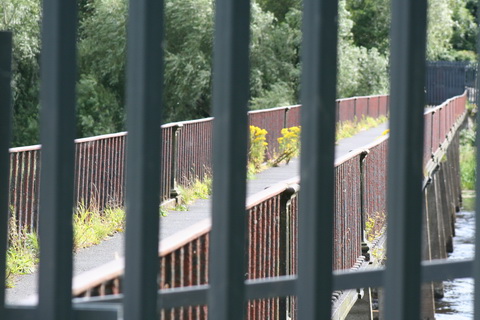
The Black Bridge at Plassey has long had a place in the hearts of Limerick people. It was damaged in the floods of 2009 and has been closed to the public ever since. Limerick Council says it can’t afford to repair it. Limerick Council is, as far as I can see, in breach of the terms of its lease of the bridge from the Department of Finance; the Department of Finance could, but has chosen not to, insist that the Council repair the bridge.
In the meantime, the Minister for Finance, for reasons best known to himself, wants a new, er, iconic footbridge in Limerick city and is prepared to spend €6 million of taxpayers’ money, via Fáilte Ireland, on a structure that can scarcely avoid blocking some of the finest views in the city.
Now, the Limerick Leader tells us, the ghastly edifice is to cost almost €18 million: €6 million from the Minister for Finance (who represents Limerick), €4 million to be borrowed and €7.8 million from the leprechauns’ pot of gold under the thorn bush. Or somewhere. Even Fianna Fáil councillors think this is insane, which is saying something.
This ridiculous proposal should be abandoned immediately and a much smaller sum should be spent instead on repairing the Black Bridge as part of a European Route of Industrial Heritage.
The Minister’s €6 million is a gift-horse that should not only have its teeth inspected: it should be taken out and shot and its carcass sent to the burger factory.
Posted in Ashore, Built heritage, Canals, Charles Wye Williams, Economic activities, Engineering and construction, Extant waterways, Industrial heritage, Ireland, Natural heritage, Non-waterway, Operations, People, Politics, Restoration and rebuilding, Scenery, Shannon, Sources, Steamers, The cattle trade, Tourism, waterways, Waterways management
Tagged Black Bridge, bridge, canal, Department of Finance, ERIH, floods, flow, Ireland, Killaloe, Limerick, Limerick city, Limerick Council, Limerick Leader, lost, Lough Derg, Minister for Finance, Operations, Plassey, Shannon, waterways, Waterways Ireland
Martin McGuinness [SF] was asked recently, in the Northern Ireland Assembly, about blueways:
Leslie Cree [UUP]: It was interesting to read that Waterways Ireland has developed this first blueway in the Carrick-on-Shannon area. Can he share with us if, in fact, Waterways Ireland has developed any projects for the Erne waterway itself?
Mr McGuinness said:
These projects are under ongoing consideration by Waterways Ireland, as the development of blueways and greenways could add to our tourist potential. It is clear from how greenways have been used, particularly in the west of Ireland, that they have huge health benefits for those now walking and cycling and involved in physical activity.
There is a proposal for another greenway from Derry city to County Donegal. Blueways and greenways offer important tourist potential, and it is exciting to see that Waterways Ireland is considering the linkage in the Leitrim area and how it can be extended to Lough Erne.
But, if I might remind TPTB, not everybody likes walking, cycling and physical activity; not everybody is going to be rolling around in a kayak or paddling a canoe. There are older folk, there are those who rightly view exercise with the gravest of suspicion and there are those whose interests simply lie elsewhere.
It is for such folk that I have developed the Greyway [TM] concept. It’s the same as a blueway or a greenway but without the sweating or the lurid dayglo clothing.
The basic idea is that you form a “route” or “way” as a marketing concept to get more people using your existing assets. Your expenditure is low: research, product development, marketing and information provision rather than infrastructure; self-guided rather than staffed user experiences. Direct income might be low too, although there may be ways to extract cash from users; there might also be spin-off opportunities for other providers. [All my usual reservations about small-scale providers apply here too.]
There might be Greyways catering for
You need a theme to attract people: “come and walk/drive the X Greyway and see all the lovely/interesting Ys”. No doubt there are several possible values for Y: bunnies, trees, fish, bogs, hills …. But the main thing that Waterways Ireland has to sell, and that it does not currently sell, is its industrial heritage. The Shannon, in particular, exists as an improved navigation only because of (a) steam, (b) the British industrial revolution, (c) Irish agriculture and (d) low politics. And industrial heritage is something that interests some at least of the older folk. Package it into routes and sell it for grey pounds, euros or dollars.
There is all sorts of interesting stuff along the Shannon, mostly just lying there, and it should be put to work. The most concentrated section is along the old Limerick Navigation, from Limerick to Killaloe: for instance, last time I looked seven of the original twelve milestones were still present. [The distance was 12 Irish miles, approx 24 km or 15 statute miles.] It’s a walkable route and it includes
But there could also be driving tours along the middle Shannon, between Portumna and Athlone, where there is lots to see, and from Lanesborough upwards. Shannon Harbour might eventually house a museum ….
What I’m suggesting is that Waterways Ireland should designate the Shannon as the first route (as opposed to site) in Ireland within the European Route of Industrial Heritage [ERIH] framework. ERIH’s website includes descriptions of the route system and of anchor points, which may be too advanced for present use, but why not a European Theme Route in Transport and Communication? Ireland might even make a case for the use of advanced (or at least interesting) transport technology (steamers) in carrying agricultural produce to industrial markets.
Furthermore, if CIE were to cooperate, the railways might be brought in too, and the livestock trade, and Dublin Port, and a regional route linking to Liverpool and the railway to Manchester ….
There is an interesting story to be told about the Shannon and its links to the east coast and beyond; its industrial heritage could be used to attract tourists and entertain natives.
Posted in Ashore, Built heritage, Canals, Charles Wye Williams, Economic activities, Engineering and construction, Extant waterways, Foreign parts, Industrial heritage, Ireland, Irish inland waterways vessels, Non-waterway, Operations, Rail, Restoration and rebuilding, Sea, Shannon, shannon estuary, Sources, Steamers, The cattle trade, Tourism, waterways, Waterways management
Tagged Athlone, canal, Clare, department of arts heritage and the gaeltacht, Dublin, ERIH, estuary, Fergus, Grand Canal, greyway, industrial heritage, Ireland, Killaloe, Limerick, lost, Lough Derg, O'Briensbridge, Royal Canal, Shannon, steamer, vessels, waterways, Waterways Ireland
John O’Dowd [SF] made a ministerial statement to the Northern Ireland Assembly on 3 November 2014, about the recent meeting of the North/South Ministerial Council in education format. His final English-language paragraph was about non-education matters:
Finally, we approved the appointment of Mr Tarlach Ó Crosáin to the board of the trade and business development body from 22 October 2014 to 12 December 2015, and, on behalf of Waterways Ireland, we approved the sale of the freehold interest in property at 9 Hanover Quay, Dublin 2 to Mrs Rita Crosby.
Here is what the Ordnance Survey says is 9 Hanover Quay. And here is what Google Maps says, with still photographs available in Street View.
The relevant NSMC minutes are here. There was a waterways NSMC meeting on 27 November 2014 at which “The Council consented to a number of property disposals”, unspecified. Perhaps the sale of the Hanover Quay freehold was a particularly urgent matter that could not wait until November.
If waterways business is going to be done at other sectoral meetings, I may have to read the whole blasted lot of them.
Posted in Ashore, Built heritage, Canals, Economic activities, Extant waterways, Ireland, Operations, People, Politics, waterways, Waterways management
Tagged Crosby, Dublin, Grand Canal, Hanover Quay, Waterways Ireland
Wednesday 22 May 2013
Brendan Smith [FF, Cavan-Monaghan]: To ask the Minister for Arts, Heritage and the Gaeltacht the position regarding the feasibility study that has been underway for some time in relation to the proposed extension of the Erne Navigation from Belturbet to Killykeen and Killeshandra; when this study will be completed; and if he will make a statement on the matter.
Jimmy Deenihan [FG Kerry North/West Limerick]: I am informed by Waterways Ireland that the current position is that work is continuing on the collection of data relating to this project and Waterways Ireland is currently preparing draft options for the project. At that point consultants will then assess the environmental implications of the options. It is expected that the feasibility study will be completed as planned by the end of 2013.
19 December 2013
Brendan Smith: To ask the Minister for Arts, Heritage and the Gaeltacht if he has received the feasibility study on the proposed extension of the Erne navigation from Belturbet to Killeshandra and Killykeen; and if he will make a statement on the matter.
Jimmy Deenihan: I am informed by Waterways Ireland that it commissioned a Strategic Environment Assessment for the possible extension of the Erne Navigation from Belturbet to Killeshandra and Killykeen.
On reviewing the environmental information from this process, Waterways Ireland considers that the environmental designations of this lake complex make the feasibility of the proposed navigation extension highly unviable. For that reason, I am advised that Waterways Ireland does not propose to pursue this project any further at this time.
11 December 2014
Brendan Smith: To ask the Minister for Arts, Heritage and the Gaeltacht the position regarding the proposal to extend the Erne navigation from Belturbet to Killykeen and Killeshandra, County Cavan; when this project will proceed to the next stage; and if she will make a statement on the matter.
Heather Humphreys [FG, Cavan-Monaghan]: I have been informed by Waterways Ireland that it commissioned a Strategic Environmental Assessment for the proposed extension of the Erne Navigation from Belturbet to Killeshandra and Killykeen in County Cavan. I am further advised that, on reviewing the environmental information from this process, Waterways Ireland’s considered view is that the development of a viable project is not feasible, given the conservation designations of the lake complex. Waterways Ireland does not, therefore, propose to pursue the proposal further at this time.
It would be nice if Mr Smith would (a) check what he was told last time and (b) tell whatever constituent is lobbying for this scheme to get stuffed. Even W T Mulvany wasn’t able to get a navigation to Lough Oughter.
Building more navigations in Ireland is a waste of money: it simply spreads the existing business more thinly. It will not attract extra business from inside or outside the state (apart from a small number of waterway twitchers). Some pub-owners in Killykeen or Killeshandra might sell some more beer-like substance, and if they would like to pay for a navigation that’s fine, but there is no advantage to the state in paying for it.
Thanks to KildareStreet for the notification.
Posted in Drainage, Engineering and construction, Extant waterways, Industrial heritage, Ireland, Irish inland waterways vessels, Natural heritage, Operations, Politics, Scenery, Tourism, Unbuilt canals, waterways, Waterways management
Tagged Belturbet, canal, Erne, Ireland, Killeshandra, Killykeen, Lough Oughter, Operations, waterways, Waterways Ireland
An interesting article [h/t celr] about the setting up of the Canal & River Trust, which runs (it says itself) 2000 miles of waterway in England and Wales. The article is not, perhaps, to be seen as an objective evaluation of the benefits of the UK’s Public Bodies Reform Programme, but the idea of transferring a large operation to the voluntary sector is an interesting one, as is the scope for volunteer donations and involvement (British Waterways, C&RT’s predecessor, had nothing like as high a proportion of lockkeepers as Waterways Ireland has).
I have occasionally been asked, by British folk, whether the possibility of transferring Waterways Ireland to the voluntary sector is being considered here. I have explained (a) that WI has nothing like as significant an independent (non-grant) income as BW had and (b) that any such transfer would require the rewriting of the Good Friday, St Andrew’s and (now) Stormont House Agreements. So we are stuck with the current arangements, which at present are leaving WI at the mercy of budget cuts, a disastrous pensions arrangement, disputes between its two governing departments and a nitwitted demand, from Sinn Féin and Fianna Fáil and perhaps from Fine Gael too, for a pointless canal reconstruction.
Posted in Built heritage, Canals, Economic activities, Engineering and construction, Extant waterways, Foreign parts, Industrial heritage, Ireland, Politics, Restoration and rebuilding, Sources, Tourism, Ulster Canal, waterways, Waterways management
Tagged canal, canal & river trust, Clones, department of arts heritage and the gaeltacht, Erne, Fianna Fail, Fine Gael, Ireland, Lough Neagh, North South Ministerial Council, north south pension scheme, Operations, Saunderson's, Sinn Fein, Ulster Canal, waterways

 Irish waterways history