… on the Mississippi.
Maybe we could sell them some from the Shannon.

… on the Mississippi.
Maybe we could sell them some from the Shannon.
What is the World Corporate Golf Challenge? And why is Waterways Ireland sponsoring it?
Or is it?
Google found about ten mentions of an event called the “Irish qualifier” for the “Waterways Ireland World Corporate Golf Challenge” including this one from the NI Chamber of Commerce, which you might expect to have better things to do with its time. However, despite what some sites suggest, I suspect that (unless it has lost its penkas completely) WI is sponsoring only the “Irish qualifier” and not the entire worldwide event. WI’s website search engine returns no relevant information.
The World Corporate Golf Challenge (I’m already reaching for the sickbag) doesn’t seem to have heard of Ireland (or of Waterways Ireland), although it lists Northern Ireland as a participating country. So is this an “Irish qualifier” or a “Northern Irish qualifier”?
The WCGC, whose website tells us where the 2010 final will take place, seems to work by licensing organisations to run local competitions. The Northern Ireland licence is held by Lough Erne Resort, where the 2012 “Irish qualifier” will be held on 25 September; it has delegated the organising of the event to Posnett Golf, which will have a special offer but doesn’t yet know what it is. The resort was placed in administration in May 2011 and may now be for sale.
But why is WI sponsoring this event? It’s just going to attract a pack of Nigels and Patricks who, on a Tuesday, should have their feet under their desks saving the Northern Ireland economy. And all of them have already, I suspect, heard of Lough Erne, and of golf, so I don’t see what WI expects to gain from this.
Incidentally, have you ever noticed that golf is essentially a less exciting variant of Eeyore’s game?
But Eeyore wasn’t listening. He was taking the balloon out, and putting it back again, as happy as could be ….
Posted in Ashore, Economic activities, Extant waterways, Foreign parts, Ireland, Operations, Tourism, waterways, Waterways management
Tagged Erne, golf, sponsor, Waterways Ireland
In February 2012 Waterways Ireland published a study of the River Barrow called The Barrow Corridor Recreational, Tourism and Commercial Product Identification Study. I’ve devoted a lot of time to the document and I confess that, although I’m in favour of WI’s conducting these studies, I found this one rather disappointing. The principal problem, as I see it, is that the document just doesn’t hang together: it is not clear how the recommendations derive from the analysis. I also thought that its recommendations on navigation were weak, suggesting a fundamental misunderstanding of the nature of the Barrow.
I haven’t finished putting my thoughts on the subject together because I want to do the study justice, but I have put up six pages about the report, linked from an overview page here. I need to give the navigation page a little more thought; when it’s finished I’ll link it to the overview page and mention the matter here.
Posted in Ashore, Built heritage, Economic activities, Engineering and construction, Extant waterways, Industrial heritage, Ireland, Irish inland waterways vessels, Natural heritage, Non-waterway, Operations, Politics, Restoration and rebuilding, Scenery, Steamers, Suir, waterways, Waterways management, Weather
Tagged Barrow, boats, canal, floods, flow, Grand Canal, Ireland, Nore, Suir, vessels, waterways, Waterways Ireland
The Black Bridge at Plassey has been closed since the floods of November 2009. Its reopening seems to have a low priority; I suspect that is because the importance of the bridge in Ireland’s technological, economic, entrepreneurial and political history is not widely appreciated. Here is a page explaining some of the background and suggesting a context within which reopening might be justifiable.
Posted in Built heritage, Charles Wye Williams, Economic activities, Engineering and construction, Extant waterways, Forgotten navigations, Industrial heritage, Ireland, Irish inland waterways vessels, Irish waterways general, Natural heritage, Operations, People, Restoration and rebuilding, Scenery, Shannon, shannon estuary, Sources, Steamers, The cattle trade, The turf trade, Tourism, waterways, Waterways management, Weather
Tagged Annaghbeg, Black Bridge, boats, bridge, canal, Charles Wye Williams, City of Dublin Steam Packet Company, Clare, floods, Grand Canal, Ireland, John Brownrigg, Killaloe, Kilrush, Limerick, Limerick Navigation, Liverpool, livestock, lock, lost, Lough Derg, Manchester, Montpelier, O'Briensbridge, Operations, P&O Line, Plassey, quay, Shannon, Thomas Rhodes, Tipperary, turf, vessels, water level, waterways, Waterways Ireland
I have added more information, from Arthur Young in 1780, to my piece on dredging for marl on Lough Derg. Young provides a few more details on the process.
Posted in Economic activities, Engineering and construction, Extant waterways, Industrial heritage, Ireland, Irish inland waterways vessels, Operations, People, Shannon, The cattle trade, waterways, Weather
Tagged Arthur Young, boats, Derry, Head, Ireland, Killaloe, Lough Derg, marl, Shannon, Tipperary, vessels, water level, waterways
… here.
h/t PW
Posted in Charles Wye Williams, Economic activities, Engineering and construction, Extant waterways, Forgotten navigations, Industrial heritage, Ireland, Irish inland waterways vessels, Operations, Scenery, Shannon, Sources, Steamers, The cattle trade, Tourism, waterways
Tagged Ballina, boats, Clare, Ireland, Killaloe, lawrence, Lough Derg, Operations, Shannon, steamer, vessels, wreck
Why, when speaking of the branded product Plasticine, did [do?] Irish teachers insist on using the Irish word marla? Even that word was, according to Terry Dolan’s Dictionary of Hiberno-English [Gill & Macmillan, Dublin 2004; new ed forthcoming], derived from the English marl.
At least in the nineteenth century, marl was a valuable manure or fertiliser and, on Lough Derg, Mr Head of the Derry Estate introduced a system of dredging it from deep water. Read about it here.
Posted in Economic activities, Engineering and construction, Extant waterways, Industrial heritage, Ireland, Irish inland waterways vessels, Operations, People, Scenery, Shannon, Sources, Steamers, The cattle trade, waterways
Tagged "marl dock", boats, broadford, Clare, Derry Castle, Derry estate, dredging, Dublin Society, fertiliser, Hely Dutton, Ireland, Killaloe, Lough Derg, manure, marl, Mr Head, Operations, Scarriff, Shannon, shelly, Spaight, Tipperary, vessels, waterways, workboat
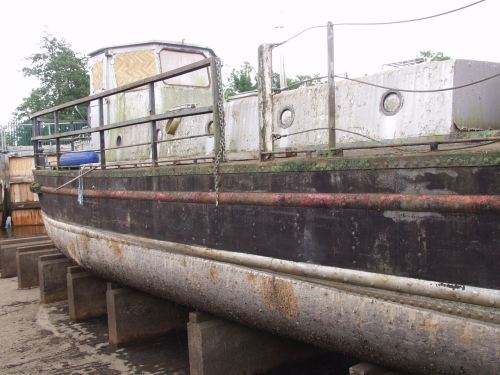
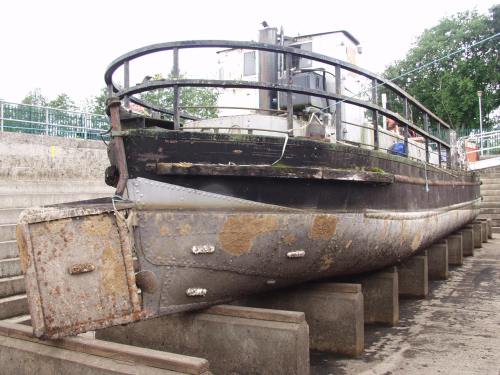
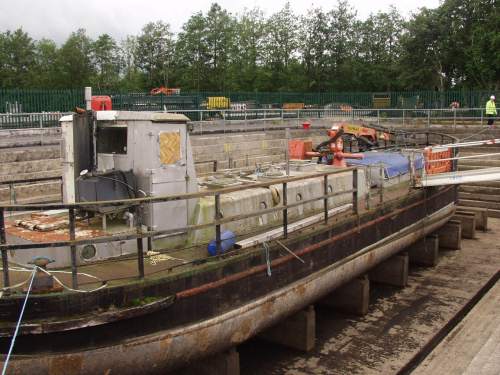
Thanks to Liam Kelly for these photos of the retired WI maintenance vessel Fox celebrating her 75th birthday in dry dock at Roosky recently.
-0-
-0-
-0-
I am to speak at Jamestown, near Carrick-on-Shannon in Co Leitrim, on Saturday 4 August 2012. Jamestown is having its heritage festival, and large numbers of old (converted) barges will be there. I will be giving one of four talks; mine is entitled
Down with barges: why cots were the really important vessels on Irish inland waterways.
I will be citing His Late Majesty Henry VIII, Fid Def, in support of my contention.
Here is some of the background to my thinking. If you would like to hear more, do come along on the day: the talks are open to all.
Posted in Economic activities, Extant waterways, Forgotten navigations, Industrial heritage, Ireland, Irish inland waterways vessels, Irish waterways general, Operations, People, Politics, Shannon, Sources, Suir, The cattle trade, The fishing trade, The turf trade, waterways, Waterways management
Tagged barges, Barrow, boats, cots, Erne, floods, Ireland, Kilrush, Limerick, Lough Derg, Lough Neagh, O'Briensbridge, Operations, Shannon, Suir, turf, vessels, waterways, workboat


 Irish waterways history