Category Archives: waterways

Is Brendan Smith a disguised Theresa May?

Theresa May, who is Prime Minister of Unicornia, is renowned for her inability to take “No”, or indeed “Definitely not”, or “What part of NO do you not understand?”, or “FOAD”, for an answer.

The same may be said of Brendan Smith, a Fianna Fáil TD for Cavan-Monaghan (in a region where mental health is a big issue). For many years, Mr Smith has been asking when a navigation (first proposed as one of W T Mulvany’s insane drainage-cum-navigation projects in the 1840s) is to be constructed between Belturbet and Lough Oughter. And, year after year, he is told, in the politest possible terms, that it’s a non-runner.

Here’s the latest example, where the unfortunate Minister for Fairytales devotes a lot of effort to telling him to FOAD. Waterways Ireland has the right idea:

There is already extensive existing underused navigation for example at Belturbet and Waterways Ireland has reiterated the potential in the waters of the Lough Oughter area being promoted as a distinct Blueway. The national context is that Blueways Ireland (National Trails Office, Canoeing Ireland and other state bodies) is currently considering the establishment of Blueways beyond the Waterways Ireland network of inland waterways.

To this end, Waterways Ireland has met with the Chief Executive of Cavan County Council, other council officials and elected representatives concerning Blueways developed successfully on the Waterways Ireland network to advise on possible ways forward. Waterways Ireland is happy to support Cavan County Council should it decide to develop a Blueway on the River Erne from Belturbet to Killykeen and Killeshandra but as the area is officially outside of their remit, this offer extends to advice and support only.

It would be nice if Mr Smith would stop wasting parliamentary time on the pursuit of unicorns. If he doesn’t, I’ll be forced to conclude that he and Mrs May are somehow related.

The cows of death

On Wednesday, a melancholy accident, attended with the loss of nine lives, occurred on Lough Derg, on the Upper [ie non-tidal] Shannon, by the upsetting of a boat in its passage across the lake from Williamstown to Dromineer. The nine men were jobbers, six of them belonging to Nenagh, and three to Cork, and were returning from a fair in the county Galway.

The accident is said to have been owing to their having carried two cows with them yoked to the boat, one of which, having burst the ties that confined it, became unmanageable, and in a few minutes the boat being upset, all on board were engulphed in the deep.

The Warder and Dublin Weekly Mail 3 March 1849, quoting Limerick Reporter

The Lough Derg Pinnace Club

Lough Derg Pinnace Club

Regatta

To take place off Williamstown Hotel
On MONDAY, the 20th of SEPTEMBER, 1841.
Viscount AVONMORE, Commodore

Sailing Committee: John Burke Esq, Tintrim; Chas Walnutt Esq, Limerick;
W A Minnett Esq, Annabeg

A SILVER Challenge Cup, value 12 Guineas, with the Entrances, to be sailed for by Pinnaces — to start at 12 o’clock. Three to start or no Race. Entrance — Half a Guinea.

A Cot Race, to start at One, pm. Three to start, or no Race.

Three sovereigns added to an Entrance of Five Shillings, to be pulled for in four-oared Gigs. Three to start, or no Race.

A Cot Race, to start at 3 pm. Three to start or no Race.

A Donkey Race, to take place at 4 pm for a Bridle presented by John Burke of Tintrim Esq.

All persons entering Boats for the above Prizes must send their names to the Treasurer previous to the day of Sailing, and the regulated Entrance at the same time.

W H MINNETT, Treasurer

Annabeg, Nenagh, Sept 11

A Dejeune will be prepared at Mr MILLS’ Hotel, Williamstown, at Four o’clock, OM. Tickets, including wine — Gentlemen, 5s; Ladies, 2s 6d to be had of the Committee and the following Gentlemen — Walter Blake Esq, Meelick; Philip Reade Esq, Woodpark; Edmond Burke Esq, Tintrim, and Francis Drew Esq.

September 11

Limerick Chronicle 11 September 1841

Ballinlaw Ferry: much more info

For many people, the first thing to look out for on a Friday morning is Andrew Doherty’s weekly posting on his Waterford Harbour Tides and Tales blog. Today’s subject is the Ballinlaw ferry on the Barrow: I had a bit of information  here (and a question here) but for the full story read Andrew’s account.

Horse under water

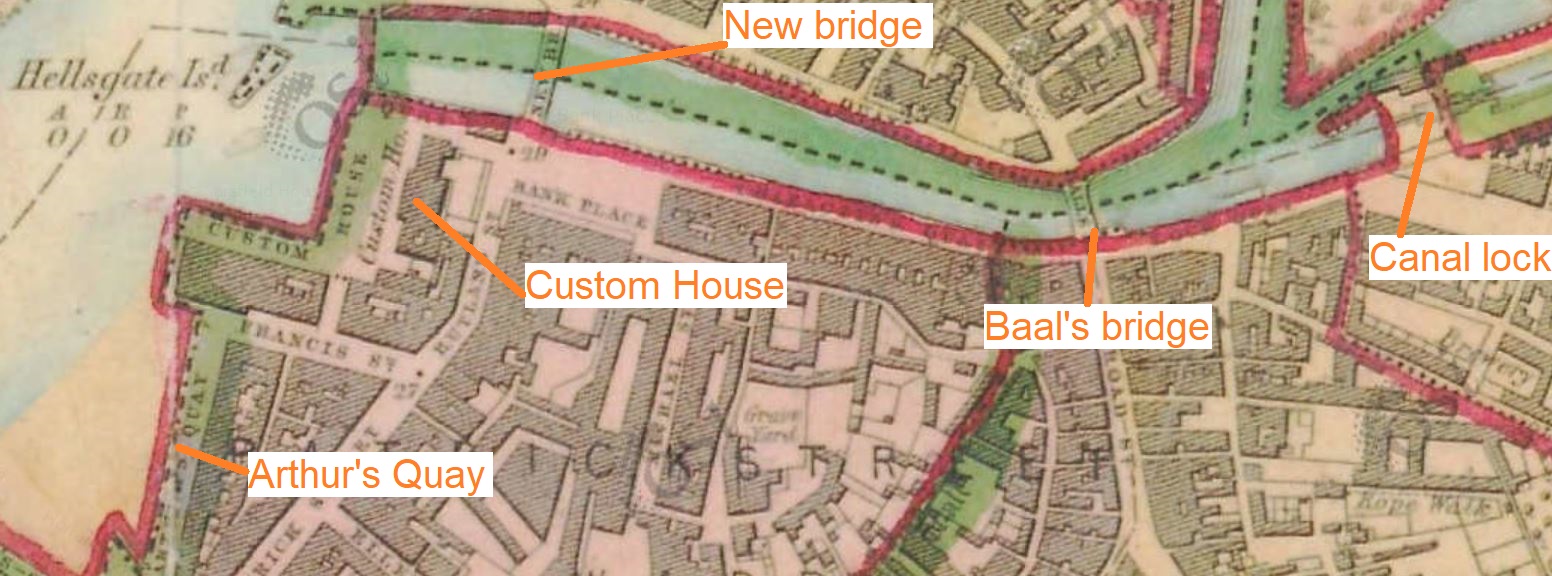
The horse’s journey (OSI 6″ ~1840)

A horse and car fell in at the lower lock of the Canal this day — passed rapidly down by the flood-gates, under Baal’s Bridge, between the Malls, under the new Bridge, by the Custom-house, where a row boat came to the rescue, and the poor struggling animal was secured by the boatmen, who cut the harness, and brought him safe to shore to Arthur’s-quay, where hundreds were assembled to behold the horse again on terra firma.

Limerick Chronicle 13 December 1845

The Four Pots tramway

Ewan Duffy has an interesting post here about a tramway from a quarry to the bank of the Grand Canal beside the Four Pots.


They killed Kenny!

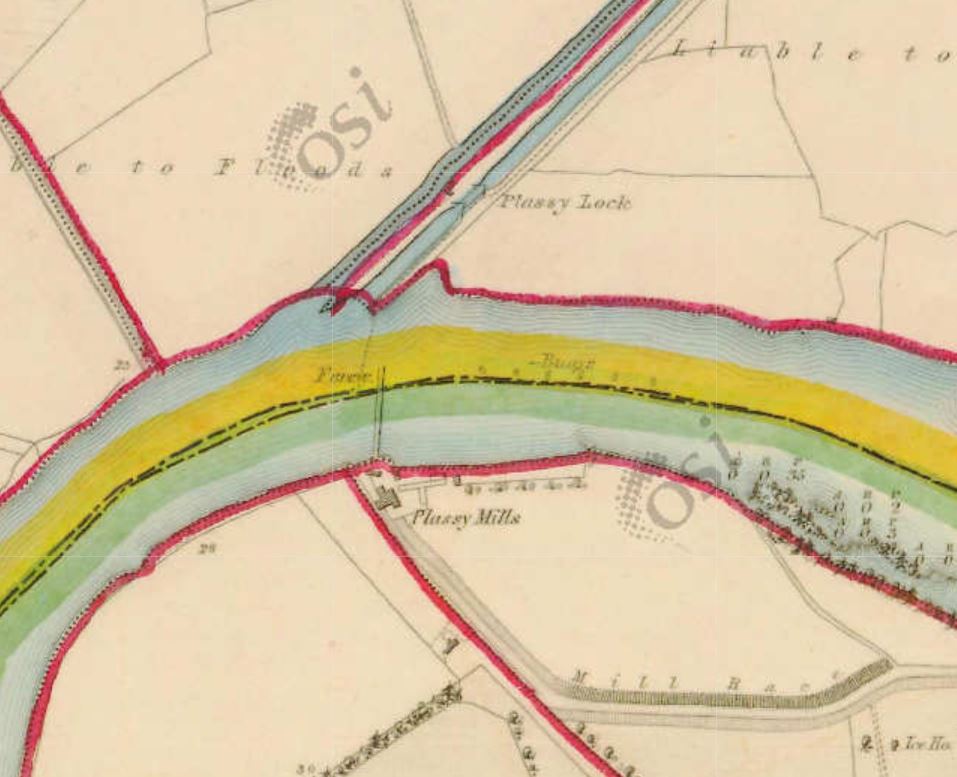
Annabeg, Annaghbeg, Plassy or Plassey Lock on the Limerick Navigation (OSI 6″ ~1840)


Last Sunday a young man of the name of Kenny, bathing in one of the locks of the Canal, near Annabeg, was unfortunately drowned; the sluices of the gates happened to be open, through which the poor lad was drawn from the great suction, and his head very much shattered.

Saunders’s News-Letter 30 July 1803

Who fears to speak of 98?

It’s one less than 99, I suppose. But the answer might be the Grand Canal Company.

The Grand Canal corps of infantry, commanded by Captain Greene, mount guard every night at the Canal harbour, which gives additional safety to that place.

Dublin Evening Post 5 January 1797

WAR-OFFICE, DUBLIN-CASTLE, 5th JAN 1797

His Excellency the Lord Lieutenant has been pleased to sign Commissions for the following Gentlemen to be officers in the under-mentioned district corps.

[…]

Grand Canal Infantry — 2d lieut J Wemys Disney, 1st lieut vice [ie in place of] Black, resigned, and Jas Murray Barton, Esq; 2d do

Dublin Evening Post 10 January 1797

Andrew Hamilton Esq was later commissioned as a 3d lieut in the Grand Canal Infantry [Saunders’s News-Letter 8 April 1797]. William Greene, the captain, was Company Secretary in real life.

The usual military guards in the Earl of Meath’s Liberty were sustained by the St Sepulchre’s infantry, from which they were yesterday relieved by the Revenue corps — and the stores of the Grand Canal Company were protected by the Canal corps.

Dublin Evening Post 5 October 1797

There was a big parade in November 1797.

GRAND CANAL CORPS OF INFANTRY

At a meeting of the Grand Canal Corps of Infantry, on parade, Saturday the 4th day of November, the following Address, with an elegant Stand of Colours, were presented by Mrs WILLIAM GREENE.

“With infinite satisfaction I have the honour of presenting this Stand of Colours to you, as a tribute of the high esteem I entertain for the fidelity and zeal you have, in every instance since your enrolment, evinced for the important cause in which you are engaged. Our recent brilliant victory, will, I trust, prevent the necessity of your being exposed to the dangers we had reason to expect, though I feel the most perfect confidence, should any arise, that you will protect these Colours with the same spirit, courage, and loyalty, your conduct has hitherto manifested.

“Cordiality, united with valour, will, I am persuaded, on every occasion crown with success your laudable exertions in support of our King and happy Constitution, the blessings attendant on which you must feel more peculiarly sensible of this day, animated by reflecting on the example of that Monarch, the anniversary of whose birth you are assembled to commemorate.”

To which the Corps returned the following Answer.

“Madam

“With heartfelt thanks we receive your much valued favour, perfectly sensible of the honour conferred on us, which is heightened by the gracious manner with which you have presented us these Colours, from which we are determined never to desert, but to retain them with that spirit and firmness which have through ages signalized our Country for loyalty to our King, and attachment to our glorious Constitution.

“Your very high opinion of us, as Soldiers, is really most flattering to us, but it is our duty as well as our wish to act, in every situation, for the support of our Constitution with the zeal and ardour that become Soldiers and become Men.”

Resolved, That the corps be specially summoned to meet on Friday next, for the purpose of ascertaining the portion of pay to be appropriated to the relief of the widows and orphans of the brave men who fell under the command of Lord Duncan.

Resolved unanimously, that the foregoing address and resolution be inserted in Saunders’s News-letter, the Dublin Evening Post, and Faulkner’s Journal.

By Order, Arthur Disney, Sec.
Parade, 4th November, 1797

According to David Dickson [David Dickson Dublin: the making of a capital city Profile Books, London pb 2015], in 1798 Dublin city had 12 infantry and 7 cavalry corps of yeomen, with another 12 corps in the county. Of those in the city, 7 were organised by district, 7 by profession or guild and 4 by institutions: the Linen Hall, Trinity College, the Custom House and the Grand Canal company.

They constituted a vast, highly visible and overwhelmingly loyalist force, the enforcers of what many, perhaps most, citizens now regarded as a hostile political order.


 

Diesel

Now that the Department of Finance and the ISA have raised the white flag and abandoned the tax-evaders’ delight, the Mineral Oil Tax scheme for private pleasure craft, I thought I might rewrite my page on tax-dodging boat-owners. The version here is completely new.

Owners who wish to pay the tax in 2019 for 2018 will find information here. Private owners want Form PPN1; the link on that page still shows last year’s form but it may be possible to use it, changing the dates as appropriate. That’s what Revenue told me to do last year.

Talbot’s Canal, Malahide

Hat-tip to Carthach Ó Maonaigh for pointing me to this article about a [proposed?] canal I had not heard of before: Richard Talbot’s Canal in Malahide. Talbot intended to build a canal to carry heavy goods inland from Malahide harbour via Swords to join the Broadmeadow River at Fieldstown.

This is yet another example of [proposed] eighteenth century investment and improvement by estate owners. Most of the canals I’ve covered were inland, and often associated with bogs for reclamation and turf extraction; this one shows that improvers could have other aims in mind.

Incidentally, the articles on the Old Yellow Walls site seem to be carefully researched and referenced.