Waterproof wireless telegraphy

A couple of weeks ago I wrote about wireless telegraphy, concluding that:

At present, the rational decision for a boat-owner is to buy a cheap VHF without bothering to get either a certificate for the operator or a licence for the vessel. This is the rational decision because the official channels for getting certificates and licences are slow, expensive and cumbersome. It may therefore be — who knows? — that the populace has already decided to ignore the regulations.

For leisure boating within some sensible distance of the shore, I suggest that the current regulations be either drastically simplified or, perhaps better, scrapped altogether. That might mean giving the International Telecommunication Union a kick up the transom, but the present system is counterproductive: it seems to limit the use of handheld VHFs in cases where they could be very useful, if only to allow search and rescue volunteers to stand down earlier.

Two reports published today by the Marine Casualty Investigation Board have caused me to reconsider that conclusion.

In the Brownstown Head case [Report no MCIB/229; no 11 of 2013] [PDF], two occupants of a 16′ punt were thrown into the water when the boat capsized. They had a handheld VHF in the boat, but it sank when the boat capsized; one occupant put his mobile phone in his mouth to keep it above the water but it was knocked out. As a result, they were unable to summon assisstance. They eventually tried to swim to the shore, but only one made it; the other was drowned.

In the MacDara’s Island Currach case [Report no MCIB/215; no 10 of 2013] [PDF], a fisherman seems to have fallen overboard from a 6.15m open boat, in which he was alone. It was equipped with flares and a VHF in a watertight container, but as the report says:

5.6. There are unique problems with fishing operations from small open boats by lone fishermen. Once they become separated from their vessel their means of communicating their distress are on board their boat and not accessible to them.

In neither of these cases was the possession of a handheld VHF of any use. The VHF sets would have had to be (a) waterproof and (b) securely attached to the boaters’ lifejackets. The report on the MacDara’s Island Currach case recommends:

6.5. That the “Code of Practice for Fishing Vessels under 15 LOA” section 9.5 Radio Equipment should be amended by the addition of a requirement for undecked vessels where there is a lone occupant that an appropriate beacon should be of the type worn on the person.

In fact, the same recommendation could be applied to cases like Brownstown Head, where there were two people in the boat. That is broadly in line with the actions announced by two ministers on 8 July; note Simon Coveney also said:

I am also establishing a new high level working group on safety in the fishing industry, to look at all aspects of safety on fishing vessels and to report to Minister Varadkar and myself with recommendations before the end of the year. The new working group will be chaired by Mr John Leech current CEO of Irish Water Safety. Because a common thread of comment in recent times has been the need to pay particular attention on issues surrounding the number of small inshore boats that get into difficulty, I have charged the group with focussing to a large degree on this aspect.

So the wider use of handheld VHFs won’t solve every problem. I still think, though, that such wider use should be encouraged by the removal of unnecessary barriers.
Inland lifeboats to be exempt from VAT

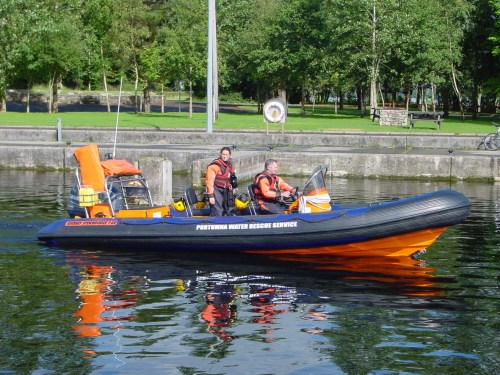
Irish Water Safety has issued a press release [PDF] saying that the government is to introduce (or launch or make or pass or something) the Value-added tax (refund of tax) (rescue boats and related equipment) order 2013 which will allow inland community rescue boats to reclaim VAT on their purchases. Under the Value-Added Tax (Refund of Tax) (No 18) Order 1985, coastal community rescue boats have been able to reclaim VAT [PDF] but inland boats have not.

Portumna Water Rescue Service

Portumna Water Rescue Service

Irish Water Safety has a defined role in assessing the eligibility of community rescue boats for VAT exemptions; indeed its checklist and guidelines for community rescue services [PDF] are rather surprisingly headed Inspection for VAT Refund Certificate. The background is explained in another document Inshore Rescue Guidelines [PDF], which will presumably now be amended to include provision for inland boats. The “Declared Facility” boats [those approved and able to claim the VAT exemption] are listed here; there is also a list of other known rescue boats, some of which, being on inland waters, will now presumably apply to IWS for approval. Thus what is already a large rescue service will become even larger and more important.

I have photos of some of these boats on this page. I have none of the Corrib & Mask Rescue service, which I regret as today’s announcement was made on their turf and with their assistance. IWS says:

They will be the first Community Rescue Boat Ireland Lifeboat to be in a position to avail of this financial incentive.

Incidentally, I do not know whether the existing inland lifeboats operated by the Coast Guard and RNLI are affected by this or whether they could already reclaim VAT. If anyone can tell me, I’ll be glad to add the information here.

Dialogue

Some time ago I noted that Waterways Ireland was now down wid da kidz in da hood, doing groovy things like social meeja with a Youtube thingie. It features (inter alia) a flight in a helicopter gunship along a restored Clones Sheugh. At least, that’s what I presume was going on, although I couldn’t work out how to fire the rockets at the suspiciously large number of narrowboats found along the way. The scenic highlight of the journey was Clones.

There’s also a Facebook page, from which I learned that there is now a skippered boat available for hire on the Barrow. And there is a Twitter whatsit, which does two interesting things.

First, it has summaries of marine notices, which will be useful to those cruising on the waterways without internet access.

Second, it shows signs of WI’s engaging in public dialogue with users, even when their comments might be critical. This is very welcome; it will be interesting to see the extent to which such public dialogue is permitted to develop.


Ardnacrusha drowning

Killaloe Coast Guard report.

Domestic travel

The current appalling weather, with temperatures over 18C, seems to have increased the number of folk going boating on the inland waterways; it will be interesting to see how it affects the Shannon lock passage figures for July when they appear in August. But Constantin Gurdgiev says, of the data for the first quarter of 2013, that …

Data shows sustained declines in domestic trips undertaken for holiday purposes by Irish residents. Weather effects are of course a factor, but it is worth noting that holiday travel abroad by irish residents also contracted y/y in Q1 2013. In other words, it looks like even disregarding weather conditions, things are grim.

But in Q2 we may have to take “seasonal factors” literally.

Living on boats in Dublin

Clare Daly [Socialist, Dublin North] elicited some information via written answers on 10 July 2013; h/t KildareStreet.

Clare Daly: To ask the Minister for Arts, Heritage and the Gaeltacht the recommendations of the Waterways Ireland consultation process on utilising Dublin’s waterways and the reason recommendations for the development for spaces for houseboats were not implemented; and his plans for same.

Jimmy Deenihan [FG; Kerry North/West Limerick]: I wish to advise the Deputy that Waterways Ireland is committed to utilising Ireland’s waterways to the greatest extent possible. In relation to the Deputy’s query regarding utilising Dublin’s waterways for the development for spaces for houseboats, I am informed that Waterways Ireland has plans to develop provision for houseboats in the Dublin City area on the existing floating moorings at Grand Canal Dock in Ringsend.

The Deputy should be aware that when Waterways Ireland applied to the Dublin Docklands Development Authority for permission to install floating moorings around the Waterways Ireland Visitor Centre to provide approximately 55 berths for boats/vessels back in 2003, the Authority issued a Certificate of approval under Section 25 of the Dublin Docklands Development Authority Act, 1997 which included the condition that ‘This Certificate permits the use of the 55 berths for boats/vessels used solely for amenity on the waterways and not as permanent residential or commercial units’. Waterways Ireland is currently in discussion with the Dublin Docklands Development Authority with the aim of having 25 berths designated for permanent residential or commercial use at Grand Canal Dock.

Second h/t to Clare Daly. I trust that Waterways Ireland will auction the residential berths to maximise the revenue from these prime city-centre locations.

Shannon Navigation Guide 1963

Messrs abebooks.co.uk have drawn my attention to the fact that Sharston Books of Manchester (which is a town or city within Her current Majesty’s Realm) have a copy of this 1963 Shell/BP guide for sale. John Weaving was Navigation Editor. I already have it, so I mention it here in case anyone else is interested.

I have no connection, commercial or otherwise, to the seller.

Bock goes boating …

… on the Shannon Estuary, the second most interesting coast of Clare (the inland coast is the most interesting, the north-west coast the least). Includes nice pics of the Scattery battery.

How low can you get?

Here’s a report from Hawthorn about Shannon water levels; here is a press statement from a political chap on the matter [PDF]; here is a post showing quite how important agriculture is to the Irish economy.

In brief: it isn’t. As Constantin Gurdgiev says:

[…] Irish agriculture is an extension of the welfare state, in so far as most of the value added in it is provided for by the subsidies.

Given that the sector as a whole includes the relatively small number of productive farms, the value of marginal farms may well be negative. Those occupying such land should be encouraged to abandon it and to take up some more productive activity elsewhere; Mongolia seems like a good bet. Activities designed to help the landlords to continue to pretend to be engaged in an economic activity are a waste of resources.

The Washington gandalow

See here.