WI has won an award

WI has won the Public Sector Award from the [Dublin] Docklands Business Forum. The award is for

[…] its active contribution to the Docklands Summer Festival, the South Docks Festival, Tall Ships Festival and Docklands community life throughout 2012.

With docklands moorings becoming available, WI may have a chance of retaining its award next year.

Incidentally, we learned earlier this week about music at the Box in the Docks; the Public Sector Award press release has more information about the Box:

Waterways Ireland owns and manages a multipurpose centre in the Basin which is used as a Visitor Centre during the summer season and provided a linchpin for the festival and events as well as community activity such as the Waterways Ireland Community Choir.

And we hear a rumour that models are being built ….

By the way, WI is compiling its events guide for next year: get your event in to them by 25 January 2013.

Looking for Hilda

In Irish Passenger Steamship Services Volume 2: South of Ireland (David & Charles, Newton Abbot 1971), D B McNeill writes:

In the autumn of 1964 the Ormonde Hotel at Nenagh took delivery of the Hilda from Holland. She is a modern canal cruising launch with central heating and a transparent roof. She is used for local trips on Lough Derg.

She is described as a single-screw motor vessel with a diesel engine but no further details are given. I would welcome more information about the Hilda; a photo would be very nice.

Music box in the docks

WI PR here.

A gratifying display of loyalty

His Excellency the Lord Lieutenant took a trip on the Shannon Estuary in July 1856 on the City of Dublin Steam Packet Company’s vessel Erin-go-Bragh. He was greeted by demonstrations of loyalty from the populace, had dejeuner on board off Scattery Island and heard an address from the proprietary, clergymen, merchants, traders and inhabitants of Kilrush, read to him by Colonel Vandeleur. Here is the Freeman’s Journal‘s account of the trip.

Campaign news 2: marine casualties

There is an appalling piece of legislation called the Merchant Shipping (Investigation of Marine Casualties) Act 2000. Actually, only part of it is appalling. The first 45 of 46 sections are OK: they’re all about investigating marine casualties, which is more or less what you would expect, and that’s fine. But Section 46 is a stinker:

The Minister may, from time to time, with the consent of the Minister for Finance, advance to a person, out of monies provided by the Oireachtas, for the purposes of marine or natural resource based tourism or heritage projects, such sums, by way of grant or loan, as the Minister may determine and upon such terms and conditions as he or she considers necessary.

First of all, it has nothing whatsoever to do with investigating marine casualties and, second, it allows a minister to hand out money to his mates on whatever terms he likes. This sort of addition to an irrelevant bill is what we might expect in the USA or in Greece, but it should never have got through the cabinet, never mind the Oireachtas. It is fortunate that the Minister for the Marine and Natural Resources at the time the act was passed was a person of the utmost probity, one Frank Fahey.

In 2010 responsibility for Section 46 was transferred to Craggy Island by Section 3 (1) of SI No 677/2010 — Marine Tourism (Transfer of Departmental Administration and Ministerial Functions) Order 2010:

3. (1) The functions vested in the Minister for Transport by or under section 46 of the Merchant Shipping (Investigation of Marine Casualties) Act 2000 (No. 14 of 2000) are transferred to the Minister for Community, Equality and Gaeltacht Affairs.

And in 2011 it was transferred again, this time to the Department of, er, Agriculture by SI No 163/2011 — Marine Tourism (Transfer of Departmental Administration and Ministerial Functions) Order 2011:

3. (1) The functions vested in the Minister for Community, Equality and Gaeltacht Affairs by or under section 46 of the Merchant Shipping (Investigation of Marine Casualties) Act 2000 (No. 14 of 2000) are transferred to the Minister for Agriculture, Fisheries and Food.

The Dept of Ag later became the Department of Agriculture, Food and the Marine, although most marine functions are still in the Department of Transport.

On 13 February 2012 I wrote to the Dept of Ag thusly:

I would be grateful if you could give me a list of grants and loans made under Section 46 of the 2000 Act since it came into force, including the names of the recipients, the purposes for which the grants or loans were given and the details of your evaluations of the effectiveness of the grants or loans.

I would also be grateful if you could tell me whether your department intends to seek the repeal of Section 46.

After several reminders, I found a kindly chap who took up the matter. He has today written to say:

We sought the assistance of our Marine Agencies and Programme Division in Clonakilty, Co Cork and they have advised that the Department of Agriculture , Food and the Marine (formerly the Department of Agriculture, Fisheries and Food) has made no grants under Section 46 since responsibility for Section 46 was vested in the Department. If any grants were made under Section 46 prior to responsibility being vested in this Department the details would be held by the responsible Departments at the date of the decision. I regret that these details are not held by this Department.

In relation to the repeal of Section 46, it can be confirmed that there are no proposals at present to seek its repeal.

I am glad to learn that no grants have been made. The reply does not mention loans, so I’ve sent a follow-up question to ask about them. I’ve also asked why the blasted section is not being repealed. And I’ve written to Craggy Island (or rather its successor, the Department of Arts, Heritage and the Gaeltacht) and the Dept of Transport to ask whether they made any grants or loans when they were responsible for Section 46.

Ireland is not Greece, a minister said today. So why has Section 46 not been repealed?

Campaign news 1: fishing rights

No response yet from the fisheries folk. I’m trying to retrieve the fishing rights for my house: the fisheries folk got them from the Land Commission, but why either body should have wanted them is not clear to me. I plan to build a large stew, and I don’t want the fisheries folk coming along and nicking the fish.

Harry Arnold …

… wins prestigious competition!

Harry Arnold has won the Irish Waterways History Christmas Caption Competition and the magnificent prize of a glass of something. “I’m over the moon,” said the excited winner: “it’s just as good as winning the lottery.”

The competition organisers dismissed rumours that they favoured overseas contestants as they would be less likely to be able to collect their prizes. “Quod scripsi, scripsi,” they said, “and our word is our bond.”

Christmas caption competition

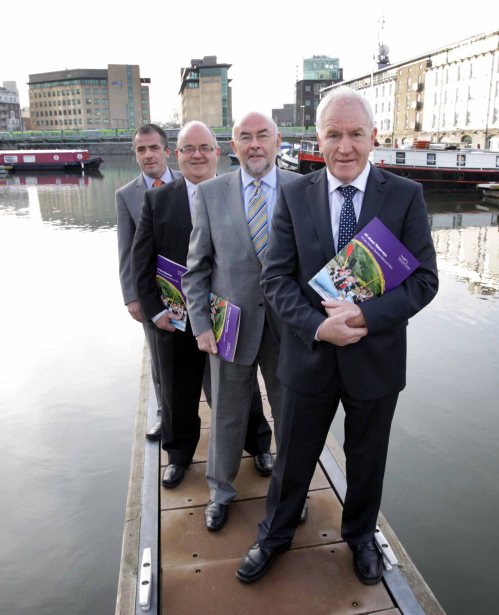
The usual prize of a glass of something or other [and I know the last two prizewinners still have a claim on me] for the best non-libellous caption for this photo, taken today at the launch of WI’s education programme for primary school children. I understand that the materials on WI’s e-learning page are complemented by “an off-line teachers resource pack”, which is what the besuited ones are clutching.

No lifejackets. Photo courtesy of Waterways Ireland, who are not to blame for my decision to use it for a caption competition

Starting at the back, the four chaps are Éanna Rowe, Waterways Ireland’s Marketing Honcho; John Martin, Heid Fector o’ Waterwyes Airlin [as we say in Ulster Scots]*; Ruairi Quinn, Minister for Education and Skills; Jimmy Deenihan, Minister for Arts, Heritage and the Gaeltacht but, on the other hand, a strong personal supporter of the Lartigue Monorail, which is a point in his favour.

Update 4 December 2012: the press release is now on the WI site.

* In its 2008 Annual Report, Waterways Ireland was, in Ulster Scots, Watterweys Airlann on the cover but Watterwyes Irelan in the Foreward bae the Cheif [sic] Executive, who signed himself as Chief [sic] Executive. By 2009, though it was still Watterweys Airlann on the cover, it was Waterwyes Airlan in the Foreward bae the Chief [sic] Executive, who signed himself as Heid Fector, a title I rather like. By 2010, though the cover remained unchanged as Watterweys Airlann, the body was Watterwyes Airlan in the Foreward, but the Heid Fector title had been dropped, alas, and John Martin was Chief Executive in two languages.

But 2008 was not the Heid Fector’s first appearance: in 2007 John Martin signed himself thus, though the foreword was called Twarthy words bae tha heid yin and the body was referred to in the text as Wattherweys [sic] Irelan.

Back in 2006, the foreword was Innin wi tha Heid Fector, and the body was Watterweys Airlann, with an accent, which I can’t reproduce, over the first e. That was the same as in 2005; in both years John Martin signed himself as Heid Fector.

I’m not sure whether I prefer Heid Yin or Heid Fector, but either seems better than Chief or Cheif Executive. But the real problem is the difficulty that this inconsistency causes for us eager students of Ulster Scots. I realise that change is inevitable in a thriving, developing language or dialect, but perhaps the cross-border bodies could give a lead in standardising the vocabulary and spelling.

WI pay 2

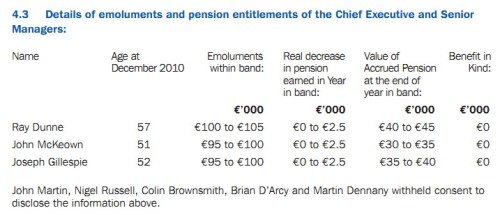
In an earlier posting I provided this extract from WI’s accounts to 31 December 2010:

WI salaries

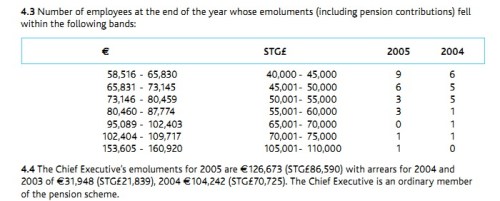
The same message appears in the annual reports for 2009, 2008, 2007 and 2006. However, back in 2005 there was a different message:

WI pay 2005


WI and the tooth fairy

There is a slightly disturbing item in WI’s 2010 accounts [PDF]:

1.5 Deferred Pension Funding

In accordance with accounting practice for  non-commercial State bodies in the Republic of Ireland, Waterways Ireland recognises an asset representing resources to be made available by the UK and Irish Exchequers for the unfunded deferred liability for pensions on the basis of a number of past events. These events include the statutory backing for the superannuation schemes, and the policy and practice in relation to funding public service pensions in both
jurisdictions including the annual estimates  process. While there is no formal agreement and therefore no guarantee regarding these specific amounts with the funding bodies, Waterways Ireland has no evidence that this funding policy will not continue to progressively meet this amount in accordance with current practice. This treatment is inconsistent with  accounting practice for UK Non-Departmental Bodies, where, due to the absence of a formal guarantee, a funding liability is not recognised until the commitment falls due.

IANAA, but an absence of evidence for the non-existence of the tooth fairy would not convince me that it does exist. I suppose it’s the same for any other unfunded pension scheme, and (unlike the UK practice) at least acknowledges the size of the problem, but it’s not exactly reassuring, either to taxpayers or to future pensioners. If I’ve misunderstood it, perhaps some kindly accountant will correct me.