Tag Archives: Banagher

Weather and water levels

Have a look at the water level at Banagher Bridge. As I write at 0823 on 20130322, the latest data is 23 minutes old. The level has been falling for the last five weeks, but are there already signs of an uptick? (Or am I assuming there should be one after last night’s rain?)

Not interested in Banagher? Pick your own spot.

Buying diesel

The Revenue Commissioners’ latest list of holders of marked fuel trader’s licences doesn’t seem to have any new names on it. So, as far as I can see, there are no licensed sellers on the Grand Canal, the Royal Canal, the Barrow, the Shannon–Erne Waterway or that part of the Erne in the republic. There are seven licensed sellers on the Shannon, with none north of Carrick-on-Shannon or south of Portumna. The seven licensed sellers are (north to south):

  • CarrickCraft, Carrick-on-Shannon
  • Emerald Star, Carrick-on-Shannon
  • Rooskey Craft & Tackle, Rooskey Quay
  • Hanley’s Marina, Ballyleague (opposite Lanesborough)
  • Quigley’s Marina, Killinure, Lough Ree
  • CarrickCraft, Banagher
  • Emerald Star, Portumna.

If I’ve left anybody out, please let me know and I’ll correct my error.

Note that the requirement for a licence includes anyone delivering green diesel, or keeping it for delivery, so that purporting not to charge for the diesel makes no difference.

Shannon Leisure Development Co Ltd

No, me neither, but it seems to mean CarrickCraft, which now has Marked Fuel Trader’s Licences for its bases at Banagher and Carrick-on-Shannon, thus swelling the host of the elect.

Where is this?

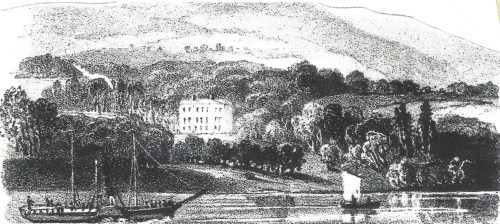
Paul Gauci's 1831 drawing of a Shannon steamer

Paul Gauci’s 1831 drawing of a Shannon steamer

This drawing of a steamer is from an 1831 book called Select Views of Lough Derg and the River Shannon by Paul Gauci. I haven’t seen the book myself, but this illustration is used in a couple of places, including Ruth Delany’s book The Shannon Navigation [The Lilliput Press Ltd, Dublin 2008]. Andrew Bowcock, in his article “Early iron ships on the River Shannon” in The Mariner’s Mirror Vol 92 No 3 August 2006, says of the steamer shown that

The funnel looks to be almost over the paddle shaft, which is artistic license.

But my question is not about the vessel but about the house in the background. If it is drawn without artistic licence, where is it?

It is a very large house, seven bays by three storeys, quite close to the water. Using the Historic 6″ Ordnance Survey map [~1840], I have followed the banks of the Shannon from Shannon Harbour down Lough Derg to Killaloe, then from Limerick down the estuary as far as Tarbert, across the estuary to Doonaha and back up on the Clare side to Limerick, then from Killaloe up the Clare and Galway shores back to Shannon Harbour. Anywhere I found a large house within what seemed the right distance of the shore, I looked it up in the Landed Estates Database and in the National Inventory of Architectural Heritage, with some supplementary googling.

I haven’t been able to find images of all the houses marked on the OSI map, but I found enough to show that houses of the size shown by Gauci were very rare. Within those few, I ruled out some (like Tervoe) because they didn’t seem to match Gauci’s drawing (although alterations could have accounted for that). I ended up with only one house that looked at all like Gauci’s, but the background may not match.

If you can identify the house, I would be glad if you could leave a Comment below.

Dublin’s canals in 1801

Grand Canal

The formation of canals was scarcely known in Ireland until the year 1765, when the Grand Canal was begun by a company of enterprising men, who were incorporated in 1772 by an act of parliament; boats began to ply to Sallins in 1783, to Athy in 1791; it is a cheap and pleasant mode of travelling, at the rate of 3½ miles an hour. This Canal is carrying on to Philipstown, Banagher, and Birr. From the first lock at Kilmainham, a cut has been made to the river Liffey at Rings-end, extending 3 miles, having 12 neat bridges to accommodate the different roads to Dublin. At the seventh lock on this line, the great basons and docks are, 4000 feet long, and 330 feet average breadth, capable of containing 400 sail of square-rigged vessels. On the 23rd of April 1796, it was opened at high tide; when his excellency Earl Camden in the Dorset yacht, commanded by Sir A. Schomberg, with a number of barges from the canal, cutters, and boats highly decorated, were admitted under a discharge of 21 pieces of cannon, and had room to sail in various directions. There were 60,000 people present; it was the best aquatic fête ever seen in this kingdom. John Macartney Esq addressed his Excellency, and was knighted.

Royal Canal

The Royal Canal is another proof of national spirit and national industry. The subscribers were incorporated in 1789; it is now finished beyond Kilcock, 14 miles, and is proceeding rapidly to Kinnegad. On Sunday the 20th of December 1795, the first excursion was made in a barge to Kilcock, with the Duke of Leinster and Marquis of Kildare, amidst the acclamations of the people.

J S Dodd, MD The Traveller’s Director through Ireland; being a topographical description not only of all the roads but of the several cities, towns, villages, parishes, cathedrals, churches, abbeys, castles, rivers, lakes, mountains, harbours, the seats of noblemen and gentlemen on those roads: their antiquities and present state respecting parliamentary representation, patronage, trade, manufactures. commerce, markets, fairs, distances from each other, and natural curiosities; with an account of their foundations, vicissitudes, battles, sieges, and other remarkable events that have occurred at them — insomuch, that this work comprehends in itself, an accurate Irish itinerary, an extensive Irish gazetteer, an Irish chronological remebrancer [sic], and an epitome of the ecclesiastical, civil, military and natural history of Ireland, from the earliest accounts to the present year, and every information necessary for the resident, or the stranger. Embellished with  two elegant maps; one of the roads and post towns in Ireland, the other of the city of Dublin, compiled from the most authentic authorities Dublin 1801

From the hearts of cranes

Several ports on the Shannon Navigation have old cranes (or parts thereof), most of them nicely painted. Their age may not be apparent, but it is possible that they date back to the days of the Shannon Commissioners in the 1840s; at least one of them may be even older than that.

This page shows photographs of those cranes I know of, and discusses their possible ages. But there is much that remains unknown, and readers may be able to cast light on some of the mysteries.

Ireland’s shortest canal?

What may have been Ireland’s shortest canal was at Banagher in Co Offaly; it was used to carry eels to the railway station. Here is a brief account of it.

Some updates

I have added some extra photos to the page on wooden boats. There are new photos of Christine (now given its name) and Cirrus (a nice photo, if I say so myself) and five boats have been added: Beal na Blath, Catherine B and Jemmy X, as well as two unidentified boats. If anyone can name any of the unidentified boats, I would be grateful.

I have also added two retired trip-boats to the page on non-WI working boats: one is on the hard in Banagher and one is Gertie,which ran trips from Keshcarrigan on the Shannon–Erne Waterway but has been tied up in Shannon Harbour for many years.