As a preliminary to increasing coverage of the old Limerick Navigation, I have improved the section’s top-level page. I added maps of the separate sections of the navigation and distances (in eighths of miles) from Prothero and Clark.

As a preliminary to increasing coverage of the old Limerick Navigation, I have improved the section’s top-level page. I added maps of the separate sections of the navigation and distances (in eighths of miles) from Prothero and Clark.
Posted in Ashore, Built heritage, Charles Wye Williams, Economic activities, Engineering and construction, Forgotten navigations, Industrial heritage, Ireland, Non-waterway, Operations, People, Politics, Rail, Restoration and rebuilding, Shannon, Sources, Steamers, The cattle trade, Tourism, Water sports activities, waterways
Tagged boats, bridge, canal, Clare, ESB, Ireland, jetties, Killaloe, Kilrush, Limerick, lock, lost, Lough Derg, O'Briensbridge, Operations, Shannon, turf, vessels, water level, waterways, weir
News reaches us that the fisheries folk, who were threatening to block the Suir (Carrick to Clonmel) navigation with a weir so that they could count fish, have removed the material they had put on site without planning permission. Let joy be unconfined (but let not vigilance be relaxed).
Posted in Ashore, Economic activities, Engineering and construction, Extant waterways, Industrial heritage, Ireland, Irish waterways general, Operations, Politics, Restoration and rebuilding, Suir, The fishing trade, Tourism, waterways
Tagged boats, canoe pass, Carrick-on-Suir, Clonmel, fish, fisheries, flow, Ireland, salmon, Suir, vessels, waterways, weir
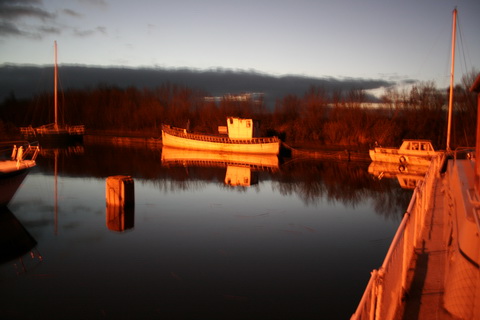
Dromaan at night (December 2011)
Posted in Extant waterways, Ireland, Irish waterways general, Natural heritage, Scenery, Shannon, waterways, Weather
Tagged boats, Clare, Dromaan, Ireland, Lough Derg, night, Shannon, weather
According to Lewis’s Topographical Dictionary (1837),
The principal trade is in wool, for which this is the greatest mart in the county, its central situation and facility of communication with the Shannon and with Dublin having rendered it the commercial centre of a wide extent of country. The City of Dublin Steam Company commenced operations here in 1830: a steamer plies twice a week between this town and Shannon Harbour, where it meets the Limerick steamer and Grand Canal boat for Dublin.
It is interesting that the steamer went west and south (37 miles, 21 locks to the Shannon, then river, lake and river to Shannon Harbour), rather than directly eastward (52 miles, 25 locks) to Dublin, but its route would have enabled it to serve Longford, Tarmonbarry, Lanesborough and Athlone. Lewis, however, does not mention steamer services at any of those places other than Athlone.
More research required ….
Posted in Charles Wye Williams, Economic activities, Engineering and construction, Extant waterways, Industrial heritage, Ireland, Irish inland waterways vessels, Operations, People, Shannon, Sources, Steamers, The cattle trade, Tourism, waterways
Tagged Athlone, boats, canal, Charles Wye Williams, Dublin, Grand Canal, Ireland, Lanesborough, Limerick, Longford, Operations, Royal Canal, Shannon, steamer, Tarmonbarry, tug, vessels, waterways, workboat
Today’s Irish Times remembers the Guinness Liffey barges in the Angling Notes.
The SS John Randolph, described as “America’s first successful iron ship in commerce”, is commemorated by a historical marker in Savannah, Georgia, USA.
The John Randolph was one of the first six iron vessels built by Lairds of Birkenhead (later merged into Cammell Laird). The other five were built for use on the River Shannon.
Posted in Ashore, Built heritage, Charles Wye Williams, Economic activities, Engineering and construction, Extant waterways, Foreign parts, Industrial heritage, Ireland, Irish inland waterways vessels, Irish waterways general, Operations, People, Politics, Restoration and rebuilding, Shannon, shannon estuary, Sources, Steamers, The cattle trade, Tourism, waterways, Waterways management
Tagged Birkenhead, boats, Charles Wye Williams, Clare, Dublin, estuary, Fergus, Garryowen, Georgia, Grand Canal, Ireland, iron, John Randolph, Killaloe, Lady Lansdowne, Laird, Limerick, lock, Lough Derg, Operations, Savannah, Shannon, steam, tug, vessels, waterways
The Limerick Leader has a story that updates my piece on Limerick dredging.
Posted in Built heritage, Economic activities, Engineering and construction, Extant waterways, Ireland, Irish inland waterways vessels, Irish waterways general, Operations, People, Restoration and rebuilding, Shannon, shannon estuary, waterways, Waterways management, Weather
Tagged boats, bridge, Clare, Custom House, ESB, estuary, floods, flow, Ireland, Limerick, lock, Operations, Pat Lysaght, pontoon, quay, Shannon, vessels, water level, waterways, workboat
The Irish Examiner reports on the proposed LNG storage terminal here. Richard Tol provides an informed view here. The objectors’ site is here. I note from the Examiner report that they say:
Shannon LNG is hoping to make millions of euro profits every year with state support at the consumers’ expense at time of increasing fuel poverty.
Unfortunately the report did not say why a wish to make profits is to be deprecated or why it is a bad idea to increase fuel supplies and security “at time of increasing fuel poverty” but perhaps the extensive bogs, whose product was exported through Saleen, are still available.
Posted in Ashore, Built heritage, Economic activities, Engineering and construction, Extant waterways, Industrial heritage, Ireland, Irish waterways general, Natural heritage, Operations, People, Politics, Restoration and rebuilding, Scenery, Shannon, shannon estuary, The turf trade, waterways, Waterways management
Tagged Ballylongford, boats, estuary, Ireland, irisheconomy, Kerry, LNG, Operations, Rabbitte, Richard Tol, Saleen, Shannon, Tarbert, turf, vessels, waterways
I wrote here about the method that the Revenue Commissioners employed to implement new rules on the rate of duty to be paid on diesel used for private pleasure navigation.
For reasons best known to themselves, Irish governments allow farmers to use cheap (“rebated”) diesel in their tractors, on the grounds that the tractors are for off-road use. And for many years boat-owners with diesel engines were allowed to use the same cheap diesel. The same arrangement applied in the UK and in Belgium. The diesel (“marked gas oil”) was coloured, latterly red in the UK and green in Ireland.
The EU decided some time ago that the rules should be standardised throughout Europe and that boats used for private pleasure navigation should not be allowed to use the subsidised fuel. The UK and Ireland sought and received successive derogations allowing them to delay the introduction, allegedly so that they could make appropriate arrangements. The governments did nothing about it. Accordingly, when the European Commission got fed up and told them there would be no more derogations, they had no plans ready and were faced by well-organised gangs of well-to-do boat-owners anxious to continue enjoying their subsidy.
The Irish authorities decided that boat-owners could continue to buy the marked gas oil, at the rebated rate, but that they would have to make a return to the Revenue Commissioners at the end of each year, showing how much diesel they had bought and how much Mineral Oil Tax they were paying to make up the difference. The December 2011 version of the document and forms is here (PDF). Mineral Oil Tax is intended to cover “the difference between the auto diesel and marked gas oil rates at the time of purchase of the oil”.
I asked the Revenue Commissioners how much they had taken in from boat-owners in 2009 and 2010. They said that they got €169,895.51 in 2009 and €140,929.12 in 2010.
For most of 2010, the rate of Mineral Oil Tax was €449.18 per 1,000 litres (it was slightly higher from 8 to 31 December 2010, a period when there would have been little pleasure-boating). That means that duty was paid on 313,748 litres of diesel.
So how effective is this system? On what proportion of sales for private pleasure navigation is the tax being collected? Revenue has no idea and has no way of getting any idea because
Mineral Oil Tax on marked gas oil (MGO) is collected at the point of release for consumption from tax warehouse or upon importation to the State and, for the vast bulk of MGO, no information is available at that stage as to the ultimate destination or use of the oil, as most of it goes through a distribution network before it reaches the final consumer.
So let’s see if we can help to provide a rough estimate. According to the RNLI
A diesel engine burns about 1 gallon per hour for every 20hp. So a 90hp diesel would use about 90/20 = 4.5 gallons of fuel per hour. For those who prefer to work in litres then simply multiply the horsepower by 2 and then divide by 9. So a 90hp has an estimated consumption of 2 x 90/9 = 20l/hour.
Let us suppose, for the sake of argument, that the average pleasure craft has a 40hp diesel engine (which is what my 1960s cruiser had). That would use two gallons or nine litres per hour. So the 313,748 litres of diesel on which Mineral Oil tax was paid would have kept one cruiser going for 34,861 hours.
On the other hand, if there are 10,000 pleasure craft in Ireland, with diesel engines averaging 40hp, then they are claiming to have cruised for an average of three and a half hours each in the whole of the year 2010.
I suspect therefore that there is significant underpayment of the Mineral Oil tax and I suggest that the system should be abolished: boat-owners should pay the full (auto diesel) price.
Under the Local Government (Household Charge) Bill 2011, published today, a residential property must be a building, and both vessels and vehicles are excluded by the definition of a building. So folk living on boats won’t have to pay the charge.


 Irish waterways history