Tag Archives: Clones

NSMC

The joint communiqué from last week’s North/South Ministerial Council Inland Waterways meeting is now available here. There was an exciting bit:

SECTORAL PRIORITIES

2. Ministers had a discussion on various priorities within their remit and noted that these will be contained in a report to be considered at a future NSMC Institutional meeting as part of the ongoing review into sectoral priorities.

Hmm … what’s cooking there? I do wonder why the NSMC bothers publishing content-free stuff like this. We may have to ask the US NSA to bug the meetings. Oh, hang on ….

Here’s a good bit, though:

PRESENTATION BY WATERWAYS IRELAND

3. Waterways Ireland delivered a presentation to Ministers entitled “Ireland’s Inland Waterways – Building a Tourism Destination”. The presentation provided an overview of the progress being made by Waterways Ireland in placing the waterways and the waterway experience at the centre of the tourism offering both in Ireland and internationally.

Now that is useful and important work. But, as I have pointed out elsewhere [including to Waterways Ireland], the WI draft Corporate Plan 2014–2016 said nothing about tourism. Some years ago, I thought that it was a mistake to have a Marketing & Communications Strategy and a Lakelands tourism initiative that seemed to exist outside the corporate planning process; I am still of the same mind.

I have asked Waterways Ireland for a copy of the presentation, and for a copy of the Strategic Development Plan for the Grand Canal Dock, Spencer Dock and Plot 8 that was mentioned in WI’s progress report. That report also covered:

  • continuing maintenance
  • public consultation on canal bye-laws
  • a Built Heritage Study and a GIS-based navigation guide for the Lower Bann
  • an environmental award for  work in restoring, protecting and promoting the heritage assets that are Spencer Dock and Grand Canal Dock
  • towpath development and work on the cycleway from Ashtown to Castleknock on the Royal
  • donating two barges for “recreational and community use”
  • “partnerships to utilise three unused navigation property for community and recreational use”, which I don’t know anything about.

The important part was this:

BUSINESS PLAN AND BUDGETS 2013 AND 2014 AND CORPORATE PLAN 2014-2016

5. Ministers noted the position with the 2013 Business Plan and budget. They also noted that Waterways Ireland has undertaken a public consultation on the draft Corporate Plan 2014-2016, the preparation of a draft 2014 Business Plan by Waterways Ireland and that the plans will be reviewed after the public consultation is analysed. They also noted that Sponsor Departments will continue to work together with Waterways Ireland to finalise the Business Plans and Budgets for 2014 and the Corporate Plans for 2014-2016 that will be brought forward for approval at a future NSMC meeting.

I read that as showing that the north-south deadlock continues. The 2012 accounts have still not been published and the plans for 2014 won’t be approved until (at the earliest) three quarters of the way through the year.

The NSMC heard something about the Clones Sheugh but has decided not to tell the citizenry anything about it. It agreed to some property disposals and decided to meet again in October. But there was one odd item:

SPECIAL EU PROGRAMMES BODY BUSINESS PLAN AND BUDGET 2014 AND CORPORATE PLAN 2014-16

8. Ministers approved the Special EU Programmes Body Business Plan and Budget 2014 and Corporate Plan 2014-16.

The oddity is that the SEUPB is a separate body and usually gets its own meeting and communiqué. The last six meetings (before this one) have been attended by NI folk from Finance & Personnel and RoI folk from Public Expenditure & Reform (or, before that, Finance).

So who let spending ministers into the sweetshop? And why? Suspicious-minded folk might think that there is a plan to  nick a lot of Euroloot for the Clones Sheugh to get the Irish government off the hook persuade the Europeans of the benefits of investing in the reconstruction of a small portion of the Ulster Canal. We note that, on the previous day, Jimmy Deenihan gave a longer than usual reply to the standard question about the Sheugh, including this:

The Inter-Agency Group has met four times, last meeting on 9 December 2013. The Group continues to examine leveraged funding opportunities for the project. This includes the exploration of EU funding which may be potentially available in the next round of structural funds covering the period 2014–2020.

I have a better idea. Vladimir? There are oppressed Russians in Clones ….


A sheugh would solve it …

… not.

If you’re feeling the need of something to depress you, troll on over to the website of the Northern Ireland Community Relations Council and download the six PDF sections of the third Peace Monitoring Report. Written by Dr Paul Nolan, it is an extremely impressive piece of work — and a welcome counter to the witterings of the peaceprocess feelgoodistas who are so prominent on 2RN these days.

If you would prefer a summary, here is Liam Clarke’s account in the Belfast Telegraph, and here is his commentary; Tomboktu and others pointed to some problems with the headline on the first piece, but I’m more concerned that the focus on education in the headline on Clarke’s account may distort perceptions of what the report and, indeed, the rest of Clarke’s article are really about.

The report uses indicators grouped into four domains:

  • the sense of safety
  • equality
  • cohesion and sharing
  • political progress.

I didn’t find much that was cheering in any of them. Nolan lists ten key points:

  1. The moral basis of the 1998 peace accord has evaporated
  2. The absence of trust has resulted in an absence of progress
  3. There has been some increase in polarisation
  4. A culture war is being talked into existence
  5. The City of Culture year presented a different understanding of culture
  6. Failure lies in wait for young working-class Protestant males
  7. Front line police have been the human shock absorbers for failures elsewhere
  8. The rebalancing of inequalities unbalances unionism
  9. At grassroots level the reconciliation impulse remains strong
  10. No one picks up the tab.

Only the fifth and ninth offer any good news. But, from a waterways perspective, I was struck by the complete irrelevance of the proposed reconstruction of the Ulster Canal, the Clones Sheugh, to solving any of these problems. Yet Waterways Ireland, around whose neck this dead albatross has been hung, is the largest of the cross-border bodies and the sheugh is the largest capital project proposed to be undertaken by any of them. If the Irish government wants to do something to solve the real and continuing problems of Northern Ireland, as outlined in the Peace Monitoring Report, couldn’t it find something more useful to do?

Incidentally, I have not been able to find coverage of the report on the websites of the Irish Times, Irish Independent or Irish Examiner, although that may reflect poor searching on my part rather than any lack of interest on theirs.

Shannon traffic 2013

Some weeks ago Waterways Ireland kindly supplied me with the Shannon traffic figures for the final three months of 2013 and I have just now had a chance to add them to my spreadsheets and produce some graphs.

The usual caveats apply: the underlying figures do not record total waterways usage (even for the Shannon) as, for instance, sailing, fishing or waterskiing on lakes or river stretches, which did not involve a passage through a lock or Portumna Bridge, would not be recorded. The passage records are our only consistent long-term indicator of usage of the Shannon but they would not show, for instance, a change in the balance of types of activities from those in larger cruising boats to those in smaller (sailing, fishing, waterskiing) boats. On the other hand, they do include the Shannon’s most significant tourism activity, the cruiser hire business.

It is good to note, incidentally, that, in its draft Corporate Plan 2014–2016, Waterways Ireland says that it intends to

Develop and implement a research programme to measure waterway usage and inform planning and development.

It won’t be easy to do, but we need much better measures of all types of activities on all seven of the waterways managed by WI.

The final outcome for 2013 won’t greatly surprise anyone who has read earlier bulletins on this subject, like this covering the figures to end-September 2013. All the illustrations are based on information supplied by Waterways Ireland, with some minor adjustments by me to eliminate anomalies, but the interpretation and comments are mine own.

All boats full year

Total Shannon traffic 2003–2013, private and hired

The decline in traffic since 2003 seems to have been halted …

All boats full year %

Total Shannon traffic as a percentage of 2003 traffic

… but it is 40% below what it was in 2003.

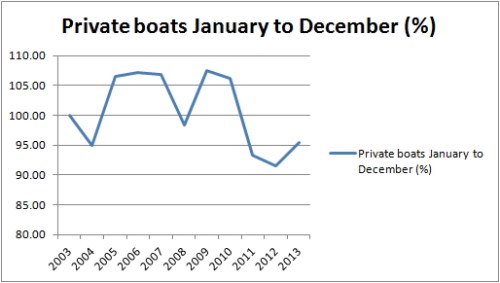
Private boats full year %

Private-boat traffic 2003–2013 as a percentage of 2003 traffic

Traffic in private boats seems to be recovering, but what is perhaps more significant is that it never went more than 10% above or below the 2003 figure. It has been remarkably stable over the period, despite the economic crash and despite the anecdotal evidence of boats being sold to overseas owners and trucked out of the country. Perhaps larger boats were replaced by smaller? Perhaps only boats bought in the boom were sold in the bust? Unfortunately the deficiencies of the registration system make it very difficult to determine what has been happening.

Hire boats full year %

Hire-boat traffic 2003–2013 as a percentage of 2003 traffic

But if private-boat traffic has been remarkably stable since 2003, the same cannot be said of hire-boat traffic. The best that can be said of 2013 is that the figures didn’t get [much] worse, but a 60% decline since 2003 is really, really dreadful.

WI’s draft Corporate Plan, which does not explicitly mention the hire industry, talks of

… unlocking opportunities to achieve recreational growth, and economic and social development.

I don’t know whether that omission means that WI sees little prospect of a rejuvenated hire-boat industry. And I note that, other than in the titles of organisations, the draft plan rarely mentions tourism or tourists. Are the waterways only for natives? If so, is that a deliberate policy decision? Or is there something that could be done, cheaply, to help to revive waterways tourism?

Emma Kennedy, writing in the Sunday Business Post on 23 February 2014, wrote about Fáilte Ireland’s latest brainwave, which is to “target” three groups:

  • social energisers, which are gangs of young people interested in “new and vibrant destinations”, which I take to mean Temple Bar
  • culturally curious folk aged 50 or over, with money, who are interested in “exploring new landscapes, history and culture”
  • great escapers, who like energetic rural holidays with their partners.

No families with kids, I see, although “Families & Loved Ones” (the latter term, by the way, nowadays seems to mean either dead people or their relicts) were one of the two “primary target customer segments” identified in Fáilte Ireland’s Inland Cruising Market Development Strategy. (Fat lot of good that strategy did, but we mustn’t be bitter.)

Anyway, without having done any market studies (though WI has funded lots of them), it seems to me that there is scope for more tourism on the waterways, but it might not be on traditional cruisers. It might involve outdoor activities like cycling and walking along the canals and Barrow: WI’s plan discusses them, but without adverting to an overseas market. And it might involve small-boat activities — canoeing, touring rowing, small-boat sailing, camping — on Shannon, Erne and SEW: WI says it will support micro-enterprises, and those providing outdoor activity holidays may need expertise and assistance rather than hard cash.

I admit to having little evidence on this, but it seems to me to be too early to give up on the tourism potential of the waterways. And the decline of the cruiser hire business does not necessarily mean that all waterway tourism is doomed.

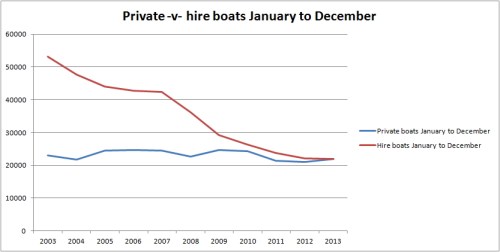
Private -v- hire full year

Private boats overtake hire boats

That said, 2013 was the year when, for the first time since Noah was an Able Seaman, the number of passages by private boats exceeded that by hire boats.

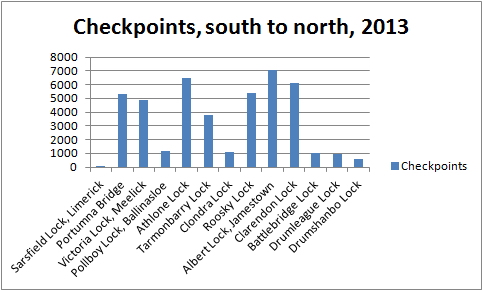
Checkpoints 2013

The points at which numbers were recorded

Finally, this chart suggests that any structures that were not built by the Shannon Commissioners in the 1840s will not attract many visitors. The extensions off the main stem of the Shannon — south to Limerick, west to Ballinasloe, east through Clondra, north to Lough Allen — are much less used than the main line from Lough Derg to Lough Key. It seems unlikely that any further extensions, especially to small towns that it would take three hours (at canal speed) to get to, are likely to be any more successful in attracting traffic.

Snails

Snails may save us from restoring the Longford Branch of the Royal. Industrialheritageireland has the story.

Might be an idea to start breeding these snails for judicious use elsewhere.

Shinners losing patience over sheugh

Caoimhghín Ó Caoláin [SF, Cavan-Monaghan] in the Dáil on 5 February 2014:

There is no excuse for either the British or the Irish Governments to stand over any delay in advancing with key cross-Border infrastructural projects such as the Carlingford Narrow Water bridge and the Ulster Canal. With regard to the Ulster Canal, I have been in touch with the office of the Northern Ireland Minister for Culture, Arts and Leisure, Carál Ní Chuilín MLA, my party colleague. She assures me that both she and her counterpart here, the Minister for Arts, Heritage and the Gaeltacht, Deputy Jimmy Deenihan, are fully committed to this project, and I welcome that affirmation. As I pointed out in the debate on the Six Counties last year, the North-South Ministerial Council agreed to proceed with the Ulster Canal project in 2007. In the intervening period, we have seen the economic collapse in this State and a parallel contraction in the North. Despite this, the Ulster Canal project was kept alive.

Permission was granted last year for the Northern section by Environment Minister, Alex Atwood, and by Clones Town Council and Monaghan County Council for the section in this jurisdiction.

The Minister for Arts, Heritage and the Gaeltacht, Deputy Jimmy Deenihan, has advised that the earliest the contract could be awarded would be late 2014 with a completion date in spring 2017. I urge the Minister to do all in his power to expedite this process and to encourage his colleagues to do so. I also urge him to maximise the possible EU funding for the project from the Peace IV programme.

The Ulster Canal project is about greatly enhancing one of the finest landscapes in Ireland for locals and tourists alike, regenerating rural areas that have long been neglected and delivering a tangible peace dividend to Border communities that were neglected for far too long. It is time to get the work on the ground under way.

Yes …. Sinn Féin’s faith in the economic potential of canals is touching, if slightly worrying for anyone who believes that the world economy has changed since the late eighteenth century.

But wait: as far as I can see, SF is one of the few groups that has not asked Jimmy Deenihan about Waterways Ireland’s proposed new byelaws, which might force boaters to pay slightly more of the cost of their hobby. Perhaps SF is secretly hoping that user charges on the Clones Sheugh will be high enough to pay at least the interest on the construction cost? That would be nice.


Matters of minor importance

Some recent(ish) discussions amongst the People’s Representatives. I haven’t time to analyse them all. All links courtesy of the estimable KildareStreeet.com.

Brendan Smith [FF, Cavan-Monaghan] wants a sheugh in Clones; he got the usual answer. And he allowed Jimmy Deenihan [FG, Kerry North/West Limerick] to announce, on 19 December 2013, the death of the suggested extension of the Erne navigation to Lough Oughter [loud cheers]:

Brendan Smith: To ask the Minister for Arts, Heritage and the Gaeltacht if he has received the feasibility study on the proposed extension of the Erne navigation from Belturbet to Killeshandra and Killykeen; and if he will make a statement on the matter.

Jimmy Deenihan: I am informed by Waterways Ireland that it commissioned a Strategic Environment Assessment for the possible extension of the Erne Navigation from Belturbet to Killeshandra and Killykeen.

On reviewing the environmental information from this process, Waterways Ireland considers that the environmental designations of this lake complex make the feasibility of the proposed navigation extension highly unviable. For that reason, I am advised that Waterways Ireland does not propose to pursue this project any further at this time.

Well, that’s one minor victory for sanity. Here’s how a dredger got to Lough Oughter in 1857.

Maureen O’Sullivan is anxious to recreate the economy of the eighteenth and nineteenth centuries by using canals for carrying cargoes. Especially on the Shannon–Erne Waterway, where commercial carrying was so successful before. [What is it about the Irish left?] Thank goodness that the sainted Leo Varadkar gave not an inch: someone should make that man Taoiseach, President and Minister for Finance. And Supreme Ruler of The Universe and Space.

The web-footed inhabitants of the midlands, who have discovered that they live in a flat area with rivers, keep wittering on about Shannon flooding, failing to realise that it is a message from The Lord, telling them to either (a) move to higher ground, eg Dublin, or build arks. On 15 January 2014 Brian Hayes told Denis Naughten, inter alia, that info from the recent OPW/CFRAM monitoring of water levels on Lough Ree (which I think was when the levels were lowered) would be placed on the OPW website “in the coming days”; I haven’t been able to find it yet so I’ve emailed the OPW to ask about it. And on 21 January one James Bannon said that he intends to introduce a bill setting up a Shannon authority, which will have magical powers. Well, if it doesn’t have magical powers it won’t be able to stop the Shannon flooding, but perhaps it’s designed to allow the unemployed landowners of Ireland another forum in which to demand taxpayers’ money to prop up their uneconomic activities.

Finally, a senator called John Whelan wants a longer consultation period on the proposed amendments to the canals bye-laws. I suppose I’d better read them  myself.

Saving the nation part 97

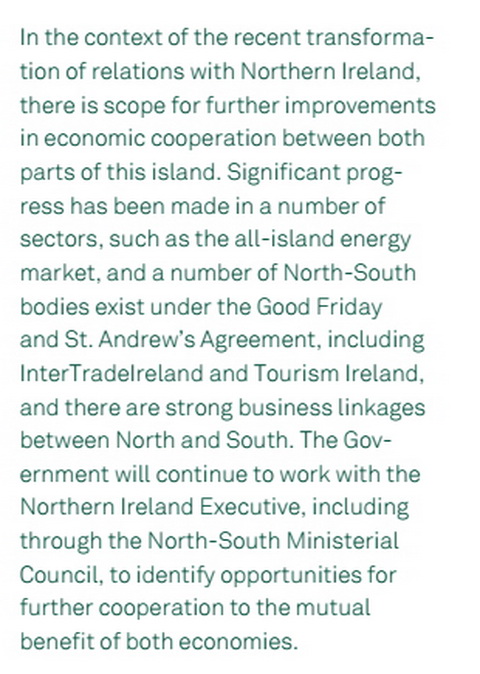
Clip_resizeThat’s from the government’s Medium Term Economic Strategy 2010 [PDF]. Not a word about the Clones Sheugh, which would undoubtedly save the economies of both jurisdictions on this island, but perhaps it will qualify for one of the new models of infrastructure funding mentioned hither and yon in the document.

Maybe the Sunbeds Bill would be more interesting – or more important.

PS Folk who write “between both” should be flogged naked through the streets before being hanged in the marketplace.

Our Glorious Leader …

is to address, on Sunday night, anyone who watches television but doesn’t have a choice of television channels. There will be a medium term economic strategy too, promising a new and better future for all our people. But as Finfacts says:

… past experience coupled with signals so far, suggest that [the strategy] will be a promotional brochure for an international audience with some questionable claims and omissions. The expected plunge in services exports by as much as €50bn during the time horizon is not likely to be acknowledged.

There is an urgent need for a credible growth strategy that has an unvarnished assessment of the challenges with an honest analysis of strengths, weaknesses, opportunities and threats, using data that is free of the outsize impact of the foreign-owned exporting sector.

I wonder whether the strategy will include any sheughs.

Sheughery

I wonder why Sinn Féin asks questions when it does. This one [h/t KildareStreet.com] seems to have been asked at a time that the minister might have welcomed.

Sandra McLellan [SF, Cork East]:

To ask the Minister for Arts, Heritage and the Gaeltacht the position regarding the Ulster Canal restoration project; the steps that must be taken to complete the project; the indicative timeline for the completion of the project; and if he will make a statement on the matter.

Jimmy Deenihan [FG, Kerry North/West Limerick] [the third para is the interesting one]:

As the Deputy will be aware, in July 2007 the North/South Ministerial Council (NSMC) agreed to proceed with the restoration of the section of the Ulster Canal between Clones and Upper Lough Erne. The then Government agreed to cover the full capital costs of the project, which were estimated at that time to be of the order of €35m.

It was always the intention that the Ulster Canal project would be funded from the Waterways Ireland annual allocations, as agreed through the annual estimates processes in this jurisdiction, as well as the deliberations of NSMC in relation to annual budgets. It was a key consideration throughout the process that the Ulster Canal project would be supported by a significant level of projected income from the commercialisation of certain Waterways Ireland assets. However, the economic downturn has had a negative impact on those plans.

I am continuing to explore all possible options to advance this project within the current fiscal constraints. In this regard, I established an Inter-Agency Group on the Ulster Canal to explore ways to advance the project and to examine possible funding options for it, including existing funding streams and the leveraging of funding from other sources. The Inter-Agency Group last met on 9th October and will meet again next week, on 9th December.

In the meantime, the Ulster Canal project is progressing on an incremental basis. Planning approvals have now been received for the project in both jurisdictions. Compulsory Purchase Order land maps are in preparation and consideration is being given to how the construction work and other technical aspects of the project will be structured once the necessary lands have been secured. The timeline for completion of the project will be determined when these preparatory steps have been completed.

I welcome these developments, which, I am sure the Deputy will agree, are a significant milestone for the project.

Hmm. The inter-agency group first met on 20 September 2012 and its second meeting was to take place in May 2013 or thereabouts. Now it’s going much faster, with meetings on 9 October and today, 9 December. Does this suggest that the group has found a pot of gold? Is there any link to the cancellation of SEUPB funding for the Narrow Water project?

And what has been going on in (and around) the North/South Ministerial Council? At its June 2013 meeting the Council approved or noted:

  • the business plan for 2012 (which had ended six months earlier)
  • the budget for 2012
  • the annual report for 2012
  • the draft accounts for 2012.

That suggests to me that there was either a major disagreement between the northern and southern ministers or a serious problem that rendered ministers unable to approve the WI budget and business plan until 18 months after the documents were required. Could it be that the northern minister, Carál Ní Chuilín [SF], like other NI politicians, had been looking for something from the waterways sector that hasn’t been delivered so far?

Note also that Jimmy Deenihan said

[…] consideration is being given to how the construction work and other technical aspects of the project will be structured once the necessary lands have been secured.

I understand that the design and construction of the Clones Sheugh was to be put out to tender but I wonder whether keeping the work in house might help WI to meet its increasing wage costs with a declining budget.


Waterways budgets: cut by one third in six years

I wrote here and here about the RoI budgetary allocations to Waterways Ireland for 2014, here about the difficulty of establishing exactly what WI’s budget is and here about some questions I have put to the Department of Arts, Heritage and the Gaeltacht on the matter.

But, while a focus on the procedural woods is important, I may have been neglecting the implicational trees. I am recalled to a consideration of the details by two written Dáil questions asked by Gerry Adams [SF, Louth] on 19 November 2013, one of Brendan Howlin, Minister for Public Expenditure and Reform, and the other of Jimmy Deenihan, Minister for Arts, Heritage and the Gaeltacht. Reading the runes is reminiscent of Kremlinology, but it seems to be possible that Waterways Ireland will have to make significant cuts in its spending, cuts that will reduce the services it provides to waterways users.

The questions and the answers

This is what Gerry Adams asked Brendan Howlin:

To ask the Minister for Public Expenditure and Reform the total budget for each All Ireland Body established under the Good Friday Agreement for the years 2010 to date in 2013; and any proposed budget reductions to the these bodies currently being considered.

And this is what he asked Jimmy Deenihan:

To ask the Minister for Arts, Heritage and the Gaeltacht the total budget for each of Waterways Ireland, Fóras na Gaeilge and Ulster-Scots Agency for the years 2010 to date in 2013; and any proposed budget reductions to these bodies currently being considered.

Ignoring the details given for bodies other than Waterways Ireland, we learn that its allocations from its two “sponsor departments”, DCAL in NI and DAHG in RoI, were:

2010 €38.99 million
2011 €35.18 million
2012 €31.15 million

These figures appear to include capital and current expenditure.

For some reason,

The 2013 Budget allocation to the Body are subject to on-going discussion by the two Sponsor Departments.

But Jimmy Deenihan said

My Department’s REV provision for Waterways Ireland for 2013 is €25.463m, a 6% efficiency saving on 2012. My Department’s Estimates provision for 2014 is €24.183m, a 5% efficiency saving on 2013.

The extent of the cuts

I don’t know how to get from a REV provision, or indeed an Estimates provision, to WI’s total budget for 2013 or 2014. One possibility is that the figures include capital and current expenditure. In that case, the RoI contribution to WI’s 2013 budget would be €21.383 million current and €4.080 million capital [PDF; see p160]; adding the NI 15% contribution to current would bring that to about €25.156 million; the €4.080 million capital makes €29.236 million. Perhaps there might be a small amount extra for NI capital spending. By the same logic [and I repeat that I don’t know whether this is the way to do it], the 2014 Estimates provision gives €27.752 million plus NI’s capital spending. Without NI capital spending, the total is 71% of the 2010 figure, so WI will have had its total spending cut by 29% in four years.

Another crude calculation is that the 2012 figure of €31.15 million is 80% of the 2010 figure. Knock off Jimmy Deenihan’s 6% in 2013 and 5% in 2014; the 2014 total comes out again at 71% of the 2010 figure.

But that’s not all. Brendan Howlin said:

In common with other public sector bodies North and South, the North South Implementation Bodies are expected to deliver their objectives in a cost effective and efficient manner. In order to provide a framework for this, my Department and the Department of Finance and Personnel, have issued guidance to the North South Implementation Bodies requiring them to achieve a minimum of 4% efficiency savings per annum in 2014, 2015 and 2016.

So we have to cut another 4% in 2015 and 4% in 2016, by which stage the total will be just under 66% of the 2010 figure: a cut of one third in six years.

Coping

The brunt of the cuts has been borne by the capital budget; we have no figures for expected NI capital spending from 2013 onwards, but on the RoI figures capital spending by 2016 will have been cut by 70%. That seems to have been the general pattern in the Irish public service: cut capital spending first, cut staff costs last.

WI’s operating income is negligible: in 2011 it was €71,000 from licences, €120 from property and €193,000 from permits, lock charges etc, as well as a few other bits and pieces; it is almost entirely reliant on its sponsor departments. So if it is to cope with reduced departmental income, it must either devise new and significant earning opportunities quickly or make serious cuts to its services.

WI’s spending is categorised under five headings, one of which (currency gains or losses and interest) involves a tiny amount. The other four are depreciation, which can’t readily be cut, staff costs, “programme costs” and “other operating costs”.

The “other operating costs” are:

Travel
Recruitment costs
Training and conferences
Contracted in services
Compensation/provision for liability claims
Premises running costs including utilities
Health and safety
Communications
Other operating lease rental
Printing and stationery
Computer running costs
Rent
Audit fee
Marketing and promotions
Insurance and legal fees
Pension administrator costs
General expenditure.

The 2011 total was €5,026,000. None of the individual items looks as if it could provide huge savings, although I imagine each category is being shaved.

The programme costs are allocated to individual waterways; in 2011 (the latest available accounts) the total was €8,082,000, and 63% of those were incurred on the Grand, Royal and Barrow. The Royal’s programme costs were up in 2011, with the reopening, but the Grand’s were cut by 25% and the Barrow’s by 17%. You can’t keep cutting at that sort of rate every year, but I suspect that the Grand, Royal and Barrow will continue to be cut more than the Shannon, Erne and SEW (the Lower Bann cost is tiny).

WI’s main cost is staff: €21,903,000 in 2011, up very slightly on the previous year. I don’t know what cuts have been made in hours or rates (I have heard that there is an overtime ban) but I suspect we haven’t seen the last of them.

At this stage, I imagine that the easy cuts have been made; further cuts may require some combination of

  • reductions in services to users
  • major changes in work practices
  • cuts in staff costs.

There are interesting times ahead.

One small pointer

I noted that, when Jimmy Deenihan spoke in the Dáil on 16 October 2013, he said that WI’s “core activities and targets” included

… keeping the waterways open for navigation during the main boating season.

The last five words [emphasis mine] may be significant: Mr Deenihan may have been hinting that boating is no longer to be regarded as a year-round activity.