Tag Archives: department of arts heritage and the gaeltacht

The (re)invention of heritage

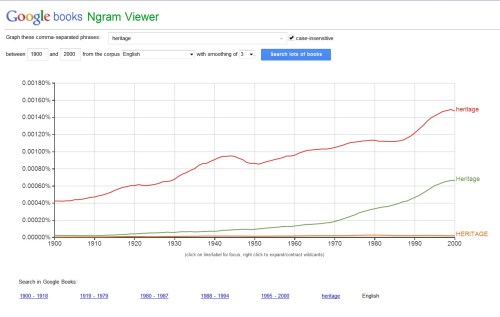
From Google’s Ngram viewer (more here):

ngram[Sorry, Google: couldn’t get the embedding to work properly. WordPress’s whitelist omits Google, though maps seem to work OK. Here’s the original.]

The growth in the use of “Heritage” with an initial capital is particularly interesting. I can think of three possible reasons:

  • that more organisations, eg The Heritage Council, use the word in their titles
  • that the word is increasingly used as an abstract noun at the start of sentences like “Heritage is important”
  • that the word is increasingly used as an attributive adjective at the start of sentences like “Heritage apples should be preserved”.

Traditional, personal uses (like “My heritage from my ancestors …”) are, I think, less likely to require initial capital letters. That in turn might suggest that Google’s Ngram viewer is reflecting a new(ish) set of meanings for the word and might lead us to ask what that new(ish) usage is (or was) intended to achieve.

It might also lead us to ask whether an even newer concept might now be more useful: one that would dissuade well-meaning folk from preserving and displaying context-free old tat and persuade them to find and record information instead.

Heritage nonsense and the Naomh Éanna

There was a Dáil debate last week about the scrapping of the Naomh Éanna; nobody gave any good reason for keeping the vessel. Preservation proponents decided not to ask for money: instead they wanted the thing left hanging around while they worked out an “investment plan“, something that they could have done at any time over the last twenty-five years.

The funniest part was the final paragraph of the third contribution by Éamon Ó Cuív [FF, Galway West], who said:

Agus muid ag caint faoi stair, is fiú a lua gur úsáid RTÉ an bád seo le haghaidh scannán an-mhaith a rinne siad, “The Treaty”. Nuair a bhí Collins ag dul go Sasana sa scannán, is ar an mbád seo, seachas bád amuigh i nDún Laoghaire, a bhí sé. Tá ceangal stairiúil le hócáidí thar a bheith stairiúil ag an mbád sin. Níl ag teastáil ach cúpla mí ionas go mbeadh deis ag daoine rud éigin a eagrú. Beidh beagáinín slándáil i gceist. B’fhéidir go mbeidh costas beag ar Uiscebhealaí Éireann. Ní dóigh liom go mbeidh sé suntasach i gcomhthéacs an maitheas a d’fhéadfadh sé seo a dhéanamh dá gcoinneofaí an bád. Má táimid ag lord eiseamláir don rud a bhféadfadh a bheith i gcest, níl le déanamh againn ach cuairt a thabhairt ar Faing agus dul isteach ar an flying boat ansin.

Learned readers will recognise that Google Translate’s version needs improvement:

And we are talking about history, it is worth mentioning that RTÉ use the boat for a very good film they made, “The Treaty “. When Collins was going to England in the film, most of the boats, except boat out in Dun Laoghaire, it was. There are historical connections with historical events particularly at this boat. All you need is a few months so that people have the opportunity to organize something. The security bit concerned. There may be a small cost of Waterways Ireland. I do not think it will be significant in the context of the good it could do this if the boat is kept. If we lord model for what could be gcest, we do not just visit Foynes and go flying into the boat then.

So the Naomh Éanna is valuable because it was used as a film set. And Foynes flying-boat museum shows what could be done.
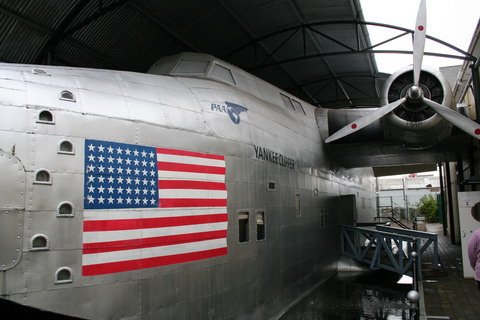
Foynes flying-boat

Foynes flying-boat

Up to a point, Lord Copper. You see — and I know this may come as a shock — the flying-boat on display at Foynes is not actually a real flying-boat. It’s not even a portion of a real flying-boat. It’s a reproduction of a portion of a flying-boat and it was built by a film-set designer.

If anyone really needs to be able to see around a small mid-twentieth-century ship, I suspect that the Foynes folk could provide a replica that would cost less to keep than the real thing.

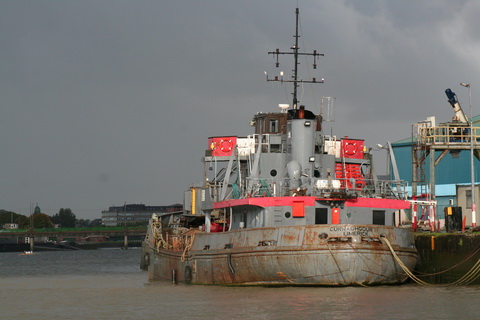
Alternatively, if Dublin needs another example of a locally built vessel, and one different in form from the Cill Áirne, it could take over the Curraghgour II or the Coill an Eo, both also built in Dublin. Maybe the preservationists should start now on their investment planning.
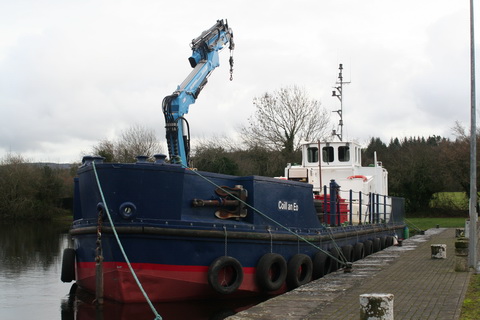
Coill an Eo
Coill an Eo

Limerick Port old dredger Curraghgour II 6_resize

Curraghgour II

An investment plan for the Naomh Éanna?

In a debate about the Naomh Éanna in the Dáil on 13 February 2014, Joan Collins TD [People Before Profit Alliance, Dublin South Central] said:

I understand the National Asset Management Agency and the Irish Ship & Barge Fabrication Company have expressed an interest in stepping in with an investment plan to restore her to her former beauty.

I see nothing about the ship on NAMA’s website, so I cannot provide any information about its views.

According to the most recent modified accounts for the Irish Ship and Barge Fabrication Company Ltd, on file at the Companies Registration Office, its total assets at 28 February 2013 were €286 in cash.

The company had no fixed assets.

Its called-up share capital was shown as €100000 and the balance on its profit & loss account was -€99714.

According to its Annual Return (B1), made up to 30 November 2013, its authorised share capital was €200000, made up of 100000 €1.00 ordinary shares and 100000 €1.00 Non Cum Red Pref shares. Only 100 of the ordinary shares were issued: 1 was owned by Saul Casey and 99 were owned by Sam Field-Corbett. All 100000 Non Cum Red Pref shares were issued and were held by Printation Limited.


Canal tourists or canal pensioners?

The Village at Lyons 265_resize

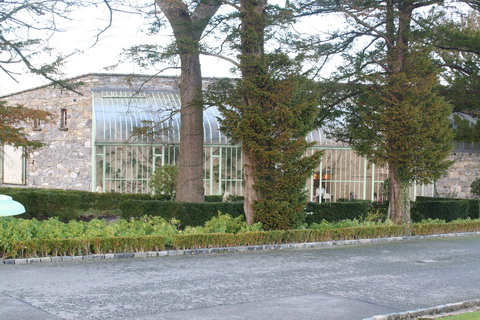
La Serre

Nibbling yesterday on a morsel of cured salmon, with fennel and apple salad, lemon crème fraiche and lavender jelly, at the excellent La Serre restaurant at the Village at Lyons, I looked forward to walking outside afterwards, on to the canal bank, to view the many boats that would undoubtedly be moored there, above the thirteenth lock, as their owners lunched at La Serre’s sister institution, the Canal Café.

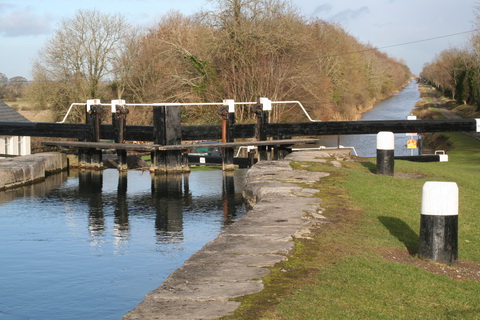
The thirteenth lock (and its wonderful O)

The thirteenth lock (and its wonderful O)

Judge of my surprise, then, when I found not a single boat outside. I realised, though, that boaters probably walked from nearby Hazelhatch and even from Sallins. For we know, do we not, that boaters are vital to tourism? Even Joe Higgins of the Socialist Party tells us so, which means that they must be out and about along the canals, spending money (and where better to spend it than at the Canal Café?).

The Canal Café, mere feet from the canal bank

The Canal Café, mere feet from the canal bank

But a difficulty has struck me. Mr Higgins’s position is that boaters have money available for discretionary expenditure, but Senator John Kelly tells us that most boaters are “retired couples from England who are receiving small English pensions”. So one politician tells us that boaters have disposable incomes and that they should not pay money to Waterways Ireland because they spend money in pubs and restaurants along the canals; another politician tells us that boaters should not pay money to Waterways Ireland because they have none to spare.

I find it difficult to reconcile these two positions.


Scrap the damn thing

The Irish Times reports today, in an article that will probably disappear behind a paywall sooner or later, that some folk don’t want the Naomh Éanna, a decrepit former ferry cluttering up the Grand Canal Dock, to be scrapped.

There seems to be a reluctance to accept that things, like people, have a lifespan. Keeping them alive indefinitely costs a lot of money. And none of those quoted in the article has put forward any good reason for keeping the damn thing, never mind any reason that would justify the spending of very large amounts of money on it.

Yes, it had some interesting (if minor) historical associations, but the best way of recording them would be to write a book, or create a website, or even make a movie, about the ship’s history. Money spent that way would be a far better investment than money spent on keeping the Naomh Éanna afloat. Its heritage or historical value lies in the associated information, not in the steel.

As it is, the vessel has been hanging around for about twenty-five years, since it failed a survey in 1986 or 1988 (I have found different dates). I don’t know how much it has done since then to advance appreciation of industrial or cultural history, or whatever it is that the complainants think is being vandalised, but I would have thought that anyone who wanted to gaze on an elderly vessel has had plenty of opportunity to do so.

Addendum: it seems some folk want to draw up an investment plan.

Snails

Snails may save us from restoring the Longford Branch of the Royal. Industrialheritageireland has the story.

Might be an idea to start breeding these snails for judicious use elsewhere.

Shinners losing patience over sheugh

Caoimhghín Ó Caoláin [SF, Cavan-Monaghan] in the Dáil on 5 February 2014:

There is no excuse for either the British or the Irish Governments to stand over any delay in advancing with key cross-Border infrastructural projects such as the Carlingford Narrow Water bridge and the Ulster Canal. With regard to the Ulster Canal, I have been in touch with the office of the Northern Ireland Minister for Culture, Arts and Leisure, Carál Ní Chuilín MLA, my party colleague. She assures me that both she and her counterpart here, the Minister for Arts, Heritage and the Gaeltacht, Deputy Jimmy Deenihan, are fully committed to this project, and I welcome that affirmation. As I pointed out in the debate on the Six Counties last year, the North-South Ministerial Council agreed to proceed with the Ulster Canal project in 2007. In the intervening period, we have seen the economic collapse in this State and a parallel contraction in the North. Despite this, the Ulster Canal project was kept alive.

Permission was granted last year for the Northern section by Environment Minister, Alex Atwood, and by Clones Town Council and Monaghan County Council for the section in this jurisdiction.

The Minister for Arts, Heritage and the Gaeltacht, Deputy Jimmy Deenihan, has advised that the earliest the contract could be awarded would be late 2014 with a completion date in spring 2017. I urge the Minister to do all in his power to expedite this process and to encourage his colleagues to do so. I also urge him to maximise the possible EU funding for the project from the Peace IV programme.

The Ulster Canal project is about greatly enhancing one of the finest landscapes in Ireland for locals and tourists alike, regenerating rural areas that have long been neglected and delivering a tangible peace dividend to Border communities that were neglected for far too long. It is time to get the work on the ground under way.

Yes …. Sinn Féin’s faith in the economic potential of canals is touching, if slightly worrying for anyone who believes that the world economy has changed since the late eighteenth century.

But wait: as far as I can see, SF is one of the few groups that has not asked Jimmy Deenihan about Waterways Ireland’s proposed new byelaws, which might force boaters to pay slightly more of the cost of their hobby. Perhaps SF is secretly hoping that user charges on the Clones Sheugh will be high enough to pay at least the interest on the construction cost? That would be nice.


Sallins speculation

I emailed Waterways Ireland on 4 February 2014:

I would be grateful if you could tell me whether any person applied, under byelaw 38q, for permission to hold an aquatic event on the Grand Canal at or near Sallins on or after Friday 24 January 2014.

WI said:

No-one applied to hold an aquatic event on or around that date on the Grand Canal.

If I were Waterways Ireland, and I heard a rumour (or got a tip-off from the NSA) to the effect that some boaters were going to hold a demo at Sallins, and if nobody had asked permission to hold the demo, or made any arrangements with me about it, and if I expected work to start shortly at Sallins, I might be worried that the demo might turn out to be more than a photo opportunity: that it might turn into an occupation or moor-in, one that would delay the work and possibly expose me to additional costs.

So I would do what I could, within the byelaws, to prevent the holding of the aquatic event. I would note byelaw 18 (2) (b):

(2) The Commissioners, or any authorised officer, may prohibit navigation on the canals or any part thereof from time to time for the purposes of—

( a ) an emergency, or

( b ) preventing the passage of a boat in respect of which a permit has not been issued under these Bye-Laws, or has been withdrawn, or is not displayed in the manner prescribed in Bye-law 40 of these Bye-laws.

If I were not Waterways Ireland, then, but a would-be demonstrator, I would make a note to inform the authorities next time I planned a demo so that there would be no surprises on either side.

I am, however, neither WI nor a would-be demonstrator, so (apart from the information I gleaned from WI) I know nothing of what either side may have done or not done, thought or not thought.

English pensioners

How useful it is to have such well-informed politicians as John Kelly, a Labour Party senator from Co Roscommon. He was able to tell us that there are 300–400 people “moored on our canals and waterways”, which is rather fewer than WI thinks, what with there being over 8000 boats registered on the Shannon. The learned Senator Kelly was also able to tell us that, of those 300–400 people,

Most of them are retired couples from England who are receiving small English pensions. This proposal will drive them off the water and back to England. They are contributing hugely to local economies throughout this country.

Most of them? For, I presume, certain values of most — and certain values of 300–400.

Maybe whoever is briefing politicians could make sure they can read their briefs properly …. It was almost a relief to turn to the more conventional Trottery from Joe Higgins. I imagine that his intervention will certainly sway Fine Gael.

Addendum: Senator Kelly did it again next day, but at least he had changed most to many.

Approximately 400 families in this country currently paying only €126 per year in respect of mooring will if these by-laws are introduced now be faced with charges of €3,500 per annum. Many of the people concerned are retired English couples and families who cannot afford housing.

The concept of a range of prices seems to be unfamiliar to the good senator, so he takes the top rate, for the largest size of boat in the best location with the highest level of services, and says that that applies to all. And he seems to be unaware that many boats are parked by people who do not live on them.

Had the good senator had able to read Waterways Ireland’s document, he would have seen that proposed mooring fees range upwards from €160 for non-residential moorings (many boats are not lived on) and €1250 for residential. Claiming that the highest value is the only one is seriously misleading.


Goodbye Naomh Éanna?

See Fergal.b’s post today on boards.ie. Scrapping sounds like a good idea to me, but it would be nice (if it hasn’t already been done) to take as many photos as possible of the vessel.