Tag Archives: Dublin

Up with this sort of thing

Folk interested in the history of the Shannon before 1850 may like to know of a talk …

The smart green technology of the 1830s: the Shannon steamers and the definition of Ireland

… to be delivered to the Thomond Archaeological and Historical Society on Monday 4 November 2013. It’s in Room T.1.17, TARA Building, Mary Immaculate College, Limerick, at 8pm.

A related topic …

Charles Wye Williams and the Anglo-Irish Trade

… will be discussed in one of the papers at the Eighth [British] Waterways History Conference on Saturday 26 October 2013 at the University of Birmingham. Leave a Comment below if you would like contact information for the conference.

Water levels in Athlone

At time of writing, the depth of water at Athlone Weir is 1.7m. “Staff gauge zero is 35.360m above Poolbeg datum”, which means the water level is 37.06m OD (Poolbeg). According to Bob Cullen’s 2002 article for Inland Waterways News [PDF], “The minimum navigation level in Lough Ree is 36.88m OD”, so if the level drops another 0.18m, about 7 inches, there may be a WI Marine Notice.

It seems that the dropping of the level of Lough Ree is intended to provide a buffer against flooding in the area from Athlone downstream to Meelick. According to Brian Hayes “A meeting between the ESB, Waterways Ireland and the Office of Public Works to review the interim operating regime is due to take place shortly.” [I have asked Waterways Ireland for a report on the meeting.]

But, if we are to believe the Dublin Evening Mail, the Shannon Commissioners took a rather more robust attitude to flooding downstream of Athlone: steamers [and PR] came first.

WI budget

In 2014 the Department of Arts, Heritage and the Gaeltacht [.pdf: go to page 51] is to cut its current expenditure on North–South Co-operation by €2.1 million:

Savings, in excess of the agreed 3% per annum efficiency savings, for the North-South Implementation Bodies will require the approval of the North-South Ministerial Council.

The 85% of Waterways Ireland’s current budget that comes from the [Republic of] Ireland government is in there somewhere; the NI executive pays the other 15% and, in theory, the North–South Ministerial Council will have to give its blessing, but in practice the NI ministers can hardly force the RoI ministers to pay up.

There’s a list of 14 High Level Programme Activities [mustn’t hurt anyone’s feelings by leaving out their favourite fodder] of which No 13 is

Development of inland waterways within the context of the implementation of the Good Friday and St. Andrews Agreements.

Translation: Ulster Canal, even if there’s no money for it. But there is half a million for a

20-Year Strategy for Irish with a range of concrete measures, including supportive actions to roll out the language planning process on the ground, in line with the Gaeltacht Act 2012. These actions will include direct support to community organisations to enable them to prepare and implement practical and deliverable Irish language plans – not only in the Gaeltacht itself but also in selected towns and areas in other parts of the country.

Do they ever give up? They’d be better off supporting Ulster Scots, which has at least some chance of showing a growth in the number of speakers. But page 51 has a long list of imaginary measures to allow the department to claim that it will save €15 million in 2014: more efficient working, review, examining the scope for achieving further efficiencies … waffle.

On the capital expenditure side, RoI and NI each pays for works within its own jurisdiction. The RoI spending will be down from €4071000 in 2003 to €3858000 for 2014: a cut of just over 5%.

Maybe the money is being put aside to pay for the Clones Sheugh, although it’s not specifically mentioned in the document.

 

Permits

Access, mooring and passage-making on the Grand & Royal Canals and Barrow Navigation are controlled by means of permits. Bye-law amendments are currently with Waterways Ireland sponsor departments which will enable the organisation to bring in further types of permits and differentiate fees for services provided along the canals.

There are three type of permits in place all with different requirements which enable the boater to suit their own style of boating while remaining within the Bye-laws.

From WI’s website.

London DUKW

A few months ago I wrote about the sinking of a DUKW trip boat in Liverpool. Today (h/t FisherBelfast’s Blog) comes news of a DUKW on fire on the Thames. Happily, nobody died and there were no serious injuries.

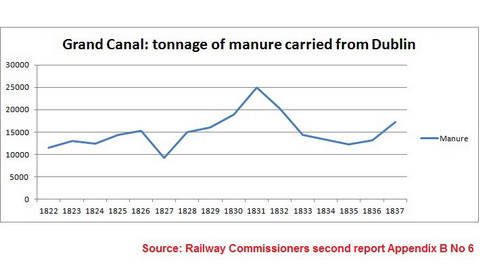
Keeping Dublin tidy

Fertilising the countryside

Fertilising the countryside

Chambers, pots

Folk knowledgeable about canal engineering and artefacts might be able to contribute to a current discussion, over at the Helpful Engineer’s website, of the Four Pots overflow and the side chambers at Lock 16 (Digby Bridge) on the Grand Canal.

Naas

An account of the official opening of the Naas Branch (County of Kildare Canal) in 1788.

Dublin docklands

A conference to be held on 21 September 2013.

Drowning

This Irish Times story updates this.