Tag Archives: Dublin

Nonsense on floats

IndustrialHeritageIreland has found a local newspaper that thinks that river buses on the Grand Canal could provide commuters from west Dublin with fast transport to Google HQ at Grand Canal docks. IHI points out that the journey from Hazelhatch can take eight hours; even Dublin traffic moves faster than that.


More on WI and the canals

It says here:

A number of questions have been repeatedly posed since the initial communications about the Canal Bye-law Enforcement. These are listed below in the following categories. Click on the category to access the questions and answers.

Five downloadable PDFs on


WI EML

EML? Extended Mooring Locations. Lots more info from WI here including a map and list of locations to be EMLed in 2012/13 and PDF maps for each of the locations currently being done.

A big shout out for whoever in WI has taken charge of using the website to keep folk informed: there has been a noticeable, and welcome, increase in the amount of information being made available.

Eeyore’s Gloomy Place

Here is an article, perhaps by Philip Dixon Hardy himself, from his Dublin Penny Journal of 1835. It is about the Bog of Allen, and the turfcutters living thereon, seen from the Grand Canal in 1835.

He visited a turfcutter’s hovel in the bog while stopped at a double lock about twenty miles from Dublin. What lock could that have been?

Note that Kildare is not among the counties mentioned in the article.

A Winn for the Grand

In today’s Sunday Business Post Jasper Winn, the paper’s Hardy Outdoor Correspondent, describes a five-day walk along the Grand Canal, from Harold’s Cross to Shannon Harbour. He did it in winter, camping out on the bank overnight despite its being so cold that the canal froze over, and finishing some of his days’ walks in the dark.

The SBP operates a paywall so you may not be able to see the page, but this is the link in case you want to try.

The end of a ghost

In the UK, the Statute Law Repeals Bill is working its way through the House of Lords. You can download a PDF list of the bills being repealed. In amongst the turnpikes, Indian railways, benevolent institutions and lotteries, we find Part 4: Ireland (Dublin City). Within that, Group 1 sees the repeal of these statutes:

  • 3 & 4 Will.4 c.cxv (1833) (City of Dublin Steam Packet Company Act)
  • 6 & 7 Will.4 c.c (1836) (Dublin Steam Packet Act)
  • City of Dublin Steam Packet Company’s Act 1860 (23 & 24 Vict. c.xcviii)
  • City of Dublin Steam Packet Company’s (Consolidation of Shares) Act 1861 (24 & 25 Vict. c.iii)
  • City of Dublin Steam Packet Company’s Act 1868 (31 & 32 Vict. c.xxx)
  • City of Dublin Steam Packet Company’s Act 1876 (39 & 40 Vict. c.xi)
  • City of Dublin Steam Packet Company’s Act 1884 (47 & 48 Vict. c.cxxx)
  • City of Dublin Steam Packet Company’s Act 1895 (58 & 59 Vict. c.cxxiii)
  • City of Dublin Steam Packet Company’s Act 1910 (10 Edw.7 & 1 Geo.5 c.vii)
  • City of Dublin Steam Packet Company’s Act 1916 (6 & 7 Geo.5 c.viii)
  • City of Dublin Steam Packet Company’s Act 1920 (10 & 11 Geo.5 c.i).

In a Consultation Paper published in 2008, the Law Commission explained:

The City of Dublin Steam Packet Company was founded by Charles Wye Williams in 1822. From 24 January 1839, the Post Office contracted the company to run the mail service from Dublin to Holyhead. This service was later extended such that the company ran both the day and night service.

During the First World War the company suffered heavy losses, including the sinking of its ship the R.M.S. Leinster by a German submarine on 10 October 1918, resulting in a loss of over 500 lives. A further two ships were sunk during this period. The company never fully recovered from its wartime losses and, in 1924, an order for the winding-up of the City of Dublin Steam Packet Company
was petitioned for and granted by the High Court at Dublin Castle.

In Ireland, the Statute Law Revision Act 2009 repealed the 1833 and 1836 Acts and the Statute Law Revision Act 2012 repealed all the rest — except the 1895 Act. I don’t know where to get a copy of that Act, so I don’t know why it was specifically retained. But, with that exception, it seems that the ghost of the CoDSPCo has been laid to rest.


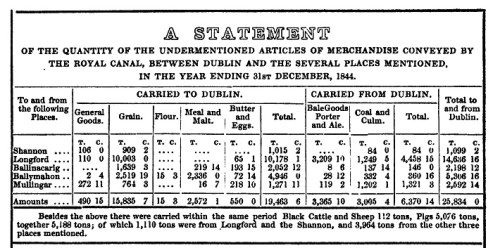
Royal Canal traffic in 1844

Royal Canal traffic in 1844 (Salt)

That table is extracted from Samuel Salt’s Statistics and Calculations essentially necessary to persons connected with railways or canals; containing a variety of information not to be found elsewhere 2nd ed Effingham Wilson and Bradshaw & Blacklock, London 1846, available from Messrs Google here.

The interesting point is how little of the Royal’s traffic travelled the whole way from the Shannon to Dublin or vice versa: only about 5% of the Dublin-bound traffic and less than 3% of the traffic westward.

Another point of interest is that traffic to Dublin was three times the traffic from Dublin.

Amongst the livestock, pigs were the dominant animals: they lost too much condition if they were walked long distances, which was the only alternative to canal transport before the railways came. Even there, I suspect that much of the tonnage described as “from Longford and the Shannon” was actually from west of the river, in Counties Mayo and Roscommon.

Grand trumps Royal

A victory today for St James’s Hospital, close to the former harbour of the Grand Canal, over the Mater Hospital, close to the former harbour of the Royal Canal at the Broadstone.

Perhaps, if St James’s needs space to expand, it could take over the former canal harbour; work on its latest development seems to have ceased.

A London pub and the history of the Shannon

Piloti’s “Nooks and Corners” column in the latest issue of Private Eye [No 1325] reports [brief extract available to non-subscribers here] that a London pub is threatened with demolition. On the Google satellite view with photos, press the button to the bottom right of the building to see a pic headed “Derelict pub”.

Piloti says that the pub was built in the 1840s [Diamond Geezer says 1839] and at that time the Marquis (or Marquess) was Henry Petty-Fitzmaurice, 3rd Marquess of Lansdowne, KG, PC, FRS. The family’s main base was in Britain but they owned large estates in Ireland, notably in Counties Limerick and Kerry; certain roads in Dublin are also named after the family.

The late Marquis has two claims on the attention of Irish waterways enthusiasts. First, the best-known of the early River Shannon steamers, the Lady Lansdowne, was named after his wife. Second, he was Lord President of the Council [the current holder of the post is Nick Clegg] when the government of Her Late Majesty Queen Victoria decided, in 1839, to spend about half a million pounds improving the Shannon Navigation.


Political parties

Regular readers will know that I sent and FOI request to the Department of Community, Equality and Gaeltacht Affairs [now the Department of Arts, Heritage and the Gaeltacht] looking for files on the Clones Sheugh (aka the Ulster Canal). One of the grounds on which I was refused access was that certain files related to “the costing, assessment or consideration or any proposal of a political party carried out for or on behalf of that party”.

While my appeal against that refusal continues on its course, I thought I might as well ask the political parties directly for the information that might be in those files — in the process, of course, establishing which of them had Clones Sheugh proposals in mind.

Party time

As far as I can see, the parties that contested, or were eligible to contest, the 2011 general election were:

Christian Solidarity Party
Fianna Fáil
Fine Gael
Fís Nua
Green Party
Labour
People before Profit
Sinn Féin
Socialist Party
South Kerry Independent
Workers and Unemployed Action Group [WUAG]
Workers’ Party.

Accordingly, I decided to email them all, enquiring whether they had asked the [then] Department of Community, Equality and Gaeltacht Affairs for information “relating to the costing, assessment or consideration of the restoration of some or all of the abandoned Ulster Canal”. I added that, if they had done so, I would be grateful for a copy of the query they put to the department and of the response they received. I told them that I was sending my query to all political parties that contested the 2011 general election (or at least to all those for which I could find an email address).

That was not quite true: I omitted the South Kerry Independent Alliance, on the grounds that its interest in the Clones Sheugh was likely to be limited (I am of course open to correction on this). Furthermore, I was unable to find any website or email address for WUAG so I did not send my request to them.

Fianna Fáil logic

All of the other parties had websites and email addresses — except one: Fianna Fáil. Now, strictly speaking it falls outside the range of parties in which I might have been interested: not just for the obvious reasons but because it was in government at the time and would automatically have had full access to the civil service costings (such as they were). But I was interested to note that Fianna Fáil did not provide an email address on its website: interested enough to ring it and ask for an email address for its press office. The polite receptionist asked someone and told me that the address to be used was pressoffice@fiannafail.ie.

So I sent my query to that address. And I got back an autoresponse saying

This email is not monitored. For urgent queries you can contact the FF Press Office on 087 955 5600.

Well I never. What was the point of that?

Labour gains

Anyway, the results so far put Labour in the lead: I got an almost immediate informal response from Dermot Lacey, saying that he didn’t think Labour had contacted the department; I also got a more formal response next day, from Mags Murphy, Director of Councillor Services and Training, saying:

Labour did not include a specific commitment to the development of the Ulster Canal in our manifesto in the 2011 Election.

However, Labour is keen that all practical possibilities for cooperation, reconciliation and mutual benefit, including maximising tourism potential from a development of the Ulster Canal would be considered seriously as part of our deep commitment to the Good Friday agreement.

To this end, the Labour members of the Implementation of the Good Friday Agreement committee visited the Ulster Canal, Enniskillen and Clones with their cross-party colleagues for a range of meetings on 27 September 2012 with Waterways Ireland officials, local councillors and community groups.

Oh dear. Still, brownie points for responding.

What is the Implementation of the Good Friday Agreement committee?

Where are the others?

I am still awaiting responses from the other political parties.

Declaration of non-interest

I did not vote for any of those parties.