Tag Archives: Erne

The contagious cargo cult

Readers will be saddened to learn that Ireland’s cargo cult, the delusion that canals bring prosperity, is spreading. It may even be that an increasing frequency of political references to Saunderson’s [né the Clones] Sheugh means that the devotees are about to engage in sympathetic magic by attempting to dig a sheugh.

The sheugh was mentioned in both legislative assemblies on the island on 20 January 2015. In Dublin, Gerry Adams [SF, Louth] said:

I remind the House that the peace process is the most important political project on this island at this time and it needs to be nurtured, protected and enhanced. It must be at the top of the Government’s agenda alongside other priorities.

I wonder how many priorities can dance on the head of an agenda ….

I welcome the financial commitments that have been made, including €25 million in annual funding for the A5 road project, which will assist people in Tír Chonaill, Derry, Fermanagh and Tyrone. I welcome additional funding for reconciliation under the European Union’s PEACE and INTERREG programmes and the Government’s renewed commitment to the Narrow Water bridge and Ulster Canal projects. These are important developments which need to be delivered.

If the Shinners are going to prioritise such nitwitted public spending projects, Goldman Sachs will never allow them into government [assuming that Goldman Sachs cares what happens in Ireland, which they might not, pace Peter Sutherland]. Nobody else mentioned the sheugh in that debate, but several Norn Iron politicos seem to have succumbed to the delusion. They had a debate on “Ulster Canal: Tourism Benefits“, which is like having a debate about the nature of unicorn excrement without first checking to see whether unicorns exist.

Note, in what follows, the complete absence of any quantification of benefits, with only a single mention of costs and with an unwavering belief that canals bring prosperity, even if they lack any interesting features (apart from the engine shed in Clones). There is no attempt at identifying why tourists would be attracted to the sheugh, no discussion of the mechanism by which public spending is translated into tourism revenue and then into local or national benefit.

Not that southern politicians are any better, of course.

Anyway, back to the NI Assembly. Sean Lynch [SF] “asked the Minister of Enterprise, Trade and Investment for her assessment of the potential tourism benefits of re-opening the Ulster canal”. Note that he didn’t say how much of the canal he wanted.

Arlene Foster [DUP] [for it was she] said

The waterways of Northern Ireland have the potential to become an integral part of the tourism experience in Northern Ireland. The proposed Ulster canal development could provide opportunities for canal boating as well as supporting infrastructure to support walking and cycling, all of which would benefit our visitors and the local area.

All of which is waffle. She provided no assessment.

Although the project is being led by DCAL, the Northern Ireland Tourist Board (NITB) continues to work with the Ulster canal inter-agency group through the Destination Fermanagh steering group and with the Clones Erne East Blackwater project to try to maximise the tourism benefit that this project could bring.

Nice to hear that the treasure-seekers, the “inter-agency group”, still exist. I wonder what they do.

So far, Arlene seems to be sticking to her script and hasn’t given much away: the sheugh could do this, that or the other, but there’s nothing concrete. But Mr Lynch asks a follow-up question:

I thank the Minister for her somewhat encouraging answer. Does she agree that, because the canal goes through Monaghan, Fermanagh, Cavan and Tyrone, both tourism boards on the island of Ireland should work closely together to ensure that it is a success?

If it were worth doing, why would the tourism boards have to “work closely together”? Would not hundreds of thousands of foreigners, from lands without canals, come flocking to the sheugh and to the irresistible attractions of Clones? What more could the tourism boards do to sell the thing? “Visit a short canal in the middle of nowhere leading to Clones”?

Mr Lynch may just have been trying to trap Ms Foster into agreeing to some tourism crossborderality. But she seems to have been doing a bit of crossborderality of her own:

The TD for Cavan-Monaghan, Heather Humphreys, has taken a particular interest in the matter, as you would imagine. It is in part of her constituency, as it is in part of ours; therefore, she is keen to move the project forward. When I last spoke to her, she again mentioned the need to push ahead on the Ulster canal.

Oh dear.

So, I think, generally, there is support for the project. I suppose that the big challenge for us all is funding. The Northern Ireland Tourist Board — or Tourism Northern Ireland, as we should now call it — will work with its counterparts to assist and make sure that all the tourism benefits are put into any business case that is put forward.

When ministers are asked questions by members of their own parties, I wonder whether the questions were arranged beforehand in order to allow the ministers to make certain points.

William Humphrey [DUP] said “The Minister is quite right that the primary responsibility lies with the Department of Culture, Arts and Leisure.” The minister knew that already. But then he asked two questions. The first was:

Is Fermanagh District Council taking a collaborative approach to the cross-border element?

That might be intended to sell the prospect of further local government crossborderality to DUP supporters. The minister answered:

As I understand it, Fermanagh District Council is part of the Clones Erne East partnership, which seems to be driving this initiative. Of course, the Erne East councillors will be part of that partnership.

Humphrey’s second question, which elicited an interesting answer, was:

Obviously, in the current economic climate, budgets are tight. Has the Department looked at the possibility of funding from the European Union, given that it is a cross-border venture?

Ms Foster said

I simply do not know is the answer, because DCAL leads on this issue. However, I do know, and I have been advised, that some €54 million would be needed to secure the project to get it completed within 21 to 24 months. It is a large sum of money. If there are options to look elsewhere for funding, we would of course be supportive of them being explored.

Now, what is that €54 million for? Irish ministers have been quoting a figure of €35 million for years, even after 2011 when I was given a revised estimate of €45 million [overview of the history here]. That was to get to Clones. Is Clones now to cost €54 million? Or is that to Castle Saunderson? Or to Lough Neagh? Probably not the last. Note that these cost increases have come even before anybody starts digging anything.

Why does Clones deserve €54 million? Its population seems to be slightly below 3000; why not give every man, woman and child €15,000 each to forget about the sheugh, thereby saving €9 million?

Back to the Assembly. Basil McCrea [UUP], who may be the most sensible MLA, suggested, as he has suggested before, that users of inland waterways pay “for example, through a boat tax” something towards the cost of the waterways “provided that the money is used specifically for enhancing inland waterways?” Ms Foster said that was not her business and added

I want to encourage more people to come and use the inland waterways. Of course, I want them to use Lough Neagh and Lough Erne in particular.

I wonder why she omitted the Lower Bann, the Shannon–Erne Waterway and the various derelict navigations — including Saunderson’s Sheugh.


ESB Erne elvers

Northern Ireland Assembly question here.

Brendan Smith TD and W T Mulvany

Wednesday 22 May 2013

Brendan Smith [FF, Cavan-Monaghan]: To ask the Minister for Arts, Heritage and the Gaeltacht the position regarding the feasibility study that has been underway for some time in relation to the proposed extension of the Erne Navigation from Belturbet to Killykeen and Killeshandra; when this study will be completed; and if he will make a statement on the matter.

Jimmy Deenihan [FG Kerry North/West Limerick]: I am informed by Waterways Ireland that the current position is that work is continuing on the collection of data relating to this project and Waterways Ireland is currently preparing draft options for the project. At that point consultants will then assess the environmental implications of the options. It is expected that the feasibility study will be completed as planned by the end of 2013.

19 December 2013

Brendan Smith: To ask the Minister for Arts, Heritage and the Gaeltacht if he has received the feasibility study on the proposed extension of the Erne navigation from Belturbet to Killeshandra and Killykeen; and if he will make a statement on the matter.

Jimmy Deenihan: I am informed by Waterways Ireland that it commissioned a Strategic Environment Assessment for the possible extension of the Erne Navigation from Belturbet to Killeshandra and Killykeen.

On reviewing the environmental information from this process, Waterways Ireland considers that the environmental designations of this lake complex make the feasibility of the proposed navigation extension highly unviable. For that reason, I am advised that Waterways Ireland does not propose to pursue this project any further at this time.

11 December 2014

Brendan Smith: To ask the Minister for Arts, Heritage and the Gaeltacht the position regarding the proposal to extend the Erne navigation from Belturbet to Killykeen and Killeshandra, County Cavan; when this project will proceed to the next stage; and if she will make a statement on the matter.

Heather Humphreys [FG, Cavan-Monaghan]: I have been informed by Waterways Ireland that it commissioned a Strategic Environmental Assessment for the proposed extension of the Erne Navigation from Belturbet to Killeshandra and Killykeen in County Cavan. I am further advised that, on reviewing the environmental information from this process, Waterways Ireland’s considered view is that the development of a viable project is not feasible, given the conservation designations of the lake complex. Waterways Ireland does not, therefore, propose to pursue the proposal further at this time.

It would be nice if Mr Smith would (a) check what he was told last time and (b) tell whatever constituent is lobbying for this scheme to get stuffed. Even W T Mulvany wasn’t able to get a navigation to Lough Oughter.

Building more navigations in Ireland is a waste of money: it simply spreads the existing business more thinly. It will not attract extra business from inside or outside the state (apart from a small number of waterway twitchers). Some pub-owners in Killykeen or Killeshandra might sell some more beer-like substance, and if they would like to pay for a navigation that’s fine, but there is no advantage to the state in paying for it.

Thanks to KildareStreet for the notification.

From the [UK] Civil Service Quarterly

An interesting article [h/t celr] about the setting up of the Canal & River Trust, which runs (it says itself) 2000 miles of waterway in England and Wales. The article is not, perhaps, to be seen as an objective evaluation of the benefits of the UK’s Public Bodies Reform Programme, but the idea of transferring a large operation to the voluntary sector is an interesting one, as is the scope for volunteer donations and involvement (British Waterways, C&RT’s predecessor, had nothing like as high a proportion of lockkeepers as Waterways Ireland has).

I have occasionally been asked, by British folk, whether the possibility of transferring Waterways Ireland to the voluntary sector is being considered here. I have explained (a) that WI has nothing like as significant an independent (non-grant) income as BW had and (b) that any such transfer would require the rewriting of the Good Friday, St Andrew’s and (now) Stormont House Agreements. So we are stuck with the current arangements, which at present are leaving WI at the mercy of budget cuts, a disastrous pensions arrangement, disputes between its two governing departments and a nitwitted demand, from Sinn Féin and Fianna Fáil and perhaps from Fine Gael too, for a pointless canal reconstruction.


The River Shannon and its Shrines

One of the Shannon books that are listed on the IWAI website but that I’d never seen is J B Cullen’s The River Shannon and its Shrines, which the IWAI list says is

Dublin. C.T.S. of Ireland. 1909. p.p.107. Green boards. Prof. illus.

IWAI also lists J E McKenna Lough Erne and its Shrines published by the Catholic Truth Society of Ireland in 1909, and it provides a link to a downloadable copy of what is a short work of 32 pages.

How many pages?

In 2004 that learnéd bibliophile Michael Slevin also provided a list of books being sold by Healy Rare Books, which included

J.B. Cullen. The River Shannon and its Shrines. Dublin. Browne & Nolan. n.d. Disbound. p.p.28. Illustrated.

I mention this because I have recently acquired a copy matching that description (though, I suspect, not at Healy prices). The number of pages is indeed 28 rather than the 107 mentioned on the IWAI listing. So were there two books with the same title by J B Cullen? My copy concludes with the words

At Killaloe may end the notice of the Upper Shannon and its Shrines.

That is followed by

[The Story of Saint Senanus, which is to follow, will introduce the remaining Sanctuaries of the hallowed and majestic River.]

It seems possible, therefore, that Cullen wrote more than one piece on the Shannon; perhaps they were originally published in the Catholic Truth Society magazine and then assembled to provide a 107-page book. The National Library suggests that there may have been four pieces.

I would be glad to hear from anyone who knows more about this — and to get copies of any other sections that may exist.

Athlone

Here is an extract from Cullen about Athlone.

To-day Athlone presents a picture of greater interest than many of our Irish cities or towns. Its normal population is some ten thousand inhabitants, but its importance as a military station often swells this aggregate. This latter circumstance gives a very distinct feature to Athlone. The town is generally bright and gay with the parade of military, and joyous with the strains of martial music, while ever and anon the practice of artillery keeps the echoes of the Shannon busy recalling — in our peaceful days — the stirring memories of the warring past.

The book was published in 1909: the army is that of His late Majesty King Edward VII.

Shannon -v- Erne

McKenna’s Erne book has a practical tone: it mentions the “finely-equipped paddle-steamer Lady of the Lake” but says

We prefer a modest little steam launch for the purpose of our present excursion.

Assuming we have a few quid to spare, of course. But Cullen says nothing about how the traveller is to get around. He has clearly been on the water (he visited several islands — and even Lough Forbes, which is not easy to see by road) but also travelled by land to Kilronan, Edgeworthstown and Roscommon. It would be interesting to know how and when he made his journeys.

Despite its title, his book[let?] displays an interest in military as well as in religious sites and history, but there is nothing about contemporary waterways usage or traffic.

J B Cullen

From searching tinterweb, I conclude that John Bernard Cullen may have attended Mungret College in Limerick [PDF; mostly irrelevant] and had a brother called James who was a Jesuit, co-founded the Rosbercon Choir, lived at Bawnjames House near New Ross, was a founding committee member of the Catholic Truth Society of Ireland, contributed to the Parnell National Tribute and wrote lots of light historical articles. In 1886 two of his daughters, aged 3 and 13, drowned in an ornamental pond in his gardens.

I would welcome more information.

As far as I can tell he was dead before 1933 and his work is therefore out of copyright; accordingly I provide a PDF [5.3 MB] below.

The River Shannon and its Shrines

Saunderson’s Sheugh

The Minister for  Arts, Heritage and the Gaeltacht [who is also a Fine Gael TD for Cavan–Monaghan] spoke at the meeeting of the Joint Oireachtas Committee on Environment, Culture and the Gaeltacht on 25 November 2014. She said:

In addition to progressing North-South co-operation, my key priority is progressing the first stage of the Ulster Canal project from upper Lough Erne to Castle Saunderson, near Belturbet, County Cavan. I am working on this with the Government and other key partners, including the North-South Ministerial Council and Waterways Ireland. […]

It sounds, then, as if the minister intends to get work started on the Clones Sheugh, but only as far as Castle Saunderson, where there is a scouting establishment. The route from Quivvy Lough (location of the Quivvy Marina) is along the Finn River; the first 5.5 km of the route would be in the river and the last 8.5 km to Clones in a canal. The route to Castle Saunderson would, I imagine, require dredging and the removal of rocks as well as work on [or replacement of] Derrykerrib Bridge [I have not read all the details].

It would, of course, be faster to get there by road, but no doubt lots of people will travel from Foreign Parts for the excitement of seeing Castle Saunderson from the water and paying tribute to the memory of a stout Orangeman and founder of the Irish Unionist Alliance.

No mention of the treasure-hunting group who are to find the money, but there’s an election in the offing so money won’t be a problem. Until afterwards.

Quivvy to Castle Saunderson [OSI ~1840]

Quivvy to Castle Saunderson [OSI ~1840]

The minister also said:

Regarding the Ulster Canal, which stretches from upper Lough Erne to Castle Saunderson, we hope to get the project started on that section because that is the one part of the inland waterway system that has not been developed. If we get that done, the Ulster Canal will connect into Lough Neagh. That means we will have a complete network of waterways in Ireland, which is very important. It is also a cross-Border project, and there is a peace dividend in terms of that project. It is very important in terms of cross-Border relationships. It is one shovel-ready project that can be progressed.

The minister said that “a complete network of waterways in Ireland […] is very important”. She did not say why and I can think of no possible economic justification for the creation of such a “network”. Nor is it clear what the “peace dividend” is. But the phrase that evoked most terror is “shovel-ready project”, which I take to mean something that might buy votes in the next election.

The minister’s predecessor, Éamon Ó Cuív, a Fianna Fáil TD for Galway West, said:

I welcome the Minister’s continuation of the work on the Ulster canals. There was quite a bit of work done on that in my time and I was very anxious to see it progress on a step-by-step basis. I was going to bring it to Clones, I am not sure whether the place the Minister mentioned is further or nearer than that.

The minister interjected:

It is not as far as Clones. We will start it anyway and we will get it there.

And Mr Ó Cuív continued:

I take the view that even if she were to get it half a mile, we should just nibble away at it until we get it finished. It is of strategic national importance and if we could connect Coleraine, where I was the other day and where my poor car is getting mended, all the way down the coast through Lough Neagh down to Shannon and back up the canals, it would be a fantastic facility for the island. I will not be heard complaining in any way that it is in the Minister’s constituency – that just happens to be a happy coincidence in this case.

Actually, although both Quivvy Marina and Castle Saunderson are in the Free State, most of the River Finn route is in the United Kingdom of Great Britain and Northern Ireland.

It seems that I must cease to speak of the Clones Sheugh: it’s Saunderson’s Sheugh. I suppose that, if reaching Castle Saunderson were enough to shut up the Shinners, who seem to be madly keen on Sheughery for some reason that is hidden from me, that might be a bargain: it would certainly be better than going all the way to Clones.

My OSI logo and permit number for website


Uninformative press release aboot thon sheugh

Plans to restore the Upper Lough Erne to Clones section of the Ulster Canal are being pursued by the Department of Culture, Arts and Leisure and the Department of Arts, Heritage and the Gaeltacht

it says here. The official NSMC version is here. No mention of the inter-agency treasure-seekers; perhaps the swag is in here:

Progress on the development of the new INTERREG V and PEACE IV Programmes for the period 2014 – 2020 was discussed. The Council noted that the draft Programmes had been submitted to the EU commission by the deadline of 22 September 2014.

I see that WI employee payments for pensions are going up:

16. Ministers also acknowledged the ongoing work in relation to reform of the North South Bodies Pension Scheme, including recently approved amendments to ensure the Scheme complies with employment legislation and best practice in both jurisdictions and to increase employee contributions.

Someone with a tin ear (perhaps someone who doesn’t do crosswords) wrote this:

driving a shift to public and more sustainable modes of transport and the potential for shared cross border public transport services in border areas.

Driving would be right, especially in Donegal. But what about parity of esteem?

development of cross border Greenways

Why no Orangeways?


A puzzle in waterways history

According to the Lagan Canal Trust,

The Lagan Navigation also forms part of a wider all Ireland waterway network. This network of waterways once traversed through the towns and cities of Ireland delivering goods and produce, helping to shape the economic fortunes of the country.

I would be grateful for information about any goods or produce that were ever carried from the Shannon, or from the Royal or Grand Canals or the River Barrow via the Shannon, through the Junction Canal in the Ballinamore & Ballyconnell Drainage District [later called the Ballinamore & Ballyconnell Canal and later still the Shannon–Erne Waterway] and then the Ulster Canal to Lough Neagh or any of the waterways connected therewith. Or, of course, in the opposite direction.

As far as I can tell, outside the sales blurbs written by engineers seeking employment and waterway owners seeking subsidies, there was never a connected all-Ireland waterways network; nor was there ever any need or demand for such a thing.

Any more than there is now.


Shannon traffic figures to July 2014

I am grateful to Waterways Ireland for letting me have the Shannon traffic figures for July 2014. All the usual caveats apply:

  • the underlying figures do not record total waterways usage (even for the Shannon) as, for instance, sailing, fishing or waterskiing on lakes or river stretches, which did not involve a passage through a lock or Portumna Bridge, would not be recorded
  • the passage records would not show, for instance, a change in the balance of types of activities from those in larger cruising boats to those in smaller (sailing, fishing, waterskiing) boats
  • figures like these, for a small number of months, will not necessarily be representative of those for the year as a whole. The winter months, January to March, see little traffic in any year; for April, May and June, the weather can have a large influence on the amount of activity especially, I suspect, in private boats.

On the other hand, the figures do include the Shannon’s most significant tourism activity, the cruiser hire business. And they are our only consistent long-term indicator of usage of the inland waterways.

Shannon all boats Jan to Jul 2014

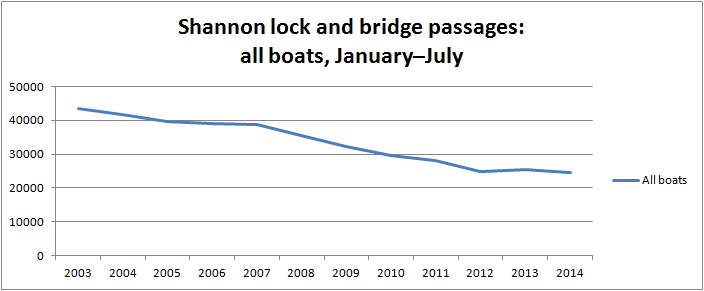
Total (private + hired) traffic for the first seven months of each year

Traffic in 2013 was up a bit on 2012; 2014 is down slightly below the 2012 level. It’s the lowest seven-month figure in the series (ie since 2003), which is a bit of a surprise: I thought that the good weather would encourage more boating.

The changes are small, so their importance must not be exaggerated, but they’re not cause for celebration. Let’s see whether the drop was amongst private or hired boats (or both).

Shannon private boats Jan to Jul 2014

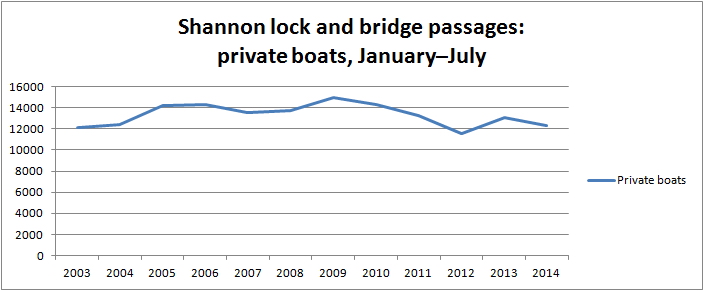
Private-boat traffic for the first seven months of each year

Private traffic is up a bit on 2012 but down on 2013.

Shannon hired boats Jan to Jul 2014

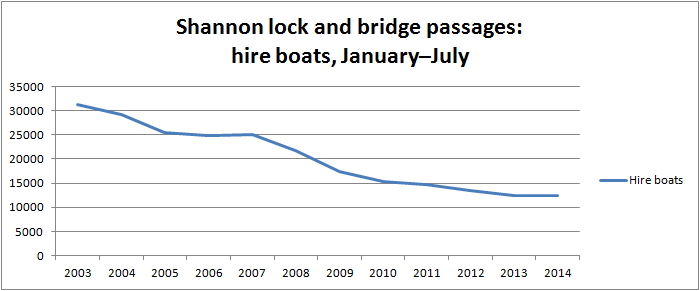
Hire-boat traffic for the first seven months of each year

Hire-boat traffic is down on both previous years, but the pace of decline seems to have slowed.

Shannon private and hired -v- 2003 Jan to Jul 2014

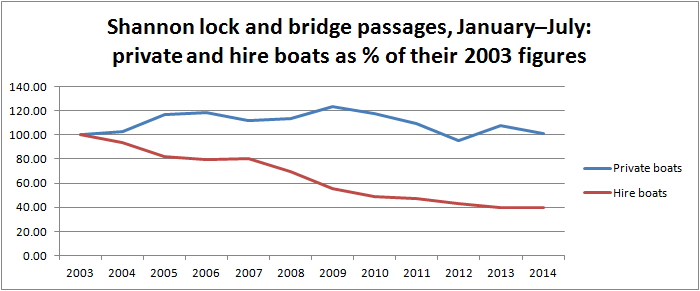
Changes since 2003: private and hired boats

Hire-boat traffic seems to be levelling off at 40% of its 2003 figure: a massive loss of business. I do not know whether anyone is trying to, or could, recover that amount of business. I am not aware of any new Shannon-based tourism business that could compensate for the losses in the cruising (hire-boat) business, but I would be glad to hear from anyone who knows of such projects. Something with high growth potential is required.

Private traffic is wobbling either side of its 2003 figure: the increases during the Celtic Tiger years have been lost.

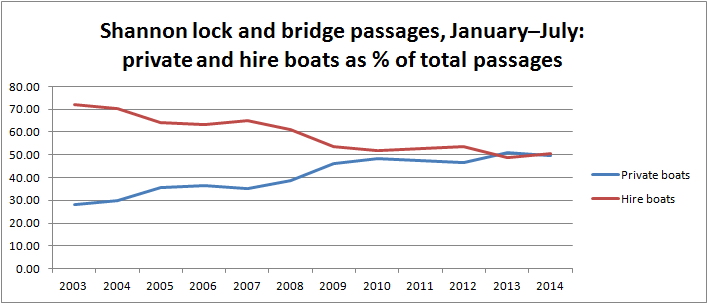
Shannon private -v- hired boats Jan to Jul 2014

Still roughly 50/50

In the year to July 2014, hire-boat traffic was just above private traffic, but there is very little in it. Private traffic is now comparatively more important to Waterways Ireland [which may be why it is now trying to establish its economic importance] but it does not bring in much money from outside the two jurisdictions, so the case for public spending on waterways becomes much weaker.

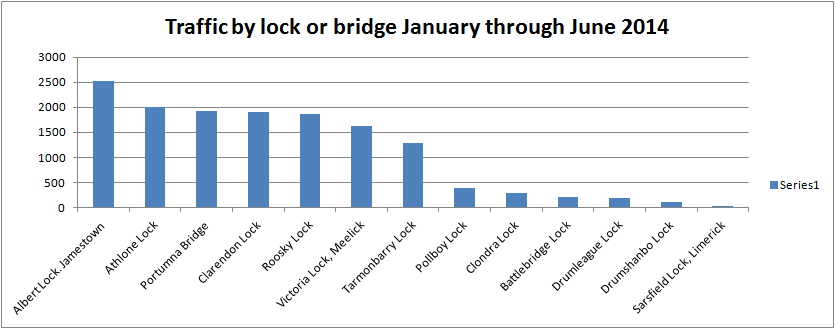
And, quite clearly, opening more waterways doesn’t work: as this chart showed last month, the branches off the main lines of the Shannon, Erne and SEW are little used. The Lough Allen Canal, the Suck and the navigation to Limerick are very little used and I see no sign that the reopened Royal Canal has attracted many visitors to Ireland. What is needed is more intensive usage of the main waterways, not further dilution by the opening of more branches [to Clones or anywhere else].

SnnNav JanJun 6

High and low usage

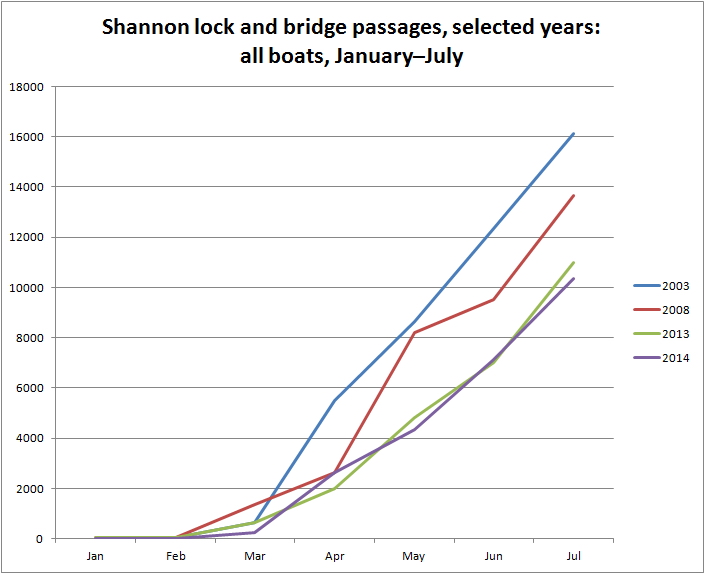
Finally, I thought it might be interesting to see whether the monthly pattern of usage has changed since 2003. To avoid an over-cluttered chart, I included only four years: 2003, 2003 +5, 2003 + 10 and 2014. The chart is for all boats, private and hired.

Shannon all boats by month selected years Jan to Jul 2014

Monthly traffic, selected years

The season seems to have got going earlier in 2003 and even in 2008. Was the weather better in those years?


Waterways Ireland news

Lots of info pouring from Waterways Ireland at the moment: July Shannon traffic stats, which will take me some time to analyse, serviced moorings in Sallins, digital navigation thingies for the Erne and Lower Bann and an online survey.

Here’s the press release for navigation thingies. I’ll cover the online survey in a separate message.

Waterways Ireland Pilots Digital Navigation Guides to the Inland Waterways

Waterways Ireland has developed an Online Navigation Guide for the Lower Bann for use on computers, tablets and mobile phones. In a major step change in the presentation of navigation guides for Ireland’s Inland Waterways, Waterways Ireland has, in consultation with user groups, developed, tested and now launched, pilot Online Navigation Guides, designed to provide a convenient alternative to printed navigation guides.

The online guide to navigation has been developed internally within Waterways Ireland using ArcGIS online. This interactive web mapping application details navigation features such as Locks, Moorings, Weirs, Navigation Markers and other facilities along the waterway. These data layers are then overlaid using ArcGIS online web maps. GPS surveys or digitising onscreen using Ordnance Survey Maps have been used to capture the location of features. The application enables the public to pan around the map, identify features, print maps, switch between base mapping & satellite view and switch on and off layers. The Lower Bann Guide is complete and available for free on our website and can be viewed on a PC, Tablet or Smartphone.

Waterways Ireland will update the maps on an ongoing basis so that the latest navigational information is always available online. Ongoing feedback is welcomed from users to keep the mapping information accurate.

With both the Lower Bann and the Erne System Navigation Guides presently available online, Waterways Ireland is commencing work with user groups on the Shannon and will subsequently cover the remaining waterways.

The maps are available on www.waterwaysireland.org by choosing the waterway and then selected the map tab. To directly access the Lower Bann & Lough Erne Online Navigation Guides, click [this] .

In the initial pilot period, broadband access or a wifi link will be required to use the online navigation guides for the Lower Bann and Erne Systems. Progress is being made on an offline/cached version which will be made available as soon as possible.
It is also planned that the next phase of the Online Navigation Guides will have additional layers of information for waterway & waterside recreational and tourism activity which the user can turn on and off.

In this transition period Waterways Ireland continues to offer a paper product to Waterway users. A comprehensive navigation guide for the Erne System, Shannon-Erne Waterway and Shannon Navigation is for sale at www.shopwaterwaysireland.org for €15/£12.60 and the Lower Bann Guide is also available.