Tag Archives: Erne

Shannon traffic figures to September 2013

The current (November 2013) issue of the British magazine Waterways World (available online only to subscribers) has an interview with Dawn Livingstone, new CEO of Waterways Ireland. There was a question about visitor numbers:

How are boating visitor numbers holding up in the recession?

The type of boating is changing — more sports boats for example, and numbers, after an initial decline, have held steady in the cruiser hire and private boat fleets. But more customers are investing in active recreation — canoeing, sailing, rowing, and these clubs and holiday types are growing rapidly.

My sense of the types of boating is the same, but I do not know of any source of reliable data. I think it would be useful if Waterways Ireland were (somehow) to collect and then to publish data on these activities and their economic costs and benefits.

But I was amused by the statement that …

[…] numbers, after an initial decline, have held steady in the cruiser hire and private boat fleets.

I’m not sure what useful data there are for the Lower Bann, Shannon–Erne Waterway, Grand, Royal and Barrow, though perhaps enhanced enforcement of the regulations will improve the data for the last three of those waterways. For the Shannon and Erne, the numbers in the fleets are, I presume, derived from the numbers of registered vessels, but there is no annual re-registration and I am not clear how many boats that are removed from the navigation are removed from the registers.

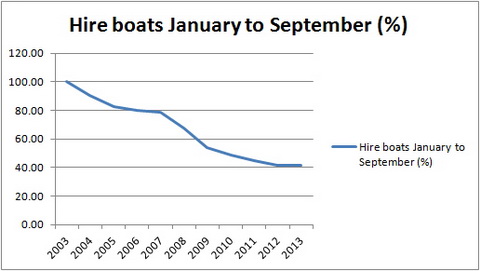
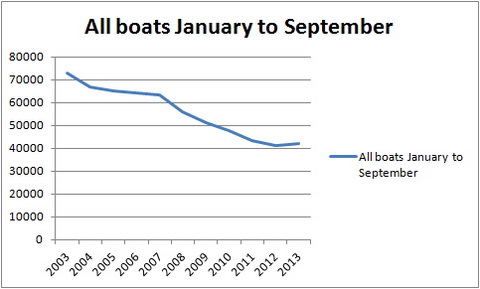
The other, indirect, measure, which applies only to the Shannon, is of passages through locks and moveable bridges. And, for hire boats, the “initial decline” has been 60% since 2003. If the numbers are now holding steady, it is at a very much lower level than ten years ago.

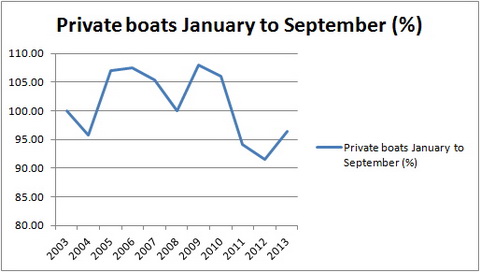
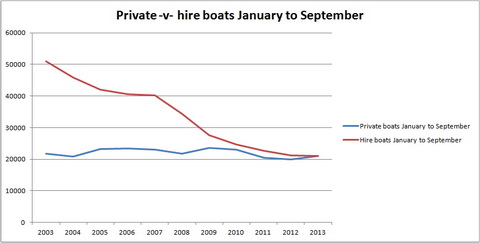
I was able to report in August that the better weather in July seemed to have led to an increase in the number of passages by private boats [the usual caveats apply]. Furthermore, for the first time that I knew of, the number of passages by private boats in the first seven months of the year exceeded the number of passages by hire boats in the same period.

I now have the figures for two more months, August and September, kindly supplied by Waterways Ireland, who are not to blame for my delay in getting the information up here.

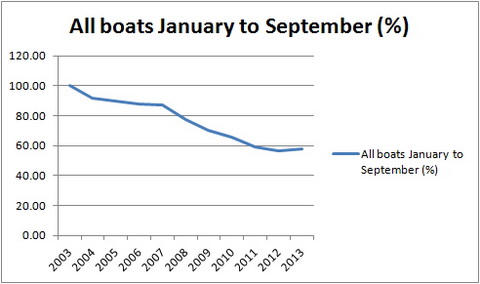
All boats JanSept nos_resize

Look! An increase!

All boats JanSept percent_resize

Total passages are now almost back up to 60% of the levels of ten years ago

Hire boats JanSept percent_resize

Hire boat numbers are down by only a tiny amount

Private boats JanSept percent_resize

Private boat numbers are up

Private -v- hire JanSept nos_resize

Hire boat numbers are slightly above private boat numbers

Private boat numbers are ahead of hire in the three main summer holiday months of June, July and August and, although the numbers are tiny, in the winter months as well; hirers are ahead in spring and autumn.


SEUPBer

SEUPB, the Special European Union Programmes Body, has withdrawn its offer of funding for the Narrowwater bridge about which I wrote here and here.

Perhaps the scheme’s proponents might now consider a Newry Southern Relief Road instead. It might not be iconic, but it would be considerably more useful.

And I really don’t think it needs an opening span to cater for a couple of yachts going up the Newry Ship Canal.

It seems that the SEUPB wants to reallocate the money to a project that could be completed by December 2015. A cross-border sheugh, maybe?

Northsouthery and sheughery

The North South Ministerial Council secretariat has been remarkably quick to publish the joint communiqué from today’s plenary meeting. They must have adopted the Quaker practice of agreeing the minutes before the meeting ends (as opposed to the diplomatic practice of agreeing them before the meeting starts). The short version is that nothing happened; the only excitement was another brainfart from Our Glorious Leader, which occurred before the NSMC meeting.

Cavan-Monaghan FF TD Brendan Smith has been wasting civil service time again, asking about the Clones Sheugh:

Brendan Smith [FF Cavan-Monaghan]: To ask the Minister for Arts, Heritage and the Gaeltacht if he will indicate the current stage of the proposed restoration of the Ulster Canal; and if he will make a statement on the matter.

Jimmy Deenihan [FG Kerry North/West Limerick]: As the Deputy will be aware, in July 2007 the North/South Ministerial Council (NSMC) agreed to proceed with the restoration of the section of the Ulster Canal between Clones and Upper Lough Erne. The then Government agreed to cover the full capital costs of the project, which were estimated at that time to be of the order of €35m.

It was always the intention that the Ulster Canal project would be funded from the Waterways Ireland annual allocations, as agreed through the annual estimates processes in this jurisdiction, as well as the deliberations of NSMC in relation to annual budgets. It was a key consideration throughout the process that the Ulster Canal project would be supported by a significant level of projected income from the commercialisation of certain Waterways Ireland assets. However, the economic downturn has had a negative impact on those plans.

In the meantime, the Ulster Canal project is progressing on an incremental basis. Planning approvals have now been secured for the project in both jurisdictions. I welcome these developments, which, I am sure the Deputy will agree, are a significant milestone for the project.

I am continuing to explore all possible options to advance this project within the current fiscal constraints. In this regard, an Inter-Agency Group on the Ulster Canal has been established to explore and examine ways to advance the project and to examine possible funding options for it, including existing funding streams and the leveraging of funding from other sources, including EU funding options.

What news of the Inter-Agency Group? Has it found a rainbow with a pot of gold buried beneath it?

I do not find the minister’s statement that …

It was always the intention that the Ulster Canal project would be funded from the Waterways Ireland annual allocations, as agreed through the annual estimates processes in this jurisdiction […].

… to be entirely consistent with the historical record or even with his further statement that …

It was a key consideration throughout the process that the Ulster Canal project would be supported by a significant level of projected income from the commercialisation of certain Waterways Ireland assets. However, the economic downturn has had a negative impact on those plans.

The plan seemed to be to sell the WI assets, thus using capital to fund what might laughingly be described as a capital asset (as opposed to a millstone around WI’s neck), rather than to rely on income from the use of its surplus assets. Maybe allowing the Corpo to run the Dublin “docklands” [Irish Times report, which will disappear behind a paywall at some stage; the Corpo’s website doesn’t yet cover this] will restore the overvaluations of the recent bubble and allow WI to flog off its three sites and splurge on the Clones Sheugh.

That seems to be what ThemUns in the Northern Ireland Assembly are expecting, if we are to judge by the discussion held on 21 October 2013, when several shinners, and a few others too, enthused about the “potential” of canals:

Phil Flanagan [SF] asked the Minister of Culture, Arts and Leisure [SF] for an update on the current funding position on the re-opening of the Ulster canal.

Carál Ní Chuilín [SF]: I thank the Member for his question. Work by Waterways Ireland on the restoration of the Ulster Canal has been solely focused on the section from Upper Lough Erne to Clones. The project will be advanced in line with available resources. The Ulster canal interagency group has been tasked to examine all possible options for financing the project. DCAL economists are reviewing the business case to update the estimated costs and identify social as well as economic benefits for the first section of the canal. The Ulster canal interagency group is exploring funding options with the Special EU Programmes Body.

Phil Flanagan [SF]: Go raibh maith agat, a LeasCheann Comhairle. Gabhaim buíochas leis an Aire as ucht a fhreagra. I thank the Minister for her answer. I welcome the Minister’s continuing commitment to the Ulster canal, particularly the section from Upper Lough Erne to Clones. However, one of the difficulties that it faces is an absence of funding. Will the Minister provide more information on potential funding options for completing the work on that section of the canal?

Carál Ní Chuilín [SF]: The work of the interagency group is focused not just on funding options but on what we can do with current available funding. It is really important that we look at the Ulster canal with a view to how we can open up waterways to improve tourism and the local economy. It is important that we get started on the restoration of the Ulster canal in that area because it has experienced a lack of investment for decades.

We are looking not just towards the Irish Government, within DCAL and towards Europe but at other opportunities, possibly through the Lottery Heritage Fund and many others to see whether we can get this started by looking at options to bring the work forward, rather than waiting until all the money is in. We can do that only on the basis of secured funding. Once that happens, I will be happy to make a statement to the House that will be a bit of good news that the Member and other Members for that area have been waiting to hear for a long time.

I suspect that “what we can do with current available funding” is “buy a shovel”, there being no large amounts available from the Free State. But perhaps the reason that the Clones area “has experienced a lack of investment for decades” is that it is not possible to make any adequate (legal) return on investment there; a policy of assisted emigration might be best. But it is gratifying to learn that SF is trying to get the Free State government off the hook of its rash promise to pay for the sheugh and is hoping to raise the money from within HM Realm.

There was a hint of a sensible question from the UUP.

Tom Elliott [UUP]: I thank the Minister for that update. Will she tell us how much the overall project was estimated to cost, based on the business case, and what income it projected?

Carál Ní Chuilín [SF]: Overall, it goes into tens of millions of pounds. I believe that the business case needs to be updated, and that will be part of discussions involving me, Minister Deenihan, and Minister McGinley. Some of the work that is being done by DCAL economists is bringing a fresh approach to the economic appraisal. We are sharing that with our Irish Government colleagues and the interagency group. That is because I believe that, rather than waiting for all the money to be secured at once, we need to look at the potential for phased approaches. It is good news that we now have full planning permission across all the councils and from our Planning Service here.

We now need to look at what capital moneys are available, what we can do and our plan to secure additional funds for that area. As I said to Phil Flanagan, it is really important — I am sure that the Member is more aware of this than I am — that we get parts of that canal opened and try to get some construction work done on it.

Unfortunately Mr Elliott did not insist on getting an answer to his question about the projected income, which I expect to be nil.

Joe Byrne [SDLP]: Can this issue be raised at the next meeting of the North/South Ministerial Council? What potential does she expect could accrue to the areas of Fermanagh and Tyrone in future tourism?

Carál Ní Chuilín [SF]: The Member should take comfort in knowing that this is always raised at the North/South Ministerial Council. Certainly, within the waterways sectoral aspect of DCAL’s North/South arrangements, it is constantly brought up. The key here is to look at what we can do now for rural communities and what moneys are available. I appreciate that, when the Irish Government said that they would fully fund the project, they were in different economic circumstances. However, they still remain committed to doing something.

In DCAL, I am looking at a new economic appraisal to see what the real costs are and what parts of the work I could try to start, possibly in conjunction with Ministers Deenihan and McGinley. There is a lot of expectation around the project, and rightly so, no more so than among the people who live and work in the surrounding area and those who are waiting for work on the restoration of the canal.

Anna Lo [Alliance]: Parts of the UK and many other countries have reinvented canals as tourist facilities and attractions. What lessons does the Minister intend to adopt from other people’s experiences?

Carál Ní Chuilín [SF]: Certainly, we regularly receive reports from Waterways Ireland about tourist potential. The royal canal has brought great potential. There are festivals across all the canals and waterways the length and breadth of this island. Unfortunately, those are some of the very few opportunities that people who live in rural communities near waterways have of generating a local economy. So the tourist potential is absolutely huge. Not only is it huge for people who live on this island; it is huge for those who want to visit here and travel. There is big interest, particularly in Europe, in canals and waterways. It is incumbent on us to do what we can to get the project financed. We need to make a start on it. We do not have all the funds yet, but it is time to make a start on it rather than sit and wait on free money coming. People who are looking for tourists and have a tourist product to offer and people who are willing and able to work look to us for opportunities to get this moving. I think that is what it could do.

Ms Lo’s question should be enough to deter people from voting Alliance. Note that Ms Ní Chuilín’s answer was all about potential: we have no cost-benefit analysis of the restoration of the Royal Canal and indeed no idea what the restoration cost, but I do not believe that the economic benefits will be significant. And while it may be that …

There is big interest, particularly in Europe, in canals and waterways.

… the prospect of travelling to Clones by water is not significantly more enticing than that of travelling there by road.



More on Major Rowland Raven-Hart

A recent comment by Horacio A Nigro of Montevideo, Uruguay, may have solved the mystery of the birthplace of Major Rowland Raven-Hart, whose Canoeing in Ireland covered several inland navigations in the 1930s. You can see Horacio’s comments, and the subsequent discussion, on my page here.

But, on his own site, Horacio has cast light on Rowland-Hart’s career in radio, working in South America between the Kaiser’s War and Hitler’s War, and he has also very kindly provided an English-language version here as a PDF.


Fun for anoraks

Lots of info on the WI website:

I liked the bit on this page:

Enforcement

Boats in non-compliance with the bye-laws will enter an enforcement process. Enforcement is undertaken by Authorised Officers and will begin with a notification in the form of a sticker and if non-compliance continues may result in the ​craft being removed from the navigation at the owners cost.

I wonder about investing in a crane company.


Northsouthery minus northsouthery

I noted here what the Minister for Arts, Heritage and the Gaeltacht had to say about Waterways Ireland’s budget — or at least that portion of it paid by the RoI government — for 2014. The minister listed WI’s “core activities and targets” and various other things it should be doing:

  • promoting increased use of the waterways resource for recreational purposes
  • developing and promoting the waterways
  • attracting increased numbers of overseas visitors
  • stimulating business and regeneration in these areas
  • increasing recreational access along the routes of waterways
  • keeping the waterways open for navigation during the main boating season.

Note that WI is not expected to promote, engage in or achieve anything in the realm of northsouthery. That’s slightly odd when it receives [the larger] part of the northsouthery budget of the minister’s department.

The modernisation of Sinn Féin

I have criticised Sinn Féin’s obsession with the cutting-edge transport technology of the eighteenth century, the canal, and particularly with the proposed reconstruction of the Clones Sheugh. I am therefore glad to report that the party has now moved on to more modern transport technology: that of the early nineteenth century, in the form of the railway.

In a written question on 15 October 2013, Caoimhghín Ó Caoláin [SF, Cavan-Monaghan, home to the Clones Sheugh] asked the unfortunate Minister for Transport, Tourism and Sport

… if he intends to apply for funding under the Trans European Network–Transport (Ten-T) 2014-2020 for the development of a rail network linking [London*]Derry to Limerick, Shannon and Cork, or any part thereof, along a western arc corridor; and if he will make a statement on the matter.

I presume that it took the minister’s civil servants some little time to answer; they would have had to recover from ROTFL [as the young folk say nowadays]. When they recovered, they penned this response to be delivered by the saintly Leo Varadkar [FG, Dublin West, who has enough problems on his hands without extending railways but who has the virtue of a lack of interest in sports]:

As I have indicated to the House previously, I have no plans to develop a so-called “Western Arc” rail line from Cork to Belfast as this would require both the re-opening of the remaining phases of the Western Rail Corridor and also the development of new rail lines to connect with the rail network in Northern Ireland. It should also be noted that the Northern Ireland Executive has no plans to provide such new rail lines. The Government’s policy in relation to the funding of capital projects to 2016, including the development of rail and road links, is set out in the “Infrastructure and Capital Investment 2012-16: Medium Term Exchequer Framework”. Due to the overall reduction in funding for transport infrastructure the priority to 2016 is to protect investment made to date and to maintain safety standards. The limited funding available over and above this priority will only be provided for projects which are affordable, meet overall transport objectives and deliver the best return in terms of economic recovery and job creation.

I would draw the Deputy’s attention to the Programme for Government and in particular the commitment that: “We will insist that major capital projects are subjected to proper cost-benefit analysis and evaluation, improving future productivity and growth prospects, and that the value-for-money obtained is significantly enhanced compared to the most recent period.”

The Irish Rail commissioned AECOM/Goodbody “2030 Rail Network Strategy Review” examined the potential for new and re-opened lines and it did not recommend the development of a rail link between Sligo and [London*]Derry or between Donegal and [London*]Derry. Likewise its predecessor, the “Strategic Rail Review” in 2003 did not recommend such rail links. The performance of Phase 1 of the Western Rail Corridor between Ennis to Athenry to date has been very disappointing even allowing for the recession. Given the pressure on the public finances there are no funds for new subsidies or to develop new rail links in any part of the country. Moreover CIE is in a precarious financial situation and is dependent on continued bank funding. For all the reasons outlined above, the Government has no plans to further extend the heavy rail network. In these circumstances the question of applying for Ten-T funding to develop a rail line between Cork and Belfast via Shannon, Limerick and [London*]Derry does not arise.

Phew.

But Mr Ó Caoláin cannot have expected any other answer, so I wonder why he wasted civil service time by asking his question. Perhaps he has been inspired by the shade of Arthur J Balfour and hopes to kill northern Home Rule with southern kindness?

* “[London]” inserted in the interests of parity of esteem and intelligibility to unionist readers.


WI budget

In 2014 the Department of Arts, Heritage and the Gaeltacht [.pdf: go to page 51] is to cut its current expenditure on North–South Co-operation by €2.1 million:

Savings, in excess of the agreed 3% per annum efficiency savings, for the North-South Implementation Bodies will require the approval of the North-South Ministerial Council.

The 85% of Waterways Ireland’s current budget that comes from the [Republic of] Ireland government is in there somewhere; the NI executive pays the other 15% and, in theory, the North–South Ministerial Council will have to give its blessing, but in practice the NI ministers can hardly force the RoI ministers to pay up.

There’s a list of 14 High Level Programme Activities [mustn’t hurt anyone’s feelings by leaving out their favourite fodder] of which No 13 is

Development of inland waterways within the context of the implementation of the Good Friday and St. Andrews Agreements.

Translation: Ulster Canal, even if there’s no money for it. But there is half a million for a

20-Year Strategy for Irish with a range of concrete measures, including supportive actions to roll out the language planning process on the ground, in line with the Gaeltacht Act 2012. These actions will include direct support to community organisations to enable them to prepare and implement practical and deliverable Irish language plans – not only in the Gaeltacht itself but also in selected towns and areas in other parts of the country.

Do they ever give up? They’d be better off supporting Ulster Scots, which has at least some chance of showing a growth in the number of speakers. But page 51 has a long list of imaginary measures to allow the department to claim that it will save €15 million in 2014: more efficient working, review, examining the scope for achieving further efficiencies … waffle.

On the capital expenditure side, RoI and NI each pays for works within its own jurisdiction. The RoI spending will be down from €4071000 in 2003 to €3858000 for 2014: a cut of just over 5%.

Maybe the money is being put aside to pay for the Clones Sheugh, although it’s not specifically mentioned in the document.


The whistling postman of Inishturk

When Hugh Malet[1] visited Lough Erne, he met a whistling postman, William Rooney, who lived on Inishturk. Rooney delivered post to the islanders on three days a week and to the mainland farms and houses on the other three. His father had had the job before him, and had used a sailing boat, but he himself had a little outboard motor on his pillarbox-red skiff.

Two years later, staying in Gibraltar over Christmas, Malet read of William Rooney’s death. He had finished his delivery round for Friday 29 December 1961 and was on his way home to his wife and family when his boat got caught in the ice.

His sixty-year-old brother James went to his assistance, but he too got caught. The two brothers were found next day, frozen to death, only a short distance apart[2].


[1] Malet, Hugh In the Wake of the Gods: On the waterways of Ireland Chatto & Windus 1970.

[2] Malet, op cit; Rogers, Mary, Prospect of Erne Watergate Press 2nd ed 1971; Irish Times 2 January 1962; British Postal Museum Archive.

Erie warning: stuck with a sheugh

New York is a place in the Americas. There is a town of that name and there is also a state, whose economic development in the nineteenth century was assisted by the development of a canal, about which you can learn more on this excellent site. There is a trail along the canal that can be walked or cycled.

The canal is run by the New York State Canal Corporation, which is a subsidiary of the New York State Thruway Authority [a thruway is, it seems, a sort of road]. The canal loses money (naturally). The Thruway Authority sought to increase tolls; the State Controller said it should save money and improve management instead. Inter alia, it should

Commission an independent analysis of the Canal System to examine ways to streamline operations, seek new funding streams, and develop a realistically attainable vision for its future role in the upstate economy.

In his full report [Assessment of the Thruway Authority’s  Finances and Proposed Toll Increase [PDF] Office of the New York State Controller August 2012], the Controller said that

[…] the New York State Constitution forbids the Legislature to sell, abandon or otherwise dispose of the canals […]

but that

[…] choices regarding operational control and financial support for the Canal System are policy matters to be determined by the Governor and the Legislature.

His summary said that

Additional factors in the Thruway Authority‟s current weakened condition include the Authority‟s responsibility for financing and operating the State‟s Canal System as a result of legislation enacted two decades ago. The Canal System has consumed more than $1.1 billion of Thruway resources in the ensuing period. Contrary to the original legislative intent, responsibility for supporting the canals has diminished the Authority‟s ability to pursue its core mission. Moving the Canal System into the Thruway Authority was intended, in part, to stimulate tourism and economic development along the historic
canal corridors. This goal, too, has been elusive; boating activity on the canal has  declined substantially under Thruway control.

Later in the report he said

Second, the Authority‟s financial resources and organizational expertise, along with the then-newly created Canal Recreationway Commission, would position the underused Canal System to improve its facilities and marketing such that new users would be attracted from around the country, and even around the world.

Neither of these hoped-for outcomes has occurred. The Thruway Authority has invested more than $1.1 billion in the Canal System, and this drain of toll resources has also contributed to the deterioration of the Authority’s financial condition over the past decade. Meanwhile, despite major investments and new amenities, pleasure-craft activity on the Canal System in recent years is down by nearly one-third since the period immediately before the Thruway Authority assumed control.

The local media seem to take a somewhat more informed interest in their sheugh than do those in these parts:

Ireland and the United Kingdon could avoid finding themselves in these difficulties by refusing to recreate any more sheughs.