Tag Archives: Ireland

Elfinsafety and DUKWs

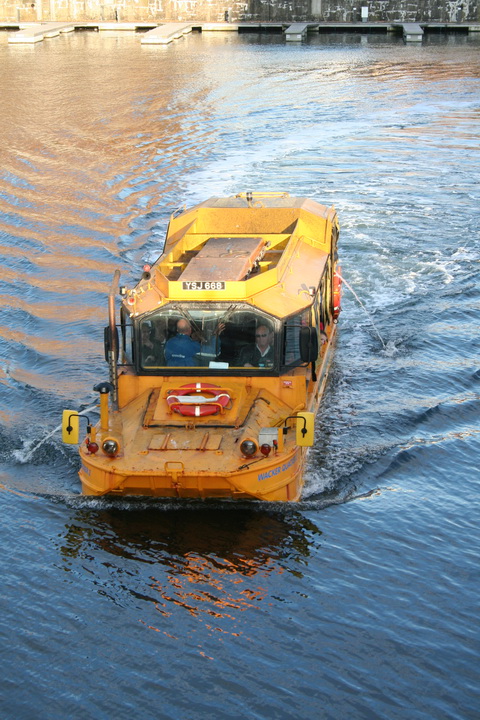
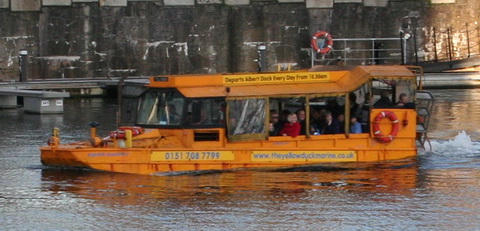
In October 2011 I was in Liverpool, where I took a couple of photos of DUKWs taking trippers around the still waters of the no-longer-used docks.

DUKW in the Salthouse Dock, Liverpool

DUKW in the Salthouse Dock, Liverpool

DUKWing under the bridge into the Albert Dock, Liverpool

DUKWing under the bridge into the Albert Dock, Liverpool

In Dublin, Viking Splash offers similar tours, with the regrettable addition of horned helmets, as not worn by Vikings. The Dublin operation seems to have added two other items that were not discernible on the Liverpool DUKW.

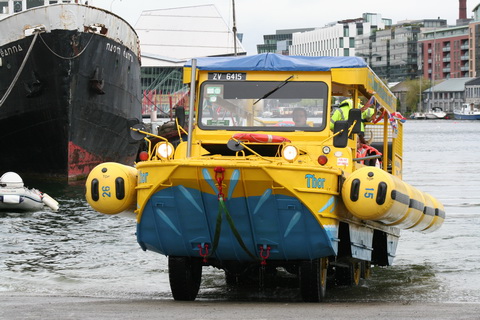
VikingSplash DUKW Thor 18_resize

Extra buoyancy on the Dublin DUKWs

First, before they enter the water at Grand Canal Dock, Ringsend, the DUKWs are fitted with extra buoyancy in cylinders that slide into racks along their sides. I saw the VikingSplash crew removing the cylinders from the yellow DUKW; it took only a couple of minutes, and I presume that it didn’t take much longer to put the cylinders on.

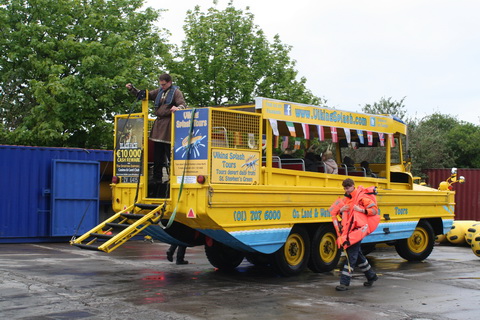
VikingSplash DUKW Thor 25_resize

Buoyancy aids being collected after the trip around the dock

Second, the Dublin passengers are issued with buoyancy aids before they take to the water. I can’t see any buoyancy aids on the Liverpool passengers, although it’s possible that they are out of camera shot.

Sometimes we complain about extra health and safety (which often means insurance) requirements. Then something like this happens: a yellow DUKW sank yesterday in Liverpool — for the second time this year. I don’t know whether the precautions taken in Dublin would have averted the accident or enhanced the safety of the passengers but it does suggest that the Maritime Safety Directorate bods in Dublin do have a point.

Addendum: the speaker on this clip says that passengers began putting on buoyancy aids, which suggests that aids were issued but not worn. Given how quickly the vessel sank, and how constricted the space inside is, it seems to me that passengers should wear their buoyancy aids throughout the waterborne trip.

Later: scary video.

Later still: a BBC story saying that a tyre may have caused the problem, the Liverpool mayor’s opinion (and some good photos) and the firm going into administration.

Longford

I thought I might make some rude remarks about Longford — the town rather than the county — but I felt I should investigate the case for the defence first. I decided to see what tourist attractions it had to offer, so I looked at the Longford page on the Discover Ireland website. It’s about the county, but that includes the town, whose many attractions will no doubt be listed. Clicking on the Highlights tab gave me a page listing three places for sightseeing:

  • Belvedere House and Gardens, which are in Co Westmeath
  • Strokestown Park House, Gardens and Famine Museum, which are in Co Roscommon
  • Corlea Trackway Visitor Centre, which is in a bog, although it is at least in a County Longford bog.

The Longford Tourism website is slightly more cheerful, mentioning walks by the Camlin on the north side of the town and along the line of the abandoned Longford Branch of the Royal Canal on the south. And the county council (I think) runs the Longford.ie website here.

Longford also has a place that fixes alternators and some nice bypasses, which is just as well as it also has the most infuriating one-way system in Christendom, allied with an almost complete lack of comprehensible signposts, especially if you want to go to Athlone, and a non-industrial wasteland to the south that adds nothing to the town’s charms.

What Longford doesn’t have is any particular reason for tourists to want to go there. So restoring the Royal Canal branch to Longford would not attract more people to the canal as a whole; it would simply displace them from elsewhere. For a boat entering the canal from the west, a night spent in Longford means a night not spent in Killashee or Keenagh or one day less to travel eastward.

The invaluable KildareStreet.com tells me that this point was not considered in a written question and answer in the Dáil on 11 June 2013.

James Bannon [FG Longford-Westmeath]: To ask the Minister for Arts, Heritage and the Gaeltacht if he will provide an update on the restoration plan for the section of the Royal Canal from Killashee, County Longford to Longford Town, in view of the fact that this has been characterised as the missing link on the Royal Canal system; and if he will make a statement on the matter.

Jimmy Deenihan [FG, Kerry North/West Limerick]: I can confirm to the Deputy that the Waterways Ireland Corporate Plan for 2011-2013, which has been approved by the North South Ministerial Council, plans for the completion of the feasibility study on the extension of the Longford Branch of the Royal Canal in December 2013, I am informed by Waterways Ireland that this study is presently on target.

I presume that, on the principle of a canal for everybody in the audience, an Inter-Agency Group will be set up shortly to find the money for the Longford Sheugh. But it makes no sense for the state to spend a penny on such a canal, although it might make sense for Longford Town Council (if it continues to exist) to spend its own money on the job of attracting visitors away from villages in County Longford.

Mr Bannon is known for his earlier attempt to promote the Irish organ.

Rail

In evidence to the Select Committee appointed to inquire into the amount of advances made by the Commissioners of Public Works in Ireland on 22 May 1835 James Pim, Treasurer to the Dublin and Kingstown Railway, said:

1431. Can you tell the average length of time which the [horse-drawn] cars took in going [between Dublin and Kingstown/Dun Laoghaire], and the distance? — I should think the average length of time taken by the cars after they got in motion, was probably 45 or 50 minutes, from Dublin to Kingstown.

1432. Are you not able to do it in 11 minutes? — Easily.

I’ve just had a look at the DART website. As far as I can see, the DART takes 19 minutes to travel from Dublin Pearse [Westland Row] to Dun Laoghaire [Kingstown]. Is the difference attributable to the number of stops?

Palindrome

“A man, a plan, a canal — Panama!”, said Leigh Mercer.

The man with the plan this time is Daniel Ortega, President of Nicaragua, who wants to build a second Atlantic–Pacific canal, capable of taking ships of greater capacity than the Panamax limits. The OilPrice story says that the canal would be more than three times as long as the Panama, with (if I understand it correctly) 130 miles of cut and 50 in Lake Nicaragua:

[…] the proposed canal could take 11 years to build, cost $40 billion and require digging roughly 130 miles of channel.

[…] the canal’s proposed locks will require 1.7 billion gallons of water per day, given that the channel will be 200 feet deep in places.

Mr Ortega hopes that China will fund the construction, which suggests that he is rather more optimistic about the Chinese economy than some others are. However, it is a thought, and one that the Inter-Agency Group on the Ulster Canal might wish to consider.

This week’s quiz: which ocean lies at the western end of the Panama Canal?


Life gets tedious …

… don’t it, when there’s no 100-page list of holders of Marked Fuel Traders Licences to plough through. Revenue didn’t update the list last week; I attributed that to the Monday bank holiday. But there was no new list today either.

Given that I probably constitute 100% of the readers of the document, I feel I should Make Representations, In The Strongest Possible Terms.

Where is it?

In 1809 Thomas Newenham included the Cloonastra amongst the tributaries of the River Shannon. There is no obvious logic to the order in which he listed the rivers, so it is not possible to deduce its position relative to other rivers.

In 1833 Charles Wye Williams listed it amongst rivers connected with the Shannon that might be noticed; he did so again in 1835. On both occasions the other rivers are identifiable and, to some extent, navigable, which suggests that the Cloonastra is a navigable tributary of either the inland or the estuarial Shannon.

If you know where it is, or what name it now bears, please leave a Comment. My best guess so far is that it might be the Hind River, which joins Lough Ree at Clooneskert and which might have been made navigable, but I have no actual evidence. There’s a Cloonmustra townland north of Ballyleague, but the watercourses look much smaller. Rinn River? I can’t find anywhere nearby that looks like a variant of Cloonastra.

No money for sheughs …

… in the government’s new €150 million election manif exchequer works programme 2013–2014, announced today. Maybe it will be in the “New PPP [public–private partnership, I presume] Pipeline”, but I note that

The Minister for Public Expenditure and Reform will be engaging with his colleagues the Minister for Education and Skills and the Minister for Transport, Tourism and Sport in order to bring forward these additional PPPs.

No mention of Arts, Heritage and the Gaeltacht, thus depriving keen investors of the opportunity of making a profitable return on an investment in the Clones Sheugh.

FF -v- SF on C18 economic development

More from the splendid KildareStreet.com, this time an actual Dáil debate, with real people speaking, on 30 May 2013. The debate was initiated by Micheál Martin [head honcho in FF, Cork South Central], who asked the minister …

… his plans for capital investment in Waterways Ireland in the coming year; and if he will make a statement on the matter.

There are three odd aspects to that question.

The first is that Micheál Martin should already know that the capital expenditure allocation for WI within RoI for 2013 is €4 071 000: I can understand that he wouldn’t have wanted to plough through the vast wodges of budgetary bumpf, but I’m sure he would have read the highlights on this site.

The second oddity is that Micheál Martin must have known that the minister would not himself have any plans for capital expenditure: they would be WI’s plans.

The third oddity is that FF didn’t seem to have any particular reason for asking this question: the rest of the debate (see below) seems rather desultory. Could it be that it’s trying to reclaim the waterways limelight from the Shinners, who’ve been keeping an eye on WI dredging as well as on thon sheugh?

To be honest, it all seems a bit pointless: waterways may be interesting to me, and presumably to readers of this site, but they’re hardly of great national importance. A serious debate, by informed participants, might be useful, but (with all due respect to the contributors) there was little sign of that here.

Jimmy Deenihan did actually give some interesting, albeit minor, details about WI’s plans for this year. I omit the first two paras and the last, which are boring boilerplate bumpf that will be familiar to regular readers.

Jimmy Deenihan [FG, Kerry North/West Limerick]: While the Waterways Ireland 2013 business plan and budget is the subject of ongoing discussions with the co-sponsoring Department of Culture, Arts and Leisure in Northern Ireland and will require formal approval by the North-South Ministerial Council, I have provided an indicative funding allocation of €4.071 million to Waterways Ireland for capital projects in this jurisdiction in the coming year. This will facilitate capital works by Waterways Ireland in developing, restoring and improving infrastructure for water based and activity recreation and tourism, consolidating facilitates and improving access to the waterways across the navigations.

I am advised that the Waterways Ireland draft 2013 business plan has a development schedule providing for 1354 m of additional moorings across the navigations. Works planned within this jurisdiction include a range of major projects such as upgrading Bagenalstown Lock on the Barrow; provision of a slipway and stabilisation of the dock walls at Grand Canal Dock, dredging the Grand Canal; development of houseboat facilities at Lowtown and Sallins; lifting the bridge at Tullamore depot; bridge upgrades, works on weirs and locks on the Shannon; and commencement of work on the Belturbet Service Block on the Shannon Erne and purchase of plant and machinery.

I said that I would welcome information about what “lifting the bridge at Tullamore depot” means. The answer was provided in the Comments below; here is a photo of the bridge in question.
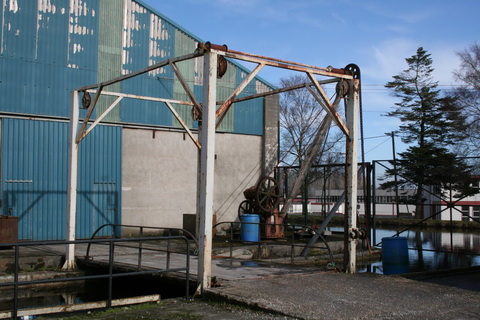
The (currently non-lifting) lifting bridge at Tullamore

The (currently non-lifting) lifting bridge at Tullamore


Most of the rest is unsurprising.

The FF follow-up came from Seán Ó Fearghaíl [FF, Kildare South], who said:

I welcome the many positive developments to which the Minister referred but one of our concerns is that since 2011 the funding available for Waterways Ireland has been cut from €35 million to approximately €32 million.

Studies over the years have shown that waterways tourism is one of the activities that is most likely to generate return visits. As a regular user of places like the Shannon Navigation, one never ceases to be amazed at the number of non-nationals one meets on that waterway who have been coming back to Ireland year in, year out. I wonder to what extent the funding the Minister has available to him should be augmented by the Department of Transport, Tourism and Sport. These waterways are of immense value to the local populations privileged to live in the catchment area of each amenity, along with their huge tourism importance. What sort of interaction does the Minister have with tourism bodies north of the Border and the Department of Transport, Tourism and Sport? Is anything planned for the waterways under the auspices of The Gathering?

What has happened in Kildare this week? We had Bernard Durkan [FG, Kildare North] the other day and Clare Daly [Socialist Party, Dublin North, but originally from Newbridge, Co Kildare] a moment ago; now we have a new chap from Kildare South.

Anyway, it can’t have come as any surprise to Mr Ó Fearghaíl that WI’s budget has been cut: so has everybody else’s, and the budgets were announced last December. I note that he didn’t ask how the Clones Sheugh was to be funded, never mind the Cavan Sheugh to Lough Oughter. But his question is the sort that a journalist might ask: vague, unfocused, couched in generalities, lacking in evidence of research into the subject. I would like to know more about his “Studies over the years”, with particular reference to the balance between and the allocation of the costs and benefits of investment in waterways; generating return visits is not in itself terribly useful (I really do not want Great Aunt Maud here again).

Not that the minister offered many hard facts in his reply:

I have seen for myself the provision of moorings at Killaloe and Ballina. Those have made a major difference to both towns in different counties on either side of the Shannon. The result of that investment is obvious and local people would accept that.

As regards involvement from Fáilte Ireland, Waterways Ireland is augmenting Fáilte Ireland’s promotion of the waterways. Waterways Ireland is providing funding on an annual basis for the promotion of tourism on its waterways. It is a North-South body, which is also very important, because Tourism Ireland promotes the entire island and the waterways network of more than 1,000 navigable kilometres can really be pushed on an all-island basis and we are doing that. I have tried to minimise the reduction in funding for Waterways Ireland because of its North-South significance and its potential and considerable work has been done. We have improved facilities for tourists so we are now ready to proactively promote this great facility.

Any, like, figures? Statistics? References to analyses? How much of WI’s budget is being diverted to the tourism bods and what is the benefit?

Next (and last) up was Peadar Tóibín [SF, Meath West], with “now for something completely different“:

A number of groups are actively trying to create a green way along the Boyne from the estuary to its source. The Boyne is littered with internationally recognised heritage monuments and would be a fantastic tourist attraction that would bring people into the region. People who holiday in the region visit Trim Castle and Newgrange on coach trips and as ar result Meath does not get the full value of their tourism. The Boyne Canal runs from Navan to Drogheda. It is not covered by the Waterways Ireland network. Would the Minister agree that such a canal should be brought within the ambit of Waterways Ireland, along with other canals, and would he consider the funds that might be available to help with the development of such a green way along the River Boyne?

The minister’s reply is interesting:

We have no plans to extend the present 1,000 kilometres of navigable waterways. The focus of our investment in capital development will be from Clones to Lough Erne to the value of €35 million.

What? No Cavan Sheugh? No Kilbeggan, Longford or Mountmellick Branch?

Oh, and note that the figure of €35 million is being quoted for the Clones Sheugh, although the last estimate I had form WI was higher than that.

The minister continued:

As regards the green way, I do not have direct responsibility but any way I can help through Waterways Ireland, I will do so. As a keen cyclist and walker, I am all for encouraging green ways wherever possible. If the Deputy has a proposal I can forward to Waterways Ireland for discussion, I will gladly take it.

Well, well. A Monaghan greenway is being developed; why not a Clones greenway too, instead of an expensive canal?

Red diesel

[European Commission] May infringements package: main decisions

Reference: MEMO/13/470 Event Date: 30/05/2013

In its monthly package of infringement decisions, the European Commission is pursuing legal action against Member States for failing to comply properly with their obligations under EU law. These decisions covering many sectors aim at ensuring proper application of EU law for the benefit of citizens and businesses.

The Commission has taken today 143 decisions, including 15 reasoned opinions and 5 referrals to the European Union’s Court of Justice. Below is a summary of the main decisions. For more information on infringements procedure, see MEMO/12/12. […]

3. Reasoned opinions […]

Taxation: Commission requests United Kingdom to ensure private boats do not use lower taxed fuel

The European Commission has formally requested the United Kingdom to amend its legislation to ensure that private pleasure boats such as luxury yachts can no longer buy lower taxed fuel intended for fishing boats. Under EU rules on fiscal marking for fuels, fuel that can benefit from a reduced tax rate has to be marked by coloured dye. Fishing vessels for example are allowed to benefit from fuel subject to a lower tax rate but private boats must use fuel subject to a standard rate.

Currently the UK law does not impose fuel distributors to have two separate fuel tanks, one with marked fuel subject to a lower tax rate and the other with regular fuel subject to a standard tax rate. As a consequence, private leisure boats can not only use fuel intended for fishing vessels but also risk heavy penalties if they travel to another Member State and the ship is controlled by the local authorities.

The Commission’s request takes the form of a reasoned opinion. In the absence of a satisfactory response within two months, the Commission may refer the United Kingdom to the EU’s Court of Justice.

(for more information: E. Traynor – Tel. +32 229 21548 – Mobile +32 498 98 3871)

h/t Michael Clarke

Limerick slavers

A passing reference in a splendid article [“Ireland and the Black Atlantic in the eighteenth century” in Irish Historical Studies vol xxxii no 126, November 2000, which you may be able to read online] by Nini Rodgers alerted me to a proposed Limerick enterprise of which I was previously unaware. Dr Rodgers’s source was Faulkner’s Dublin Journal of 27–30 November 1784, to which I don’t have access, but it was probably the source for stories in the Derby Mercury of 2 December 1784 and the Chelmsford Chronicle of 10 December 1784, both of which are in the British Newspaper Archive.

The Derby Mercury put it thus:

Extract of a Letter from Dublin, Nov 27

There is at last some Probability that a vigorous Effort will soon be made for the Establishment of a West-India Trade, that may become a national Object in this Kingdom; an African Company is now projecting to be established in Limerick, where six Vessels will sail annually for the Guinea and Slave Coast, and from thence to the West-India Islands, whose Produce they will bring Home. They will at their own Out-Fit in Limerick take on board Linens and Cottons, plain and printed, Tallow, Horns, &c. The Out-Fit of these Vessels will not exceed 3,500 l. There is nothing against this Project but the Explanation of the Act of Navigation, which our Parliament alone has it in its Power to rectify.

Apart from minor points of punctuation and capitalisation, the Chelmsford Chronicle story is the same.

Limerick was, Nini Rodgers says, the first Irish port to promote a slaving enterprise. The African Company would have traded its linens, cottons, tallow and horns for slaves, sold them in the West Indies and bought sugar with the proceeds. I don’t know whether it ever got off the ground.

In general, though, Irish merchants profited from the slave trade not by buying and selling slaves but by supplying provisions to feed the slaves on the islands, allowing the plantation owners to devote their land entirely to growing sugar.