Tag Archives: lock

Shannon passage times 1838

Estuary

Kilrush to Limerick 4 hours

Tarbert to Limerick 3 hours

Clare[castle] to Limerick 3.5 hours

Limerick Navigation

Limerick to Killaloe:

  • iron passenger boat 2.5 hours
  • timber passenger boat 3.5 hours
  • trade boat 6 hours.

Shannon

Killaloe to Portumna:

  • passenger steamer 6 hours
  • steamer towing lumber boats 8 hours.

Portumna to Shannon Harbour:

  • 6 hours.

Shannon Harbour to Athlone:

  • 8 hours.

Source: Railway Commissioners second report Appendix B No 6.

Erie warning: stuck with a sheugh

New York is a place in the Americas. There is a town of that name and there is also a state, whose economic development in the nineteenth century was assisted by the development of a canal, about which you can learn more on this excellent site. There is a trail along the canal that can be walked or cycled.

The canal is run by the New York State Canal Corporation, which is a subsidiary of the New York State Thruway Authority [a thruway is, it seems, a sort of road]. The canal loses money (naturally). The Thruway Authority sought to increase tolls; the State Controller said it should save money and improve management instead. Inter alia, it should

Commission an independent analysis of the Canal System to examine ways to streamline operations, seek new funding streams, and develop a realistically attainable vision for its future role in the upstate economy.

In his full report [Assessment of the Thruway Authority’s  Finances and Proposed Toll Increase [PDF] Office of the New York State Controller August 2012], the Controller said that

[…] the New York State Constitution forbids the Legislature to sell, abandon or otherwise dispose of the canals […]

but that

[…] choices regarding operational control and financial support for the Canal System are policy matters to be determined by the Governor and the Legislature.

His summary said that

Additional factors in the Thruway Authority‟s current weakened condition include the Authority‟s responsibility for financing and operating the State‟s Canal System as a result of legislation enacted two decades ago. The Canal System has consumed more than $1.1 billion of Thruway resources in the ensuing period. Contrary to the original legislative intent, responsibility for supporting the canals has diminished the Authority‟s ability to pursue its core mission. Moving the Canal System into the Thruway Authority was intended, in part, to stimulate tourism and economic development along the historic
canal corridors. This goal, too, has been elusive; boating activity on the canal has  declined substantially under Thruway control.

Later in the report he said

Second, the Authority‟s financial resources and organizational expertise, along with the then-newly created Canal Recreationway Commission, would position the underused Canal System to improve its facilities and marketing such that new users would be attracted from around the country, and even around the world.

Neither of these hoped-for outcomes has occurred. The Thruway Authority has invested more than $1.1 billion in the Canal System, and this drain of toll resources has also contributed to the deterioration of the Authority’s financial condition over the past decade. Meanwhile, despite major investments and new amenities, pleasure-craft activity on the Canal System in recent years is down by nearly one-third since the period immediately before the Thruway Authority assumed control.

The local media seem to take a somewhat more informed interest in their sheugh than do those in these parts:

Ireland and the United Kingdon could avoid finding themselves in these difficulties by refusing to recreate any more sheughs.


Chambers, pots

Folk knowledgeable about canal engineering and artefacts might be able to contribute to a current discussion, over at the Helpful Engineer’s website, of the Four Pots overflow and the side chambers at Lock 16 (Digby Bridge) on the Grand Canal.

Naas

An account of the official opening of the Naas Branch (County of Kildare Canal) in 1788.

After the summer

I don’t really know much about politicians, local or national, but I presume that, in the summer recess, they retire to their country estates for a bit of huntin, shootin and fishin, with breaks for trips to agreeable parts of foreignlandia (Tuscany, perhaps) and with occasional visits from other gentlefolk.

At any rate, something distracts them and keeps them quiet, but summer is now giving way to autumn and, er, innovative suggestions are coming thick and fast from politicos anxious to get other people to contribute to social and economic development in their constituencies (or to get reelected, whichever comes first).

So we have one who wants a walkway across Meelick Weir and another who wants a riverbus service on the Park Canal in Limerick.

Meelick turns up in another story from the past week, by John Mulligan in the Irish Independent. But despite the silly headline and subhead, the body of the article is a thorough and balanced account of flooding on the Shannon. Mr Mulligan is to be commended.


Two brief notes about eels

Fr Oliver Kennedy, of the Lough Neagh Fishermen’s Cooperative Society, which ran the eel fishery [PDF], has died at the age of 83.

The ESB eel-catching apparatus at Killaloe Bridge is being renewed (and not, as I feared, removed). Eels are caught now only to be transported around Ardnacrusha. Read about the fishery here and, at greater length, here.

Transition?

I am grateful to Waterways Ireland for letting me have the Shannon traffic figures for July 2013. As I said last month:

The usual caveats apply: the underlying figures (kindly supplied by Waterways Ireland) do not record total waterways usage because, for instance, sailing, fishing or waterskiing on lakes or river stretches, which did not involve a passage through a lock or Portumna Bridge, would not be recorded. The passage records are our only consistent long-term indicator of usage of the Shannon but they would not show, for instance, a change in the balance of types of activities from those in larger cruising boats to those in smaller (sailing, fishing, waterskiing) boats. It is quite possible, therefore, that overall usage might be increasing while long-distance cruising was declining.

I also said:

[…] the figures show a small increase over 2012 in passages by private boats. I suspect that July’s warm weather will spur a further increase.

And so indeed it proved to be.

Shannon all JanJul

A slight increase

July’s traffic was up enough to increase the total for the year to date: the first increase (for the period January through July) since 2003.

Here are the figures as percentages of the 2003 figure.

Shannon all JanJul %

Seven-month totals as percentages of the 2003 seven-month total

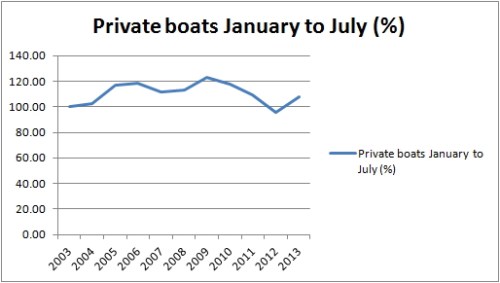
The total is still around 60% of 2003’s figure: a significant decline. But there was a marked increase in private traffic …

Shannon private JanJul %

Private traffic up

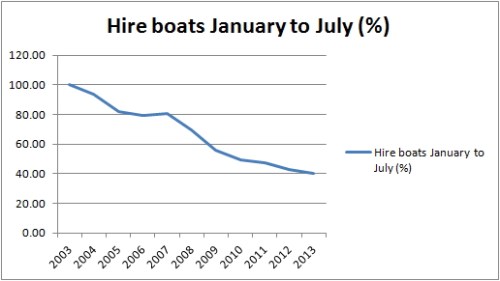
… while the decline in the hire-boat traffic continued.

Shannon hire JanJul %

Hire-boat traffic down

Over on Afloat, someone wrote that:

[…] a source close to Afloat.ie says that the falling numbers may be skewed by a growing emphasis on larger-capacity vessels on Ireland’s inland waterways, with eight- and 12-berth boats supplanting older four-berth vessels, and families and groups consolidating their recreational boating.

I don’t know what “skewed” is intended to mean. Well-capitalised hire firms may be adding larger boats to their fleets, but the number of passages is down by 60% and sources close to irishwaterwayshistory.com say that the combined hire fleet is down from about 500 to about 250 boats.

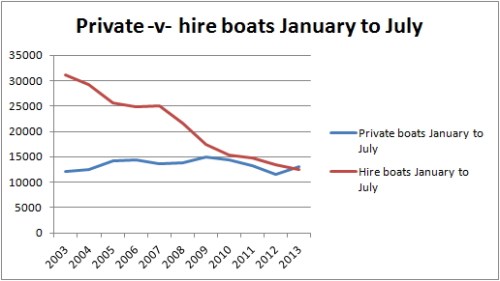
That doesn’t mean that the hire-boat industry is entirely dead, but it is much less important to the Irish waterways than it was. I don’t know of any published figures [if IBRA would like to supply them, I’ll happily publish them], but I suspect that employment within the industry has gone down and that its comparative economic importance to the Shannon and to the Irish tourist industry has declined too. And here is an interesting chart:

Shannon private v hire JanJul

The transition


For the first time that I know of, the seven-month figures show that measured private traffic outweighs hire-boat traffic. It may be that we need new approaches to attracting more overseas visitors to the Shannon. According to Waterways Ireland’s Lakelands & Inland Waterways Strategic Plan 2010–2015 (which I can no longer find on the WI website):

The mission of the Lakelands and Inland Waterways Strategic Plan is:
Throughout the Lakelands and Inland Waterways Region, to increase domestic and overseas visitors in number and revenue, while supporting existing sustainable tourism enterprises and encourage emerging tourism businesses through a series of practical business supports.

The plan was short on hard numbers for its targets, but at least as far as the Shannon hire business is concerned, it ain’t working.


Ardnacrusha drowning

Killaloe Coast Guard report.

Bottles in Limerick

Limerick has a new Economic and Spatial Plan, with lots of downloadable files and the general tone of a letter to Santa Claus. It has lots of adjectives, though, and fashionable concepts; all it lacks is money.

It wants a renaissance of the Limerick waterfront. It seems, though, that that doesn’t mean lots of dockers unloading timber, turf boats from Poulnasherry Bog, ships taking the ground at low tide, gales throwing vessels against the bridge, mills at Curragour, tolls on the bridges or other features of past life along the quays. Instead there will be things like this:

A New Public Waterfront

 Arthur’s Quay Park will be transformed into a signature Waterfront public space that draws visitors, hosts special events and provides a key stopping point within the City Centre and along the Waterfront and Riverwalk;

 This new Riverside Park will run the length of the City Centre from Sarsfield Bridge through where Sarsfield House currently stands, along between the Hunt Museum and the River and over a new pedestrian bridge into a pedestrianised Potato Market area linking up to the upgraded King John’s Castle tourist attraction;

 A new appropriately sized iconic building could be developed in the new Riverside Park on the former Dunnes Stores Site to accommodate tourism/cultural uses;

 New landscape, trees, surfaces, lighting, furniture, public art and interpretation should be structured to create a landmark WaterfrontPark, designed to international standards reflecting the prominence of this location within Limerick;

 A new space should be defined to host public events including celebrations, performance, festivals and start and finish points to Limerick based marathons and races;

 Clear, high quality pedestrian connections from Patrick Street and O’Connell Street and Henry Street would draw people to the Park;

 Signage and materials should identify the water’s edge as part of the continuous Riverwalk linking bridges across the Shannon and the two sides of the Shannon River;

 A new public open space should be created at the Sarsfield House site in the event of government office relocation, to reveal the view north along the Shannon to King’s Island from the City Centre and extend Arthur’s Quay Park;

 The Waterfront and public space at the Hunt Museum should be strengthened to provide an intimately scaled green space with external seating from the Hunt Museum restaurant and destination in its own right along the Riverwalk.

What is being proposed here (page numbered 99; page 124 of 172 in An Economic and Spatial Plan for Limerick [PDF]) is that Sarsfield House should be demolished and the area above the Custom House moorings would be opened up, with citizens not just permitted but encouraged to enter. Later on (page 108; PDF page 133 of 172) we read this:

Limerick Quays will be defined as the principal visitor and entertainment zone in the City  Centre – passive and active – accommodating a new visitor destination, walking, as well as eating and drinking in bars and restaurants that will activate the quays overlooking the River. This will be fully pedestrianised.

Now, that’s all very nice in theory, but what it means in practice is that any boats moored at the only safe moorings in Limerick, at Custom House Quay, will be within range of any bottles that may be thrown by the less domesticated portion of the citizenry, on their way home from getting tanked up in the bars and restaurants.

But perhaps the planners have thought of that and solved it in their own way. Figure 36: City Centre Proposals – Aerial View 1 on page 116 (141/172) is an aerial photo with coloured bits added; it shows the Custom House moorings. But Figure 37: City Centre Proposals – Aerial View 2 on page 117 (142/172), taken from a different angle, shows the pontoon at the corner of the weir, and the water space in the corner behind the Custom House, but the mooring pontoons have disappeared.

 

Hunt the lock

The Hunt Museum in Limerick is chiefly famous for its being accommodated in the former Custom House, which was designed by Davis Dukart [there are many variants of the spelling] who installed dry hurries on Dukart’s Canal, built in the eighteenth century to link the Drumglass coalfield to the town of Coalisland and thence to Lough Neagh, the Newry Canal and Dublin.

At the moment the Custom House has a large banner draped over it, with a picture of a canal lock on it. This is to advertise an exhibition of paintings collected by a bank. Unfortunately there is very little information about the collection on the museum’s website, so I can’t say whether the ratio of important  pics (showing canals, boats etc) to dross is high enough to make a visit worthwhile.