Tag Archives: lock

A load of old bollards

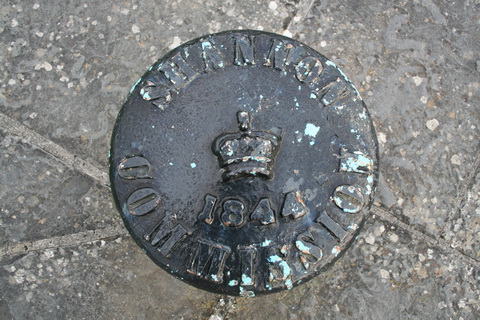
Our London Correspondent reports that the latest and most fashionable souvenir to go on sale there is a reproduction cast-iron “paperweight/doorstop/bookend based on the mooring bollards of Regents Canal”. Available in black or fluorescent red, these items were designed by a designer who was being worked with by another chap who was commissioned by a Creative Agency. The result is a “desirable antidote to the overly-commercial, tacky souvenirs” available elsewhere, it says here.

Shannon Commission bollard 1844_resize

A bollard at Meelick

Well, that’s nice. Maybe Waterways Ireland could commission the same creative types to design a range of reproductions of Irish waterways bollards; folk could be encouraged to collect the entire set.

But one minor drawback does strike me. The artistic merits of these reproduction bollards are of course obvious, but as souvenirs they have one minor drawback. A souvenir is something you buy, while on holiday, to take home to someone else. Nowadays, the steamer services are not what they once were and many folk travel on these new-fangled flying-machines. But according to that nice Mr O’Leary, who operates some such machines, you may take only 10 kg of cabin baggage. These bollards, though, weigh about 1.5 kg each, which rather limits the number of bollards you can carry as souvenirs.

Canal Boat No 279

There is a mystery about Canal Boat No 279, which sank in the entrance to Spencer Dock, on the Royal Canal, in December 1873. Actually, there are several mysteries, and readers’ comments, information and suggestions would be welcome. Read the story here.

Newcomen Bridge again

Last month I wrote about the lock at Newcomen Bridge on the Royal Canal:

Industrial Heritage Ireland has created a page giving the history of the railway crossing at Newcomen Bridge. However, it would be nice to have some documentary evidence about the resiting of the lock — and about the headroom under the bridge before the lock was moved.

Here it is, from the Freeman’s Journal of 12 April 1873, in an article about the new Spencer Docks:

Above the new metal bridge there is a basin for Canal boats, with a quayage of 450 feet at either side and a depth of six feet. In connection with the new works, the lowering of Newcomen-bridge on the Clontarf-road must be alluded to. To effect this the old lock had to be moved higher up, and the old bridge replaced by one suited for the requirements of the tramway traffic. The arch of the bridge crossing the Canal was lowered five feet, and a new girder iron bridge crosses the railway at the same level. The Main Drainage Board wisely took advantage of the opportunity of the Canal being drained to make a main sewer under the canal and the railway above Newcomen-bridge at the low level required.

Happy, Mick?

Grand Canal: propulsion

This is a point that I do not recall seeing before. It arises in a short report from the Freeman’s Journal of 17 July 1876.

SAVED FROM DROWNING. — On Saturday evening a man named Patrick Fitzsimons, while employed with others in getting a canal boat through the lock of the Portobello-bridge, fell into the basin and sank. He rose to the surface in about a minute, and was apparently exhausted, for, after a vain attempt to hold on by the projecting ledge of the boat, he went down again. There now seemed to be great danger of the man’s life being lost, but some of his companions held out one of their long “sweep” oars towards the place where he sank, and when he came up the third time he succeeded in grasping the oar and holding on till he was taken out of the water. He was then in a very weak state, and it appeared very plainly that when he fell into the basin he was not in the best condition to protect himself from accident.

I suspect that the last phrase means that he was drunk. But what is more interesting, at least to me, is that a canal boat was equipped with oars. I do not recall having read that anywhere. But we know little about the design, equipment and operation of nineteenth century canal boats. Oars would certainly be useful for moving around basins and on rivers like the Liffey, but how were the oars pivoted and how many men did it take to row a loaded canal boat?

WI mooring locations batch 5

A press release today says:

The fifth set of areas to offer the E.M.P includes locations in Dublin on the Royal Canal at Blanchardstown as well as Thomastown, Co Westmeath.  On the Grand Canal Ballycowan, Derries and Gallen in Co Offaly will open. In addition Athy and Ballyteigue both in Co Kildare and St Mullins in Co Carlow which are all on the Barrow will also open for applications on the 21st January.

As far as I can see, the rest of the text of the press release is standard information that we already knew.

To see exactly what locations will be covered in batch 5, you’ll have to check the WI website on 21 January 2013.

Dredgers

I’ve moved my pics of dredgers to a new page and added a few more.

The end of an era

Ger Reid, the Ardnacrusha lockkeeper, retired at the end of December 2012. Ger has guided many boats through the locks over the years and has always been cheerful and reassuring as well as informative, helpful, reliable and competent. He will be sadly missed but I wish him well in his retirement.

Meanwhile, I have heard that Limerick City Council has decided not to renew Pat Lysaght’s contract for work on the river and has suggested that Waterways Ireland should retain him. Pat’s most important role, though, in assisting boats passing through Limerick (220 in 2012), has always been voluntary. Were Pat to cease to provide that service, I think the number of boats visiting Limerick would be greatly reduced.

Carrying on the Royal Canal

This is a point I’ve come across in passing. It’s not central to my main concerns so I won’t pursue it further for the moment, but I’m posting it here in case it helps anyone else researching the subject.

It will be recalled that, until the passing of the Canal Carriers Acts 1845 and 1847, most canal companies carried passengers but not freight on their own canals. After the passing of those acts, the Grand Canal Company set out to take over the bulk of the freight business on their own canal (and, in consequence, on the rivers connected thereto). But what of the Royal Canal, which had been taken over by the Midland Great Western Railway in 1845?

Ruth Delany, in Ireland’s Royal Canal 1789–2009 [with Ian Bath; The Lilliput Press, Dublin 2010], says on page 192:

In 1871, despite its failure to show a profit on the Grand Canal lease, the MGWR decided to try acting as carriers on the Royal, which had been permitted by legislation since 1845. Horse-drawn boats were used until 1875 when five steamers were purchased: Rambler, Rattler, Mermaid, Conqueror and Pioneer.

In a note, she says

For this period, 1849–1906, the principal source of information is found in the minutes of evidence to the Shuttleworth Commission, HC 1907 (Cd 3717), XXXIII, Part 1, 9.

Peter Clarke, in his The Royal Canal: the complete story (ELO Publications, Dublin 1992), says:

It is important to recall that at this time, the carriage of goods on the canal was undertaken by a number of boat owners who paid tolls to the railway company. The failure to have these tolls increased was what most probably prompted the railway company to establish themselves as carriers on the canal in 1870. […] Until 1876 an unknown number of railway owned horse drawn barges were used. In that year, the service was expanded when four new screw propelled boats were purchased at a cost of £5000.

His source is the Waterways Commission of 1923, Minutes of Evidence nineteenth day, p13.

Ernie Shepherd in The Midland Great Western Railway of Ireland: an illustrated history (Midland Publishing Ltd, Leicester 1994), says

The MGW decided to operare its own carrying trade in 1871 and this lasted until 1886. Horse drawn boats were used until 1875 when steamers were purchased.

On 15 August 1853 The Freeman’s Journal and Daily Commercial Advertiser of Dublin carried this notice in the Railways column.

Midland Great Western Railway (Ireland) Company — Royal Canal

Haulage of boats

The Directors will receive Proposals for the Haulage of their Trade Boats to and from Dublin and Longford and the River Shannon, from and after the 12th November next. Parties are at liberty to tender for a part or the whole of the work. Security will be required for the fulfilment of the Contract; and further particulars may be had on application at this Office.

Tenders to be sent in on or before 10th September next.

By order, Henry Beausire, Secretary.
Dublin Terminus, 10th August, 1853

This suggests that, in 1853, the MGWR had its own trade boats (lumber boats, freight-carrying barges) at work on the Royal Canal. It would be nice to know more. I have said before that we do not know anything like the full history of the Royal Canal.

Some updates

Very often, when I’m visiting a waterway site, I take as many photographs as possible of anything that catches my eye, without worrying [at the time] about what an artefact is or what it does. Then, when I get back to my computer, I try to work out what everything was. Sometimes I find that the camera has recorded something I didn’t notice; sometimes I find there are aspects I just don’t understand (not being at all a technical person). In such cases, I put photos on this site and make it clear that I don’t understand them.

My hope is, of course, that a knowledgeable person will explain them, and that very thing has just happened with some pages on waterways of Ulster and thereabouts. John Ditchfield has very kindly explained several aspects of the machinery shown; I have inserted his explanations into the text on these pages:

I am very grateful to John for taking so much trouble and for sharing his expertise with me and with all who read these pages.

Newcomen Bridge

Mick Farrell of the HBA has pointed out that, on the Historic 6″ Ordnance Survey map (~1840), the first lock on the Royal Canal is downstream of Newcomen Bridge whereas on the Historic 25″ (~1900) the lock is upstream of the bridge.

Industrial Heritage Ireland has created a page giving the history of the railway crossing at Newcomen Bridge. However, it would be nice to have some documentary evidence about the resiting of the lock — and about the headroom under the bridge before the lock was moved.