Tag Archives: Royal Canal

Shannon traffic figures to September 2013

The current (November 2013) issue of the British magazine Waterways World (available online only to subscribers) has an interview with Dawn Livingstone, new CEO of Waterways Ireland. There was a question about visitor numbers:

How are boating visitor numbers holding up in the recession?

The type of boating is changing — more sports boats for example, and numbers, after an initial decline, have held steady in the cruiser hire and private boat fleets. But more customers are investing in active recreation — canoeing, sailing, rowing, and these clubs and holiday types are growing rapidly.

My sense of the types of boating is the same, but I do not know of any source of reliable data. I think it would be useful if Waterways Ireland were (somehow) to collect and then to publish data on these activities and their economic costs and benefits.

But I was amused by the statement that …

[…] numbers, after an initial decline, have held steady in the cruiser hire and private boat fleets.

I’m not sure what useful data there are for the Lower Bann, Shannon–Erne Waterway, Grand, Royal and Barrow, though perhaps enhanced enforcement of the regulations will improve the data for the last three of those waterways. For the Shannon and Erne, the numbers in the fleets are, I presume, derived from the numbers of registered vessels, but there is no annual re-registration and I am not clear how many boats that are removed from the navigation are removed from the registers.

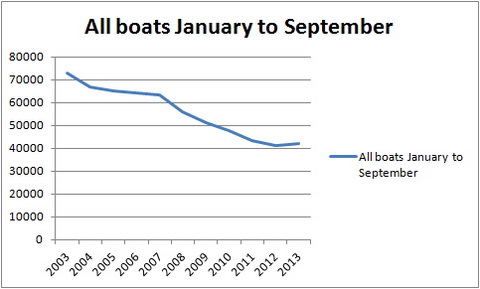
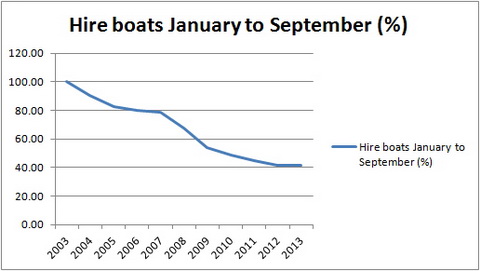
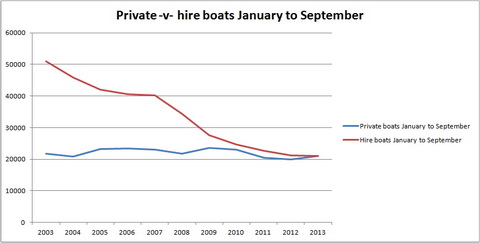
The other, indirect, measure, which applies only to the Shannon, is of passages through locks and moveable bridges. And, for hire boats, the “initial decline” has been 60% since 2003. If the numbers are now holding steady, it is at a very much lower level than ten years ago.

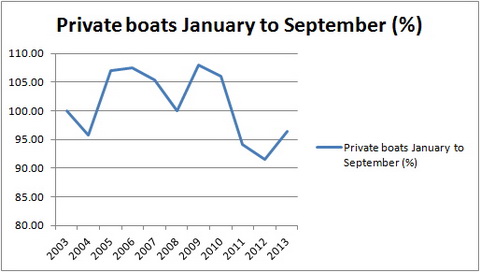
I was able to report in August that the better weather in July seemed to have led to an increase in the number of passages by private boats [the usual caveats apply]. Furthermore, for the first time that I knew of, the number of passages by private boats in the first seven months of the year exceeded the number of passages by hire boats in the same period.

I now have the figures for two more months, August and September, kindly supplied by Waterways Ireland, who are not to blame for my delay in getting the information up here.

All boats JanSept nos_resize

Look! An increase!

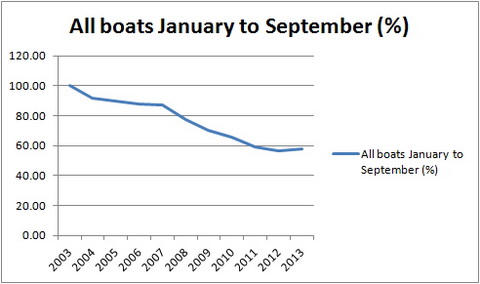
All boats JanSept percent_resize

Total passages are now almost back up to 60% of the levels of ten years ago

Hire boats JanSept percent_resize

Hire boat numbers are down by only a tiny amount

Private boats JanSept percent_resize

Private boat numbers are up

Private -v- hire JanSept nos_resize

Hire boat numbers are slightly above private boat numbers

Private boat numbers are ahead of hire in the three main summer holiday months of June, July and August and, although the numbers are tiny, in the winter months as well; hirers are ahead in spring and autumn.


Effin stats

I wrote here about Maureen O’Sullivan’s questioning of ministers about Effin Bridge, the lifting railway bridge below Newcomen Bridge on the Royal Canal in Dublin. It seems that she would like a drop-lock to replace the bridge, thus enabling boats to pass under the railway at any time without interfering with the operation of the trains. Which would be very nice, but that it would cost over €5 million and cause significant disruption to the railway during construction.

I was distressed by Ms O’Sullivan’s failure to make any sort of economic case for the drop-lock or for any other measure that might allow for free movement of boats on that section of the Royal Canal. I said:

As the expenditure on reopening the Royal Canal is a sunk cost, I am all in favour of making its use easier — provided that it can be demonstrated that (a) there is a demand for increased use, (b) such increased use will have benefits that outweigh the costs of any improvements and (c) no alternative investment offers better returns. As far as I can see, Ms O’Sullivan has demonstrated none of the three: indeed I see no evidence that she has even considered them.

Ms O’Sullivan’s position might be described as favouring an increase in the supply of possible passages along that section of the canal, but I thought it might be interesting to know what the demand for such passages was, so I asked Waterways Ireland how many boats had passed under Effin Bridge in 2013.

I was wrong about the number of days on which the bridge was lifted: nine lifts were available altogether. Six were on Tuesdays, two on Saturdays and one on a Sunday (to facilitate the Dublin boat rally):

Tuesday 16 April 2013:           0 boats
Tuesday 30 April 2013:         10 boats
Sunday 5 May 2013:            24 boats
Tuesday 21 May 2013:           0 boats
Saturday 1 June 2013:           8 boats
Tuesday 18 June 2013:           2 boats
Saturday 20 July 2013:          3 boats
Tuesday 13 August 2013:       7 boats
Tuesday 17 September 2013:  4 boats

So that’s 58 boats in a year.

I asked what the cost was: I was told that Irish Rail charges €1200 per weekday lift and €2000 per weekend lift. I presume that Waterways Ireland itself incurs other costs, perhaps overtime at weekends, but I don’t know what they are. The cost per boat for each lift was:

Tuesday 16 April 2013:           0 boats: lift cancelled as no boats wanted it
Tuesday 30 April 2013:         10 boats: €120.00 per boat
Sunday 5 May 2013:            24 boats: €83.33 per boat
Tuesday 21 May 2013:           0 boats: lift cancelled as no boats wanted it
Saturday 1 June 2013:           8 boats: €250.00 per boat
Tuesday 18 June 2013:           2 boats: €600.00 per boat
Saturday 20 July 2013:          3 boats: €666.67 per boat
Tuesday 13 August 2013:       7 boats: €171.43 per boat
Tuesday 17 September 2013:  4 boats: €300.00 per boat

The total charged to Waterways Ireland (not to the boaters) by Irish Rail was €10800.00.

Suppose that a drop-lock had been built for €5000000. Would it be worth investing that amount to save an annual expenditure of €10800? I suspect not, although I am open to correction by anyone capable of calculating NPVs or other relevant measures.

It seems to me, though, that the case for any capital expenditure is weak while demand for passages is lower than supply. Perhaps Royal Canal enthusiasts might work on attracting more boats to the Dublin end, whether from the Shannon end or from the Grand and Liffey.


Bolshevism, boats and bridges

The balance bridge crossing the canal, near Newcomen-bridge, as designed and erected under the superintendence of Mr Bindon Stoney, engineer of the Dublin Port and Docks Board, has been completed, and adds considerably to the facilities for carrying on the traffic. This bridge has been erected in substitution of a lift-bridge, constructed in 1872, but to which an unfortunate accident occurred in February, 1878.

Ralph S Cusack, Chairman, in the report of the Directors of the Midland Great Western Railway, 19 February 1879, quoted in the Freeman’s Journal 27 February 1879

In mid-October I mentioned that Maureen O’Sullivan [Ind, Dublin Central] had asked the unfortunate Jimmy Deenihan [FG, Kerry North/West Limerick, and minister for waterways] about Effin Bridge, the lifting railway bridge below Newcomen Bridge on the Royal Canal in Dublin. The bridge is lifted, to allow boats through, on [IIRC] one Saturday each month in the summer, making five lifts a year. Waterways Ireland says on its website [click Bridges if necessary]

The Newcomen Lift Bridge in Spencer Dock is owned and operated by Irish Rail, and requires a rail possession to be lifted. It can only be lifted for boats at limited prearranged times organised with Waterways Ireland. For details of opening times and to arrange passage contact the Eastern Regional Office on 01 868 0148.

Maureen O’Sullivan wanted

… a meeting of interests concerned with the operation of the lifting bridge with a view to devising a management and operational system that is less hostile to the use of the waterway as currently it is an impediment and discouragement to navigation on the Royal Canal and an obstacle to navigation-communication between the Royal Canal and River Liffey and between Royal Canal and Grand Canal at their eastern reaches […].

Jimmy Deenihan said

The bridge is operated by Irish Rail staff on a request basis at Waterways Ireland’s expense.

However, he wasn’t giving any hostages to fortune by making rash promises or even by commenting on whether the bridge was an impediment to navigation. But Ms O’Sullivan was undeterred: she returned to the topic with two written questions on 5 November 2013 and a priority question, no less, on 7 November 2013 [for certain values of “priority”]. On 5 November she asked two questions of Jimmy Deenihan

To ask the Minister for Arts, Heritage and the Gaeltacht further to Parliamentary Question No. 59 of 16 October 2013, the extent of railway track that needs to be closed by Irish Rail in order for a vessel on the Royal Canal, Dublin, to be given access between the First and Sea Levels of the Royal Canal; if there has been an assessment of whether the extent of track closure could be reduced to facilitate greater ease of navigation on the Royal canal; and if he will make a statement on the matter.

To ask the Minister for Arts, Heritage and the Gaeltacht further to Parliamentary Question No. 59 of 16 October 2013, if the option of a introducing a drop lock to replace the need of the lifting bridge has been considered since the establishment of Waterways Ireland or if that assessment was made by Waterways Ireland’s predecessors; the level of use of the sea level assumed in relation to the assessment; if the impact of the Spencer Dock Greenway was taken into account and vice versa, was account taken of the impact on the Greenway were the sea level to be made accessible to navigation by replacing the lifting bridge; if the assessment includes analysis of whether the effective re-opening of the sea level of the Royal Canal to meaningful levels of year-round traffic would be consistent with the EU’s commitment to the ‘protection and preservation of cultural heritage, in view of the fact that Dublin’s waterway’s heritage is part of the cultural infrastructure of Europe, contributing to economic attractiveness, job opportunities and quality of life; and if he will make a statement on the matter.

The ever-patient Mr Deenihan replied:

I am advised that the option of constructing a drop lock to replace the need for the lifting bridge at the location in question has been considered by Waterways Ireland but it was not deemed viable due to the estimated costs involved, given that the minimum cost for a drop lock to replace the bridge would be of the order of €5m. Work to install a drop lock at this location would also involve considerable temporary works, the extent of which would be unknown until ground conditions were assessed in detail.

I am also advised that there have been no assessments or analyses undertaken by Waterways Ireland in respect of the level of use or impact on the Spencer Dock Greenway.

I can inform the Deputy that the length of railway track disconnected from the rest of the loop line from the station when the bridge is in the ‘up’ position is approximately 16 metres. However, as the control and operation of the railway line in the vicinity of the lifting bridge lies entirely with Irish Rail, only it can indicate the extent of the permanent rail line that needs to be closed when the bridge is opened.

He might also have pointed out that €5m is more than WI’s entire capital budget, which is under €4m for all southern waterways for 2014. And if he were an argumentative chap, he might have pointed out that there is no evidence of a demand for

… the effective re-opening of the sea level of the Royal Canal to meaningful levels of year-round traffic …

and no evidence that it would be of any economic benefit to anyone, least of all the residents of Dublin Central, even if boats were travelling that way every day of the week.

He might, if he were an impatient sort of chap, have pointed to the idiocy of the “cultural heritage” argument: with one or two minor exceptions, pleasure craft were not part of the “cultural heritage” of the Royal but, even if they were, such “heritage” wouldn’t be worth millions that might be spent instead on bringing soup to the deserving poor of Dublin Central.

Ms O’Sullivan was back with more on 7 November, this time trying to get Leo Varadkar [FG, Dublin West] to get the National Transport Authority to include Effin Bridge and the Sheriff Street non-lifting bridge (not a Scherzer) included in a National Transport Authority study of “the management and movement of people and goods to, from and within Dublin city centre”. Ms O’Sullivan’s rather confused and confusing case seemed to be that there was a greenway, and there were walking and cycling routes along the canal, so a road bridge (that works perfectly well for carrying a road) and a railway bridge (that works perfectly well for carrying a railway) should be included  in the study because the canal has navigational potential.

Or something. She even managed to bring water polo [does she mean canoe polo?] into the argument.

As far as I can see, walking, cycling, road travel and rail travel — and even water polo — are not in any way adversely affected by the current arrangements, while the canal is of negligible importance in the movement of people and goods. Boating on the canal is a leisure activity for a small number of people who are sufficiently well heeled to own pleasure-boats; I am rather surprised to find that their interests are a matter of such concern.

As the expenditure on reopening the Royal Canal is a sunk cost, I am all in favour of making its use easier — provided that it can be demonstrated that (a) there is a demand for increased use, (b) such increased use will have benefits that outweigh the costs of any improvements and (c) no alternative investment offers better returns. As far as I can see, Ms O’Sullivan has demonstrated none of the three: indeed I see no evidence that she has even considered them.

What’s depressing here is the absence of any indication of a rational approach to capital spending on waterways. They’re still cargo: a magical source of wealth, that will bring peace and prosperity as long as we all believe in fairies and avoid facts, thinking and analysis.

No wonder the country is in a state of chassis.

Update 15 November 2013: some information about demand for passage under Effin Bridge.

Horses on board

An ad from the Freeman’s Journal of 11 September 1876 provides a snippet of information about horse haulage on the Royal Canal, with a point that I cannot recall seeing anywhere else about Irish waterways. Here’s a French example and here’s an American from this excellent page.

Fun for anoraks

Lots of info on the WI website:

I liked the bit on this page:

Enforcement

Boats in non-compliance with the bye-laws will enter an enforcement process. Enforcement is undertaken by Authorised Officers and will begin with a notification in the form of a sticker and if non-compliance continues may result in the ​craft being removed from the navigation at the owners cost.

I wonder about investing in a crane company.


WI’s budget: the minister speaks

I wrote here about the implications of the RoI 2014 budget for Waterways Ireland. The minister, Jimmy Deenihan [FG, Kerry North/West Limerick], spoke about it in the Dáil on Wednesday 16 October 2013 [h/t KildareStreet.com]. At the end of his lengthy contribution he said:

I am committed to developing North-South co-operation within the broader arts, heritage and commemorative activities of the Department as well as through the funding of North-South bodies. A provision of €38.3 million will be made available to support the two North-South implementation bodies, An Foras Teanga, comprising Foras na Gaeilge and the Ulster-Scots Agency, and Waterways Ireland. The provision will enable Waterways Ireland to deliver on its core activities and targets, which include keeping the waterways open for navigation during the main boating season and promoting increased use of the waterways resource for recreational purposes. This expenditure should also assist in developing and promoting the waterways, attracting increased numbers of overseas visitors and stimulating business and regeneration in these areas. Capital funding of almost €4 million will be made available to Waterways Ireland to facilitate the ongoing maintenance and restoration of Ireland’s inland waterways, thereby increasing recreational access along the routes of waterways.

The Government has reaffirmed its commitment to continuing to make progress, to improving the economy, to exiting the bailout, and to helping to create jobs. The Department and the sectors it represents will make a significant contribution to this work over the course of 2014.

I pointed out last year that Waterways Ireland is part of northsouthery and that, at budget time, we don’t get a breakdown of the northsouthery budget between An Foras Teanga and Waterways Ireland. In 2011, WI got roughly 60%, but I don’t know what happened after that. Here’s what I thought was happening last year:

Current spending (WI)

2010 Estimates: €25 585 000
2011 Estimates: € 24 335 000
2012 Estimates: €22 929 600 (60% of €38 216 000)

Capital spending (WI)

2008 Estimates: €11 000 000
2009 Estimates: €10 300 000
2010 Estimates: €8 000 000
2011 Estimates: €6 000 000 (or €6 002 000)
2012 Estimates: €4 500 000 (or €4 502 000) (100%)

In his speech, above, the minister said that northsouthery is going to get €38.3 million and that Waterways Ireland is to get capital funding of €4 million. However, the €4 million is included in the €38.3 million. The expenditure report [PDF; see page 160] gives these details:

  • for 2013 northsouthery had €36 210 000 of current spending; for 2014 it will get €34 425 ooo
  • for 2013 northsouthery had €4 080 000 of capital spending (all, or almost all, of which was for Waterways Ireland}; for 2014 it will get €3 958 000
  • the overall budget for northsouthery is down 5%.

We can calculate that the capital budget is down about 3%; the much larger current budget is down 5%. If WI gets 60% of the total, its current expenditure contribution from RoI will be €20 655 000, down over €2 000 000 from the previous year and about €5 000 000 since 2010, and its total current expenditure (85% RoI, 15% NI) will be €24 300 000.

The other interesting part of the minister’s speech is what WI is expected to do:

  • promoting increased use of the waterways resource for recreational purposes
  • developing and promoting the waterways
  • attracting increased numbers of overseas visitors
  • stimulating business and regeneration in these areas
  • increasing recreational access along the routes of waterways.

That should keep them busy. But I omitted one activity:

  • keeping the waterways open for navigation during the main boating season.

Emphasis mine, but does this mean that winter boating (at least if it involves staff time, eg at locks) will become a thing of the past?


Maureen O’Sullivan and Effin Bridge

A knowledgeable written question [h/t KildareStreet.com] from Maureen O’Sullivan [Ind, Dublin Central] about the Effin Bridge over the Royal Canal at Newcomen Bridge:

To ask the Minister for Arts, Heritage and the Gaeltacht if he will identify the parties concerned with the operation of the lifting bridge which occupies the site of the original first lock on the Royal Canal Newcomen Bridge, Dublin 1; the factors that contribute to the status of the lifting bridge; if he will convene a meeting of interests concerned with the operation of the lifting bridge with a view to devising a management and operational system that is less hostile to the use of the waterway as currently it is an impediment and discouragement to navigation on the Royal Canal and an obstacle to navigation-communication between the Royal Canal and River Liffey and between Royal Canal and Grand Canal at their eastern reaches; and if he considers the lifting bridge could be re-engineered as a dropping bridge.

The minister, Jimmy Deenihan [FG, Kerry North/West Limerick], responded:

I can advise the Deputy that the parties concerned with the operation of the lifting bridge over the railway line close to Newcomen Bridge are Irish Rail and Waterways Ireland. The bridge carries the rail line from Connolly Station to the lower line link to the docks area. The bridge was procured and installed by Waterways Ireland’s predecessors. The bridge is operated by Irish Rail staff on a request basis at Waterways Ireland’s expense. The option of introducing a drop lock to replace the need of the lifting bridge has been considered but not deemed viable due to the cost estimate involved.

Note that the question was about a “dropping bridge” but the answer was about a “drop lock”.

The answer suggests that the number of lifts each year is a function of the number of requests made by Waterways Ireland; it would be interesting to know whether that it actually so. If it is, then WI’s budget [cut again] is probably the ultimate determinant; if Irish Rail has a say in the matter, its operational needs may influence the decisions.

I cannot think of any cost-effective solution. I am not convinced that the bridge in itself discourages navigation.


Up with this sort of thing

Folk interested in the history of the Shannon before 1850 may like to know of a talk …

The smart green technology of the 1830s: the Shannon steamers and the definition of Ireland

… to be delivered to the Thomond Archaeological and Historical Society on Monday 4 November 2013. It’s in Room T.1.17, TARA Building, Mary Immaculate College, Limerick, at 8pm.

A related topic …

Charles Wye Williams and the Anglo-Irish Trade

… will be discussed in one of the papers at the Eighth [British] Waterways History Conference on Saturday 26 October 2013 at the University of Birmingham. Leave a Comment below if you would like contact information for the conference.

Permits

Access, mooring and passage-making on the Grand & Royal Canals and Barrow Navigation are controlled by means of permits. Bye-law amendments are currently with Waterways Ireland sponsor departments which will enable the organisation to bring in further types of permits and differentiate fees for services provided along the canals.

There are three type of permits in place all with different requirements which enable the boater to suit their own style of boating while remaining within the Bye-laws.

From WI’s website.

Not weed?

Waterways Ireland and the Japanese knotweed, courtesy of KildareStreet.