Tag Archives: Royal Canal

Shannon history

Folk interested in the history of the Shannon Navigation, and in particular in the work of the Shannon Commissioners in the 1840s, may like to get hold of an article “Steam, the Shannon and the Great British breakfast”, published in the Journal of the Railway & Canal Historical Society Vol 38 Part 4 No 222 March 2015.
Belleek to Tralee in 10 hours by inland waterway

Learned Readers are undoubtedly familiar with Design-Driven Innovation, but I’m afraid I hadn’t come across it until I read a conference paper: S McCartan, P Murphy, R Starkel, A Sánchez González and M López Cabeceira “Design-Driven Innovation: Sustainable Transport Opportunities for the Inland Waterways of Ireland”, read at the fifth annual conference of the Irish Transportation Research Network at the University of Limerick from 3 to 5 September 2014.

The paper [PDF] can be downloaded free from Sean McCartan’s page on the academia.edu site, though you have to be registered with the site; the paper is also available, I think, from researchgate.net, but I’m not registered there so I haven’t tried the download.

As I understand it — and I am a Bear of Very Little Brain, and Long Words Bother me — Design-Driven Innovation means that a lot of clever chaps and chapesses come up with new and brilliant ideas and then ask people what they think of them:

The process of Design-Driven Innovation is an exploratory research project, which aims to create an entirely new market sector for a given product through changing the design meaning the user has for the product.

It seems that, in Ireland, 99.1% of freight travels by road, leaving just 0.9% for rail; 82.8% of passenger traffic is by car and 14.4% by bus and coach, leaving just 2.8% by rail. Waterways transport could use existing ports and canals; once the canals had the right bridges and automatic locks, running costs would be low. West coast ports could be used by a “coastal cruiser service”; people could travel by fast boat from Donegal right around the west and south coasts to Rosslare. All of this would reduce the carbon dioxide footprint (assuming, of course, that folk on the west coast wanted to travel, or needed to send goods, to anywhere else on the west coast rather than to Dublin).

On the inland waterways, 139 catamaran CLF vessels (Cruise Logistics Ferries) could run from Belleek to Tralee. Travelling at 22 knots, and ignoring lock times, they would complete the journey in only 10 hours; they could carry freight but also carry passengers in green luxury. These CLFs would be 81 metres long and 25 metres wide; each could carry 20 TEUs. At sea, 26 high-speed (40-knot) CLFs could each transport 12 TEUs from Cork to Dublin in just under four hours. And solar-powered catamarans on the Shannon and Erne could carry 64 passengers at 12 knots.

Meanwhile, the Grand, Barrow and Royal would not be forgotten. They would have a fleet of 1549 unmanned canal catamarans, with autonomous control systems, powered either by batteries or by fuel cells, ultimately fed from wind farms. They would each carry two TEUs but could also be converted for tourist cruising.

The overall aim, with those numbers of boats, is to replace half of the amount carried by road.

The paper concludes:

This is a first step in the analysis of the potential of the coastal and inland waterways of Ireland, to meet the EU targets for transport. State aid has been identified as a potential funding mechanism to support the realisation of these proposals.

Sometimes I wonder.


Cycling the MGWR

From Michael Geraghty:

There is a photography exhibition currently running at the National Photographic Archive in Temple Bar’s Meeting House Square called Midland – Lár Tíre: Cycling the MGWR from past to present and features photographs along the 1,000km old Midland Great Western Railway (MGWR) network. The photographer, Pamela De Brí (my sister), cycled the 1,000km and recorded her journey as photographs and audio tapes.

The exhibition will run until Sunday 24 May 2015 and here is a link to an article on the Journal.ie.

The history of the MGWR is linked to that of Irish waterways more closely than, I think, that of any other Irish railway.

Canals conference 7 March 2015

Information posted at the request of the organisers


Inland Navigations of Ireland Historical Society
in partnership with
The Heritage Boat Association

The Canals of Ireland

Saturday 7 March 2015

Hugh Lynch’s Function Room, Tullamore, Co Offaly

Programme

Memorial Slides Conor Nolan 09.30
Welcome Gerard Bayly 09.55
Session 1 Chairperson Judie Lambert
The Canals of Europe Mike & Rosaleen Miller 10.00
The Canals of Ireland Colin Becker 10.20
Coffee break 10.40
Saving the Royal Niall Galway 11.00
Fighting for the Grand Mick Kinahan 11.20
Living on a Canal Eric Kemp 11.40
Morning Question Time 12.00
Lunch break 12.30
Session 2 Chairperson Kristina Baker Kenny
Newry Canal Geraldine Foley 13.30
Limerick Navigation Raymie O’Halloran 13.50
John’s River Brian Simpson 14.10
Grand Canal Kilbeggan Branch James Scully 14.30
Boyne Navigation Seamus Costello 14.50
Coffee break 15.10
The Future Joe Treacy 15.25
The Future Brian J Goggin 15.45
The Future Nigel Russell 16.05
Evening Question Time 16.25


Details

Admission:                          €12
Breaks:                                Tea/coffee included
Lunch in room:                   Soup and sandwiches included
Music:                                 Live music session during lunch
HBA:                                   Merchandise for sale
IWAI:                                  Merchandise for sale
Authors:                              Books for sale

Directions

Hugh Lynch’s Pub, Kilbride Street, Tullamore, Co. Offaly

087 250 5422


Overloaded boat

A Railway Wanted. — On Thursday week the fly-boat on the Grand Canal was so crowded with passengers returning from Ballinasloe fair, that between Tullamore and Philipstown they sat nearly up to their knees in water. Not liking the comfort afforded by such a mode of conveyance, many of the passengers left at the latter place and took cars, and the boat proceeded to Dublin without accident.

London Standard 28 October 1845 quoting the Longford Journal

Greyways and the Black Bridge

Martin McGuinness [SF] was asked recently, in the Northern Ireland Assembly, about blueways:

Leslie Cree [UUP]: It was interesting to read that Waterways Ireland has developed this first blueway in the Carrick-on-Shannon area. Can he share with us if, in fact, Waterways Ireland has developed any projects for the Erne waterway itself?

Mr McGuinness said:

These projects are under ongoing consideration by Waterways Ireland, as the development of blueways and greenways could add to our tourist potential. It is clear from how greenways have been used, particularly in the west of Ireland, that they have huge health benefits for those now walking and cycling and involved in physical activity.

There is a proposal for another greenway from Derry city to County Donegal. Blueways and greenways offer important tourist potential, and it is exciting to see that Waterways Ireland is considering the linkage in the Leitrim area and how it can be extended to Lough Erne.

But, if I might remind TPTB, not everybody likes walking, cycling and physical activity; not everybody is going to be rolling around in a kayak or paddling a canoe. There are older folk, there are those who rightly view exercise with the gravest of suspicion and there are those whose interests simply lie elsewhere.

The Greyway concept

It is for such folk that I have developed the Greyway [TM]  concept. It’s the same as a blueway or a greenway but without the sweating or the lurid dayglo clothing.

The basic idea is that you form a “route” or “way” as a marketing concept to get more people using your existing assets. Your expenditure is low: research, product development, marketing and information provision rather than infrastructure; self-guided rather than staffed user experiences. Direct income might be low too, although there may be ways to extract cash from users; there might also be spin-off opportunities for other providers. [All my usual reservations about small-scale providers apply here too.]

There might be Greyways catering for

  • walkers: gentle walks with opportunities for sitting down, drinking tea and getting a taxi back to the start
  • drivers: long-distance routes taking in several sites
  • boaters: most of Waterways Ireland’s sites are accessible by water and by road. Furthermore, some trip boats might use elements of the Greyway material in providing information for their passengers.

Themes

You need a theme to attract people: “come and walk/drive the X Greyway and see all the lovely/interesting Ys”. No doubt there are several possible values for Y: bunnies, trees, fish, bogs, hills …. But the main thing that Waterways Ireland has to sell, and that it does not currently sell, is its industrial heritage. The Shannon, in particular, exists as an improved navigation only because of (a) steam, (b) the British industrial revolution, (c) Irish agriculture and (d) low politics. And industrial heritage is something that interests some at least of the older folk. Package it into routes and sell it for grey pounds, euros or dollars.

There is all sorts of interesting stuff along the Shannon, mostly just lying there, and it should be put to work. The most concentrated section is along the old Limerick Navigation, from Limerick to Killaloe: for instance, last time I looked seven of the original twelve milestones were still present. [The distance was 12 Irish miles, approx 24 km or 15 statute miles.] It’s a walkable route and it includes

  • the neglected Black Bridge at Plassey, whose very existence reflects the Victorian version of Just-in-time delivery
  • the bridge and artefacts at O’Briensbridge
  • the richest waterways heritage site in Ireland at Killaloe.

But there could also be driving tours along the middle Shannon, between Portumna and Athlone, where there is lots to see, and from Lanesborough upwards. Shannon Harbour might eventually house a museum ….

ERIH

What I’m suggesting is that Waterways Ireland should designate the Shannon as the first route (as opposed to site) in Ireland within the European Route of Industrial Heritage [ERIH] framework. ERIH’s website includes descriptions of the route system and of anchor points, which may be too advanced for present use, but why not a European Theme Route in Transport and Communication? Ireland might even make a case for the use of advanced (or at least interesting) transport technology (steamers) in carrying agricultural produce to industrial markets.

Furthermore, if CIE were to cooperate, the railways might be brought in too, and the livestock trade, and Dublin Port, and a regional route linking to Liverpool and the railway to Manchester ….

There is an interesting story to be told about the Shannon and its links to the east coast and beyond; its industrial heritage could be used to attract tourists and entertain natives.


Tourism and beer

According to Padraig Cribben of the Drinks Industry Group of Ireland [which seems to include the brewers of the beers we don’t drink],

[…] the latest figures I have seen show that 35% of foreign tourists do not move outside Dublin. That creates a massive challenge. That challenge is being addressed, initially through the Wild Atlantic Way, but even if one looks at the figures for that, my understanding is that while it was very successful last year, two thirds of all visitors to the Wild Atlantic Way were domestic visitors. There is still a great deal of scope there and it will pay more dividends over time.

There is an initiative due to happen in 2015 which is being broadly termed “south and east” and involves a trail from the Boyne Valley through to the heritage centres in the south east. In 2016 or thereabouts, a whole waterways section will relate to the Shannon and the canals to increase the dispersal.

Jolly good, but why is the drinks industry announcing this? Whose initiatives are these? Who else is involved? More info and links welcome, please.

By the way, Mr Cribben also said

The other point to make is that the Irish pub is unique. It is not just unique here, it has been replicated around the world.

I’m still trying to work out what “unique” means there.

Folk seeking interesting Irish beer should start with the Beoir directories.

Royal water

An interesting piece of information from Waterways Ireland’s feasibility study on the restoration of the Longford Branch of the Royal Canal. We learn on page 44 that the Royal Canal needs, on average, 10 million gallons of water per day to cope with “lockages, leakage, seepage and evaporation” and that the current supply arrangements, with much pumping, are costing €300,000 a year.


Sorry, Longford

Waterways Ireland’s Feasibility Study into the Restoration of the Longford Branch of the Royal Canal is available for download [7 PDFs: main report + 6 appendices]. Skip straight to page 59:

6.5 Recommendation

Given the current financial climate and because of the associated costs, environmental issues and uincertainty regarding planning approval it is not recommended to pursue this project any further at this time.

The recent work undertaken in regard to the shared walkway/cycleway has protected the asset as a publicly owned recreational amenity and it is recommended that any outstanding property issues be resolved and finalised in order to complete the protection of the asset.

I hope that admirable recommendation survives the pre-election period.

By the way, there’s a snail ….

Royal Canal drawbridge

According to the Freeman’s Journal of 5 April 1837, Henry Garnett was

superintendent or agent to the èxtensive and highly respectable firm of Purcell and Jameson, coach proprietors.

Their offices were in Sackville Street. On Sunday 2 April 1837 Mr Garnett had been on his way home to [Royal] Canal Terrace when

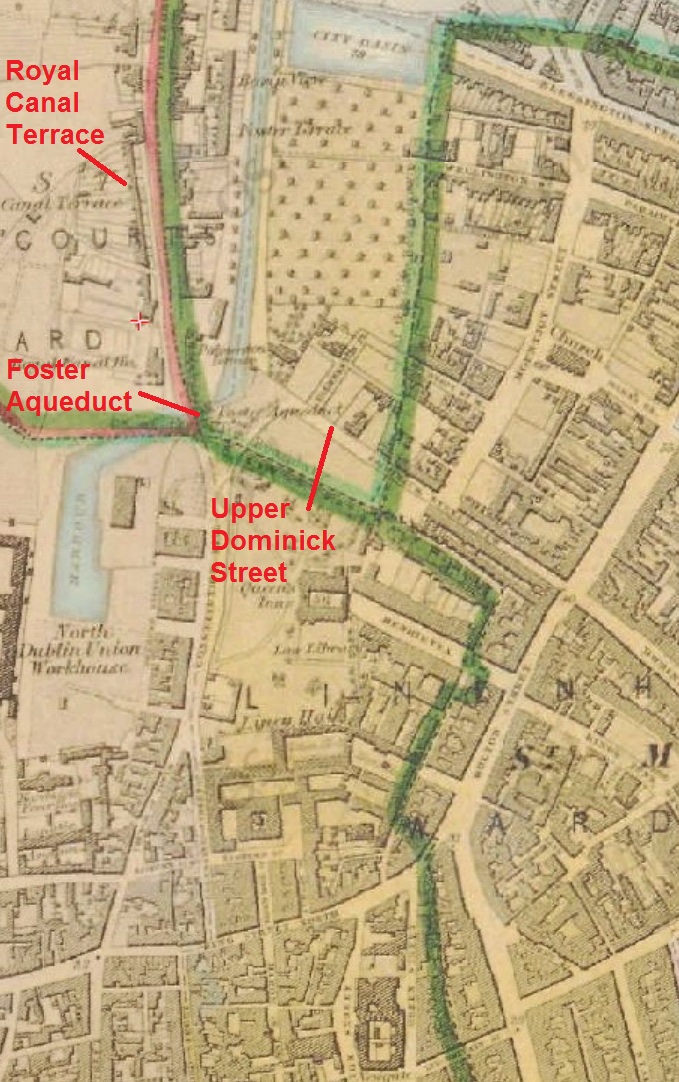
as he ascended the hill at the bend of Upper Dominick-street he met a man habited in a dark cloak, and having a cap on his head, who, after looking him steadfastly in the face, opened the cloak, and fired at him.

The man was not more than a yard away, so close that the powder scorched Garnett’s hand, but the bullet struck a suspender button, wounding but not killing the victim.

The scene of the crime

The scene of the crime [OSI ~1840]

William Cagburn heard the shot and also heard Garnett calling out

I am shot — stop the murderer, he has run in the direction of the aqueduct.

Cagburn gave chase:

He instantly pursued, crossed the draw-bridge, and came under the aqueduct, when he saw the prisoner running along the Phibsborough road.

Cagburn and the watchman seized the man; the watchman took two pistols from him and another witness found a third, discharged, pistol nearby on the pathway.

The prisoner, Christopher Clanchy, had been a road maker for eight years. The Freeman’s Journal said:

While a contractor for repairing part of the Ashbourne road, in the employment of Messrs Bourne, he [Clanchy] was allowed to travel free by Mr Purcell’s coaches, and Mr Garnett in the discharge of his duty having occasion to withdraw this privilege, hence proceeding his desire to be revenged. […] We are happy to state Mr Garnett is not likely to suffer any inconvenience from the injury.

But of more interest for this site is the route taken by William Cagburn. What or where was the drawbridge he crossed?

Foster Aqueduct

Upper Dominick Street and the Foster Aqueduct [OSI ~1840]

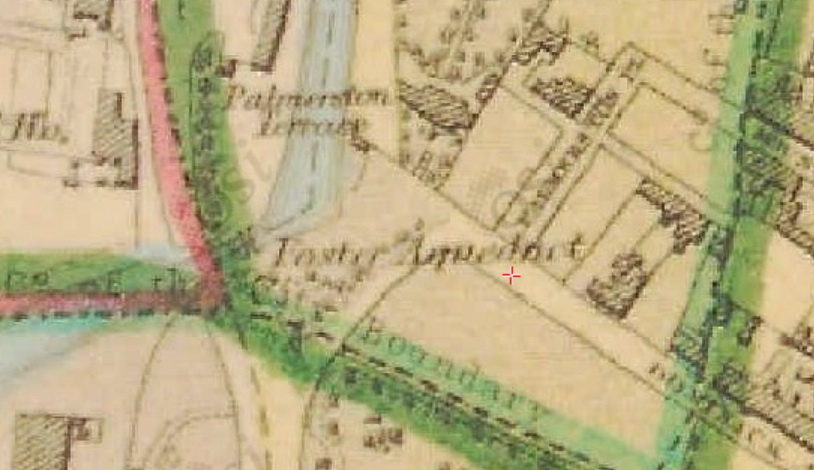
I haven’t come across [or at least I haven’t noticed] any previous mention of a drawbridge in this area. I presume that it was across the canal. And, looking closely at the map extract above …

Possible site of drawbridge

Possible drawbridge [OSI ~1840]

… I see what might be a bridge just to the left of the F of Foster. It shows up more clearly on the black and white OSI map. At Clanchy’s trial before the Commission of Oyer and Terminer, reported in the Freeman’s Journal of Monday 26 June 1837, the bridge was said to be a wooden bridge; George Cayburn [probably the William Cagburn named in the earlier report] described it as “the swinging bridge”.

Perhaps Mallet’s Insistent Pontoon merely replaced an old nuisance with a new.

Clanchy, incidentally, was found guilty: there were suggestions that he was insane, but the jury rejected them. Baron Richards said [Freeman’s Journal 1 July 1837]

The court had no discretion but to pass the extreme sentence of the law, that he should be hanged by the neck […].

Purcell, Garnett’s employer, had requested a commutation of his sentence; Richards said that it was open to Clanchy to memorial for a commutation, and the court would put no obstacle in his way; indeed it hoped he would meet the mercy “which he would have denied his intended victim”. I do not know what happened to Clanchy.

Update December 2016

The Warder and Dublin Weekly Mail of 26 September 1835 mentions the bridge:

Monday night a respectable looking elderly man fell into the Royal Canal Basin, at the Broadstone, on the Dominick-street side, within a few yards of the draw bridge.

A canal employee called Keybourne hauled Mr White out within a few minutes, but he was DOA at the Richmond Hospital.

This seems to confirm that the bridge was moveable and was where the OSI map suggests.

From the BNA

My OSI logo and permit number for website