Tag Archives: steamer

A London pub and the history of the Shannon

Piloti’s “Nooks and Corners” column in the latest issue of Private Eye [No 1325] reports [brief extract available to non-subscribers here] that a London pub is threatened with demolition. On the Google satellite view with photos, press the button to the bottom right of the building to see a pic headed “Derelict pub”.

Piloti says that the pub was built in the 1840s [Diamond Geezer says 1839] and at that time the Marquis (or Marquess) was Henry Petty-Fitzmaurice, 3rd Marquess of Lansdowne, KG, PC, FRS. The family’s main base was in Britain but they owned large estates in Ireland, notably in Counties Limerick and Kerry; certain roads in Dublin are also named after the family.

The late Marquis has two claims on the attention of Irish waterways enthusiasts. First, the best-known of the early River Shannon steamers, the Lady Lansdowne, was named after his wife. Second, he was Lord President of the Council [the current holder of the post is Nick Clegg] when the government of Her Late Majesty Queen Victoria decided, in 1839, to spend about half a million pounds improving the Shannon Navigation.


How to collide

Cases, however, occasionally arise in river navigation, wherein it is not possible to avoid collision, either with vessels, barges, or boats; as, for instance, in the pool, near the Tower, &c, owing to the very crowded condition in which such places are generally found; being surrounded on every side by one or the other. In such a dilemma the only alternative is to stop the [paddle-]wheels, and let the vessels close together as easy as possible, taking care to guard the sides and paddle boxes with fenders, and using every endeavour to boom each other off; after which, let the Steamer drift with the tide, but watch an opening among the vessels for escape, and, so soon as it offers, set her on at rather better than half speed, in order to insure a command of her.

It is somehow consoling to know that even Commanders RN have been known to collide ….

The quotation is from Commander Robert Otway RN An Elementary Treatise on Steam, more particularly as applicable to the purposes of navigation, with a familiar description of the engine; Shewing the manner of its management in giving the Rotatory Motion; how started, eased, and stopped; the Nature and Properties of Steam, on both High and Low-pressure principles; its introduction into, and discharge from, the Cylinders, illustrated; as, also, how to ascertain the quantum of Actual Pressure at which the Engine is working; and the manner of Condensing Steam explained; together with a General Account of the operations of the Engine-Room; shewing the Accidents to which Steam Boilers are liable, and means of prevention; and, further, the Economy of Coals, how to be effected, &c, &c G Poore, Plymouth 1837.

This is a very readable book, available here as a free Google PDF, giving an interesting insight into the problems of the early naval steamers — and of their engineers.

Theatre steam

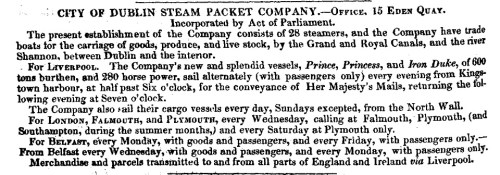
The Abbey Theatre has announced that it has bought Nos 15–17 Eden Quay, Dublin 1. No 15 was the address of the main offices of the City of Dublin Steam Packet Company.

From the Dublin Almanac of 1845

The company crest is said to be still on the wall. Abbey Street Old seems to run between the two premises; no doubt there will be some means of avoiding any problem.

I wish the Abbey Theatre well in its extension, but I hope it will find some way of honouring the memory of the City of Dublin Steam Packet Company and of the underrecognised Charles Wye Williams.

The Repealer

Here is a brief account of a trip from Waterford to new Ross by steamer in 1842.

The Lagan and Lough Neagh in 1830

Philip Dixon Hardy wrote in The Northern Tourist, or Stranger’s Guide to the north and north west of Ireland: including a particular description of Belfast, the Giant’s Causeway, and every object of picturesque interest in the district referred to William Curry, Jun and Co, Dublin 1830:

The river Lagan, although of very considerable breadth in the immediate vicinity of Belfast, and running nearly thirty miles, is yet by far too inconsiderable to be of any great advantage to the town in the way of trade or commerce. By its means, however, a regular communication is kept up between Belfast, Lisburn, and Lough Neagh. Since the year 1755, upwards of £100,000 have been expended in forming a canal, by the assistance of cuts in various places along the line of the river, where it was found too shallow for lighters to pass.

The Lagan Navigation Company have now the direction of the entire line, and have made such judicious improvements, as materially to promote the desired object — a speedy transit of goods and merchandise. This, however, can, after all, be only partially accomplished, as, from the circumstance of the Company not being able to have a horse-track-way along the entire line, nor to introduce steam power, the journey can be performed in a much shorter space of time by waggons and drays going direct. On Lough Neagh there is a small steam-vessel, by which the goods taken up in the lighters are rapidly conveyed to the different towns which lie in various directions round that extensive sheet of water.

W A McCutcheon, in The Canals of the North of Ireland David and Charles, Dawlish 1965, confirms the point about the trackway:

As a result [of various improvements in the early 1800s] traffic greatly increased, though water supply problems remained, and there was a horse-towing path for only part of the length of the navigation.

He gives no details, though, so I don’t know why the trackway was incomplete, how lighters travelled on those stretches that had no trackway or when and how the deficiency was remedied. My guess is that those stretches were along the river rather than the artificial cuts and that the riparian landowners were unhelpful, but I would welcome further information.

McCutcheon does not mention the steamer on Lough Neagh. However, D B McNeill mentions it in Coastal Passenger Steamers and Inland Navigations in the North of Ireland Belfast Museum and Art Gallery Transport Handbook No 3 1960:

The first steamer on the lough was the Lagan Navigation Company’s Marchioness of Donegall. She was built by Ritchie and MacLaine of Belfast, her engines were obtained from David Napier of Glasgow and she was launched at Ellis Gut in November, 1821. She was the first inland navigation steamer in Ireland and was used for towing the Lagan canal boats across the lough. When new, she was reputed to have had a speed of two knots. She was uneconomical and her owners tried to sell her in 1824, but there were no buyers. It is believed the Marquess of Donegall used her occasionally as a yacht. She was broken up sometime about 1840 and her engines were stored in Belfast.

In his Irish Passenger Steamship Services Volume 1: North of IrelandAugustus M Kelley Publishers, New York 1969 he says that the Marchioness was a wooden paddle steamer, built in 1821 and broken up in 1843, 73′ long with a beam of 16′, with a simple single-cylinder engine. He says that the engine cost £1,400, provided 30hp and gave her a speed of 6 knots. A passenger service was considered but never provided, but picnic parties could charter the boat for five guineas a day.

 

A very interesting photo …

here.

h/t PW

Fairies, squirrels and steamers

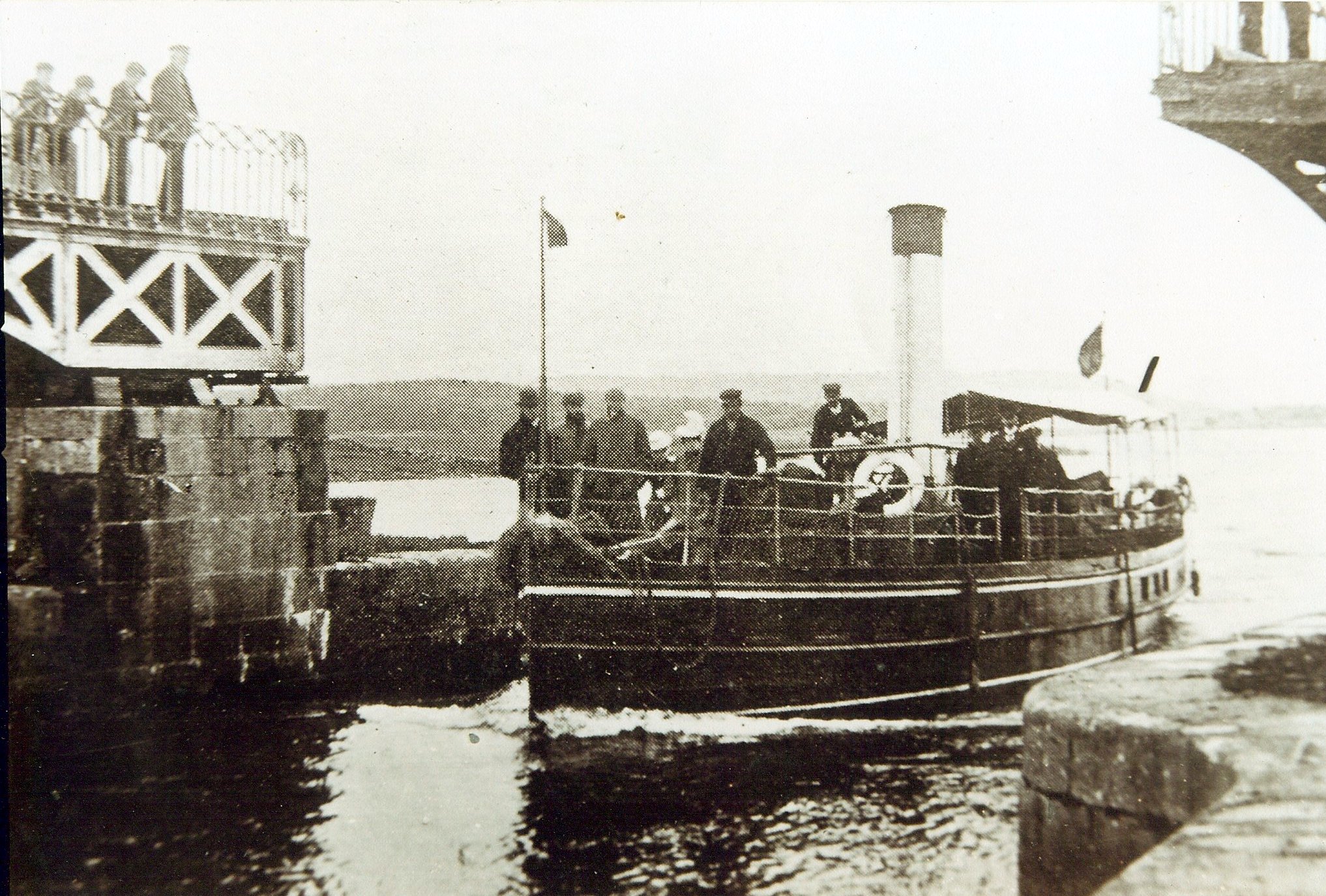
I am grateful to Liam Kelly for sending me this photo of a steamer on the Shannon. He says that the photo is believed to show a steamer belonging to Lord Granard (Bernard Forbes, 8th Earl of Granard) passing through Lanesborough Bridge in 1900.

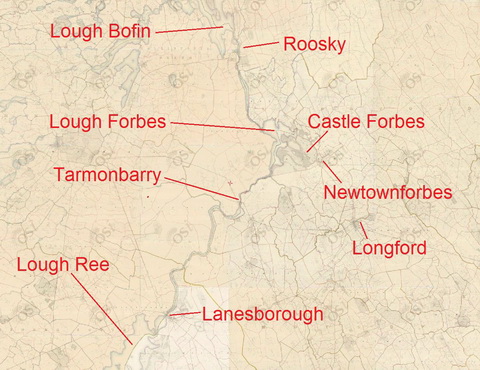
Here is a map showing Lanesborough and Castle Forbes.

Lanesborough and Lough Forbes (OSI ~1840)

And here is Castle Forbes shown in relation to Lough Forbes.

Castle Forbes and Lough Forbes (OSI ~1900)

According to a programme reproduced on page 200 of Ruth Delany’s The Shannon Navigation (Lilliput Press, Dublin 2008), Lord Granard (Right Hon the Earl of Granard, KP, GCVO) was Commodore of the 1929 Lough Forbes Regatta, held under the auspices of the North Shannon Yacht Club Flag and the Motor Yacht Club of Ireland. Page 197 of the same work has a photo of a North Shannon Yacht Club regatta on Lough Boderg in 1903; it includes a large steam yacht, but with a white rather than a black hull.

The Fairy Queen

Page 181 of the same work has a photo of a passenger steamer, the Fairy Queen, one of the six operated by the Shannon Development Company, which was set up in 1897: the Fairy Queen and the Shannon Queen worked the confined waters of the Shannon above Athlone. The same photo of the Fairy Queen can be seen here.

To my eye, the steamer in the Lanesborough photo looks rather like the Fairy Queen, although I don’t think I could go so far as to suggest that they are one and the same. They’re shown from different angles and, anyway, similarities between steamers of the same era are to be expected. The reason I comment on the matter is that, while looking into the history of the Fairy Queen, I found that the invaluable Clydebuilt Ships Database had a photo of the 1893 Fairy Queen that served on the Shannon (not to be confused with her 1897 replacement). And, again to my eye, the Fairy Queen in the Scottish photo does not seem to be the same as that in the Irish photo. I would welcome other people’s comments on the matter.

The squirrels

The story is here. There is more on the family’s collection of animals here.


The steamer Firefly at Crom in 1850

Some time ago I posted a query, asking whether anyone could identify the location shown in this drawing on the National Library of Ireland website. Click on the thumbnail to expand it; you may then need to click “PRINTABLE VERSION”. I said:

The black object between the sailing boats and the church looks to me like a paddle steamer, but the image is quite blurred so I’m not certain.

I have now seen the original in the National Library. I have also seen a print of a painting that is, I think, based on the drawing; the painting was done by Henry Brocas junior and is entitled “Lord Clarendon’s visit to Crom Castle, Co Fermanagh, 1850” (tiny thumbnail here).

According to the Erne papers [PDF]:

The earliest known steam boat at Crom was the “Firefly”, which is recorded as having brought the Viceroy, Lord Clarendon, from Crom to Lanesborough Lodge [Belturbet] on his visit of 1850.

It may be that the view is pretty well south from Crom Old Castle with its yew gardens  (Historic 6″), which might explain the odd shapes in the foreground, but it could also be from Crom new castle or even from Inisherk: I don’t know the lie of the land well enough, and would welcome enlightenment. The church on the right-hand side of the picture is Holy Trinity (C of I) church at Derryvore, which originally had a steeple. The drawing shows the island of Innisfendra (Inishfendra) on the left, after which Waterways Ireland’s latest tug has been named.

Another Brocas pic on the NLI site seems to complement the first image: it shows a view to the right of the other, with Gad Island and with Corlatt in the background. I suspect that The regatta  was done (perhaps from a boat) at the same event: the ruins look to me like those of Old Crom Castle.

Where is it?

Troll on over to the National Library website and see what you think of this drawing. Click on the thumbnail to expand it; you may then need to click “PRINTABLE VERSION”.

The black object between the sailing boats and the church looks to me like a paddle steamer, but the image is quite blurred so I’m not certain.

If you can identify the location, I would be glad if you left a Comment below.

Royal Canal steamers

According to Lewis’s Topographical Dictionary (1837),

The principal trade is in wool, for which this is the greatest mart in the county, its central situation and facility of communication with the Shannon and with Dublin having rendered it the commercial centre of a wide extent of country. The City of Dublin Steam Company commenced operations here in 1830: a steamer plies twice a week between this town and Shannon Harbour, where it meets the Limerick steamer and Grand Canal boat for Dublin.

It is interesting that the steamer went west and south (37 miles, 21 locks to the Shannon, then river, lake and river to Shannon Harbour), rather than directly eastward (52 miles, 25 locks) to Dublin, but its route would have enabled it to serve Longford, Tarmonbarry, Lanesborough and Athlone. Lewis, however, does not mention steamer services at any of those places other than Athlone.

More research required ….