Tag Archives: Ulster Canal

Shannon traffic to May 2014

I am grateful to Waterways Ireland for letting me have copies of the recorded numbers of boat passages through Shannon locks and Portumna Bridge for the first five months of 2014. All the usual caveats apply:

  • the underlying figures do not record total waterways usage (even for the Shannon) as, for instance, sailing, fishing or waterskiing on lakes or river stretches, which did not involve a passage through a lock or Portumna Bridge, would not be recorded
  • the passage records would not show, for instance, a change in the balance of types of activities from those in larger cruising boats to those in smaller (sailing, fishing, waterskiing) boats
  • figures like these, for a small number of months, will not necessarily be representative of those for the year as a whole. The winter months, January to March, see little traffic in any year; for April and May, the weather can have a large influence on the amount of activity especially, I suspect, in private boats.

On the other hand, the figures do include the Shannon’s most significant tourism activity, the cruiser hire business. And they are our only consistent long-term indicator of usage of the inland waterways.

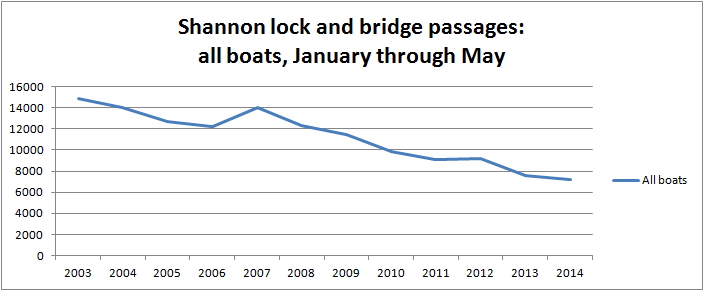
Shannon passages May 2014 01


The total amount of traffic continues to decline.

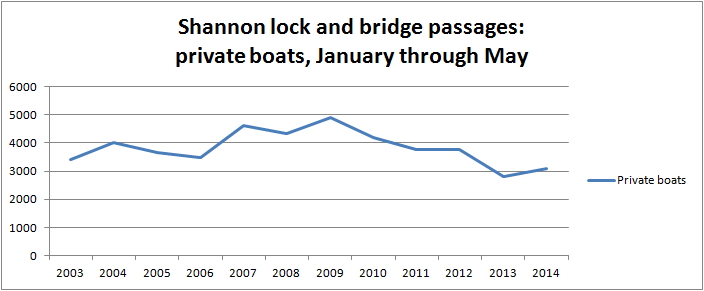
Shannon passages May 2014 02

Private-boat traffic is still below its average for the period but increased slightly on the same period of the previous year [but see the third caveat above].

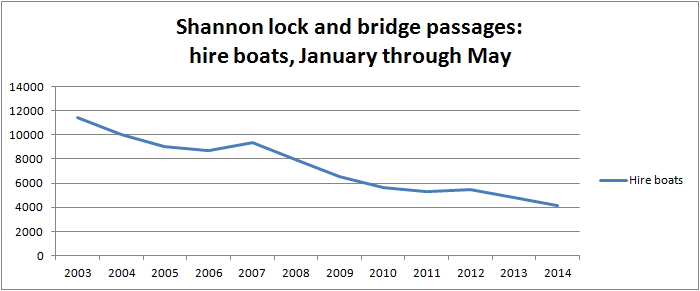
Shannon passages May 2014 03


Hire-boat traffic is just over one third of its 2003 level.

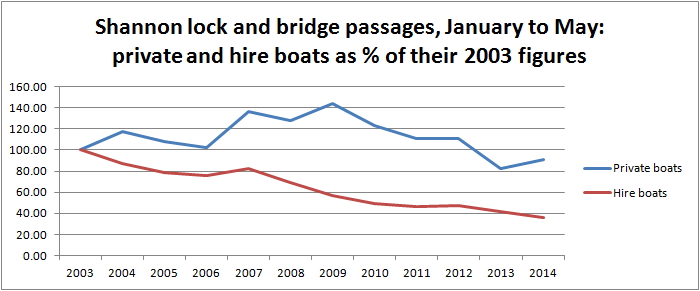
Shannon passages May 2014 04


Since 2003, both private and hired traffic have fallen, from the highest figures attained within the period, by about 60% of the 2003 figure. But private traffic first rose by 40% of the 2003 figure, so it is now only about 20% below that figure. Hire traffic has fallen pretty consistently since 2003.

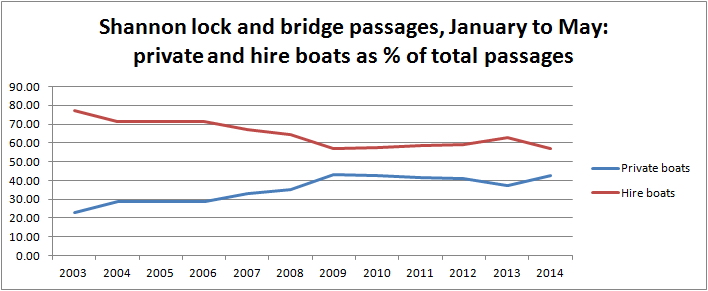
Shannon passages May 2014 05


Hire traffic is usually greater than private traffic between April and October (roughly speaking), but the gap is closing.

Carál Ní Chuilín, NI’s [SF] waterways minister, said the other day:

Waterways Ireland delivered a presentation to Ministers entitled ‘Ireland’s Inland Waterways — Building a Tourism Destination’. The presentation provided an overview of the progress that Waterways Ireland is making in placing waterways and the waterway experience at the centre of the tourism offering in Ireland and internationally.

And a good thing too, but the waterways need new water-based tourism products to complement, and perhaps to replace some of, the hire-boat cruising business. Opening new waterways — Royal Canal, Longford Branch, Ulster Canal, Kilbeggan Branch or anything else — is a waste of money until demand, domestic and visitor, private and hired, exceeds existing capacity.


NSMC explained

I reported here on April’s meeting of the North-South Ministerial Council (inland waterways flavour). I wasn’t there, though, and Carál Ní Chuilín was. Here is her account of the meeting, as explained to the Northern Ireland Assembly yesterday. There is much of interest, including the prospect of new byelaws on the Erne.

Members of the free state parliament don’t, as far as I know, get similar briefings.

It is slightly disconcerting to note that Jim Allister, the Traditional Unionist Voice MLA, seems to be the only person on the island, apart from me, to worry about delays in approving Waterways Ireland’s budgets.


Euroloot for the Clones Sheugh?

According to today’s Irish Times [which will disappear behind a paywall at some stage]

EU seeks feedback on plans to invest €500m in North and Border counties.

For full information, go to the SEUPB website. The Consultation Information Document [PDF may open or download as soon as you click] is the more useful and most readable document, but there are several others, including drafts of the PEACE and INTERREG Cooperation Programmes.

I have not myself been initiated into the Mystical Brotherhood of Euroloot Interpreters, so I can’t be sure, but I don’t think that either of these programmes contains, or could contain, anything that could fund the Clones Sheugh. It is difficult to see how a Sheugh-related action could be made to fit any of the objectives of either programme. But who knows what Fine Gael’s desperation might drive it to do? It faces the threat, in Monaghan, that the Shinners might arrive from Stormont bearing money from Her Majesty’s Treasury [NI branch office].


UK considers business case for investing in Ireland [updated]

DCAL, the Northern Ireland Department of Culture, Arts and Leisure, is still considering investing in the Clones Sheugh, as the Northern Ireland Assembly heard on 27 May 2014 [h/t TheyWorkForYou.com]:

Dolores Kelly [SDLP] asked the Minister of Culture, Arts and Leisure how many business cases are with her Department and awaiting a decision.

Carál Ní Chuilín [SF; Minister]: I thank the Member for her question. DCAL is considering five business cases. They are at various stages, and my officials are continuing to work with the relevant organisations to ensure that each case is of sufficient quality to facilitate a timely decision on the investment of public funds.

In addition, DCAL has provided feedback on two further business cases and is awaiting the submission of revised drafts. Work is also ongoing in the Department on the development of a further four business cases for projects that we hope to progress in the near future.

Dolores Kelly: I thank the Minister for her answer. I take it that there are nine business cases in total: the five plus the four. Will she give us a flavour of the business cases, the impact on the budget and whether the spend will be met? Indeed, what does that mean if some are to be spent within the school term timetable?

Carál Ní Chuilín: I am not sure about the school term timetable; I am going by own timetable. As for the flavour of the business cases, although there are nine cases today, I could go in next week, and there could be a further two. That is the nature of the progression, which is good because it means that we are moving in the right direction.

We are looking at the refurbishment of Coleraine library at a cost of over £2 million; the Arts Council gifting of musical instruments at almost £60,000; Tollymore National Outdoor Centre at almost £2·5 million; Dungiven sports provision; Omagh Riding for the Disabled Association; the Ulster canal; T: BUC; and the strategic outline business cases for the subregional stadia programmes.

I have asked for a copy of the Ulster Canal business case, although it is not clear whether it has yet been completed.

Update

DCAL says:

Thank you for your email on 30th May 2014 to DCAL Communications Office requesting a copy of the business case for the Ulster Canal.

Your request is being treated as a Access to Information request and will be handled under either Freedom of Information Act 2000 or the Environmental Information Regulations 2004.

As per either legislation, you should receive a response from the Department on or before 27 June 2014.

Please use reference number DCAL/2014-0292 on any further correspondence relating to this request.

Well I never.


Construction

The government’s new election manifesto construction strategy has just been published and can be downloaded here. I wouldn’t bother, though: there’s nothing in it about the Clones Sheugh and it’s written in the sort of turgid prose that won’t fry your brain: it will instead submerge your brain in a slurry pit and hold it under, providing a slow, choking, unpleasant death.

Anyway, the doughty Rob Kitchin has waded through it on our behalf and gives his conclusions here. I don’t share his enthusiasm for National Spatial Strategies and National Development Plans, but I have some sympathy for him when he says

I would have preferred something a bit more holistic, rather than trying to frame a whole bunch of stuff as a coordinated plan.

Michael Hennigan uses the B word.

NSMC

The joint communiqué from last week’s North/South Ministerial Council Inland Waterways meeting is now available here. There was an exciting bit:

SECTORAL PRIORITIES

2. Ministers had a discussion on various priorities within their remit and noted that these will be contained in a report to be considered at a future NSMC Institutional meeting as part of the ongoing review into sectoral priorities.

Hmm … what’s cooking there? I do wonder why the NSMC bothers publishing content-free stuff like this. We may have to ask the US NSA to bug the meetings. Oh, hang on ….

Here’s a good bit, though:

PRESENTATION BY WATERWAYS IRELAND

3. Waterways Ireland delivered a presentation to Ministers entitled “Ireland’s Inland Waterways – Building a Tourism Destination”. The presentation provided an overview of the progress being made by Waterways Ireland in placing the waterways and the waterway experience at the centre of the tourism offering both in Ireland and internationally.

Now that is useful and important work. But, as I have pointed out elsewhere [including to Waterways Ireland], the WI draft Corporate Plan 2014–2016 said nothing about tourism. Some years ago, I thought that it was a mistake to have a Marketing & Communications Strategy and a Lakelands tourism initiative that seemed to exist outside the corporate planning process; I am still of the same mind.

I have asked Waterways Ireland for a copy of the presentation, and for a copy of the Strategic Development Plan for the Grand Canal Dock, Spencer Dock and Plot 8 that was mentioned in WI’s progress report. That report also covered:

  • continuing maintenance
  • public consultation on canal bye-laws
  • a Built Heritage Study and a GIS-based navigation guide for the Lower Bann
  • an environmental award for  work in restoring, protecting and promoting the heritage assets that are Spencer Dock and Grand Canal Dock
  • towpath development and work on the cycleway from Ashtown to Castleknock on the Royal
  • donating two barges for “recreational and community use”
  • “partnerships to utilise three unused navigation property for community and recreational use”, which I don’t know anything about.

The important part was this:

BUSINESS PLAN AND BUDGETS 2013 AND 2014 AND CORPORATE PLAN 2014-2016

5. Ministers noted the position with the 2013 Business Plan and budget. They also noted that Waterways Ireland has undertaken a public consultation on the draft Corporate Plan 2014-2016, the preparation of a draft 2014 Business Plan by Waterways Ireland and that the plans will be reviewed after the public consultation is analysed. They also noted that Sponsor Departments will continue to work together with Waterways Ireland to finalise the Business Plans and Budgets for 2014 and the Corporate Plans for 2014-2016 that will be brought forward for approval at a future NSMC meeting.

I read that as showing that the north-south deadlock continues. The 2012 accounts have still not been published and the plans for 2014 won’t be approved until (at the earliest) three quarters of the way through the year.

The NSMC heard something about the Clones Sheugh but has decided not to tell the citizenry anything about it. It agreed to some property disposals and decided to meet again in October. But there was one odd item:

SPECIAL EU PROGRAMMES BODY BUSINESS PLAN AND BUDGET 2014 AND CORPORATE PLAN 2014-16

8. Ministers approved the Special EU Programmes Body Business Plan and Budget 2014 and Corporate Plan 2014-16.

The oddity is that the SEUPB is a separate body and usually gets its own meeting and communiqué. The last six meetings (before this one) have been attended by NI folk from Finance & Personnel and RoI folk from Public Expenditure & Reform (or, before that, Finance).

So who let spending ministers into the sweetshop? And why? Suspicious-minded folk might think that there is a plan to  nick a lot of Euroloot for the Clones Sheugh to get the Irish government off the hook persuade the Europeans of the benefits of investing in the reconstruction of a small portion of the Ulster Canal. We note that, on the previous day, Jimmy Deenihan gave a longer than usual reply to the standard question about the Sheugh, including this:

The Inter-Agency Group has met four times, last meeting on 9 December 2013. The Group continues to examine leveraged funding opportunities for the project. This includes the exploration of EU funding which may be potentially available in the next round of structural funds covering the period 2014–2020.

I have a better idea. Vladimir? There are oppressed Russians in Clones ….


A sheugh would solve it …

… not.

If you’re feeling the need of something to depress you, troll on over to the website of the Northern Ireland Community Relations Council and download the six PDF sections of the third Peace Monitoring Report. Written by Dr Paul Nolan, it is an extremely impressive piece of work — and a welcome counter to the witterings of the peaceprocess feelgoodistas who are so prominent on 2RN these days.

If you would prefer a summary, here is Liam Clarke’s account in the Belfast Telegraph, and here is his commentary; Tomboktu and others pointed to some problems with the headline on the first piece, but I’m more concerned that the focus on education in the headline on Clarke’s account may distort perceptions of what the report and, indeed, the rest of Clarke’s article are really about.

The report uses indicators grouped into four domains:

  • the sense of safety
  • equality
  • cohesion and sharing
  • political progress.

I didn’t find much that was cheering in any of them. Nolan lists ten key points:

  1. The moral basis of the 1998 peace accord has evaporated
  2. The absence of trust has resulted in an absence of progress
  3. There has been some increase in polarisation
  4. A culture war is being talked into existence
  5. The City of Culture year presented a different understanding of culture
  6. Failure lies in wait for young working-class Protestant males
  7. Front line police have been the human shock absorbers for failures elsewhere
  8. The rebalancing of inequalities unbalances unionism
  9. At grassroots level the reconciliation impulse remains strong
  10. No one picks up the tab.

Only the fifth and ninth offer any good news. But, from a waterways perspective, I was struck by the complete irrelevance of the proposed reconstruction of the Ulster Canal, the Clones Sheugh, to solving any of these problems. Yet Waterways Ireland, around whose neck this dead albatross has been hung, is the largest of the cross-border bodies and the sheugh is the largest capital project proposed to be undertaken by any of them. If the Irish government wants to do something to solve the real and continuing problems of Northern Ireland, as outlined in the Peace Monitoring Report, couldn’t it find something more useful to do?

Incidentally, I have not been able to find coverage of the report on the websites of the Irish Times, Irish Independent or Irish Examiner, although that may reflect poor searching on my part rather than any lack of interest on theirs.

Shannon traffic 2013

Some weeks ago Waterways Ireland kindly supplied me with the Shannon traffic figures for the final three months of 2013 and I have just now had a chance to add them to my spreadsheets and produce some graphs.

The usual caveats apply: the underlying figures do not record total waterways usage (even for the Shannon) as, for instance, sailing, fishing or waterskiing on lakes or river stretches, which did not involve a passage through a lock or Portumna Bridge, would not be recorded. The passage records are our only consistent long-term indicator of usage of the Shannon but they would not show, for instance, a change in the balance of types of activities from those in larger cruising boats to those in smaller (sailing, fishing, waterskiing) boats. On the other hand, they do include the Shannon’s most significant tourism activity, the cruiser hire business.

It is good to note, incidentally, that, in its draft Corporate Plan 2014–2016, Waterways Ireland says that it intends to

Develop and implement a research programme to measure waterway usage and inform planning and development.

It won’t be easy to do, but we need much better measures of all types of activities on all seven of the waterways managed by WI.

The final outcome for 2013 won’t greatly surprise anyone who has read earlier bulletins on this subject, like this covering the figures to end-September 2013. All the illustrations are based on information supplied by Waterways Ireland, with some minor adjustments by me to eliminate anomalies, but the interpretation and comments are mine own.

All boats full year

Total Shannon traffic 2003–2013, private and hired

The decline in traffic since 2003 seems to have been halted …

All boats full year %

Total Shannon traffic as a percentage of 2003 traffic

… but it is 40% below what it was in 2003.
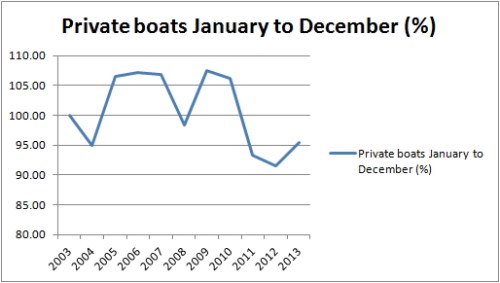
Private boats full year %

Private-boat traffic 2003–2013 as a percentage of 2003 traffic

Traffic in private boats seems to be recovering, but what is perhaps more significant is that it never went more than 10% above or below the 2003 figure. It has been remarkably stable over the period, despite the economic crash and despite the anecdotal evidence of boats being sold to overseas owners and trucked out of the country. Perhaps larger boats were replaced by smaller? Perhaps only boats bought in the boom were sold in the bust? Unfortunately the deficiencies of the registration system make it very difficult to determine what has been happening.

Hire boats full year %

Hire-boat traffic 2003–2013 as a percentage of 2003 traffic

But if private-boat traffic has been remarkably stable since 2003, the same cannot be said of hire-boat traffic. The best that can be said of 2013 is that the figures didn’t get [much] worse, but a 60% decline since 2003 is really, really dreadful.

WI’s draft Corporate Plan, which does not explicitly mention the hire industry, talks of

… unlocking opportunities to achieve recreational growth, and economic and social development.

I don’t know whether that omission means that WI sees little prospect of a rejuvenated hire-boat industry. And I note that, other than in the titles of organisations, the draft plan rarely mentions tourism or tourists. Are the waterways only for natives? If so, is that a deliberate policy decision? Or is there something that could be done, cheaply, to help to revive waterways tourism?

Emma Kennedy, writing in the Sunday Business Post on 23 February 2014, wrote about Fáilte Ireland’s latest brainwave, which is to “target” three groups:

  • social energisers, which are gangs of young people interested in “new and vibrant destinations”, which I take to mean Temple Bar
  • culturally curious folk aged 50 or over, with money, who are interested in “exploring new landscapes, history and culture”
  • great escapers, who like energetic rural holidays with their partners.

No families with kids, I see, although “Families & Loved Ones” (the latter term, by the way, nowadays seems to mean either dead people or their relicts) were one of the two “primary target customer segments” identified in Fáilte Ireland’s Inland Cruising Market Development Strategy. (Fat lot of good that strategy did, but we mustn’t be bitter.)

Anyway, without having done any market studies (though WI has funded lots of them), it seems to me that there is scope for more tourism on the waterways, but it might not be on traditional cruisers. It might involve outdoor activities like cycling and walking along the canals and Barrow: WI’s plan discusses them, but without adverting to an overseas market. And it might involve small-boat activities — canoeing, touring rowing, small-boat sailing, camping — on Shannon, Erne and SEW: WI says it will support micro-enterprises, and those providing outdoor activity holidays may need expertise and assistance rather than hard cash.

I admit to having little evidence on this, but it seems to me to be too early to give up on the tourism potential of the waterways. And the decline of the cruiser hire business does not necessarily mean that all waterway tourism is doomed.
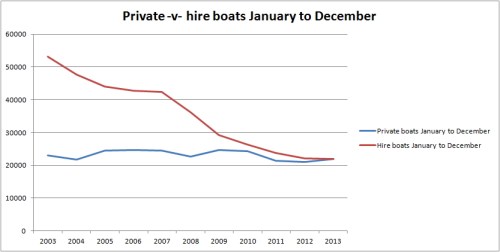
Private -v- hire full year

Private boats overtake hire boats

That said, 2013 was the year when, for the first time since Noah was an Able Seaman, the number of passages by private boats exceeded that by hire boats.
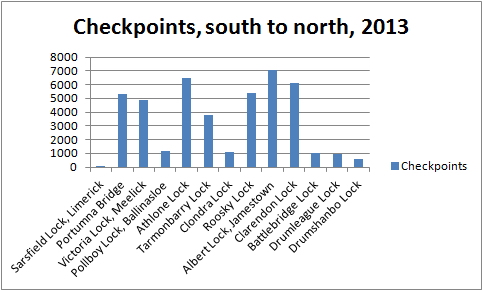
Checkpoints 2013

The points at which numbers were recorded

Finally, this chart suggests that any structures that were not built by the Shannon Commissioners in the 1840s will not attract many visitors. The extensions off the main stem of the Shannon — south to Limerick, west to Ballinasloe, east through Clondra, north to Lough Allen — are much less used than the main line from Lough Derg to Lough Key. It seems unlikely that any further extensions, especially to small towns that it would take three hours (at canal speed) to get to, are likely to be any more successful in attracting traffic.

What part of “no” does Brendan Smith not understand?

On 11 February 2014 Brendan Smith [FF, Cavan-Monaghan] asked a written question and got a written answer:

To ask the Minister for Arts, Heritage and the Gaeltacht the level of expenditure incurred to date in relation to the feasibility study and any other studies undertaken in respect of the proposed extension of the Erne Navigation from Belturbet to Killykeen and Killeshandra; if his Department proposes to review the decision not to proceed with this project any further; and if he will make a statement on the matter.

Jimmy Deenihan [FG, Kerry North/West Limerick] said:

I am informed by Waterways Ireland that expenditure incurred to date in relation on this project, the Lough Oughter project, on the Erne Navigation from Belturbet to Killykeen and Killeshandra is €84,647. I am also advised that, on reviewing the environmental information from this process, Waterways Ireland considers that the environmental designations of this lake complex make the feasibility of the proposed navigation extension highly unviable.

I understand that Waterways Ireland does not, therefore, propose to pursue this project any further at this time.

The thing is that Mr Smith asked about Lough Oughter back in December and was told then:

On reviewing the environmental information from this process, Waterways Ireland considers that the environmental designations of this lake complex make the feasibility of the proposed navigation extension highly unviable. For that reason, I am advised that Waterways Ireland does not propose to pursue this project any further at this time.

Unless Mr Smith thinks that Waterways Ireland has won the Euromillions lottery since December, he is just wasting time and resources by asking again about Lough Oughter.


Snails

Snails may save us from restoring the Longford Branch of the Royal. Industrialheritageireland has the story.

Might be an idea to start breeding these snails for judicious use elsewhere.