Tag Archives: vessels

A problem in trigonometry

I mentioned the other day that extensive searches of tinterweb had failed to find any data on the heights of overhead power lines above the Shannon and that I had been forced to resort to the telephone.

I am pleased to report that the ESB expert duly rang me back today, and further pleased to report that he had himself measured the height of every cable over the Shannon. Oh joy, oh happiness, I thought. But not for long.

The ESB, it seems, does not reveal the actual height of power lines above the water. This, if I understood the reasoning correctly, is because the water level varies and a boat-owner might not understand that, hit a line with a mast and then sue the ESB [where “ESB” means “electricity transmission or distribution operation”]. I have been told that a boat-owner in coastal water did just that (presumably between the mainland and an island) and that the lawyers have advised ESB to take no further risk; I would welcome information about the incident.

So, if you want to find the height of a power line, you’ll need to polish up your trigonometry (and then relate the height to Ordinary Summer Level). But the ESB does supply the information to one organisation that makes charts: the United Kingdom Hydrographic Office. That’s OK for coastal charts, but the UKHO (to the best of my knowledge) has not surveyed the inland Shannon since 1839, and I don’t think its inland charts have been updated since then. It is possible, of course, that the UKHO supplies the data to other (electronic or paper) chart-makers; I have emailed them to ask.

The quest continues again. More info when I get it.
The surprising importance of the Shannon steamers in the 1830s

A short, lavishly illustrated talk in Killaloe Cathedral, Co Clare, at 6.00pm on Sunday 29 April 2012, as part of the Waterways Ireland Discover Killaloe and Ballina thingie.


A lock mystery

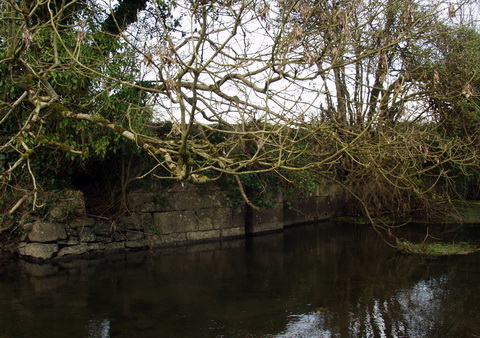
So what lock is this then?


Yes, it’s abandoned. Yes, it’s in Ireland.

The answer is here.

Dublin or bust

If you’re not already a reader of Barge Hawthorn’s blog, may I suggest that you start now? The account of the descent into Dublin along the Royal Canal, over three days, features mounting tension, a really superb photo of the M50 aqueduct and a happy ending when Effin Bridge lifted when required.

You can work your way backwards through earlier posts to find the how and the why.

Willie Leech and the Royal trade

I have uploaded an old article of mine based on an interview with Willie Leech of Killucan, whose father ran the last trading boats on the Royal Canal.

More on Mineral Oil Tax

I showed here that very few boat-owners paid the Mineral Oil Tax for 2009 (38) and 2010 (41). I now have the figures for 2011 (MOT paid by 1 March 2012) and I can report that there has been a very significant change, of 46%, in the numbers paying the tax.

Unfortunately the change was downwards, from 41 to 22. The Revenue Commissioners tell me that

[…] there were 22 returns received by 1 March 2012 for 2011, amounting to €53,398.58 MOT [Mineral Oil Tax] on 141,503.29 litres oil.

That’s an average of 6432.1 litres each, which is a lot; I suspect that much of the total came from the hire fleet, with less than twenty private owners making returns.

This ridiculous tax should be scrapped; those operating private pleasure craft should be required to use non-rebated diesel.


Kildare canal history

John W Freeman of Donadea, near Naas, Co Kildare, has very kindly sent me a copy of his third book, Reflections through a Parish Window, which he published in November 2010, and tells me that he is at work on his fourth book. As usual, his third has several items of waterways interest from the land between the canals: Donadea is south of the Royal and north of the Grand.

John gives special thanks to Essie Conroy of Lowtown (19th Lock), who died in September 2010. There is an article (p111 et seq) about her grandparents, Murt and Mary Murphy; Murt, originally from Ballycowan near Tullamore, died in 1922 aged 73. The Lowtown section also includes photos of a model flyboat, the wooden canal boat 104B (Maid of Erin, owned by Roches of Tullamore) and Essie Conroy with one of Ted Barrett’s boats at Lock 19. Her husband John Conroy is pictured on p123.

There is a photo of another wooden canal boat at Lowtown. It has the name Ocean Star written across its stern and what look like horizontal wooden slots on both sides of the rudder. The crew are named as William Connolly and his son Patrick, with Thomas Murphy (Essie Conroy’s father) standing on the bow holding a rope.

Other Grand Canal items include a photograph of 31M at Landenstown (p56)  and two photos of Robertstown, one undated (p120) and the other taken in 1895 (p116). There is a photo of the Royal at Kilcock (p64), perhaps taken in the 1980s, and a short article about the Royal with a photo of Lock 1 (pp137–8). There is even a photo of Guinness Liffey barges of, I think, the first fleet (p68).

Perhaps the most surprising item is a photograph from the Irish Press of 23 October 1947 with this caption:

Propeller-driven “water-bike”, built by motor and cycle mechanic Patrick Kennedy, of Corduff, Co Kildare, to contact his clients in their village homes along the Grand Canal. Comfortably seated on the kitchen chair “tandem seat” is Christie Brereton, Patrick’s assistant, enlivening the pair’s progress with his accordion. These mechanics say that they will perfect this style of transport for river and lake travel.

The photograph is a little blurred, but the two men can be seen clearly, with Patrick in front clasping the handlebars. The structure of the craft seems to include at least two 40-gallon drums but the steering and propulsion methods are not specified. If anyone has any more information about this craft, do please leave a Comment below.

All in all, a lot of very interesting material once again, and I am looking forward to John’s fourth book.


Competition closed

Nobody has attempted to identify this quay, so the competition is now closed and I’ll drink the sherry myself.

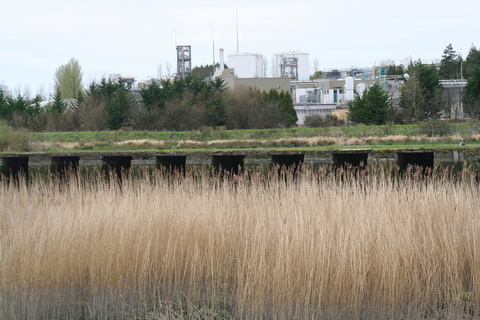
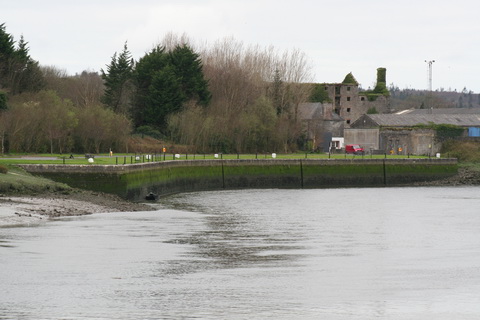
It is, of course, the downstream quay at Clarecastle at the head of the Fergus Navigation.

Clarecastle downstream

Here is the upstream quay, just around the corner.

Clarecastle upstream

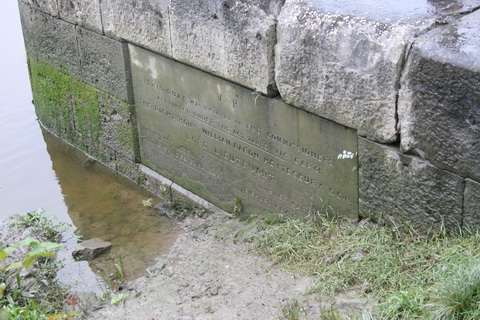
The upstream quay bears the following inscription.

Inscription at Clarecastle

I really must return and get a better photo when it’s less slippy. Note that, although this is on tidal waters, Thomas Rhodes was the engineer.

Did you know that Clarecastle still has its own port authority? Go to this excellent pub and ask John Power about it. His brother (Dr Joe) wrote the definitive history of Clarecastle. John has lots of interesting old photos and maps on display in a really good traditional pub. He’s got a facetweet thingie too.

On the occasion of Her Majesty’s Diamond Jubilee …

… (that is, of course, Her Late Victorian Majesty), F E Prothero suspended his explorations of Irish waterways after he had descended the Nore, from Abbeyleix to New Ross, in May 1897. Here is his account of that trip.

Thomas Omer in Athlone

Here is a new page showing the route of the old canal in Athlone, which was used before the Shannon Commissioners built the new lock, weir and bridge in the 1840s. The canal is easily accessible along most of its route, although some explanatory signs might be useful to call attention to notable features.