Tag Archives: vessels

The barge at Plassey: seeking experts on iron

On my old photographic website I had a page of photos of an abandoned barge at Plassey, on the River Shannon. I have now moved those photos to here and added some text.

I am hoping that someone expert in old iron barges might be able to make a guess at the age, and perhaps even the origin, of the barge. I will, in the meantime, be trying to pin down the date of its abandonment.


More wooden boats

I’ve added some more pics of wooden boats to the main page here. I’ve also added links to some pages about a boat that was built for use on Lough Derg, the Gleeson hydroplane Sereia:

Sereia history (note links to pages on restoration and photos)

Sereia for sale

Arthur’s Day

I spent today helping the skipper of a barge to carry a cargo of Guinness by water to Limerick, fifty years after the last Grand Canal Company commercial cargo, which was of Guinness to Limerick. (Actually, my help was minimal, confined mostly to acting as ballast, a role I fill very well, and taking 1,439 photographs.) There will be a ceremony at Dolan’s in Limerick tomorrow at the appropriate time.

Folk in other parts of the country may find it easier to undertake a pilgrimage to Uncle Arthur’s final resting place.  Here are links to some maps:

in relation to the Grand Canal. Towards the top right of the page, you can see a little castle symbol, which is roughly where the graveyard is. Notice that the road to the right of the symbol has a sharp bend; the entrance to the graveyard is just north of that bend. It’s a narrow country road, so be careful
– in relation to the N7. The orientation is slightly different on the Google map but you’ll recognise the shape of the area enclosed by the roads
– with the path into the graveyard on the OSI map.

The Ulster Canal: abandon it now

I have now completed an examination of the proposals for the reconstruction of a section of the Ulster Canal from Lough Erne to the town of Clones in Co Monaghan. My conclusions are linked from this page, which also contains a brief summary of my views.

Ulster Canal 0: overview presents the main points of the argument in about 3,600 words. It does not contain most of the quotations and omits the references; it also omits some sections of the argument. However, it’s about one fifth of the length of the whole thing.

Ulster Canal 1 to Ulster Canal 10 present the argument under ten headings, amounting to about 18,500 words in all. That may be too much for most people. There are no photos or other illustrations, and most of the argument is about economics or politics.

It will be clear that I do not have full information; I will be glad to have Comments from anyone who can fill the gaps or correct anything I’ve got wrong.

For anyone who can’t wait, here is a copy of the summary of my views.

Summary

The Irish government has been pushing, since the 1990s, for the restoration of the Ulster Canal. Several studies have been commissioned; all of them show that the project is uneconomic. At no stage has either the UK or the Northern Ireland administration shown any willingness to commit funding to the project. As a result, the Irish government has scaled back its ambitions, proposing to fund the construction of a canal from Lough Erne to Clones in Co Monaghan: it would cross the border several times, but it would pass through no significant conurbation on the northern side.

However, this scaled-back project makes even less sense than the proposal for full restoration, and there is no reason to believe that the canal will ever get any further than Clones. The Irish government might, I suppose, decide to dig on to Monaghan, as a form of famine relief work, but there is no evidence that the Northern Ireland Executive will ever put money into completing the route to Lough Neagh.

The costs of the proposal have not been reexamined for many years (or, if they have, the results have not been published), and the economic analyses may overstate the likely benefits. Even if they are accurate, though, the main benefits seem to come from casual visitors rather than from boaters. The benefits will go to service providers in the area, rather than to the waterways authority, but even if they went to Waterways Ireland they would not pay the running costs, never mind repaying the capital cost. The project has failed every economic test to which it has been subjected: it simply does not provide the sort of return that would justify the project.

There seems to be some doubt over the source of the proposed funding. The Irish government said that it canal to Clones would be paid for by the Irish Exchequer, but it later said that Waterways Ireland would sell surplus assets to pay some or all of the cost. It is not clear that Waterways Ireland’s surplus assets would, in current economic conditions, bring in enough money; nor is it clear that the Department of Finance is willing to make up any shortfall.

There might be something to be said for acquiring the land and creating a walking and cycling route, but the current proposal for a canal to Clones is utterly unjustifiable and should be dropped.

The Ulster Canal: the supposed benefits

Here is the latest (and almost the last) in this series of posts: an examination of the expected benefits of the canal to Clones. My conclusion is that the benefits cited are higher than those likely to arise in current conditions.

The Ulster Canal: the costs

The figure of €35 million is widely quoted as the cost of the canal to Clones, but the basis for that figure is not clear. Here are some thoughts on the subject.

From the hearts of cranes

Several ports on the Shannon Navigation have old cranes (or parts thereof), most of them nicely painted. Their age may not be apparent, but it is possible that they date back to the days of the Shannon Commissioners in the 1840s; at least one of them may be even older than that.

This page shows photographs of those cranes I know of, and discusses their possible ages. But there is much that remains unknown, and readers may be able to cast light on some of the mysteries.

Minor updates

I’ve made some additions to three pages:

Several people have very kindly sent me photos of boats I hadn’t seen or photographed myself; I’m grateful to them and always happy to hear from people who can help to fill the gaps.

I have more updates to make, including many, many sailing-boats and some nice wooden boats.

Down the Rockville

Some time ago I wrote three pages about the Rockville Navigation, which is linked to Grange on the Carnadoe Waters in Co Roscommon.

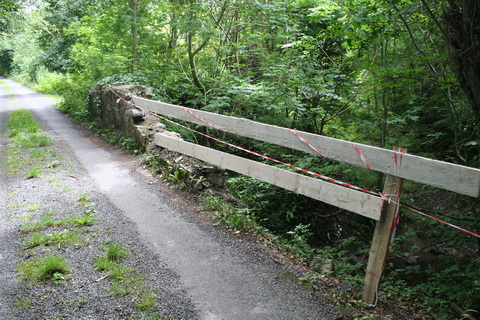
I recently revisited the area. I was horrified, first, to find that the bridge — built in June 1765 — has been severely damaged, with large chunks of masonry in the cut beneath and with a crude wooden repair. How many bridges of that age are there in Co Roscommon? How many that are associated with one of the oldest navigations in the country? Please, someone, restore the bridge!

Damage to the bridge

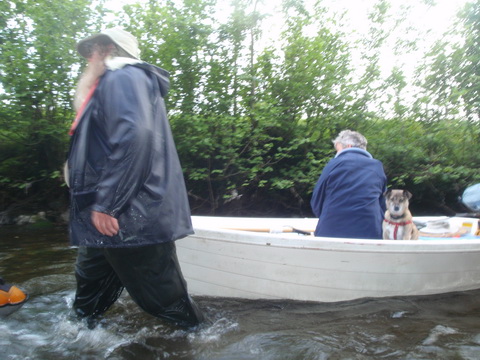
Anyway, the more pleasant part of the day was the four hours that we spend descending, by dinghy and kayak, from the bridge to Grange. The route took us through artificial cuts, small lakes and sections of river, with very clear water and an extraordinary abundance of vegetation. This route would have been easily navigated by large wooden cots or similar boats, and it should be developed today as a canoe-and-small-boat trail. Even with very low water levels, we had no real problems, although someone has to end up with wet feet …. Here is an account of the trip.

Wading in the water

Anguilla anguilla: the ESB eel fishery

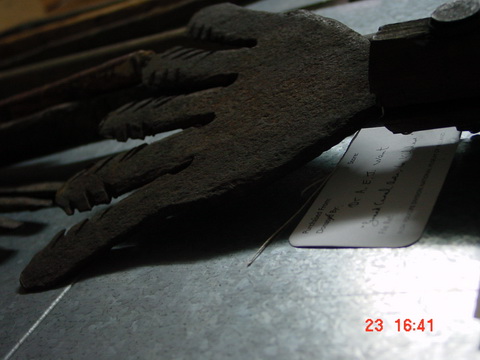
This photo shows an eel spear from the National Folklife Collection‘s overflow material, stored in the former “reformatory” at Daingean, on the Grand Canal in Co Offaly. There were many spears there, with different designs from different rivers. This one, to judge from the label underneath it, came from the extraordinarily prolific and observant Dr A E J Went.

If you look at pretty well any Irish river on the 1840s Ordnance Survey map (here’s the Shannon at Killaloe; switch to Historic 6″ if necessary), or indeed on the 1900s map (same URL but switch to Historic 25″), you’ll find evidence of eel weirs. Ireland’s shortest canal was built to allow the eel-boats of Anthony Mackey’s fleet to reach the trains at Banagher.

But the European eel is a “critically endangered species” and all eel fishing has been banned in Ireland. As far as I know, though, the Lough Neagh fishery, in Northern Ireland, continues.

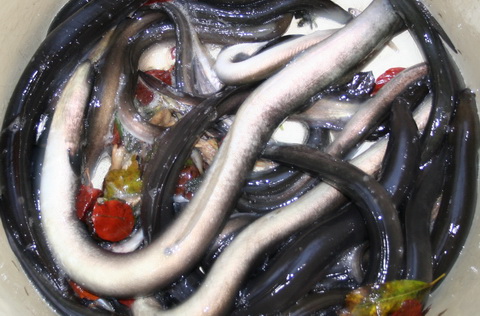
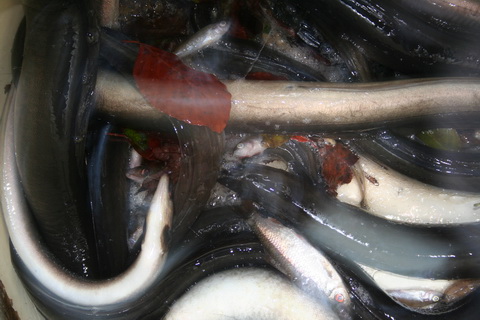
The Electricity Supply Board (ESB) is in charge of the eel fishery on the River Shannon. It has nets and a storage unit (packing station) at Killaloe and, until recently, it also had nets at Clonlara on the headrace supplying the power station at Ardnacrusha; the Clonlara nets have just been removed. This page is about the Clonlara and Killaloe operations, but includes a look at an eel survey conducted for the ESB in 2008, before eel fishing was banned in Ireland. The aim now is to make it easy for eels to reach the sea to reproduce, and that sometimes involves “trap and transport”: catching the eels and moving them past obstacles, whether on their way to the sea or, for the young glass eels, on their way upriver.

The photos on this page are a tribute to what was an important activity on the Shannon. I hope that the European eel stocks can recover.