Tag Archives: vessels

Thon sheughery business

It will be recalled that Her Majesty’s Loyal Home Rule Government in Belfast is considering investing in the Clones Sheugh [aka Ulster Canal] and that I asked DCAL, the department responsible, for a copy of the Business Case. To my surprise, it said:

Your request is being treated as a Access to Information request and will be handled under either Freedom of Information Act 2000 or the Environmental Information Regulations 2004.

Either way, DCAL has now told me that I can’t see it. The Business Case, which is apparently an addendum to the 2007 Business Case (which was rotten: see here passim), won’t be complete until November. I have made a note to remind myself to ask for it then.

I quite sympathise with the DCAL folks: it can’t be easy thinking of any good reason to spend taxpayers’ [British or Irish] money on the Clones Sheugh. But perhaps DCAL can spin it out until the Shinners have taken over the Free State, at which point the economics of Grattan’s Parliament will be in vogue and we can all take up growing flax, spinning and weaving, giving grants for canals and making money out of the slave plantations.

Speaking of Shinners, there’s one called Cathal Ó hOisín, a member of HM Loyal Home Rule Government in Belfast representing East Londonderry, who said there recently:

The possibility of the reopening of the Ulster canal would open up limitless opportunities in tourism. The idea that, once again, we could travel from Coleraine to Limerick, Dublin and Galway by boat would be absolutely wonderful.

Well, you can do that: by sea. There was never an inland navigation from Coleraine, Limerick or Dublin to Galway, despite the urgings of Lord Cloncurry and the nitwitted ideas of Sir Edward Watkin.

As for a connection between Limerick or Dublin and Coleraine, I suspect that Mr Ó hOisín is perpetuating the error into which Her late Majesty Victoria, by the Grace of God of the United Kingdom of Great Britain and Ireland Queen, etc, seems to have fallen when she appointed

Commissioners to inquire respecting the System of Navigation which connects Coleraine, Belfast, and Limerick

which Commissioners reported in 1882. There was no such system and, if Mr Ó hOisín can provide evidence that any vessel ever travelled by inland navigation between Coleraine and Limerick, I would be glad to hear of it. I prefer to think of the Commissioners’ conclusion that

As an investment for capital the whole canal system in Ireland has been a complete failure.

I see no reason why politicians of the twenty-first century should repeat the errors of their predecessors in the eighteenth, nineteenth and twentieth centuries.

You expect the Parnellite members to have a bit more sense, but one John Dallat said in the same debate:

[…] when the Ulster canal is open, tourists will come in their thousands and that will benefit the Lower Bann, the Foyle as well, and right over to Scotland.

Er, John? There are actually canals in other countries. Even in Scotland. Folk are familiar with canals. They’ve seen them before. And a short sheugh to Clones is not going to attract tourists (apart from the relatively small number of canal twitchers, who will need to tick it off on their lists) unless the town of Clones is particularly attractive. Which … well, let me put it this way: why not look it up on TripAdvisor?

Of course I’m all in favour of Clones myself: I am quite interested in concrete engine-sheds and former canal stores.
 

Shannon traffic to May 2014

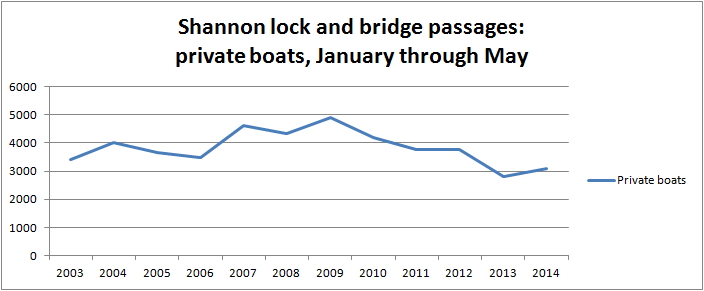
I am grateful to Waterways Ireland for letting me have copies of the recorded numbers of boat passages through Shannon locks and Portumna Bridge for the first five months of 2014. All the usual caveats apply:

  • the underlying figures do not record total waterways usage (even for the Shannon) as, for instance, sailing, fishing or waterskiing on lakes or river stretches, which did not involve a passage through a lock or Portumna Bridge, would not be recorded
  • the passage records would not show, for instance, a change in the balance of types of activities from those in larger cruising boats to those in smaller (sailing, fishing, waterskiing) boats
  • figures like these, for a small number of months, will not necessarily be representative of those for the year as a whole. The winter months, January to March, see little traffic in any year; for April and May, the weather can have a large influence on the amount of activity especially, I suspect, in private boats.

On the other hand, the figures do include the Shannon’s most significant tourism activity, the cruiser hire business. And they are our only consistent long-term indicator of usage of the inland waterways.

Shannon passages May 2014 01


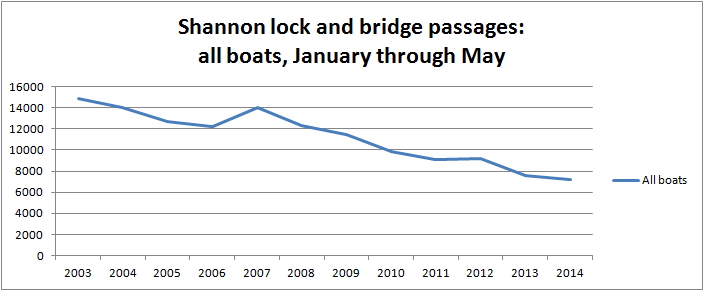
The total amount of traffic continues to decline.

Shannon passages May 2014 02

Private-boat traffic is still below its average for the period but increased slightly on the same period of the previous year [but see the third caveat above].

Shannon passages May 2014 03


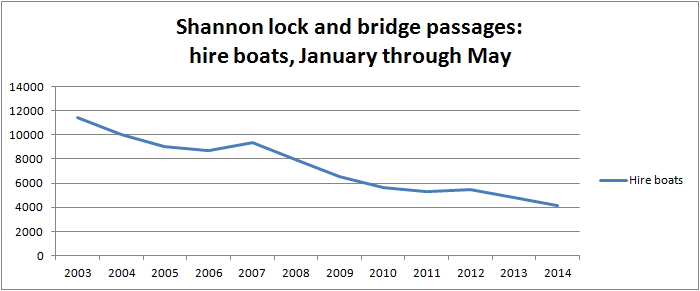
Hire-boat traffic is just over one third of its 2003 level.

Shannon passages May 2014 04


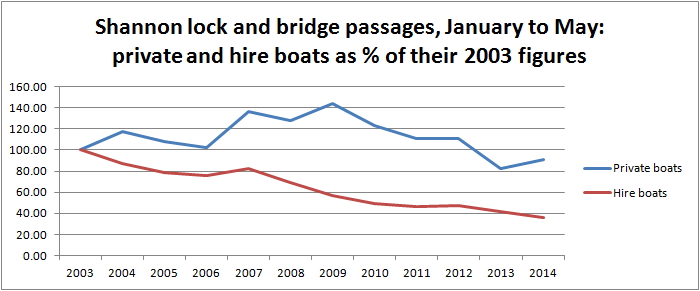
Since 2003, both private and hired traffic have fallen, from the highest figures attained within the period, by about 60% of the 2003 figure. But private traffic first rose by 40% of the 2003 figure, so it is now only about 20% below that figure. Hire traffic has fallen pretty consistently since 2003.

Shannon passages May 2014 05


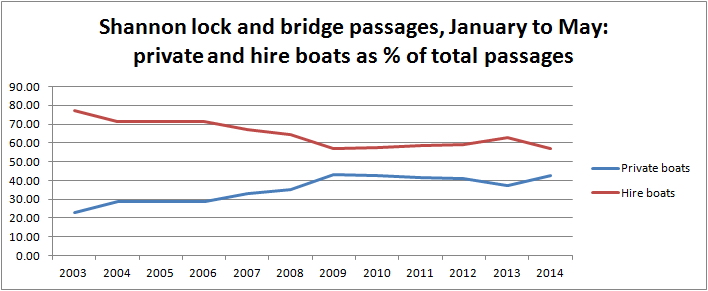
Hire traffic is usually greater than private traffic between April and October (roughly speaking), but the gap is closing.

Carál Ní Chuilín, NI’s [SF] waterways minister, said the other day:

Waterways Ireland delivered a presentation to Ministers entitled ‘Ireland’s Inland Waterways — Building a Tourism Destination’. The presentation provided an overview of the progress that Waterways Ireland is making in placing waterways and the waterway experience at the centre of the tourism offering in Ireland and internationally.

And a good thing too, but the waterways need new water-based tourism products to complement, and perhaps to replace some of, the hire-boat cruising business. Opening new waterways — Royal Canal, Longford Branch, Ulster Canal, Kilbeggan Branch or anything else — is a waste of money until demand, domestic and visitor, private and hired, exceeds existing capacity.


NSMC explained

I reported here on April’s meeting of the North-South Ministerial Council (inland waterways flavour). I wasn’t there, though, and Carál Ní Chuilín was. Here is her account of the meeting, as explained to the Northern Ireland Assembly yesterday. There is much of interest, including the prospect of new byelaws on the Erne.

Members of the free state parliament don’t, as far as I know, get similar briefings.

It is slightly disconcerting to note that Jim Allister, the Traditional Unionist Voice MLA, seems to be the only person on the island, apart from me, to worry about delays in approving Waterways Ireland’s budgets.


A little information on Lacy’s Canal

Here is a new page about Lacy’s Canal.

And I’m like wow …

… as the young folk say nowadays. Searching the National Library catalogue for prints and drawings of the Royal Canal before 1900 brought up the usual suspects but also a very interesting map and this stunning view of Dublin in 1853. Viaducts! Railways! Steamers! Barges being propelled by sweeps!

I couldn’t find the Royal Canal, though.

Green diesel: reasoned opinion [updated]

Some news on one of our favourite topics.

The European Commission has formally requested Ireland to amend its legislation to ensure that private pleasure boats can no longer buy lower taxed fuel intended for fishing boats. Under EU rules on fiscal marking for fuels, fuel that can benefit from a reduced tax rate has to be marked by coloured dye. Fishing vessels for example are allowed to benefit from fuel subject to a lower tax rate but private boats must use fuel subject to a standard rate. Currently, Ireland breaches EU law by allowing the use of marked fuel for the purposes of propelling private pleasure craft. As a consequence, private leisure boats can not only use fuel intended for fishing vessels, subject to a lower taxation, but also risk heavy penalties if they travel to another Member State and the ship is checked by the local authorities. The Commission’s request takes the form of a reasoned opinion. In the absence of a satisfactory response within two months, the Commission may refer Ireland to the EU’s Court of Justice.

European Commission press release dated 16 April 2014, about three quarters of the way down the page.

Update: I see that the Irish Examiner noticed the EC statement. And NESC believes (sensibly) that green diesel should be scrapped altogether. Which won’t happen, because if you didn’t have unnecessary or ridiculous regulations Irish politicians wouldn’t be able to pretend to be doing something useful by playing with them.


Guinness

The visit of Her late Majesty Victoria, by the Grace of God of the United Kingdom of Great Britain and Ireland Queen, to Messrs Guinness in Dublin in 1900 [h/t Adrian Padfield]. It is not known whether Her late Majesty was forced to drink a pint of Guinness. And here is a less dramatic day at the Guinness wharf.

Pics of Cong here and here; no date given.

If we had eggs …

… we could cook bacon and eggs, if we had bacon.

What with one thing and another, I haven’t recently been paying much attention to the campaign to keep the decayed former Aran Islands ferry Naomh Éanna from being scrapped. I gather that there is a proposal for spending €1.86 million on the vessel but I found little information online, especially about the proposed sources of capital or the expected return on investment; if the full plan is available anywhere online, I’d welcome a link.

None of the proposed onboard activities seem to require a floating home, none seems to have anything much to add to the heritage or historic value (if any) of the vessel and the only purpose of the heritage tag seems to be to enable the proposed tourism complex to get a berth from Galway Port Company. There is a cheaper floating hotel available elsewhere, which might require less expense; it could be renamed Naomh Éanna II.

I see that the fans of the existing vessel are trying to raise €15000 to have it surveyed. As far as I can gather from a Facebook page, the total raised so far is €1965: €1835 by 16 April and €139 at a beer-tasting. There seems to have been an update on 23 April but, as far as I can see, access is confined to Facebook subscribers.

Of the €1835, €500 came from the Dublin Branch of the Inland Waterways Association of Ireland. I do hope that such a donation is not ultra vires: the preservation of old seagoing vessels does not seem to be within the objectives set out in IWAI’s Memorandum of Association, at least as described under “Goals of the Inland Waterways Association of Ireland” on the IWAI website. Perhaps the page needs updating?

I note that folk have been sending in photos of and other information about the vessel. Now, my interest in this vessel is not in possible uses as a floating brewery or as a tourist attraction in Galway.

First, I want this albatross to be lifted from Waterways Ireland’s neck and, if Galway Port wants to house it, that’s fine by me, as long as they get it out of the inland waterways (and the taxpayer doesn’t have to pay for it).

Second, I want to counter the notion that, because the vessel is old, it is worth preserving. As I wrote here:

Yes, it had some interesting (if minor) historical associations, but the best way of recording them would be to write a book, or create a website, or even make a movie, about the ship’s history. Money spent that way would be a far better investment than money spent on keeping the Naomh Éanna afloat. Its heritage or historical value lies in the associated information, not in the steel.

National Historic Ships UK says:

As with all man-made structures, ships and boats were not built to last forever. However, the issue of dilapidation is especially acute for vessels. Unlike buildings, the accepted working life for most vessels is only some 30 years: they were not and still are not built for the long term. For many vessels of intrinsic historical importance, there will come a time when the cost of conserving or even simply repairing them becomes unaffordable. Unless the burden can be passed to another willing organisation, such vessels have no sustainable future.

That’s from one of the three volumes of its series Understanding Historic Vessels. The first two volumes are published as free PDF downloads from this page:

  • Recording Historic Vessels
  • Deconstructing Historic Vessels [from which I quoted].

Both are well worth reading and the first, in particular, might guide anyone who is actually interested in the heritage or historic value of the Naomh Éanna; it suggests that recording should be done before deconstruction [aka scrapping] but further information can be recorded during the latter process.

The authors suggest drawing up, for each vessel, a two-page Statement of Significance. I note that I have not seen such a statement, or any equivalent, for the Naomh Éanna, which makes me sceptical about the vessel’s value. And, using the National Historic Ships Criteria and Scoring System (which is included in both documents), I fear that the Naomh Éanna would not score highly.

I accept, though, that I do not have complete information about the vessel. It may be that some of the Naomh Éanna enthusiasts are engaged in a structured recording of information about the vessel and that they are building a case — the equivalent of a Statement of Significance — for its preservation on heritage or historic grounds. However, I haven’t yet come across their work; if it exists, I would welcome a link. As it is, though, the preservation campaign seems to me to be based more on sentiment rather than on fact or logic.

Finally, the third volume of Understanding Historic Vessels, called Conserving Historic Vessels, has now been published on dead trees and can be bought through the Royal Museums Greenwich online shop at STG £30; P&P to Ireland is STG £15. Other reference sources are listed here. And here is information about the Dunleary lifeboat.


Shannon history in Birmingham

According to the Railway & Canal Historical Society’s Events page, its annual Clinker Memorial Lecture, to be held in Birmingham in October 2014, will be about River Shannon steamers in the second quarter of the nineteenth century:

The 2014 Clinker Memorial Lecture will be held in Birmingham on the afternoon of Saturday 18th October 2014. The speaker will be Brian Goggin, BA (Mod), MA.

Brian graduated from Trinity College, Dublin in Economics and Politics, and spent some years as honorary Editor of the quarterly magazine of the Inland Waterways Association of Ireland. He and his wife Anne have been boating on Irish inland waterways since the late 1970s. He is currently working on a book on the Shannon steamers of the 1830s and 1840s, and the Clinker Lecture will draw on his research.

Before lunch (and independent of the Lecture) there will be a walking tour of central Birmingham, focusing on sites of waterway and railway interest.


WI and the canals

Three important documents [all PDFs] available for download from WI’s site:

  • Action Plan for Grand Canal Dock and Spencer Dock​ here
  • Grand Canal (rural) Product Development Study here
  • Royal Canal (rural) Product Development Study here.

These are lengthy documents [50, 177 and 175 pages respectively] and it will be some time before I can comment on them, but I welcome their publication. I also hope to be able to comment on the presentation Ireland’s Inland Waterways – Building a Tourism Destination which WI made to the recent meeting of the NSMC; I’m told it’s on its way to me but it hasn’t arrived yet.