Tag Archives: waterways

Sallins speculation

I emailed Waterways Ireland on 4 February 2014:

I would be grateful if you could tell me whether any person applied, under byelaw 38q, for permission to hold an aquatic event on the Grand Canal at or near Sallins on or after Friday 24 January 2014.

WI said:

No-one applied to hold an aquatic event on or around that date on the Grand Canal.

If I were Waterways Ireland, and I heard a rumour (or got a tip-off from the NSA) to the effect that some boaters were going to hold a demo at Sallins, and if nobody had asked permission to hold the demo, or made any arrangements with me about it, and if I expected work to start shortly at Sallins, I might be worried that the demo might turn out to be more than a photo opportunity: that it might turn into an occupation or moor-in, one that would delay the work and possibly expose me to additional costs.

So I would do what I could, within the byelaws, to prevent the holding of the aquatic event. I would note byelaw 18 (2) (b):

(2) The Commissioners, or any authorised officer, may prohibit navigation on the canals or any part thereof from time to time for the purposes of—

( a ) an emergency, or

( b ) preventing the passage of a boat in respect of which a permit has not been issued under these Bye-Laws, or has been withdrawn, or is not displayed in the manner prescribed in Bye-law 40 of these Bye-laws.

If I were not Waterways Ireland, then, but a would-be demonstrator, I would make a note to inform the authorities next time I planned a demo so that there would be no surprises on either side.

I am, however, neither WI nor a would-be demonstrator, so (apart from the information I gleaned from WI) I know nothing of what either side may have done or not done, thought or not thought.

English pensioners

How useful it is to have such well-informed politicians as John Kelly, a Labour Party senator from Co Roscommon. He was able to tell us that there are 300–400 people “moored on our canals and waterways”, which is rather fewer than WI thinks, what with there being over 8000 boats registered on the Shannon. The learned Senator Kelly was also able to tell us that, of those 300–400 people,

Most of them are retired couples from England who are receiving small English pensions. This proposal will drive them off the water and back to England. They are contributing hugely to local economies throughout this country.

Most of them? For, I presume, certain values of most — and certain values of 300–400.

Maybe whoever is briefing politicians could make sure they can read their briefs properly …. It was almost a relief to turn to the more conventional Trottery from Joe Higgins. I imagine that his intervention will certainly sway Fine Gael.

Addendum: Senator Kelly did it again next day, but at least he had changed most to many.

Approximately 400 families in this country currently paying only €126 per year in respect of mooring will if these by-laws are introduced now be faced with charges of €3,500 per annum. Many of the people concerned are retired English couples and families who cannot afford housing.

The concept of a range of prices seems to be unfamiliar to the good senator, so he takes the top rate, for the largest size of boat in the best location with the highest level of services, and says that that applies to all. And he seems to be unaware that many boats are parked by people who do not live on them.

Had the good senator had able to read Waterways Ireland’s document, he would have seen that proposed mooring fees range upwards from €160 for non-residential moorings (many boats are not lived on) and €1250 for residential. Claiming that the highest value is the only one is seriously misleading.


Goodbye Naomh Éanna?

See Fergal.b’s post today on boards.ie. Scrapping sounds like a good idea to me, but it would be nice (if it hasn’t already been done) to take as many photos as possible of the vessel.

Floating faithful

An entry in J W de Courcy’s The Liffey in Dublin (Gill & Macmillan, Dublin 1996) alerted me to the existence of the Port of Dublin Society for the Religious Instruction of Seamen. It bought, he tells us, the hull of the appropriately named Danish vessel the Prince Christian, and used it as a floating chapel.

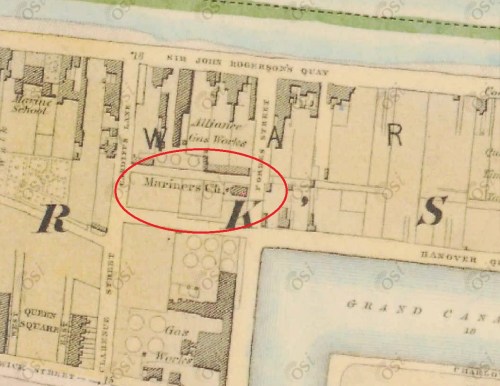
The National Library has an engraving of the vessel. I haven’t seen it, but de Courcy says it shows the chapel moored at the corner of Hanover Quay and Grand Canal Quay in the Grand Canal Dock, Ringsend.

In 1833 the Society moved ashore to the new Mariners’ Chapel in Forbes Street. That was sold to the Gas Company in 1889; the 25″ Ordnance Survey map shows tanks on the site.

The Mariners' Church, Forbes Street, Dublin (OSI ~1838)

The Mariners’ Church, Forbes Street, Dublin (OSI ~1838)

In The Picture of Dublin or Stranger’s Guide to the Irish Metropolis. Containing an account of every object and institution worthy of notice, together with a brief description of the surrounding country and of its geology. New Edition. With a plan of the city and thirteen views (William Curry, Jun and Company, Dublin 1835) we read this:

MARINER’S CHURCH — In the year 1822, the Episcopal Floating Chapel, for the especial use of seamen, was fitted up and opened under the sanction of the late Archbishop of Dublin, and a Chaplain appointed, whose duty is not only to perform divine service, but to visit the vessels frequenting this port, and otherwise to attend to the spiritual wants of seafaring persons.

The Floating Chapel being old and decayed, and requiring frequent and expensive repairs, it was at length determined to substitute for it a Chapel on shore, to be built in the immediate neighbourhood. The first stone of the Mariner’s Church was accordingly laid by Vice-Admiral Oliver, July 18, 1832, in Forbes-street, Sir John Rogerson’s Quay.

This neat and commodious edifice, capable of containing 500 persons, cost, including school-rooms, &c, about £2000. It was opened for divine service, Sept 15, 1833. Hours of service on the Sunday, half-past ten AM, four PM; Lectures on the evenings of Wednesday and Friday, at seven o’clock. In winter there is a daily evening school for seamen, and a Sunday-school throughout the year.

It is in contemplation to erect another Mariner’s Church at Kingstown, immediately.

The National Archives have the society’s regulations, from October 1822, amongst the Chief Secretary’s papers [Record 3435]; the National Library has a report of proceedings from 1824 and another for the years 1837 to 1842. I found various items, mostly ads seeking funds, in Dublin newspapers of the 1860s; I found none for earlier years, which may suggest that a different variant of the name was used — or that the society was in less need of assistance.

In Britain, the Boaters Christian Fellowship keeps the faith afloat on the inland waterways; some of the Canal Ministries boats are pictured here. I am not aware of any similar organisation or activity in Ireland.

My OSI logo and permit number for website

Relationships: guest post by Adele Picard

I invited Adele Picard to write a piece explaining why canal-based boaters are distrustful of Waterways Ireland. I am very grateful to her for agreeing to do so. The post’s appearance here does not mean that Adele and I agree on all the issues, but we are agreed that relationships are important and that the relationship between WI and canal-based boaters needs to be improved.

The Comments facility has been switched off. bjg

Relationships between WI and canal boaters

I have been asked to write this piece to explore a range of issues faced by canal users in recent years.

I set up home in 2003 when my partner and I bought our first narrow boat Chimwemwe. We lived in Lowtown and were enjoying life so much that we bought a wide-beam barge Rigmarole in 2005. We moved ashore in 2007 and soon after got married and started a family. Fortunately my two little boys are just as mad about the boat as we are and we enjoy cruising all over Ireland on the inland waterways.

In this piece I will be talking about issues that I have witnessed myself as well as first-hand accounts that have been related to me by others. I would like to point out at this stage that what follows is my personal opinion and is in no way claimed to be representative of views that may be held by any Irish boating organisations I may be a member of.

Lack of regulation and enforcement of bye-laws has always been a contributing factor to the issues experienced by users of the canals and River Barrow. In the current times as Waterways Ireland (WI) attempts to throw down the gauntlet and assert some kind of control over the navigations, a deepening of these issues is inevitable.

Control = a means of limiting or regulating something in order to mitigate any inherent risk that may occur.

At the moment Waterways Ireland’s reputational risk among the boaters on the canals has been realised but can this risk now be mitigated?

Taking control of the electricity

During my time as a liveaboard in Lowtown, a lot of boaters availed of the precious electricity supply, regardless of distance from their vessel to the power points. This resulted in long leads being run down the towpaths. When the clampdown started on this sort of thing by WI in 2006, a warning was shot across the bows and soon after the electricity was removed. In some cases this action resulted in vulnerable people being left without shore power. People felt that this situation could have been handled better by WI. On the other hand, everybody knew that, underneath it all, this situation represented a serious health and safety violation. This for me was the first indication that WI was putting controls in place to minimise their exposure to risk.

The Lowtown fiasco

In early 2012, after WI pulled out of a deal with Robert Few and Vita Marine on the expansion of Lowtown Marina, a meeting was held with the residents, a representative from WI and the management of Vita Marine. What came out of that meeting was that everybody moored there had to leave within the following 30 days due to health and safety concerns.

This is where we as a boating community started to engage with WI on the issues, mostly through the Property and Legal section. The frustration of going back and forth with emails and letters with no clear answers forthcoming from WI was disheartening. Furthermore the action led to the desolation and abandonment of Lowtown. This is when we started to open our eyes to the lack of willingness from WI to engage with the boating community. Legal proceedings began shortly afterwards, and we got very little information after that.

Rollout of new permits

The introduction of new permits in 2012 was at first to me a positive step, as one of the main issues on the canal is the number of sunken vessels; there was a real need to implement controls where every vessel is registered so owners can be contacted.

Then you go a little deeper and realise that these permits come with new issues. I would like to make it very clear that I have no problem paying for permits, but the following issues have not been dealt with to my satisfaction:

  • the legality of the new indemnity clause
  • the lack of an appeals process when and if there is action taken
  • the need for a deposit
  • the lack of a dispute resolution mechanism.

Although WI will say that they are within their rights to introduce reasonable changes to the terms and conditions of their permits, in my opinion these changes are not reasonable. Furthermore, the complaints procedure is frustrating due to a weak corporate governance structure.

Extended Mooring Permit (EMP)

It was after I had given up the liveaboard lifestyle, although still using the boat regularly, that I noticed that far fewer of the usual gang were travelling by boat to attend social gatherings along the waterways. I subsequently found out that the commonly accepted gentlemen’s agreement that many liveaboards have in relation to their spots had been broken. A boater returning from a rally had their spot taken. This kind of behaviour added to the already problematic lack of movement of some boats which has raised debate before. People were afraid to move!

The addition of the EMP, I felt, could stop this situation, but friends of mine bought one in 2013 to find that when they went out for the day their spot was occupied on their return. A WI official said nothing could be done. The EMP is now not fit for the purpose intended.

Also for those of us who like to move around the system there seemed to be no options: we didn’t really need an EMP as we would be in many different locations over the season and one location in the winter.

Then the stickering started in selected areas on the canal for those in breach of the five-day rule. In one instance boats were being stickered for the breach in Lowtown, while less than a mile down the road in Robertstown boats that hadn’t moved for years were not stickered.

Furthermore boats that wanted to move on the Royal were encountering their own problems in relation to low water levels, canal closures and the difficulties lifting Newcomen bridge.

Of course a barrage of correspondence ensued from boaters with WI on all these issues only to be met with what was becoming the standard with WI: more emails and unclear answers. It’s hard to explain this frustration but what it feels like is someone just shrugging their shoulders at you and saying “I don’t know”. Not a good way to treat your customer base in these times of expected transparency and professional standards in public service.

Liveaboards

I think on the whole liveaboards in general would welcome regulation on mooring as long as the terms and conditions are not too harsh and the price is right. I think the terms and conditions that are currently on offer at this present time are too stringent and could be improved with some consultation with the users.

For example during the planning process on the proposal to build jetties in Sallins Harbour submissions were made to Kildare County Council in August 2012 asking that Sallins should not go down the same road as the jetties in Shannon Harbour and Grand Canal Dock, which were lying empty at the time.

Following this WI did actively consult with the boating community and a deal was struck. This shows how a positive approach and engagement can make a real difference to our waterways and the communities on and around them.

The Sallins lockout

This positive development now has a shadow lying over it. Subsequent to the start of the consultation period on the 2014 proposed bye-law amendments, a campaign was launched on social media by concerned boaters and support grew rapidly. A peaceful protest was planned for Sallins on 25 January 2014. What follows are a series of actions by WI:

  • on Friday 24 January a Marine Notice issued stating that the canal at Sallins would be closed from Monday 27 January
  • on the Friday morning WI blocked the western entrance to the harbour and removed the racks from lock 14 on the eastern side, stranding 6 boats between locks 13 and 14
  • a Marine Notice issued after the fact stating that WI were now closing the canal on 24 January.

There was a serious risk to those stranded boats not only from a health and safety viewpoint but also because most of them were too big to turn around on that stretch of canal.

Conclusion

My opinion on the events of the recent past is that WI has a lot to do in order to improve communication with canal boaters. If the true purpose of these bye-law amendments is to …

develop the canals as a vibrant recreational waterway for all users by enhancing Waterways Ireland’s ability to manage the investment in infrastructure and facilities on the canals for both the navigational and recreational user

… the only way forward is for WI to actively engage with the communities both on and around the waterways.

© Adele Picard 2014

Quick work

Since some time yesterday (after 3.00pm, I presume) WI’s website has said:

Waterways Ireland ​undertakes Public Consultations as required under the legislation.
There is currently one consultation open:
1) Waterways Ireland Draft Corporate Plan 2014-2016 […]

Verb sap.

A sense of proportion

Waterways Ireland’s funding comes from Ireland [RoI] and Northern Ireland [NI] in the ratio 85:15. I understand that the ratio reflects the length of WI-run waterway in each jurisdiction, although I am not sure how length is measured on lakes.

The proportions of boats in the two jurisdictions are not 85:15. As of December 2013 there were 5570 boats on the Erne Register and 8816 on the Shannon Register. These numbers may or may not reflect the numbers of boats on the waterways as (a) there may be unregistered boats and (b) folk may not always deregister boats that have moved off the navigation. I do not know how many boats there are on the Lower Bann; boats on the Shannon–Erne Waterway should be on either the Erne or the Shannon Register.

Waterways Ireland reckoned that there were 520 boats on the Grand, Royal and Barrow at the end of 2013. Adding them to the Shannon number gives us

  • RoI 9336
  • NI (excl Lr Bann) 5570.

The ratio is RoI 63, NI 37.

On programme costs, though, matters are otherwise. Granted that the 2011 figures, the most recent available, may not be representative of long-term average costs: the Royal has not been reopened long enough for us to get such a long-term average, and the 2011 figure may be unusually high.

The other difficulty is with the allocation of the costs of the Shannon–Erne Waterway. I have arbitrarily divided it 50/50 between the two jurisdictions, although they probably exaggerates the proportion attributable to NI.

Shannon + Royal + Grand + Barrow + ½ SEW = €7275000

Erne + Lower Bann + ½ SEW = €807000

The ratio is RoI 90%, NI 10%.

So:

  • funding: NI 15%
  • number of boats: NI 37%
  • spending: NI 10%.

All subject to caveats.

No particular point: I just thought it was interesting.

The cost of parking a boat

On the east side of Dublin

Poolbeg: €280 per metre for a year plus membership; €20 a night for visitors.

Dun Laoghaire: €435 per metre with facilities for a year, €290 per metre without; €3.60 per metre per night for visitors.

Howth: €81 per metre per month; daily rate €3,20 per metre, minimum daily charge €20.

On the west side of Dublin

Grand or Royal Canal: current maximum €278 per year, irrespective of boat length, less than Dun Laoghaire charges per metre (for a berth with no facilities).

Admittedly you can go to more places from Dun Laoghaire (like, er, Holyhead), but on the other hand you can go boating from west Dublin in all but the most extreme conditions and there are more pubs along the way.

Comments closing

Very large numbers of new readers have visited this site in recent days and have read my posts about the draft WI canals byelaws. I am grateful to them and even more grateful to those who took the trouble to comment.

I have spent pretty well the whole week on this, between reading the legislation and draft byelaws, writing up posts and responding to comments. I have fallen behind with other work, and accordingly I need to turn my attention to other issues.

I have invited one person to write a guest post on an aspect of the byelaws issue that I think is important, but that apart I won’t be adding new material on the subject for some time. Furthermore, later this evening I will close the existing posts to comments. Those posts, latest first, are:

Draft canals byelaws: comments on what I sent to WI as my contribution to the consultation process

Bang em’ up? Alas, no more on the enforcement mechanisms

Pull the plug: drain the canals on WI’s financial situation. I hope it is clear that I don’t really want to see them drained, but that I do think action is needed

Asleep at the wheel on why the production of new draft byelaws should not have come as a surprise.

The posts themselves and the existing comments will remain visible.

I hope that readers have found the discussion and information useful — even those who didn’t agree with my views.

My next substantial post will be on the Dublin & Kingstown Canal.

If you are interested in the mix of contemporary and historical waterways matters, you are welcome to subscribe to the site’s RSS feeds or by email. Note that the site is non-commercial and does not carry advertisements.

Jimmy Deenihan, cricketer

Jimmy Deenihan, minister for waterways and some other stuff, supporter of the Lartigue Monorail in Listowel, is known to have played two forms of football: rugby and Gaelic. His cricketing expertise is perhaps less well known but, in a written answer to four Dáil questions yesterday, he showed his mastery of the straight bat.

I was surprised to find Bernard Durkan [FG, Kildare North] referring to “traditional canal boat dwellers”. I suppose it depends on your timescales: in my view, anything that began after 1850 isn’t really traditional.