Category Archives: Ashore

A gale at Limerick

Doubtless there must have been a pretty considerable storm at Limerick on Thursday week; though the following Hibernian account of it, in the Limerick Chronicle, goes somewhat beyond our sober and humble notions of the style proper for narrative.

That comment was made by the Spectator of 7 December 1833. Odd that a mag later edited by Boris Johnson should once have been devoted to “sober and humble” narratives. O tempora o mores.

Here is the Chronicle report as the Spectator quoted it:

A violent gale of wind set in at WNW, accompanied by occasional heavy showers of rain; and on the same evening, the gale assumed all the appalling characteristics of a most furious hurricane.

Throughout the night, the scene was terrific in the extreme, and the streets presented a most desolate aspect. Nearly all the public gas-lights were extinguished; and the howling of the storm, as it swept in pitiless squalls through every street, lane, and alley, struck terror to the hearts of every inmate of those mansions which suffered more or less from its destructive power.

A spring-tide, raised by the storm beyond its usual boundaries, dashed with desperate force against the quays, rolling a vast mass of water over the docks, etc and presenting one continuous sheet of liquid foam, at either side of the river for two miles. Several boats were thrown out of the docks upon the quay, where they were left high and dry at low tide. The vessels of the Shannon Yacht Club, laid up for the winter season at anchorage in the Abbey river, were driven against the salmon-weir bank, but received no material injury.

The strong banks enclosing the Abbey river (island and salmon-weir) were broken up, and the waters rushed in, deluging the fields on both sides to a wide extent. The cattle grazing there, cows and sheep, were saved with great difficulty. The long-pavement, or causeway, from Quinpool to the Thomond Gate Distillery, was inundated, and the fields around flooded.

The yards of the city gaol were full of water, and the tide came up to its very gates, as it did also to the verge of the flagging on Arthur’s Quay. The underground kitchens in houses adjacent to the river were from one to two feet deep in water. It is worthy of remark, that a few hours before this dreadful commotion, the quicksilver fell rapidly to a degree so low as we scarce ever remember.

The horses of the Ennis coach had to wade knee-deep several miles of the road, especially about Cratloe, without a vestige of the usual landmarks. The salmon weir received considerable damage, a great portion of the large timber-work having been torn up and sent adrift. Some of the strongest houses in the city literally rocked in the blast like a cradle. A house building off William Street, which wanted merely the roofing to complete it, was hurled to the ground, and became a pile of rubbish.

 

Romance on the Shannon

Elopement

We are informed that Maurice O’Connell Esq, MP for Clare, has proceeded to Scotland on a matrimonial excursion. Our correspondent states that on Saturday morning the Member for Clare induced Miss Scott to leave her father’s residence at Cahircon and proceed with him to Gretna Green. The Lady is young, handsome, and an heiress.

Wexford Conservative 3 October 1832

A letter has just arrived in town from a friend of the member for Clare, which states that, on Saturday morning, a Miss Scott eloped from Cahir Con (between Knock and Kildysart), with Maurice O’Connell, MP. They crossed the Shannon in a pleasure-boat, and landed at Shanagolden, county of Limerick. From thence they proceeded in a chaise through Limerick. Their route will probably be through Waterford to Bristol, and thence northward to Gretna Green. Miss Scott has, or will have, it is said, £20,000.

Spectator 6 October 1832 citing “Dublin Paper”

It’s not safe to believe conservative papers.

Marriages

At Tralee, by special licence, by the Very Rev Dr McEnery, and afterwards at Kenmare, by the Rev William Godfrey, Rector of that parish, Maurice O’Connell, MP for the County of Clare, to Mary Frances, only daughter of Bindon Scott Esq of Caheracon in that County.

Limerick Chronicle 3 October 1832

Who said Cahircon was boring?

Mind you, Mary Frances may have inherited less than she expected. Perhaps if her father had spent less on the house of the dead, he might not have ended up as the only Shannon Estuary landlord unable to pay his debt to the Shannon Commissioners. His estate was offered for sale in the Encumbered Estates court in 1854.

Navigating Ardnacrusha

The Western Mail & South Wales News of 19 April 1929 had an article by M Franklin Thomas about “Ireland’s Big Engineering Scheme”. The article was illustrated with a map and three photographs were reproduced on the newspaper’s “picture page”. It had a couple of interesting points about the headrace and tailrace considered as navigations; I can’t recall seeing these points made elsewhere.

Current

This [headrace] canal is level, but a flow of about 3½ miles per hour will be maintained owing to the water released through the turbines and navigation locks.

I don’t recall seeing a figure for the current. I presume that that is with three turbines running flat out.

There is an interesting account of the laying of the concrete apron that protects the banks against the “wave action set up by navigation, and the flow of the stream, wind, &c”. And the lock was to have an “ingenious arrangement by which the entering streams of water neutralise each other’s effect”.

Tailrace

Mr Thomas says

The tail race is one mile and a half long, cut from the solid blue limestone, and one of the most interesting points was the method adopted to permit barges to ascend the tail race against the enormous scour from the turbine discharges.

A special navigation channel is cut from the locks to a point some 200 yards below the outfall, and the bed of the tail race rises 20ft in the mile and a half, so that the depth of water will be 35ft at the outfall from the turbines and 15ft at the junction with the Shannon.

This will give a cushioning effect, and the rate of flow will be thus reduced to enable barges to navigate upstream. A bend is also provided where the special navigation channel joins the tail race and the rate of flow is estimated to be the same as that of the head race — 1.5 metres per second, or about 3½ miles per hour.

I would be glad to hear from anyone who can cast further light on this, and especially on whether the rising bed does have the intended effect.

Kerrygold

It is, no doubt, well known that the first transatlantic steam shipping company was founded by a Kerryman and was to be based in his home county: indeed on his own estate at Valentia Island. The transatlantic steamers would run thence to Halifax, Nova Scotia: that was amongst the shortest possible ocean crossing, which was important in the early days of steam navigation, when inefficient engines required prodigious quantities of coal. There were to be feeder services at both ends of the route, thus linking London with New York, and a second line from Valentia to the West Indies.

The Kerryman was Sir Maurice Fitzgerald MP, the 18th Knight of Kerry.  A meeting of supporters was held in London in June 1824 and, a year later, an Act of Parliament permitted the formation of a joint stock company with limited liability for its shareholders. However, the American and Colonial Steam Navigation Company did not last long: it softly and suddenly vanished away in 1828, its single steamer, the Calpé, sold to the Dutch government before completing a single voyage (although, under her new ownership, she ran a successful transatlantic mail service to Surinam and Curacao).

The prospectus, published before the meeting in June 1824, said of Valentia:

Ballast cargoes may be obtained there in slates, butter, and coarse linen, for the American markets.

However, Alexander Nimmo, writing to Fitzgerald, said

Remember, your whole peninsula only affords 100 tons of butter per annum, and all Kerry would not provide for a constant trade.

The gallant knight would therefore, I am sure, be delighted with the news from the Americas that “Irish Butter Kerrygold Has Conquered America’s Kitchens“. I hope he would have known enough to realise that “[…] Ireland’s landscape and economy, which both remain dominated by agriculture” may be true of the landscape but is not true of the economy.

Sources

John Armstong and David M Williams “The Perception and Understanding of New Technology: A Failed Attempt to Establish Transatlantic Steamship Liner Services 1824-1828” in The Northern Mariner/le marin du nord XVII no 4 [October 2007]

Letters and papers of Maurice FitzGerald in Public Record Office for Northern Ireland ref MIC639/6

Public Ledger and Daily Advertiser 28 June 1824

Thon sheugh and the paddling pool

Exciting news from the Minister for Fairytales about the Clones Paddling Pool, which is now called the Terminus Project. I see they’re worried about the water supply: not a new problem for water-using structures in that area.

Irish slobs

The word “slob” is a provincial term, and applied to banks of mud in the same way that the word “warp” is used to signify similar formations in the River Humber.

Second Report of the Commissioners appointed pursuant to the Act 5 & 6 William IV cap 67 for the improvement of the navigation of the River Shannon; with maps, plans, and estimates HMSO, Dublin 1837

Staffing the Shannon

According to the eleventh and final report of the Shannon Commissioners, published in 1850 but covering the year 1849, each of the quays built by the commissioners on the Shannon Estuary had an officer stationed at it to collect tolls and other charges. Five of the six — Querrin, Saleen, Kilteery, Kildysart [aka Cahircon] and Clare [now Clarecastle] — had Second Class Collectors; Kilrush, being busier, had a First Class Collector.

Cappa [Kilrush] pier

Moving upriver, Limerick was one of only two places on the Shannon to have an Inspector; it also had a First Class Collector and a Lock-keeper. Park, the next lock up on the Limerick Navigation, also had a keeper, as did five of the six locks on the Plassey–Errina Canal — Plassey [aka Annaghbeg], Gillogue, Newtown, Cloonlara [so spelt] and Errina. Presumably the Cloonlara keeper also locked after the nearby Monaskeha Lock. Preusmably, too, the keepers collected any tolls or charges due at the locks: there were no separate collectors, yet from other evidence we know that tolls and wharfage were collected at Plassey [Annaghbeg] and Errina.

O’Briensbridge modern [ie 1830s] navigation arch

Back on the river, O’Briensbridge had a Second Class Collector. On the Killaloe Canal, each of the three locks — Cussane, Moyse [sic] and Killaloe — had a keeper; the Cussane keeper must have collected tolls and wharfage. Killaloe had a First Class Collector.

On Lough Derg, Scarriff and Portumna each had a Second Class Collector. Portumna, like several places upstream, had an opening bridge, but the Shannon Commissioners did not employ a bridge-keeper: the bridge was not built, owned or operated by the Shannon Commissioners.

Back on the river, on what used to be called the Middle Shannon, the commissioners employed both a Second Class Collector and a lock-keeper at Victoria Lock (Meelick). There was another Second Class Collector, and a bridge-keeper, at Banagher. At Wooden Bridge, the crossing of the Shannon from the Grand Canal’s main line to its Ballinasloe line, the commissioners employed two ferry boatmen: by that stage the bridge no longer existed and the commissioners had installed a ferry to carry horses and tow boats between the canals.

Shannon Bridge had a Second Class Collector and a bridge-keeper; Athlone had a bridge-keeper but earned itself a First Class Collector. On Lough Ree, Lecarrow and Lanesborough each had a Second Class Collector but Tarmonbarry had nobody: a First Class Collector was assigned to Cloondragh [so spelt] but presumably had to look after Clondra and Tarmonbarry locks, the weir, Tarmonbarry bridge and the collection of tolls. Mighty men they had back then.

The second Inspector was based at Rooskey, along with a lock-keeper who presumably also operated the bridge and did anything that needed doing on the weir. Albert Lock on the Jamestown Canal had a lock-keeper but Kilbride, the quay at the upper end of the canal, had a wharfinger, the only one on the Shannon.

Fermate at Kilbride Quay

The collection of tolls (presumably by the wharfinger) did not begin at Kilbride until March 1849 but in that year it took in £6 in tolls and £1 in wharfage, compared with £1 + £2 at Drumsna and £0 + £0 at Jamestown. Perhaps the road beside the quay made it a suitable place for cargoes from Roscommon to transfer from road to water transport.

Carrick-on-Shannon, not an important station on the Shannon, had just a Second Class Collector; there was a lock-keeper at Knockvicar for the Boyle Water and another at Battle Bridge who presumably looked after all the locks on the Lough Allen Canal.

Cranes were provided at several places but there is no mention of designated crane-operators.

Source: Eleventh and Final Report of the Commissioners under the Act 2 & 3 Vict c61 for the improvement of the Navigation of the River Shannon, Ireland; with an appendix Ordered, by The House of Commons, to be Printed, 3 June 1850 [407]


I’ve often wondered …

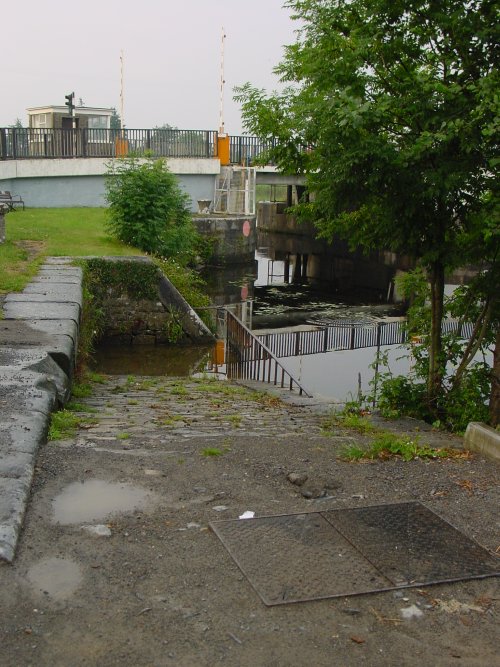
… what this ramp is, or at least what it was originally intended as.

Curious object [2006]

And now I know. There will be a special prize, of a blank sheet of A4 paper, for the first person to describe its origins correctly.

Kilteery

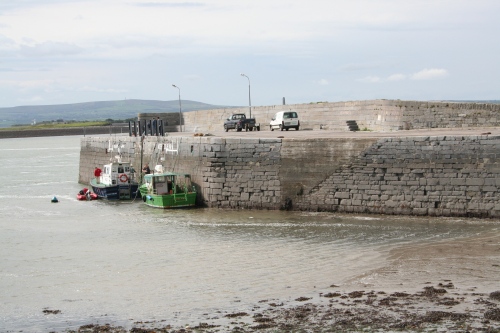
The current header photo shows Kilteery Pier on the Shannon Estuary. Here is a page about the building of the pier.

The new header photo

Kilteery pier, on the Shannon estuary, August 2015