
I thought there was only one canal in Co Kerry, but there were three more at Lixnaw. They’re still to be seen and they have interesting associations.
Thanks to Ewan Duffy of Industrial Heritage Ireland for the tip-off.
1580 Is there an engineer employed to oversee the works on the Blessington Road? — There has been a surveyor, a Mr Dargan.
1581 From the commencement of the Trust? — From the commencement of the Trust.
1582 At what salary is Mr Dargan employed? — About £100 a year.
1583 Is he still in the employment of the Trust? — He is nominally so.
1584 Does he receive a salary at present? — He does not.
1585 But he is still in the employment of the Trust? — He is.
1586 What was the reason, if the Trust continue to employ him, that they should take away his salary? — At that meeting in Baltinglass, in November, there were very general complaints as to the quality of the materials then lying on the road, and also of the quality of materials that had been expended on the road during the year; this induced me to ask the question, whether the surveyor, to whom we paid so high a salary, had attended; and upon further inquiry, I could not ascertain that he had done any duty, or taken any active part whatever in the management of the road, for the twelve months previous; upon which I entered on the books of the Trust a notice, that at the ensuing meeting I would move for the dismissal of Mr Dargan from that situation altogether. At the subsequent meeting I brought forward this motion, when there was a proposal sent in from Mr Dargan, in which he offered to do the duty for £50 a year. Upon further pressing the matter, his friends at the Board stated that he would withdraw all claim whatever for salary, would not ask what he might do for the last half year, and that he would be obliged to us if we would allow him to remain nominally as our surveyor, and pay him as we would any other surveyor when we had occasion to employ one. This was a proposition that I thought only reasonable, and I consented to it, and it was so entered upon the books, and I did not further interfere or further press the proposition that I had originally brought forward.
1587 In any further accounts that were laid before the Board, did any charge appear on the part of the treasurer for a sum of £50 to be paid to Mr Dargan after he had refused to receive any salary? — There was; the very first item in the treasurer’s account was a claim for a credit of £50 for salary to Mr Dargan, which he himself had conscientiously refused to take; so that we were, in fact, putting £50 into Mr Dargan’s pocket, whether he would take it himself or not.
1588 What was the proceeding of the Board upon that item appearing on the accounts of the treasurer? — It was, I presume, a mistake.
1589 Was it actually paid? — I never heard; but the moment I heard that it was a mistake, not to go to the credit of the treasurer, I said no more about it. It is not the loss of £50 to the funds. I only mention it to show the willingness to dispose of the money of that Trust.
[…]
1656 Can good materials be obtained? — As good as possible; there are as good materials on that road as on any in Ireland.
1657 Then you conceive that the putting on of bad materials was the cause of the bad state of the road ever since? — I do; repairs are eternally going on; it is not permanent. They do not screen it properly, so that it is literally drawing on mud and drawing off mud; for this gravel is not properly screened; the consequence is, that what they draw on to-day they draw off to-morrow.
1658 Do they ever employ an engineer? — Mr Dargan is professedly an engineer.
1659 Did not that engineer give directions as to the materials to be employed? — He may have done; but his directions were not attended to, if he gave them.
1660 Still he received his salary? — Still he received his salary.
Evidence of Peter Purcell in Report from Select Committee on Turnpike Roads in Ireland: with the minutes of evidence and appendix Ordered, by The House of Commons, to be Printed, 26 July 1832 645
Finally, as to the want of cleanliness of which you complain — although I do not pretend to say that the Irish peasantry are as fond of order as the English, yet here also we can discover how much is owing to want of education and early training. If you visit the union workhouses, the prisons, the lunatic asylums, and other public institutions in Ireland, you will perceive that, under proper instruction and discipline, Irish men and women can be cleanly, and can keep rooms and houses as orderly and neat as any other people. The fact is, that the Celtic race appear to stand in need of training and discipline, for the acquirement of those habits which seem to come naturally to the Saxon; but with such training, and the stimulus of suitable encouragement, or even of a kind word, the Irish may be made all that their English neighbours can desire.
Edward Newenham Hoare The English Settler’s Guide through Irish Difficulties; or, a hand-book for Ireland, with reference to present and future prospects Hodges and Smith, Dublin; John W Parker, London 1850
Posted in Built heritage, Engineering and construction, Foreign parts, Historical matters, Ireland, People, Politics
Tagged CELT, cleanliness, England, godliness, Ireland, Saxon
Most respectfully informs his friends and the public, that he has removed from the Old Town of Monasterevan, to a spacious and elegant house adjoining the Canal, which he has fitted up in a stile superior to any on the road:— His coach-houses, stabling, &c are on a very extensive scale; he has gone to a great expence in fitting up stall stables, which he flatters himself will give general satisfaction; — returns his sincere thanks for the numerous favours received since his commencement in business.
His Larder is constantly well assorted, and his wines are of the first quality.
NB said Jenkinson informs the public, that his Stage from Kilkenny sets off precisely at half after four in the morning, arrives in time for the three o’clock packet which leaves Monasterevan, and on passengers coming from Dublin will arrive in Ballyroan, so as to be in Kilkenny early next day. Said coach passes through Castle Durrow coming and going.
Stage passengers for Limerick or Kilkenny not charged with beds.
Seats taken in Dublin at Mr John Goffen’s, No 7, Bolton-street, and in Kilkenny at Mr Francis Reynold’s, Wheat Sheaf.
Dublin Evening Post 17 June 1790

I would be glad to hear from anyone who can tell me where Mr Jenkinson’s Drogheda’s Arms was. Please leave a Comment below.
Posted in Ashore, Built heritage, Canals, Economic activities, Engineering and construction, Extant waterways, Historical matters, Irish inland waterways vessels, Operations, Passenger traffic, People, Roads, waterways, Waterways management
Tagged Drogheda Arms, Dublin, Grand Canal, Jenkinson, Kilkenny Monasterevan, Limerick, passage boat
Brian Simpson writes from Waterford:
There’s a new bridge being built on the Waterside in Waterford City and sadly it looks like it is going to be a death blow for the Friends of St John’s River and Waterford Small Boat Owners Association’s attempts to restore navigation along this waterway.
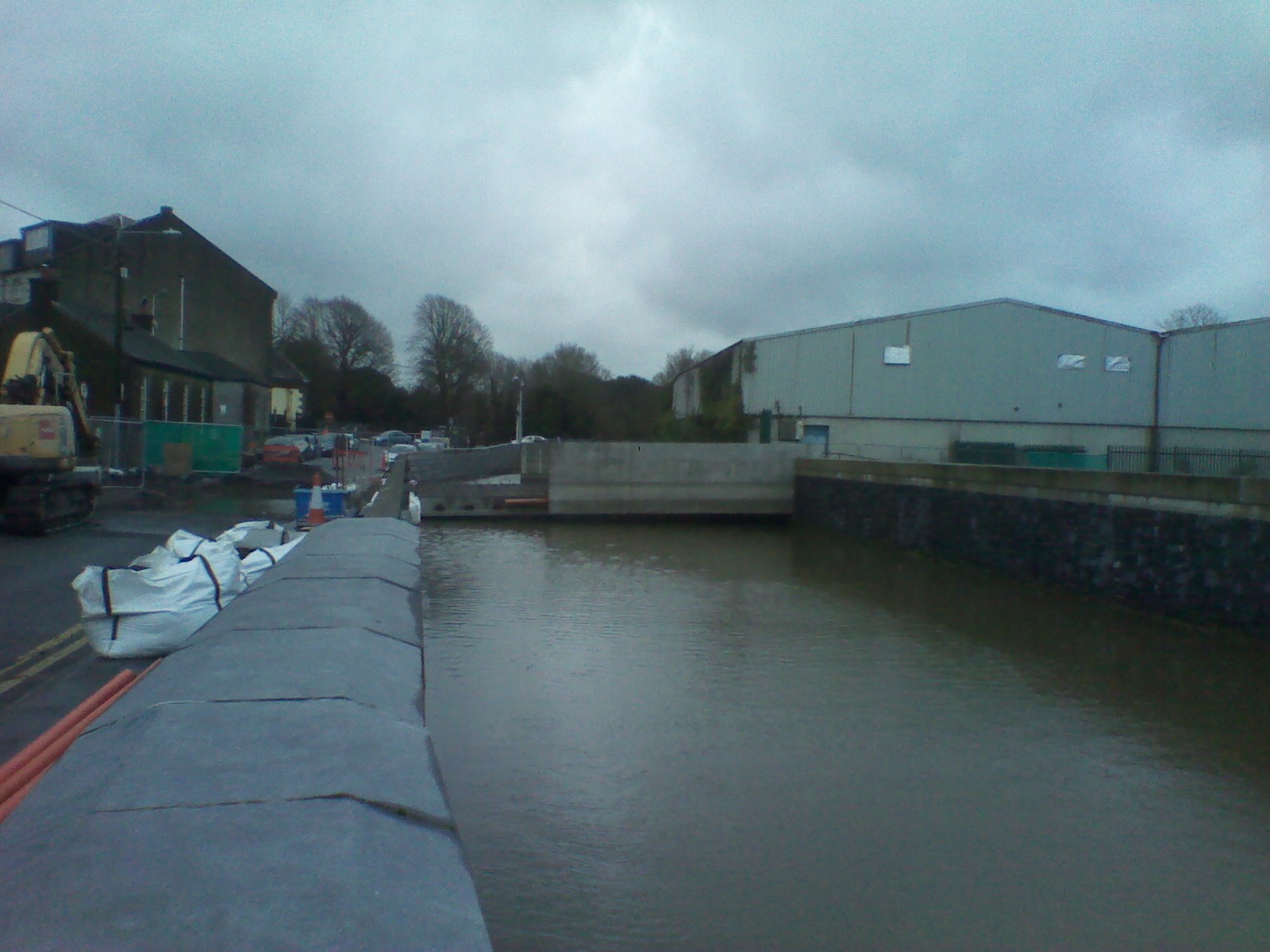
The new bridge at high tide (Brian Simpson)
Please find attached the Facebook link for comments and attached photo of bridge at high tide.
Half our canal was taken by a humpback bridge, Wyse Bridge, being replaced at Poleberry in 1980; this effectively stopped any chance of barges navigating the other part of the waterway, which was being done up to the 1950s.
I do hope that boats will still be able to use the Pill.
Update: a link to a video.
Posted in Ashore, Built heritage, Canals, Economic activities, Engineering and construction, Extant waterways, Forgotten navigations, Historical matters, Industrial heritage, Ireland, Irish inland waterways vessels, Modern matters, Operations, People, Restoration and rebuilding, Water sports activities, waterways, Waterways management
Tagged Poleberry, small boats, St John's Pill, Waterford, Waterside
The hopes of a gentleman of Limerick ….
Posted in Ashore, Built heritage, Canals, Economic activities, Engineering and construction, Extant waterways, Historical matters, Industrial heritage, Ireland, Irish inland waterways vessels, Operations, Shannon, Sources, Unbuilt canals, waterways
Tagged Athlone, boat, coal, iron, Killaloe, Leitrim, Limerick, Lough Allen, Shannon, Slieve Anerin
Thanks to Ted McAvoy (via Andrew Waldron) for this photo.
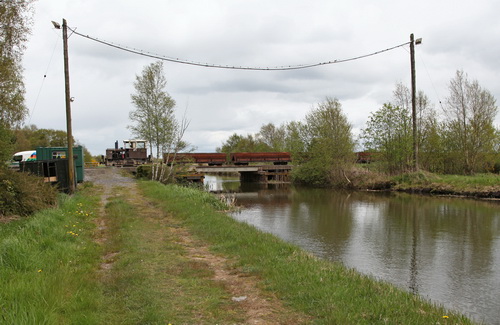
LM 238 crossing the Grand Canal (Ted McAvoy)
It shows a Bord na Mona ballast train crossing the Grand Canal just here. It’s on the BnM’s Derrygreenagh System and, if you follow the line northwards on the map, you’ll get to Derrygreenagh on the R400. I am told that the train was going to Ballybeg Bridge Quarry but I haven’t managed to locate that.
I had a page with photos of the construction of Ardnacrusha in 1930; I have expanded that page to include
Posted in Ashore, Built heritage, Canals, Economic activities, Engineering and construction, Extant waterways, Historical matters, Industrial heritage, Ireland, Irish inland waterways vessels, Modern matters, Non-waterway, Operations, Shannon, Sources, waterways, Waterways management
Tagged archive, Ardnacrusha, Chatterton, ESB, Parteen Villa, scheme, Shannon, Siemens

 Irish waterways history