Category Archives: Built heritage

Waterways trees

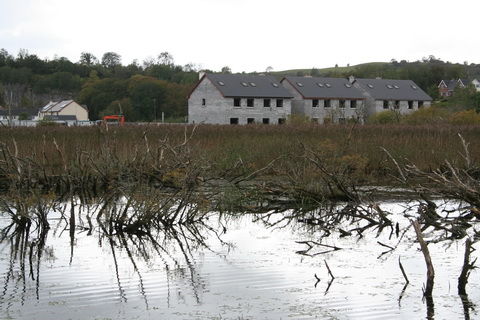
Nama to Nature has been planting trees at Keshcarrigan on the Shannon–Erne Waterway, along which far too many developers wanted to sell houses that would have fast boats parked outside. I don’t know whether my photo shows the Waterways estate or a different one.

Keshcarrigan September 2011


h/t Ireland after NAMA.

Thomas Omer in Athlone

Here is a new page showing the route of the old canal in Athlone, which was used before the Shannon Commissioners built the new lock, weir and bridge in the 1840s. The canal is easily accessible along most of its route, although some explanatory signs might be useful to call attention to notable features.

Support the Clones Canal

It was suggested to me today that, because some boating organisations want the Clones Canal, the project must be worthy of support. I find that argument less than convincing. If I offer someone the benefit of a sum of money, without charge, I will not be surprised if that person likes the idea — but that won’t show that it’s a good deal for whoever bears the cost.

In this case, owners of boats are being offered the benefit of €45 million, so it’s not surprising that they like the idea. But I think they should be offered a practical method of demonstrating the depth of their support.

Accordingly, I propose that owners of registered boats on  the Shannon and the Erne be offered the opportunity to pay half the €45 million cost (the other half could be raised from a levy on the publicans of Clones, the other main beneficiaries). If there are 10,000 boats, the charge per owner, spread over three years, would be no more than €750 a year. Willingness to pay would provide more convincing evidence of support and would also make the project better value for the taxpayer.


Clever chaps in Youghal

No, not the one in Cork: the one in North Tipperary.

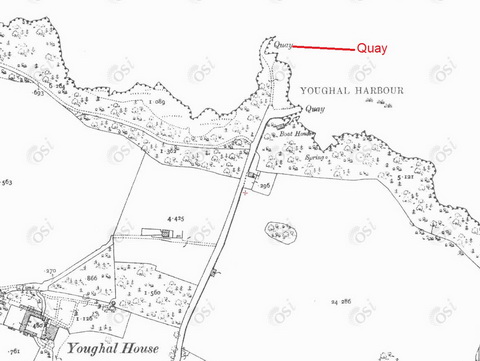
Youghal Quay ~1900

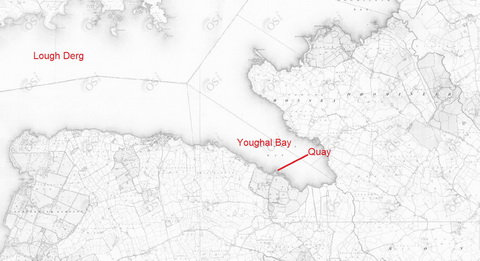
Youghal Quay and Bay ~1900

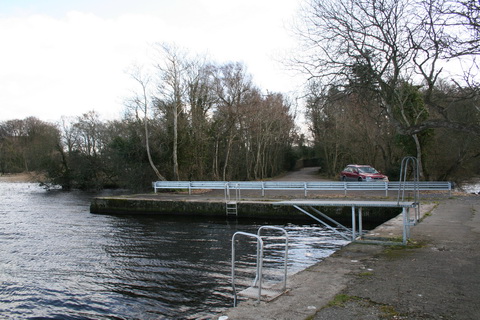
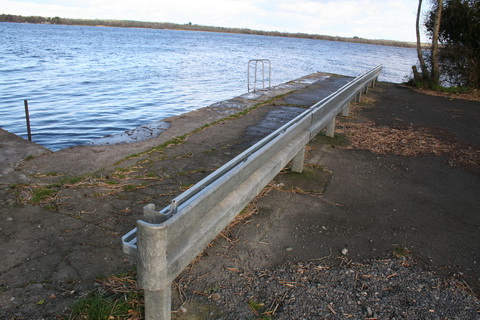
Formerly used for landing turf from the west side of Lough Derg, Youghal Quay is now a swimming area.

Ladder and diving board. Note the barrier at the landward end

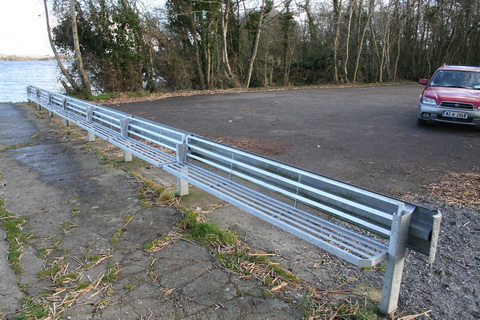
The business end of the barrier

The other side supports a seat

Nice idea.


Shannon 1 design

If you don’t like hanging around airports, Shannon offers you a choice: you can go and look at the estuary instead, which is much more interesting.

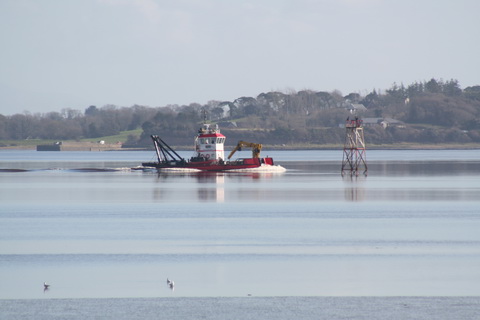
Shannon Foynes Port Company workboat Shannon 1 passing Shannon Airport; Ringmoylan Pier in the background

Shannon 1, the successor to Curraghgour II, is a Damen MultiCat.

Shannon Foynes Port Company has updated its website.


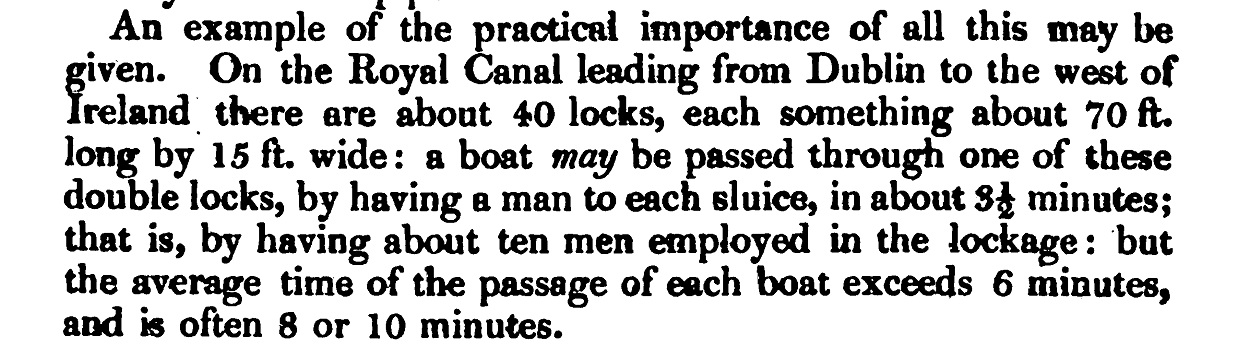
Royal Canal: speed of lock operation

From Robert Mallett MRIA, MSCEI “On certain improved Methods of constructing Valves or Sluices, as applied to Canal and Dock Gates, &c, and similar Works of Hydraulic Engineering” in The Architectural Magazine 1837.


A target for WI to aim for?

Sunset on the Lower Shannon

A poem by Sir Aubrey de Vere, father of the more famous Aubrey Thomas de Vere. The family estates were at Curraghchase, now a forest park, on the south side of the Shannon estuary and now best known as the home of Caroline Rigney, producer of some of Ireland’s best bacon. Sir Aubrey’s wife was one Mary Rice, of the Mount Trenchard family, one of whose members had a major role in the development of the Shannon in the 1840s.

Sunset on the Lower Shannon

How beautiful the tints of closing even!
The dark blue hills, the crimson glow of heaven,
The shadows purpling o’er the wat’ry scene,
Now streaked with gold — now tinged with tender green;
And yon bright path that burns along the deep,
Ere the sun sinks behind his western steep,
Soft fades the parting glory through the sky,
Commingling with the cool aerial dye;
While every cloud still kindling in the beam,
In mirrored beauty prints the waveless stream,
Light barques, with dusky sails, scarce seen to glide,
Bend their brown shadows o’er the glowing tide;
And hark! at intervals the sound of oars
Comes, faint from distance, to the silent shores,
Blent with the plaintive cadence of the song
Of boatmen, chanting as they drift along.
But see the radiant orb now sinks apace —
Gradual and slow, he stoops his glorious face;
And now — but half his swelling disk appears —
And now, how quickly gone! he scarcely rears
One burning point above the mountain’s head —
And now, the last expiring beam has fled.

Sir Aubrey de Vere in The Dublin Penny Journal Vol 1 No 17
October 20 1832

The “light barques” probably included some turf boats.

There are more poems by Sir Aubrey here.

A waterway for everyone in the audience

My attention has been drawn to this Dáil written question by Joan Burton TD (Dublin West, Labour) and the answer by Éamon Ó Cuív TD (Minister, Department of Community, Rural and Gaeltacht Affairs; Galway West, Fianna Fail).

The layout on the kildarestreet site is not perfect, so I reproduce some of the list here:

The following are the details requested by the Deputy in respect of non-navigable stretches of canals that are within the control of Waterways Ireland and are being or could be restored:

Grand Canal

  • Kilbeggan Branch (8.2 miles long) in Co. Offaly and Co. Westmeath
  • Part of Naas & Corbally Branch (Corbally Extension) (4.4 miles long) in Co. Kildare
  • Barrow Line Part of Mountmellick Branch (0.25 miles long) in Co. Kildare (remaining 11 miles filled in).

Royal Canal

  • Part of Royal Canal (11 miles long) in Co. Longford, currently under restoration
  • Longford Branch (3 miles long) in Co. Longford.

The Royal Canal main line is currently under restoration and the remaining work necessary to return it to full navigation between Dublin and the Shannon is due for completion in 2010.

Ulster Canal

  • 46 miles long in Co. Cavan, Co. Monaghan, Co. Fermanagh and Co. Armagh.

Approval has been given to Waterways Ireland to restore the stretch between Lough Erne and Clones. Present indications are that this stretch could be re-opened by 2013.

And (perhaps because the economy was so successful) we could have waterways everywhere:

It is intended, subject to availability of resources, to carry out feasibility studies and preliminary designs in relation to the Longford Branch, the Kilbeggan Branch and the Corbally Extension, along with extensions to Annagh Upper near Dowra on the Shannon Navigation and to Lough Oughter on the Erne System with a view to possible re-opening. Consideration will also be given to the carrying out of preliminary analysis and assessment of the Mountmellick Branch, as well as the Boyne Navigation (which is primarily a river navigation) and the extension towards Mohill on the Rinn River, as future possibilities for restoration.

“The Irish economy entered severe recession in 2008,” according to Wikipedia’s useful summary of the financial crisis, but Craggy Island (nach maireann, comme on dit) still hoped to drag Ireland into the Canal Age.


Lough Derg water

The lake level seems to be down about a foot. Two rumours purport to account for this: either (a) the powers-that-be want us to get used to a new, lower level, so that we won’t notice when Dublin starts extracting water, or (b) the ESB is generating as much electricity as it can before it starts getting charged for water. Such charges would be covered by the same European Commission reasoned opinion as that mentioned here that might see Waterways Ireland being charged to fill the Grand, Royal and SEW.

Or, of course, it could just be that there hasn’t been much rain. According to Met Éireann’s seasonal summary for winter 2012 [two-page PDF]:

Majority of rainfall totals were below normal for winter across the southern half of the country and in some parts of the east. Rainfall totals were below average in the majority of these parts during December and January, while all stations reported dry conditions in February. Most stations the east and south reported a below average number of wetdays (days with 1 mm or more) and the driest winter since 2006 (6 years).

Ardnacrusha usually runs fewer turbines in summer.

How much Dáil time …

… is wasted in asking and answering questions over and over again? I’d have thought that Caoimhghín Ó Caoláin TD (Cavan-Monaghan, Sinn Fein) would have realised that the government has discovered neither oil nor a crock of gold and that there is no money for a canal to Clones. The task of finding some is to be delegated to an “inter-agency group”, poor dears. I’d have thought it might be better to give the job to people with experience of unconventional fund-raising; there must be some such people around.