
A train ferry, claimed to be in service on the Liffey
Fishing at Ringsend the hard way
Launching the Irish Elm in Cork
Making and using a Boyne currach in 1921 (you can learn the art yourself here)
A non-watery film: Irish Aviation Day 1936
Parteen Villa Weir is sending large amounts of water down the original channel of the Shannon, and over the Falls of Doonass, to draw water off from the upper reaches of the river.
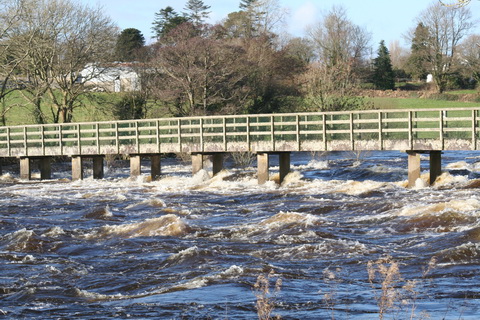
The footbridge at Castleconnell
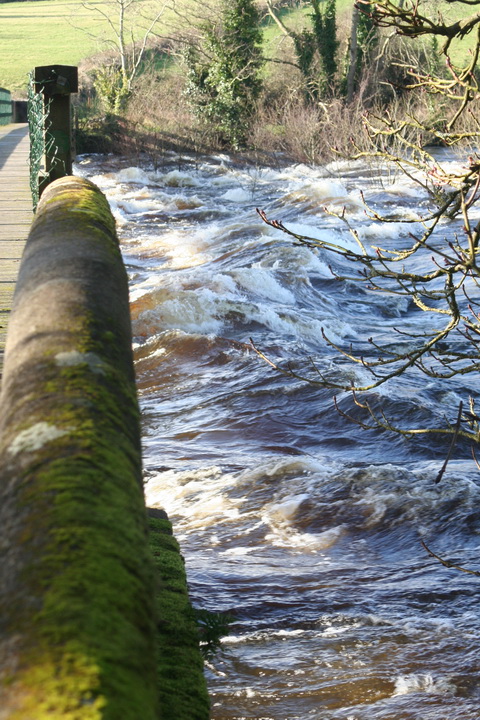
Above the bridge
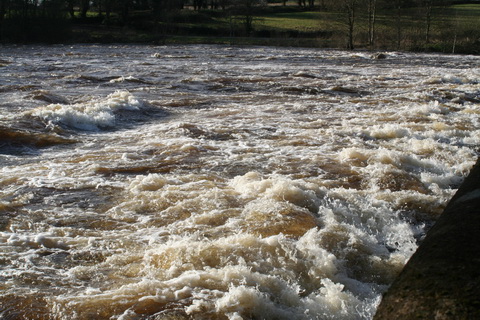
The downstream side of the bridge
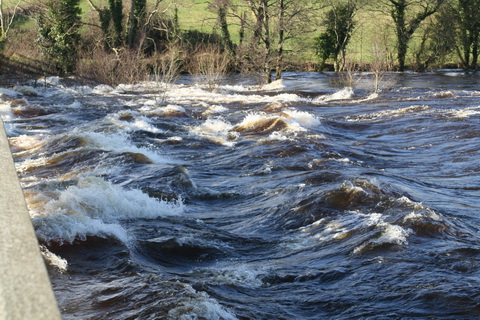
A bumpy ride
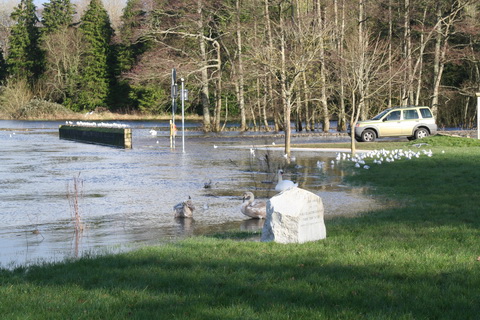
At normal levels the bottom of the wall is several feet above the water
Levels below Parteen Villa have not yet reached those of 2009 and the channel can probably take more before folk get flooded.
The Old River Shannon site has some photos taken at Parteen Villa Weir.
Posted in Built heritage, Canals, Charles Wye Williams, Drainage, Economic activities, Engineering and construction, Extant waterways, Industrial heritage, Ireland, Natural heritage, Operations, Safety, Shannon, Sources, Tourism, Water sports activities, waterways, Waterways management, Weather
Tagged boats, bridge, canal, Castleconnell, Clare, ESB, floods, flow, Ireland, Killaloe, Limerick, lost, O'Briensbridge, Operations, Parteen Villa Weir, quay, Shannon, turf, vessels, water level, waterways, Waterways Ireland, weir
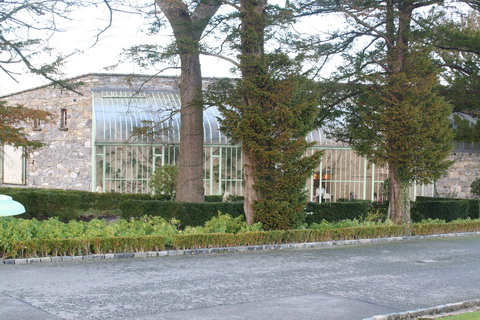
La Serre
Nibbling yesterday on a morsel of cured salmon, with fennel and apple salad, lemon crème fraiche and lavender jelly, at the excellent La Serre restaurant at the Village at Lyons, I looked forward to walking outside afterwards, on to the canal bank, to view the many boats that would undoubtedly be moored there, above the thirteenth lock, as their owners lunched at La Serre’s sister institution, the Canal Café.
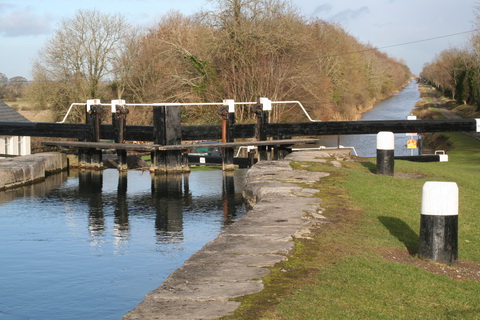
The thirteenth lock (and its wonderful O)
Judge of my surprise, then, when I found not a single boat outside. I realised, though, that boaters probably walked from nearby Hazelhatch and even from Sallins. For we know, do we not, that boaters are vital to tourism? Even Joe Higgins of the Socialist Party tells us so, which means that they must be out and about along the canals, spending money (and where better to spend it than at the Canal Café?).

The Canal Café, mere feet from the canal bank
But a difficulty has struck me. Mr Higgins’s position is that boaters have money available for discretionary expenditure, but Senator John Kelly tells us that most boaters are “retired couples from England who are receiving small English pensions”. So one politician tells us that boaters have disposable incomes and that they should not pay money to Waterways Ireland because they spend money in pubs and restaurants along the canals; another politician tells us that boaters should not pay money to Waterways Ireland because they have none to spare.
I find it difficult to reconcile these two positions.
Posted in Ashore, Built heritage, Canals, Drainage, Economic activities, Engineering and construction, Extant waterways, Industrial heritage, Ireland, Irish inland waterways vessels, Non-waterway, Operations, People, Politics, Scenery, Tourism, Uncategorized, Water sports activities, waterways, Waterways management
Tagged barge, Barrow, boats, bridge, bye-laws, byelaws, canal, department of arts heritage and the gaeltacht, Dublin, Grand Canal, Ireland, jetties, lock, Operations, quay, vessels, water level, waterways, Waterways Ireland
The Irish Times reports today, in an article that will probably disappear behind a paywall sooner or later, that some folk don’t want the Naomh Éanna, a decrepit former ferry cluttering up the Grand Canal Dock, to be scrapped.
There seems to be a reluctance to accept that things, like people, have a lifespan. Keeping them alive indefinitely costs a lot of money. And none of those quoted in the article has put forward any good reason for keeping the damn thing, never mind any reason that would justify the spending of very large amounts of money on it.
Yes, it had some interesting (if minor) historical associations, but the best way of recording them would be to write a book, or create a website, or even make a movie, about the ship’s history. Money spent that way would be a far better investment than money spent on keeping the Naomh Éanna afloat. Its heritage or historical value lies in the associated information, not in the steel.
As it is, the vessel has been hanging around for about twenty-five years, since it failed a survey in 1986 or 1988 (I have found different dates). I don’t know how much it has done since then to advance appreciation of industrial or cultural history, or whatever it is that the complainants think is being vandalised, but I would have thought that anyone who wanted to gaze on an elderly vessel has had plenty of opportunity to do so.
Addendum: it seems some folk want to draw up an investment plan.
Posted in Built heritage, Canals, Economic activities, Engineering and construction, Extant waterways, Industrial heritage, Ireland, Irish inland waterways vessels, Operations, People, Politics, Restoration and rebuilding, Sea, Sources, Steamers, The cattle trade, The turf trade, Tourism, waterways, Waterways management
Tagged Aran Islands, boats, canal, department of arts heritage and the gaeltacht, Dublin, Grand Canal, Grand Canal Dock, Ireland, lock, Naomh Eanna, Operations, Ringsend, vessels, waterways, Waterways Ireland
I read here that some folk want to remove the retired lifeboat Mary Stanford from Grand Canal Dock (a laudable aim, especially if it saves Waterways Ireland money), transport it to Ballycotton, Co Cork, and restore it.
It is to be hoped that their efforts will be more successful than those of the group that intended to restore the Clogherhead lifeboat Charles Whitton.
Posted in Ashore, Canals, Economic activities, Extant waterways, Ireland, Irish inland waterways vessels, Operations, People, Restoration and rebuilding, Sea, Sources, Water sports activities, waterways, Waterways management
Tagged Ballycotton, boats, canal, Charles Whitton, Clogherhead, Dublin, Grand Canal, Grand Canal Dock, lifeboat, lock, Mary Stanford, Operations, waterways, Waterways Ireland
I emailed Waterways Ireland on 4 February 2014:
I would be grateful if you could tell me whether any person applied, under byelaw 38q, for permission to hold an aquatic event on the Grand Canal at or near Sallins on or after Friday 24 January 2014.
WI said:
No-one applied to hold an aquatic event on or around that date on the Grand Canal.
If I were Waterways Ireland, and I heard a rumour (or got a tip-off from the NSA) to the effect that some boaters were going to hold a demo at Sallins, and if nobody had asked permission to hold the demo, or made any arrangements with me about it, and if I expected work to start shortly at Sallins, I might be worried that the demo might turn out to be more than a photo opportunity: that it might turn into an occupation or moor-in, one that would delay the work and possibly expose me to additional costs.
So I would do what I could, within the byelaws, to prevent the holding of the aquatic event. I would note byelaw 18 (2) (b):
(2) The Commissioners, or any authorised officer, may prohibit navigation on the canals or any part thereof from time to time for the purposes of—
( a ) an emergency, or
( b ) preventing the passage of a boat in respect of which a permit has not been issued under these Bye-Laws, or has been withdrawn, or is not displayed in the manner prescribed in Bye-law 40 of these Bye-laws.
If I were not Waterways Ireland, then, but a would-be demonstrator, I would make a note to inform the authorities next time I planned a demo so that there would be no surprises on either side.
I am, however, neither WI nor a would-be demonstrator, so (apart from the information I gleaned from WI) I know nothing of what either side may have done or not done, thought or not thought.
Posted in Ashore, Built heritage, Canals, Economic activities, Engineering and construction, Extant waterways, Ireland, Irish inland waterways vessels, Operations, People, Politics, Restoration and rebuilding, Safety, Sources, Tourism, Water sports activities, waterways, Waterways management
Tagged boats, bridge, canal, demo, department of arts heritage and the gaeltacht, Dublin, Echelon, Grand Canal, Ireland, jetties, Kildare, lock, NSA, occupy, Operations, quay, Sallins, vessels, waterways, Waterways Ireland
See Fergal.b’s post today on boards.ie. Scrapping sounds like a good idea to me, but it would be nice (if it hasn’t already been done) to take as many photos as possible of the vessel.
Posted in Built heritage, Canals, Economic activities, Engineering and construction, Extant waterways, Industrial heritage, Ireland, Irish inland waterways vessels, Operations, People, Politics, Restoration and rebuilding, Safety, Sea, Sources, Tourism, Water sports activities, waterways, Waterways management
Tagged boats, canal, department of arts heritage and the gaeltacht, Dublin, Grand Canal, Grand Canal Dock, graving dock, Ireland, Naomh Eanna, Operations, Ringsend, scrap, vessels, waterways, Waterways Ireland

 Irish waterways history