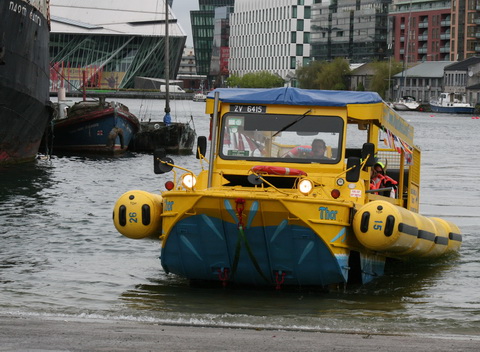
The Thing from the deep

The Thing from the deep
Posted in Ashore, Charles Wye Williams, Economic activities, Engineering and construction, Extant waterways, Industrial heritage, Ireland, Irish inland waterways vessels, Non-waterway, Operations, Tourism, waterways, Waterways management
Tagged boats, canal, Dublin, DUKW, Grand Canal, Grand Canal Dock, Operations, Ringsend, Thor, vessels, Viking Splash, waterways, Waterways Ireland, workboat
I reported last October that an unused London pub, named after Henry Petty-Fitzmaurice, 3rd Marquess of Lansdowne, KG, PC, FRS, was threatened with demolition in favour of a museum extension.
I pointed out that the late Marquis had two claims on the attention of Irish waterways enthusiasts. First, the best-known of the early River Shannon steamers, the Lady Lansdowne, was named after his wife. Second, he was Lord President of the Council [the current holder of the post is Nick Clegg] when the government of Her Late Majesty Queen Victoria decided, in 1839, to spend about half a million pounds improving the Shannon Navigation.
The Indie reports today that Hackney Council’s planning committee has voted against the demolition, so the Marquis survives, at least for now.
Posted in Ashore, Built heritage, Charles Wye Williams, Economic activities, Engineering and construction, Extant waterways, Foreign parts, Forgotten navigations, Industrial heritage, Ireland, Irish inland waterways vessels, Irish waterways general, Non-waterway, Operations, People, Politics, Restoration and rebuilding, Shannon, shannon estuary, Sources, Steamers, The cattle trade, waterways, Waterways management
Tagged boats, bridge, canal, Clare, estuary, Fergus, Geffyn, Ireland, Killaloe, Kilrush, Lady< Marquis, Lansdowne, Limerick, Lord President of the Council, Lough Derg, O'Briensbridge, Operations, Petty-Fitzmaurice, Shannon, steamer, vessels, waterways
I dare say you’ve observed, Major, how singularly little originality there is about Chief Secretaries. One of them, whose name is lost in the mists of antiquity, thought of piers and seed potatoes, and since then all his successors have gone on building piers and handing out seed potatoes. They never hit on anything original. Now if I was a Chief Secretary I’d strike out a line of my own. When I found I had to build something I’d run up a few round towers.
Thus the Rev J J Meldon, curate of Ballymoy, to Major Kent in George A Birmingham’s excellent Spanish Gold. (Birmingham was really Canon James Owen Hannay, who managed to annoy nationalist Catholics, which is always useful.)
Amongst the builders of piers were Alexander Nimmo and the Shannon Commissioners, whose works on the estuary included Saleen Pier.
The Irish Press Releases website has a page dated 17 April 2013:
Funding approved for Clare piers
Co. Clare, Ireland — 17 Apr. 2013 — Funding has been approved for various harbour and pier improvement projects in County Clare. Minister for Agriculture, Food and the Marine, Simon Coveney, T.D., today announced funds totalling 91,500 euro for projects at Ballyvaughan, Cappagh, Liscannor, Carrigaholt and Kilbaha harbours/piers.
“The safety works scheduled to take place at these harbours will have a hugely positive impact on the livelihoods of fishermen and other users of the piers,” explained Clare Senator Tony Mulcahy. He added: “These projects are central to ensuring the safety of all users of the piers. The continued upgrading of these piers is essential to the development of both industry and tourism in the respective areas.”
The funding announcement features allocations of €22,500 to Carrigaholt, €37,500 to Ballyvaughan, €9,000 to Kilbaha, and €11,250 to both Liscannor and Cappagh.
According to Senator Mulcahy: “The funding contribution from the Government covers 75% of the total cost of the relevant projects which include repairs to the pier wall in Ballyvaughan, the installation of a handrail to pier access, harbour wall and upgrade of visitor moorings at Carrigaholt, a complete remediation to the existing pier walls at Liscannor, repairs to the sea wall at Cappagh, and repairs to the harbour wall capping stones at Kilbaha.”
Carrigaholt, Kilbaha and Cappa[gh] are all Shannon Estuary harbour or piers; Cappa[gh] was extended by the Shannon Commissioners. This press release suggests therefore that, if the Chief Secretary’s successors cannot afford to build any new piers, they can at least afford some money to repair them. There is no news about seed potatoes (or, alas, about fodder).
Unfortunately I could find nothing about this topic either on the website of Senator Tony Mulcahy FG or on that of the Department of Agriculture and Technical Instruction, although I may have had the wrong search terms. However, some other (coincidentally. also Fine Gael) politicians have welcomed the planned spending of money on Glin pier [do look at all the pics], which seems to be used only for swimming, so perhaps there is a nationwide campaign of spending small amounts of money in many places — and getting local Fine Gael pols to announce it. Presumably it distracts attention from the shortage of seed potatoes.
The Minister for Ag is a member of Fine Gael.
Posted in Ashore, Built heritage, Charles Wye Williams, Economic activities, Engineering and construction, Extant waterways, Forgotten navigations, Industrial heritage, Ireland, Irish waterways general, Operations, People, Politics, Restoration and rebuilding, Scenery, Shannon, shannon estuary, Sources, Steamers, The cattle trade, The turf trade, Tourism, waterways, Waterways management
Tagged boats, Cappa, Carrigaholt, Clare, estuary, George A Birmingham, Glin, Ireland, J J Meldon, jetties, kilbaha, Kilrush, Limerick, Operations, Shannon, Spanish Gold, steamer, waterways
According to the wonderful KildareStreet.com, on 25 April 2013 Jimmy Deenihan, Minister for Arts, Heritage and the Gaeltacht [FG Kerry North/West Limerick] and prominent supporter of the Lartigue monorail, answered two written questions by Clare Daly [Socialist, Dublin North]:
31. To ask the Minister for Arts, Heritage and the Gaeltacht if he will ensure that Waterways Ireland will respect the rights of citizens who have lived on residential barges in Lowtown, County Kildare, for more than a decade. [19163/13]
38. To ask the Minister for Arts, Heritage and the Gaeltacht the dealings he has had with Waterways Ireland in relation to the Lowtown Marina, County Kildare, with particular reference to safeguarding the homes of boat dwellers who have resided there for more than a decade. [19164/13]
Jimmy Deenihan gave no ground:
I propose to take Questions Nos. 31 and 38 together.
As the Deputy will appreciate, the issues referred to relate to operational day to day matters for Waterways Ireland, for which I have no direct responsibility. However, the Deputy can be assured that Waterways Ireland respects the rights of all users of the navigations under its remit. I am advised by Waterways Ireland that it has carried out significant improvements in the Lowtown area over the last number of years. A new amenity block, including toilets and showers, has been provided, as well as new moorings and other facilities. Some of the moorings at Lowtown have access to electricity, water and lighting and Waterways Ireland would encourage all boat permit holders in the area to avail of these facilities. Boat dwellers can be accommodated on the new moorings under an Extended Mooring Permit.
Waterways Ireland has also endeavoured to regularise the ownership and lease arrangements at Lowtown Marina and it continues to work closely with the owners of the adjacent boat yard in that regard. I am informed that unsafe moorings currently in place there have to be removed, for health and safety reasons.
I am advised that throughout this period when works were planned and underway, Waterways Ireland communicated updates on developments by letter to all permit holders, including barge dwellers, with regard to mooring locations and extended mooring permits. It also responded to queries from a number of individual barge dwellers by email, letter, phone and onsite meetings. In addition, press releases were issued to local media. This approach to communicating with stakeholders will continue.
It would be interesting to know what rights Clare Daly thinks might be infringed, what obligation the taxpayer is assumed to have towards boat dwellers, how much the boat dwellers are paying to the taxpayer and what proportion of the costs of the waterways those users are covering. My own view is that the taxpayer is not obliged to subsidise boat-owners, and that a rational taxpayer might choose to devote resources to some other end, but then I never have understood socialism, save as explained by P G Wodehouse’s Psmyth in Mike:
I am with you, Comrade Jackson. You won’t mind my calling you Comrade, will you? I’ve just become a Socialist. It’s a great scheme. You ought to be one. You work for the equal distribution of property, and start by collaring all you can and sitting on it.
Posted in Charles Wye Williams, Economic activities, Engineering and construction, Extant waterways, Industrial heritage, Ireland, Irish inland waterways vessels, Operations, People, Politics, Restoration and rebuilding, Sources, Steamers, The cattle trade, waterways, Waterways management
Tagged barge, boats, bridge, canal, Clare Daly, department of arts heritage and the gaeltacht, Grand Canal, Ireland, jetties, lock, Lowtown, Operations, vessels, waterways, Waterways Ireland
Just for a change, I’ve put up a new header photo showing a Shannon 1. The photo was taken from Shannon Airport; you can see Ringmoylan Quay on the far side of the river and the beacon on the right is (I think) on the Horse Rock.
Posted in Ashore, Built heritage, Charles Wye Williams, Economic activities, Engineering and construction, Extant waterways, Forgotten navigations, Industrial heritage, Ireland, Irish inland waterways vessels, Natural heritage, Non-waterway, Operations, Scenery, Shannon, shannon estuary, waterways, Waterways management
Tagged airport, Clare, estuary, Horse Rock, Rineanna, Ringmoylan, Shannon, Shannon 1, Shannon Foynes Port Company, waterways
Dublin City Council has published its call for proposals for naming the new bridge across the Liffey. According to RTE, various bolshies and literary types have been suggested, as though we didn’t have enough of them (and of politicians too). Accordingly, I have submitted an application suggesting that the bridge be named after a successful entrepreneur who understood technology and created employment: Charles Wye Williams, the Father of the Shannon, whose fleet of nine steamers and fifty-two barges gave us the Shannon as we know it today.
I will be happy to send a copy (PDF) of my application to anyone who is willing to support it.
Posted in Ashore, Built heritage, Charles Wye Williams, Economic activities, Engineering and construction, Extant waterways, Industrial heritage, Ireland, Irish inland waterways vessels, Operations, People, Politics, Rail, Restoration and rebuilding, Shannon, shannon estuary, Sources, Steamers, The cattle trade, waterways, Waterways management
Tagged barge, boats, bridge, canal, Charles Wye Williams, City of Dublin Steam Packet Company, Clare, Dublin, Dublin City Council, estuary, Grand Canal, Haawkins Street, Ireland, Killaloe, Kilrush, Limerick, lock, Lough Derg, Marlborough Street, O'Briensbridge, Operations, Royal Canal, Shannon, steamer, Tipperary, turf, vessels, waterways
Posted in Ashore, Built heritage, Charles Wye Williams, Drainage, Economic activities, Engineering and construction, Extant waterways, Industrial heritage, Ireland, Irish inland waterways vessels, Operations, People, Restoration and rebuilding, Shannon, Sources, Steamers, The cattle trade, The turf trade, Water sports activities, waterways, Waterways management
Tagged Albert Lock, Ardnacrusha, Athlone, barge, Battlebridge, boats, Boyle, canal, Clare, Clarendon, Clondra, Drumleague, Drumshanbo, ESB, floods, Ireland, Jamestown, Killaloe, Limerick, lock, Lough Allen, Lough Derg, Meelick, Operations, Richmond Harbour, Rooskey, Royal Canal, Shannon, Tarmonbarry, vessels, Victoria Lock, waterways, Waterways Ireland
Here is a table showing the sizes of the locks on the (now abandoned) Limerick Navigation.
Posted in Ashore, Built heritage, Charles Wye Williams, Drainage, Economic activities, Engineering and construction, Forgotten navigations, Industrial heritage, Ireland, Irish inland waterways vessels, Non-waterway, Operations, Restoration and rebuilding, Shannon, shannon estuary, Sources, Steamers, The cattle trade, Tourism, waterways, Waterways management
Tagged Abbey River, Annaghbeg, Ardnacrusha, barge, boats, bridge, canal, Clare, clonlara, Cussane, Errina, ESB, estuary, flooded area, floods, flow, Gillogue, Ireland, jetties, Killaloe, Limerick, lock, lost, Lough Derg, Monaskeha, Moys, Newtown, O'Briensbridge, Operations, Park, Parteen Villa Weir, Plassey, quay, Shannon, steamer, turf, vessels, water level, waterways, Waterways Ireland, weir
WI & L&MK at Lowtown, with pics and map, here.
Posted in Ashore, Built heritage, Charles Wye Williams, Drainage, Economic activities, Engineering and construction, Extant waterways, Industrial heritage, Ireland, Operations, Restoration and rebuilding, Sources, Steamers, The cattle trade, The turf trade, Tourism, Water sports activities, waterways, Waterways management
Tagged barge, Barrow, boats, bridge, canal, Dublin, flow, Grand Canal, Ireland, jetties, L&M Keating Ltd, lock, Lowtown, Operations, Shannon, steamer, turf, vessels, water level, waterways, Waterways Ireland, weir, workboat
I feel it necessary to point out that Thomas Rhodes (1789–1868), engineer to the Shannon Commissioners, whose name is on a plaque on Athlone bridge, was not a brother of Cecil Rhodes. Thomas was born near Bradford, the son of a carpenter called James Rhodes; Cecil was born in Bishop’s Stortford, the son of a clergyperson.
Posted in Ashore, Built heritage, Charles Wye Williams, Economic activities, Engineering and construction, Extant waterways, Industrial heritage, Ireland, Operations, People, Restoration and rebuilding, Shannon, Sources, Steamers, waterways
Tagged Athlone, bridge, Cecil Rhodes, Ireland, Shannon, Thomas Rhodes, waterways


 Irish waterways history