Category Archives: Charles Wye Williams

CWW bridge

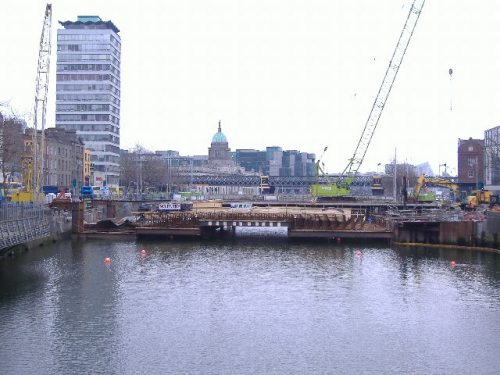
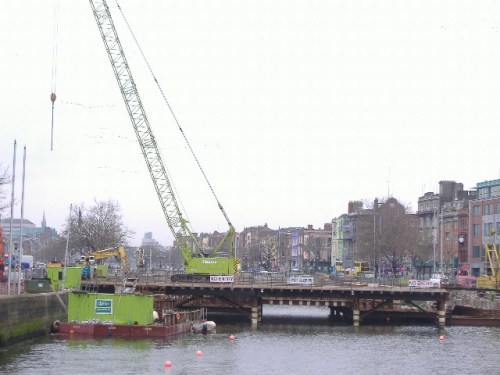
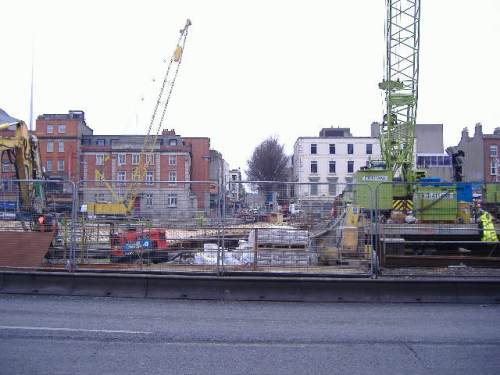
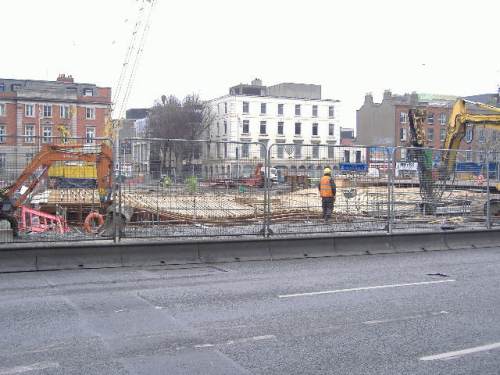
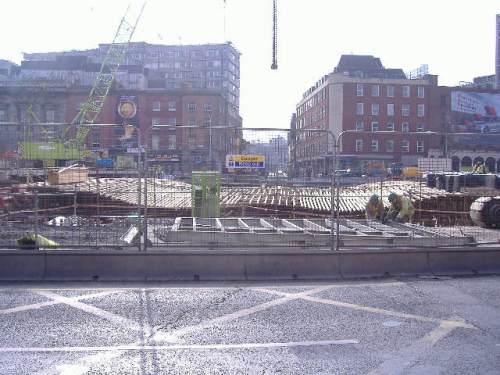
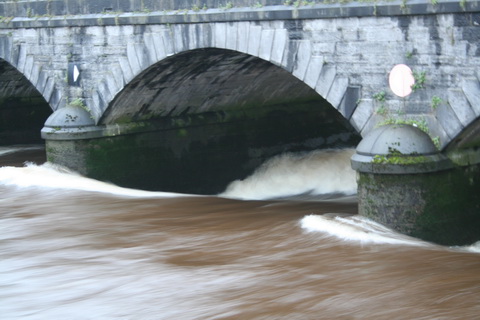
Paul Quinn’s photos showed the new Marlborough Street Bridge being constructed across the Liffey. Last Saturday’s Irish Times reported that Dublin City Council would soon be advertising to seek suggestions for naming the bridge; it said that a body called Labour Youth [whose members may be socialists, I fear] wanted it named after one Rosie Hackett, who went on strike  many years ago. It did not report that there is another campaign to have the bridge named after E T S Walton, a physicist.

The north-eastern corner of the bridge features the site of the offices of the City of Dublin Steam Packet Company, whose crest still adorns the walls. I suggest that the bridge be named after the company’s founder, the remarkable Irish entrepreneur Charles Wye Williams: the father of the Shannon, the master of scheduled steam shipping, the founder of the CoDSPCo and a founder director of the Peninsular and Oriental Steam Navigation Company, godparent of the Irish livestock industry, innovator in marine safety, promoter of the turf industry, writer and experimenter on steam technology, tireless campaigner ….

Apart from his company’s crest on Eden Quay, and his name on a bridge he caused to be built in Limerick, there is no monument to this remarkable man. Name the bridge after him and move the plaque to it (and protect it adequately).
 

Crossing the Liffey

Thanks to Paul Quinn for pics of the construction of the new LUAS bridge across the River Liffey in Dublin.

DSCF0945

The Powers That Be

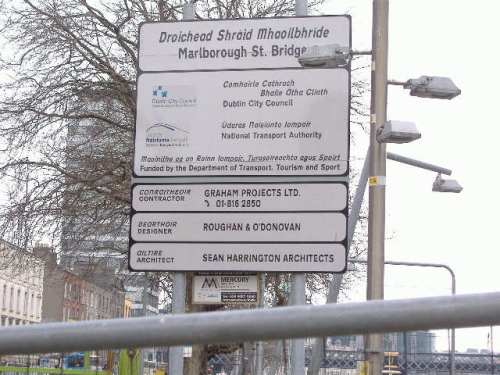
Dublin City Council tells us that “Construction on the bridge is due to commence in Autumn 2011”, which is nice to know, although an update would be nicer. Its PDF has a diagram of the bridge. If you can find anything about the bridge on the website of the National Transport Authority (which is paying for it), do please let me know. Incidentally, I hadn’t realised that the NTA’s reach had extended to passengers on ships, including those on inland waterways.

graham projects

The contractors

DSCF0939

Drilling contractor

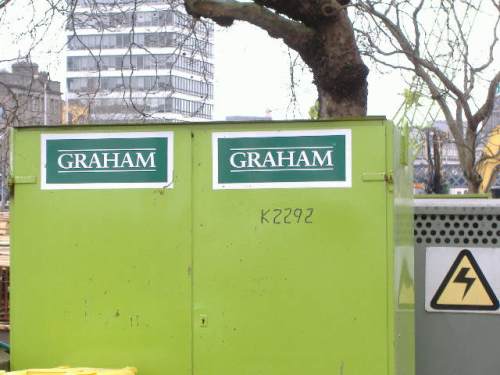
The contractor is Graham Projects Ltd; Quinn Piling were working there a few weeks ago, but seem to have finished their end of things by now; I can’t find a website for Hilliard & Hilltwister Ltd of Listowel, Co Kerry.

from o'connell brg.

Looking east from O’Connell Bridge

from butt bridge looking west

Looking west from Butt Bridge

looking north

Looking north from Burgh Quay

looking north from burgh quay

Looking north to the City of Dublin Steam Packet Company offices

looking south from eden quay

Looking south from Eden Quay

Revising the Royal

Ewan Duffy of IndustrialHeritageIreland and I have both, in recent times, uncovered new information about the history of the Royal Canal after it was taken over by the Midland Great Western Railway in 1845: a period that, because (I think) of the absence of company archives, is not well covered in published histories of the Royal. Ewan today said that he will be posting new material about the stretch from Lock 1 to Lock 5 on 30 March 2013, so watch that space.

Simon O’Regan -v- John Inshaw

Did Simon O’Regan attempt to preempt John Inshaw? Here is a page about O’Regan’s single-screw passenger steamer, demonstrated at Portobello on the Grand Canal in Dublin in 1850.

Wexford

Here is a great account of the development of Wexford Harbour, with a history of its shipping here.

The fear of Baal’s Bridge

In May 1895 the fear induced by the prospect of a passage under Baal’s Bridge, on the Abbey River in Limerick, as revealed in the commercial court in London before Mr Justice Mathew and reported by the Freeman’s Journal of 20 May 1895.

Arthur George Mumford of Colchester, Essex, was described as an agent, but was actually a marine engineer and manufacturer of steam engines. He owned a 25-ton steam yacht called Gipsy, which he decided to sell through Messrs Cox & King, the well-known yachting agents (their 1913 catalogue is here).

The buyer was Ambrose Hall, the man responsible for the statue of Patrick Sarsfield. A former mayor of Limerick, he was an alderman and a “house and land commission agent”; his address was given as Mignon House, Limerick, which I have not so far found.

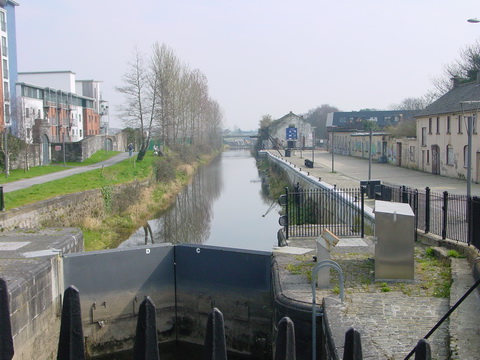
Hall bought the boat for £500; it was to be delivered to him at Limerick. The original plan was to sail it around the coast of Ireland and up the Shannon estuary, but bad weather in late 1894 caused Cox & King to suggest taking it to Dublin and then down the Grand Canal and the Shannon to Limerick. Hall agreed; the boat left Dublin in January 1895. It reached Killaloe on 19 January and Limerick “a day or two afterwards”, where it was moored in the canal harbour.

25 Grand Canal Harbour Limerick March 2007 01_resize

Canal harbour, Limerick in March 2007

Hall refused to accept the boat in the canal, saying that it should have been delivered to Limerick dock, a short distance downstream. Mumford and Cox & King sued him and the National Bank.

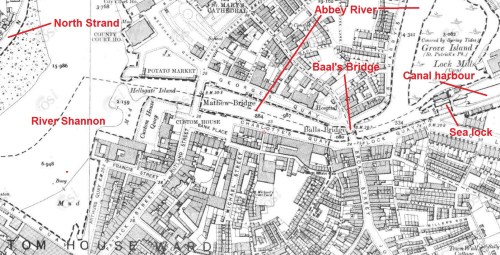
Hall and Baal

Ordnance Survey ~1900

Hall, an alderman and a former mayor, who had lived at North Strand, presumably knew the river and its difficulties.

Baal's Bridge 20091128 1_resize

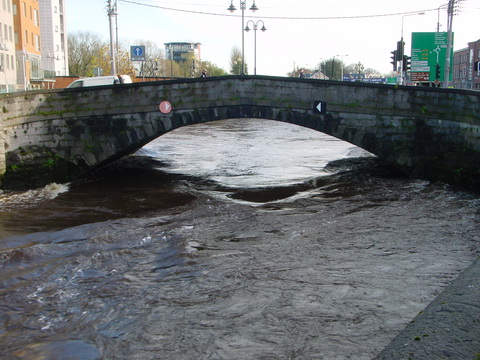
Baal’s Bridge looking upstream towards the canal harbour in the floods of 2009

Navigation arch at Mathew Bridge 20091122_resize

The navigation arch at Mathew Bridge looking downstream in the floods of 2009

It was contended by the defendant that to get the vessel from the canal into the estuary of the Shannon there was a considerable risk involved. The passage was only a few hundred yards, but it was stated it could only be effected at certain states of the tide when it would be possible to get through Ballsbridge.

The judge sensibly suggested that it should be possible to insure the boat for the journey; the plaintiffs agreed to deliver it; Hall agreed to accept delivery and to pay £15 for the cost of the caretaker who had been looking after the boat since 23 January; the case was settled.

Clearly Ambrose Hall didn’t know Pat Lysaght.

My OSI logo and permit number for website

The 120′ Irish steam-powered narrow boat

Read about it here.

Northsouthery 121212

The North/South Ministerial Council reports here [PDF] on the most recent inland waterways meeting, which was held on 121212. Not much happened (or at least not much that is being revealed to the citizens and subjects). Sponsor departments are to think about having a board; there is still no money for the Clones Sheugh but an interagency groups is to find some [hint: look under the end of a rainbow] and it was John Martin’s last appearance as he will be retiring in March and the search for a new CEO has a process (which is important).

The interesting bit is that WI is to transfer some property at Harvey’s Quay, Limerick, to Limerick City Council, which is making a boardwalk. And something similar is happening in Tullamore. You’re nobody nowadays unless you have a boardwalk; their usefulness in Irish weather is not proven.

Finally, I noted a certain modesty in WI’s aims for 2013, no doubt in keeping with the tenor of the times:

Ministers discussed the main priorities for Waterways Ireland in 2013 and noted progress on the 2013 Business Plan and Budget. The priorities for 2013 include:

• ensure the navigations are open and all existing facilities operational during the main boating season from April to October
• to actively promote the waterways to extend and expand recreational use of the waterways in all its forms.


Mountshannon

In the Foreword to his latest book, Portraits of Mountshannon (East Clare Heritage, Tuamgraney 2012), Ger Madden writes of the changes to Mountshannon since 1993:

The Aistear, the children’s playground, the pre-school building, the floating jetties at the harbour, additional restaurants and shops have been hugely positive and successful. The same cannot be said for housing. Ten years of reasonable prosperity for some, has resulted in new private holiday homes built on the fringes of the village and others planned. They are not associated with the needs of the community. The majority of the owners have not the slightest interest in the history, culture or welfare of the community they have chosen to display their wealth.

Any such owners wishing to develop an interest in the history of Mountshannon could not do better than to start with Ger’s book. It’s A4 landscape, with an aerial colour photo of Mountshannon on the front and a map on the back. Inside, the foreword gives a brief overview of Mountshannon’s history. Then follow 52 pages, each with a black and white photo and each covering a building, a tree or a place of interest in and around Mountshannon. Their locations are shown on the map on the back cover.

But, although architectural information is provided, the book is not about the buildings per se. Each page is a window into Mountshannon’s history and, together, they provide a rich account of the place and its people over the centuries. Part of the interest is in the fact that buildings you might pass by without noticing turn out to have interesting stories attached to them. Nor are they all about the distant past: I was glad to see that Mountshannon’s more recent claim to fame, as the last telephone exchange in the country to be automated, was recognised here (although I suppose that too may seem like the distant past to younger readers).

I highly recommend the book. If you’re in the area, you’ll probably know better than I where to get copies; if you’re not, you might ask East Clare Heritage.

Ger runs boat trips to Holy Island during the summer.


Around the world with Irish waterways

Yesterday was one of those days: I managed to track down sources for several pieces of information I’ve been hunting for some time, but in the process I came across a few interesting links, from Gordon of Khartoum to the War between the States.

The starting point was William Watson, manager of the Inland Department and later Chairman of the City of Dublin Steam Packet Company. He worked with Robert Mallet on the design of an innovative boat for use on Irish inland waterways. Robert Mallet married a Cordelia Watson in 1831. (I thought that might be a daughter of William of the CoDSPCo but it’s pretty clear from the excellent Mallett Family History site that that was not so.)

One of Mallet’s inventions was a large mortar designed for use in the Crimean War. And one of Mallet’s sons, John William Mallet, went to the USA and became professor of chemistry at the University of Alabama. He joined the Confederate forces, rising to the rank of lieutenant-colonel in the artillery and superintendent of the Confederate ordnance laboratories.

Meanwhile Watson’s son Charles Moore went east rather than west. Colonel Sir Charles Moore Watson KCMG, CB, MA, of the Royal Engineers, Watson Pasha, was a general in the Egyptian Army and Governor-General of the Red Sea Littoral. Watson’s base was at Suakin on the Red Sea. The Dubliner was succeeded in that post by a Kerryman, Horatio Herbert Kitchener, from Ballylongford near Saleen on the Shannon Estuary, on which the City of Dublin Steam Packet Company operated.

Watson was “Gordon’s principal friend in Egypt”:

It is certain that Watson was, above all others, the one man in Cairo whom Gordon cared about most, and that he was the last to see Gordon off when he started [for Khartoum].

Gordon died at Khartoum; the relief expedition, led by another Irishman, Sir Garnet Wolseley, arrived two days too late.

A younger brother of Sir Garnet, Frederick Wolseley, went to Australia. His Sheep Shearing Machine Company made a brief expedition into the manufacture of motor-cars, under one Herbert Austin, who later founded his own company. Austin and Wolseley both ended up in British Leyland Motor Corporation, which made diesel engines, some of which were marinised and used in boats on the Irish inland waterways … which brings us back to where we started.