Category Archives: Extant waterways

Où est la plume de ma tante?

21 February 2018: voici une mise à jour.

Post originally written in January 2014 follows

Où sont les neiges d’antan? [That’s French for “Where is Anto’s stash of heroin?”] Où est l’étoile d’émeraude?

I remarked in August, on sighting le grand bateau de Monsieur Thibault in Athlone, that it carried the Le Boat brand, not that of Emerald Star. Emerald Star is now one speck within Le Boat, which is one of the activities within the Marine Division of the Specialist & Activity Sector of TUI Travel, which employs 54000 people.

Le le Boat bateau

Le le Boat bateau

I wrote to Messrs TUI Travel’s “corporate communications” department at the time to ask whether the Emerald Star name was being phased out, but answer came there none: no doubt all 54000 employees were busy at the time. But I noticed today that a hapless seeker after truth, searching for “emerald star”, ended up here, so I had a look myself. There is no emeraldstar.ie website (and emeraldstar.com is unrelated) but the UK Le Boat site has a little badge on the top left of the page saying “Emerald Star from le Boat”. I wonder whether that appears if the site detects that you’re accessing it from outside Ireland. I could find no other mention of Emerald Star, so I suspect the brand is doing a Cheshire Cat.

I was glad to find that Messrs Le Boat have found Google Translate useful. At least, I assume that’s how they produced this paragraph under their “Useful info” tab:

Useful Info for the Ireland

The Irish coast rises tallish from the sea, and yet the terrain drops farther inland, creating a sort of cup where the water gathers. One fifth of the water drains inward to the Shannon River, Ireland’s largest at 360 kilometres (224 miles). The fall on the navigable middle section of the river is slight at only 9 metres (29 feet), which means the water moves slowly. A Shannon River map also reveals the large number of lakes in the Shannon system, a real plus for canal boat cruising!

No, I’ve checked: it’s not Ulster Scots.

Then there’s this:

Feel the irresistible lure of the Shannon-Erne

The Shannon River gives Ireland’s central reaches their character. It’s an obvious feature if you study a Shannon River map. At a glance, it’s clear that the waters influence the land. The fishing is superb and golf is extremely popular! The towpath is level, so you’re in cycling heaven! […]

You learn something every day: I never knew that the Shannon had a towpath. I wonder where it is.

But that’s not the only puzzle. Messrs Le Boat list some suggested cruises, eg:

The Celtic Cruise Ireland
Oneway: Portumna to Carrick-on-Shannon

[…]

The golf course calls! The fishing itch must be scratched! Castles loom tall! Feel the warm embrace of Celtic charm!

Who writes this rubbish? But this is the puzzling one:

The Northern Shannon Cruise Ireland
Return Trip: Carrick-on-Shannon, via Belturbet

[…]

Travelling in the thousand lakes area takes you from the Lake Niegocin to the Lake Sztynorckie, with plenty to see on the way!

Well, I admit I don’t know the north Shannon as well as I do Lough Derg [“Lough Derg, an angler’s paradise, casts an Irish spell of contentment to keep you fishing and having too much fun!”], but I can’t find either of those lakes on any Shannon or Erne map. Où sont les mille lacs de M. Thibault? Où sont les Niegocins, Antoin? Ils sont dans le jardin avec la plume de ma tante.
Hospital barge

Richard Hare, writing in Practical Boat Owner February 2014, drew my attention to this ww1 poem by Wilfred Owen..

Composite construction on Irish inland waterways

I wrote here about Watson’s Double Canal Boat, saying inter alia that, in 1839, William Watson, manager of the inland department of the City of Dublin Steam Packet Company, patented:

an improvement in the construction of ships, and which improvement is also applicable to all kinds of sea-going vessels; and also certain improvements in the construction of boats and other vessels intended to be used on canals and inland navigations. [1]

I quoted the Mechanics’ Magazine of December 1839, which said that:

Three canal barges have already been built upon Mr Watson’s plan of construction, of 60 tons burthen each, and with eminent success.[2]

I said that the size suggested that these canal barges were for the CoDSPCo’s Irish inland operations, but that I had no information about where they were built.  I have now found information about one builder.

SHIP BUILDING

On Thursday, the 22nd instant, a fine new trade boat, built with iron ribs, according to the patent of William Watson, Esq., and belonging to the City of Dublin Steam company, also a new smack, 50 tons measurement, were launched from the Brunswick dock-yard, Ringsend Docks.[3]

I would be grateful for more information.


[1] “List of patents granted for Scotland from 18th March to 18th June 1839” in The Edinburgh New Philosophical Journal , exhibiting a view of the progressive discoveries and improvements in the sciences and the arts Vol XXVII No LIII — July 1839; “List of English patents granted between the 25th of May and the 25th of June, 1839” in The Mechanics’ Magazine No 829, Saturday, June 29, 1839

[2] The Mechanics’ Magazine Vol XXXII No 855 28 December 1839

[3] The Freeman’s Journal Saturday 24 July 1841. An almost identical note appeared in the Dublin Evening Mail of Monday 26 July 1841.

Sending gunboats

From the Newcastle Courant 8 December 1843:

WARLIKE PREPARATIONS. — The Penelope steam-frigate has arrived in Kingstown harbour, loaded almost to the water’s edge with large gun-boats. They are intended for the Upper [ie non-tidal] Shannon, and the large lakes formed by that river in its progress towards the lower branch. A considerable number of persons were collected on the banks of the canal to witness their being towed to Portobello from the basin at Ringsend. They are immense boats, with great beam, capable of carrying two guns, and accommodating a large body of men. They are double banked, and each pulled by twelve rowers. As floating batteries they are most formidable, and furnish an important, as well as a novel, addition to the armament already existing in this country.

The amazing success of Harbour Flights

I have written before about Harbour Flights, which operated a seaplane (floatplane) at Mountshannon on Lough Derg and conducted trial flights hither and yon. I was a little confused about whether Harbour Flights was “fully operational” but its redesigned web page (there were once several pages) carries the impressive news that the company has been so successful that it has ceased operations, at least temporarily.

But it will be back, and instead of operating a single aircraft, which was actually owned by somebody else, it will have a veritable fleet “operating from [sic] destinations nationwide” and will be “fully operational again”, which suggests that it was fully operational before. I wonder how many of the “50 new Irish jobs” were created when it reached that point.


Lough Derg floods: a book

If you happen to have €1400 or so to spare, you could buy Henry Trench’s 1879 book called Shannon Floods. Lough Derg level. The 25 Miles North from Killaloe with a double-page map and seven coloured plates. I have no connection with the seller — and no €1400 either, so I won’t be buying it.

A new concept in electricity transmission

Lower pylons 2_resize

We read on the Clare FM website:

The Government says it is not realistic or financially feasible to run new electricity pylons underground.

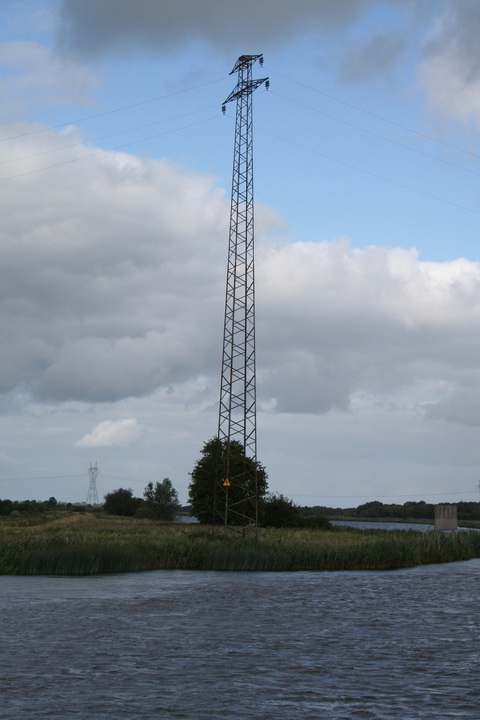
Well, yes, I’d imagine there’s something in that. Although I don’t quite see why anyone would want underground pylons. I knew some folk wanted underground electric cables, but hadn’t realised they wanted the pylons buried too.

Personally, I’m all in favour of pylons: I like them, and would like to see more of them. I don’t understand why a row of nice pylons should be thought to make scenery less, er, scenic. It might make scenery less like a pre-industrial idea of scenery, but that’s a good thing; big it up for Stephen Spender.

And think of the industrial heritage value in the future: as well as old canals and railways, folk will come to photograph pylons; indeed some people already do so.


Slightly Foxed

WI says today, of its sale of surplus barges:

The ” Fox” workboat/barge currently located at Roosky has been withdrawn from the Sale .

Ballinlaw ferry

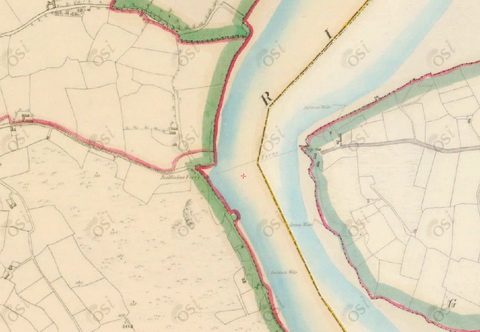
A visitor to my page on the tidal Barrow is a descendant of ferrymen at Ballinlaw on the Barrow. He would like to find a photograph (or, presumably, other illustration) of the ferry boat and I would welcome more information about the service (eg when it ended).

Ballinlaw ferry (OSI ~1840)

Ballinlaw ferry (OSI ~1840)

If anyone knows of a possible source of information or illustration, I will pass it on to the enquirer.

Update January 2019: much information about Ballinlaw Ferry from Andrew Doherty here.

My OSI logo and permit number for website

Clashganny Lock on the Barrow

I would be grateful if anyone could explain the holding tank at Clashganny. Waterways Ireland’s water-level gauge [Flash thingy; takes ages to load] at Clashganny is named “Clashganny Holding Tank”.