Category Archives: Extant waterways

WI budget

In 2014 the Department of Arts, Heritage and the Gaeltacht [.pdf: go to page 51] is to cut its current expenditure on North–South Co-operation by €2.1 million:

Savings, in excess of the agreed 3% per annum efficiency savings, for the North-South Implementation Bodies will require the approval of the North-South Ministerial Council.

The 85% of Waterways Ireland’s current budget that comes from the [Republic of] Ireland government is in there somewhere; the NI executive pays the other 15% and, in theory, the North–South Ministerial Council will have to give its blessing, but in practice the NI ministers can hardly force the RoI ministers to pay up.

There’s a list of 14 High Level Programme Activities [mustn’t hurt anyone’s feelings by leaving out their favourite fodder] of which No 13 is

Development of inland waterways within the context of the implementation of the Good Friday and St. Andrews Agreements.

Translation: Ulster Canal, even if there’s no money for it. But there is half a million for a

20-Year Strategy for Irish with a range of concrete measures, including supportive actions to roll out the language planning process on the ground, in line with the Gaeltacht Act 2012. These actions will include direct support to community organisations to enable them to prepare and implement practical and deliverable Irish language plans – not only in the Gaeltacht itself but also in selected towns and areas in other parts of the country.

Do they ever give up? They’d be better off supporting Ulster Scots, which has at least some chance of showing a growth in the number of speakers. But page 51 has a long list of imaginary measures to allow the department to claim that it will save €15 million in 2014: more efficient working, review, examining the scope for achieving further efficiencies … waffle.

On the capital expenditure side, RoI and NI each pays for works within its own jurisdiction. The RoI spending will be down from €4071000 in 2003 to €3858000 for 2014: a cut of just over 5%.

Maybe the money is being put aside to pay for the Clones Sheugh, although it’s not specifically mentioned in the document.
 

The Southern Star

The Southern Star is West Cork’s indispensable source of news and information. I don’t know whether its masthead still proclaims that it incorporates the Skibbereen Eagle, or whether, in the print edition, its news from Bandon is still headed “Bandon Brieflets”, but it is — as we would expect — keeping up with digital technology with a website, a FaceBook thingie and a napp.

It reports today on another “trial flight” by what it terms “A newly formed company, Harbour Flights”, which I wrote about here. The aircraft shown in the photo is EI-CFP [which is registered, incidentally, as a land aeroplane [.xls]], so Harbour Flights does not seem to have acquired a larger plane — or the use of one: the register shows that EI-CFP is owned by Kieran A O’Connor, not by Harbour Flights.

Being ignorant of aviation matters, I don’t know what constitutes a trial flight — or how it is to be distinguished from a promotional flight.

I note a slight contradiction in the Southern Star‘s report:

The company […] has taken five years to grow from its initial concept to become fully operational last July. […]

When it becomes fully operational, Mr Heaps estimated that the company could create up to 50 new Irish jobs […].

So is it, or is it not, “fully operational”? I am confused.


Waterways minister keen on waterways

An exchange from the Northern Ireland Assembly on 7 October 2013, thanks to theyworkforyou.com.

Pam Brown (DUP) asked the Minister of Culture, Arts and Leisure whether inland waterways could be developed to provide a major leisure and recreational activity resource.

Carál Ní Chuilín (Sinn Féin; Minister for Culture, Arts and Leisure): Waterways Ireland is one of the all-Ireland bodies that my Department has responsibility for. You can see the value of the work that it does, particularly in rural areas. I am also working with some councils to improve some of the waterways within their control. I agree with the Member that inland waterways provide brilliant opportunities not just for tourism but for local leisure. They are the economic driver in some towns and villages.

Pam Brown (DUP): I thank the Minister for her answer. She has touched on my supplementary question. Does the Minister agree that the development of inland waterways, while a great source of leisure and recreational activities, can also act as a catalyst for urban and rural regeneration?

Carál Ní Chuilín (Sinn Féin): I agree. I made a statement to the House in July, I think, about some of the events that take place at inland waterways across the island. Those events include festivals and family fun days. Huge numbers attend those events, and they act as economic drivers. Not only are those responsible keen to make sure that they are further developed, but people from other areas visit those festivals in towns and villages to see how they can extract that product for their area. They see the potential and outcome of those events.

That’s good: nice cheap family fun days, not expensive and unnecessary waterway restorations.

Work begins at Sallins

New moorings: Waterways Ireland press statement here and marine notice here.

Edenderry ducks …

… in the Irish Times [article will become inaccessible at some stage].

Waterways Ireland and information

From Kevin Humphreys [Labour, Dublin South East] in a Dáil debate on the second stage of the Freedom of Information Bill 2013 on Thursday 3 October 2013 [with thanks to KildareStreet.com]:

There are several agencies which, because they are North-South bodies, must, I understand, be excluded from the provisions of the Bill before us today. However, oversight of these bodies is important. We should examine whether safefood, Tourism Ireland and Waterways Ireland, for example, might be brought within the scope of the legislation. My experience of dealing with Waterways Ireland on several occasions is that it is extremely difficult to extract information from it. Including it and other bodies with a North-South remit in the freedom of information regime would be useful for citizens, Members of this House and journalists.

Emphasis mine.

I must chase up my outstanding queries ….


Newry and Narrow Water

I wrote a few days ago about the proposed bridge across Carlingford Lough at Narrowwater (or Narrow Water). I was reminded of that today on reading a debate, held in the Northern Ireland Assembly on 30 September 2013, about a proposed Newry Southern Relief Road [thanks to theyworkforyou.com].

Apart from an admittedly minor mistake made by a Sinn Féin MLA about the Newry Canal (first summit-level canal, not “oldest inland waterway” in These Islands), the debate was remarkable for its demonstration of cross-party agreement: not so much on the desirability of public works (a desideratum of Irish politicians since the eighteenth century) as on the irrelevance of the Narrowwater bridge. Jim Wells [DUP] said:

There has also been some progress on the Narrow Water bridge project, although we do not know exactly where we stand. First, that bridge is far from certain, and, secondly, even if it were built, it would not relieve much of the traffic that we are dealing with. It would certainly not relieve the large number of juggernauts coming through from Warrenpoint harbour.

Sean Rogers [SDLP] said:

Narrow Water bridge is merely a tourist bridge, but the relief road would take heavy goods vehicles off the streets of Newry, reduce traffic congestion and attract even more shoppers to the city. Heavy goods vehicles would also have a direct route to Warrenpoint port, increasing trade in the port area.

And the other contributors to the debate did not mention it, which suggests to me that it is seen as irrelevant to the traffic problems of Warrenpoint and of Newry.

The Minister for Regional Development, Danny Kennedy [UUP], gave a lengthy response to the debate, including this point:

A more detailed technical investigation of the specific options for crossing the Newry canal was also recommended, given the sensitive nature of this important heritage feature. It is expected to require at least the provision of a bascule, or lifting bridge, to allow the passage of tall ships on the canal. The width of the Victoria lock already limits the size of ship that can enter the canal and it is expected that any bridge would maintain a navigation channel that matches the width of the sea lock. My Department will continue to consult with NIEA on how the impact of the proposal on the canal might be mitigated and an appropriate design developed.

And it seems that one of the areas being considered for the road is Fathom, which is where the Victoria Lock is. It is a short distance north (and upstream) of the border.

It must surely be unlikely that there will be two crossings of Carlingford or the Newry River [and canal] within a few miles of each other. But if one option, the Newry Southern Relief Road, helps to relieve Newry and Warrenpoint traffic and the other, the Narrowwater bridge, doesn’t do so, then the first option would seem to be the rational choice.

Although I wouldn’t bother providing for “tall ships”.


The whistling postman of Inishturk

When Hugh Malet[1] visited Lough Erne, he met a whistling postman, William Rooney, who lived on Inishturk. Rooney delivered post to the islanders on three days a week and to the mainland farms and houses on the other three. His father had had the job before him, and had used a sailing boat, but he himself had a little outboard motor on his pillarbox-red skiff.

Two years later, staying in Gibraltar over Christmas, Malet read of William Rooney’s death. He had finished his delivery round for Friday 29 December 1961 and was on his way home to his wife and family when his boat got caught in the ice.

His sixty-year-old brother James went to his assistance, but he too got caught. The two brothers were found next day, frozen to death, only a short distance apart[2].


[1] Malet, Hugh In the Wake of the Gods: On the waterways of Ireland Chatto & Windus 1970.

[2] Malet, op cit; Rogers, Mary, Prospect of Erne Watergate Press 2nd ed 1971; Irish Times 2 January 1962; British Postal Museum Archive.

Lough Derg Regatta 1849

The Dublin Evening Mail of 19 September 1849 has come to hand.

LOUGH DERG REGATTA

The Regatta on the above-named beautiful lake came off last week. Monday, the 10th of September commenced the annual aquatic sports: the day was tolerably fine, and at two o’clock, PM, the Commodore, the Right Hon Lord Viscount Avonmore, started four yachts for a 30 Guinea Challenge Cup, with £12 added. After a drifting match (for it fell flat calm shortly after three o’clock), they came in as under:—

Gem, 12 tons, James Spaight, Esq
Hero, 8 tons, Dash Gainor, Esq
Iris, 19 tons, Wills C Gason, Esq
Foam, 24 tons, Lord Avonmore.

This was a time race.

While the yachts were absent several cot races came off.

On Tuesday, the 11th, the yachts sailed down in fleet to Killaloe, but the following day it blew a whole gale of wind, and the match that was to have been sailed for on that day was put off till the next; however, in the evening there were some well contested cot races.

The course was as usual — start from the Jetty, over the diagonal wall (built by the Shannon Commissioners to keep the water to a proper level in summer), under the bridge, round Friar’s Island, and back: to a stranger, it is astonishing to see a boat go down an incline nearly four feet high, which they are obliged to do in the race, and what is more extraordinary, any cot that is not rowed at it pretty fast, is almost certain of being upset.

Thursday, the 12th, at the Commodore’s signal, all the yachts got under weigh, and came to anchor off Derry, and at two o’clock, PM, five yachts started for a Silver Cup, valued at £15, witn £5 added. This was a time race for yachts under twelve tons. The wind was WNW, and blew a fine gaff-topsail breeze; at half-past four o’clock the yachts came in as under:—

Hero, 8 tons, Dash Gainor, Esq
Gem, 12 tons, James Spaight, Esq
Willy Wa, 9 tons, Captain Hon F Yelverton
Vampire, 9 tons, Arthur Vincent, Esq
Midge, 7 tons, Bassett W Holmes, Esq.

This was a beautiful race, all the yachts coming in almost together: the Hero only winning by 27 seconds — indeed she may thank the Midge for winning the prize, as going free the first round she got the Gem under her lee, and kept her back some minutes. Shortly after the signal was given to weigh anchor, and start for Portumna, where the fleet arrived at a late hour. In passing Scilly Island the Foam carried away her rudder head, and was near going ashore.

Next day, Friday the 14th, the yachts assembled off Portumna Castle, and at three o’clock, PM, the Commodore started the following boats for a 40 Guinea Challenge Cup, with a purse of Sovereigns added, for all yachts. A handicap race.

Novice, 4 tons, Dash Ryan, Esq
Midge, 7 tons, Bassett W Holmes, Esq
Vampire, 9 tons, Arthur Vincent, Esq
Gem, 12 tons, James Spaight, Esq
Foam, 24 tons, Lord Avonmore
Iris, 18 tons, Wills C Gason, Esq.

This was a most exciting race, and during the first hour it was difficult to tell which would be the winner. Before rounding the second flag boat the Novice put about and gave up the race, and off Church Island, the Midge carried away the jaws of her gaff, and was obliged to give up the race, which she was almost sure of winning — having gained two minutes the first round. The course was a long one, and the race was not over till after eight o’clock, when the four boats came in as follows:—

Iris
Foam
Gem
Vampire.

During each day of the Regatta, the City of Dublin Steam Company placed one of their fine steamers at the disposal of the Sailing Committee, who took out all their friends, and accompanied the yachts each day during the race.

In the evening, after several cot races and other amusements too numerous to relate. The ladies and gentlemen present were entertained at Belle Isle, the beautiful seat and hospitable mansion of Lord Avonmore; and at a later hour assembled some 120 of the elite of Tipperary, Galway, and King’s County, at the Clanricarde Arms, Portumna, where dancing was kept up with spirit until morning.

The population of the Portumna DED declined by 30.46% between 1841 and 1851.

The drowning of Randal M’Donnell

I am indebted to the [London] Standard of 8 February 1858 for alerting me to the sad circumstances reported by Saunders’s Newsletter.

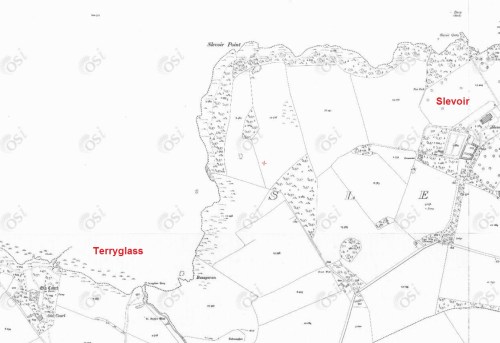
Slevoir OSI ~ 1900

Slevoir OSI ~ 1900

Parsonstown, Friday Evening. — A most distressing accident, which resulted in the death of Randal M’Donnell, Esq, of Slevoir, occurred yesterday. Mr M’Donnell was much devoted to aquatic pursuits, and had made several voyages to Australia and other countries, and had only recently returned from a visit to relations in America.

He was the proprietor of a yacht, which was moored in the River Shannon, opposite Slevoir, in the county Tipperary, and yesterday, as was his habit when at home, he proceeded, it appears, in a small boat, and got on board the yacht. After remaining some time, when stepping into the skiff, to return to Slevoir, it was capsized, and the unfortunate gentleman was thrown into the water. He was very lusty [in the context, this probably means fat], and he soon disappeared.

A peasant from the bank of the river witnessed the fatal occurrence, and ran to Slevoir House and gave the alarm. After some time the body was discovered, but life was quite extinct. It is stated that a brother of the deceased’s also perished some time ago by drowning.

My OSI logo and permit number for website