Category Archives: Foreign parts

London Docklands

Big it up for the Museum of London Docklands, near Canary Wharf. You can go there on the DLR, always a bonus, which will counteract the queasiness you feel at proximity to a large number of bankers, accountants and lawyers.

Apart from any temporary exhibitions, the Museum offers a chronological account of the ports of London from Roman times to the present day; you start on the third floor and work downwards. The timeline anchors the narrative, but there is no attempt to pretend that there is a single uncontested history: conflicts over slavery, dock labour schemes and modern redevelopment are all presented, using a mixture of text, displays of artefacts large and small, models, paintings, audio and video. Easy to spend several hours there; the Docklands at War section was particularly interesting.

And if you have time afterwards, nip around to The Grapes for bangers and mash (£6.50) [or whatever you like] and a pint of Timothy Taylor’s Landlord, which (weather permitting) you may be able to consume on the balcony overlooking the Thames, with the shingle below on which the mudlarks worked, while you remember all those Conrad novels and sing “Sweet Thames flow softly” .

DUKWs

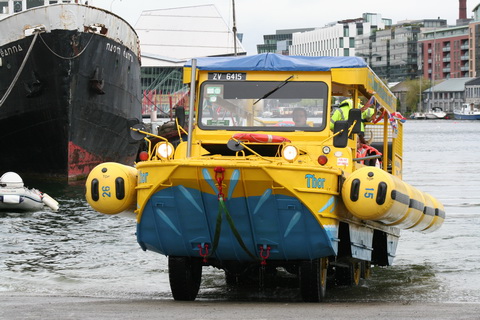
In June 2013 I reported on the sinking of a DUKW in Liverpool, the second of the year, and in September on the fire aboard a DUKW in London. Oddly enough, it seems that the two accidents had a common element: the foam added inside the hulls to improve buoyancy.

The UK’s Marine Accident Investigation Branch has found that the DUKWs in the Liverpool fleet had not been fitted with enough foam to provide 110% buoyancy, enough to keep the vessel afloat when flooded. MAIB’s tests on the Liverpool vessels

… raised serious questions about whether the operators of DUKWs could fit sufficient foam internally to comply with the current requirement for 110% buoyancy without compromising the safe operation and the practical day to day maintenance of these vehicles.

The “safe operation” part affected the London vessels. In July 2013, a DUKW had to be towed in after a drive shaft universal coupling failed when it overheated and ran dry of lubrication: engine bay temperatures were too high because of the volume of foam inserted. And a report commissioned by the London Fire Brigade into the September fire concluded that:

… the most likely cause of fire was the action of the rotating drive shaft (or other moving parts) on the oil contaminated surfaces of the buoyancy foam blocks.

MAIB has issued a safety bulletin [four-page PDF] with this conclusion:

The MAIB identified significant difficulties in fitting a DUKW with the volume of foam required to meet the buoyancy standards set out in MSN 1699 (M). Further, the nature of these old amphibious vessels, specifically their weight in relation to their size and the complexity of their propulsion arrangements, makes it difficult for operators to comply with the standards applicable to more conventional craft by solely using internal foam buoyancy. An alternative standard, ensuring that DUKWs have the necessary level of damage survivability, therefore needs to be established if they are to be operated safely.

It has recommended that the Maritime and Coastguard Agency should

… ensure that the means used by DUKW operators to achieve the required standard of buoyancy and stability for their vessels does not adversely impact on their safe operation. Furthermore, these vessels should not be permitted to operate until satisfactory levels of safety can be assured under all feasible operating conditions.

The Maritime and Coastguard Agency’s website doesn’t seem to be working, but there is a BBC report here quoting an MCA person as saying

We will not be permitting the vessels to operate until we are satisfied that the necessary safety measures have been achieved.

VikingSplash DUKW in Dublin

VikingSplash DUKW in Dublin

All of this may help to explain why the VikingSplash DUKWs operating in Dublin are fitted with additional external buoyancy.

Northsouthery minus northsouthery

I noted here what the Minister for Arts, Heritage and the Gaeltacht had to say about Waterways Ireland’s budget — or at least that portion of it paid by the RoI government — for 2014. The minister listed WI’s “core activities and targets” and various other things it should be doing:

  • promoting increased use of the waterways resource for recreational purposes
  • developing and promoting the waterways
  • attracting increased numbers of overseas visitors
  • stimulating business and regeneration in these areas
  • increasing recreational access along the routes of waterways
  • keeping the waterways open for navigation during the main boating season.

Note that WI is not expected to promote, engage in or achieve anything in the realm of northsouthery. That’s slightly odd when it receives [the larger] part of the northsouthery budget of the minister’s department.

Up with this sort of thing

Folk interested in the history of the Shannon before 1850 may like to know of a talk …

The smart green technology of the 1830s: the Shannon steamers and the definition of Ireland

… to be delivered to the Thomond Archaeological and Historical Society on Monday 4 November 2013. It’s in Room T.1.17, TARA Building, Mary Immaculate College, Limerick, at 8pm.

A related topic …

Charles Wye Williams and the Anglo-Irish Trade

… will be discussed in one of the papers at the Eighth [British] Waterways History Conference on Saturday 26 October 2013 at the University of Birmingham. Leave a Comment below if you would like contact information for the conference.

The modernisation of Sinn Féin

I have criticised Sinn Féin’s obsession with the cutting-edge transport technology of the eighteenth century, the canal, and particularly with the proposed reconstruction of the Clones Sheugh. I am therefore glad to report that the party has now moved on to more modern transport technology: that of the early nineteenth century, in the form of the railway.

In a written question on 15 October 2013, Caoimhghín Ó Caoláin [SF, Cavan-Monaghan, home to the Clones Sheugh] asked the unfortunate Minister for Transport, Tourism and Sport

… if he intends to apply for funding under the Trans European Network–Transport (Ten-T) 2014-2020 for the development of a rail network linking [London*]Derry to Limerick, Shannon and Cork, or any part thereof, along a western arc corridor; and if he will make a statement on the matter.

I presume that it took the minister’s civil servants some little time to answer; they would have had to recover from ROTFL [as the young folk say nowadays]. When they recovered, they penned this response to be delivered by the saintly Leo Varadkar [FG, Dublin West, who has enough problems on his hands without extending railways but who has the virtue of a lack of interest in sports]:

As I have indicated to the House previously, I have no plans to develop a so-called “Western Arc” rail line from Cork to Belfast as this would require both the re-opening of the remaining phases of the Western Rail Corridor and also the development of new rail lines to connect with the rail network in Northern Ireland. It should also be noted that the Northern Ireland Executive has no plans to provide such new rail lines. The Government’s policy in relation to the funding of capital projects to 2016, including the development of rail and road links, is set out in the “Infrastructure and Capital Investment 2012-16: Medium Term Exchequer Framework”. Due to the overall reduction in funding for transport infrastructure the priority to 2016 is to protect investment made to date and to maintain safety standards. The limited funding available over and above this priority will only be provided for projects which are affordable, meet overall transport objectives and deliver the best return in terms of economic recovery and job creation.

I would draw the Deputy’s attention to the Programme for Government and in particular the commitment that: “We will insist that major capital projects are subjected to proper cost-benefit analysis and evaluation, improving future productivity and growth prospects, and that the value-for-money obtained is significantly enhanced compared to the most recent period.”

The Irish Rail commissioned AECOM/Goodbody “2030 Rail Network Strategy Review” examined the potential for new and re-opened lines and it did not recommend the development of a rail link between Sligo and [London*]Derry or between Donegal and [London*]Derry. Likewise its predecessor, the “Strategic Rail Review” in 2003 did not recommend such rail links. The performance of Phase 1 of the Western Rail Corridor between Ennis to Athenry to date has been very disappointing even allowing for the recession. Given the pressure on the public finances there are no funds for new subsidies or to develop new rail links in any part of the country. Moreover CIE is in a precarious financial situation and is dependent on continued bank funding. For all the reasons outlined above, the Government has no plans to further extend the heavy rail network. In these circumstances the question of applying for Ten-T funding to develop a rail line between Cork and Belfast via Shannon, Limerick and [London*]Derry does not arise.

Phew.

But Mr Ó Caoláin cannot have expected any other answer, so I wonder why he wasted civil service time by asking his question. Perhaps he has been inspired by the shade of Arthur J Balfour and hopes to kill northern Home Rule with southern kindness?

* “[London]” inserted in the interests of parity of esteem and intelligibility to unionist readers.


WI budget

In 2014 the Department of Arts, Heritage and the Gaeltacht [.pdf: go to page 51] is to cut its current expenditure on North–South Co-operation by €2.1 million:

Savings, in excess of the agreed 3% per annum efficiency savings, for the North-South Implementation Bodies will require the approval of the North-South Ministerial Council.

The 85% of Waterways Ireland’s current budget that comes from the [Republic of] Ireland government is in there somewhere; the NI executive pays the other 15% and, in theory, the North–South Ministerial Council will have to give its blessing, but in practice the NI ministers can hardly force the RoI ministers to pay up.

There’s a list of 14 High Level Programme Activities [mustn’t hurt anyone’s feelings by leaving out their favourite fodder] of which No 13 is

Development of inland waterways within the context of the implementation of the Good Friday and St. Andrews Agreements.

Translation: Ulster Canal, even if there’s no money for it. But there is half a million for a

20-Year Strategy for Irish with a range of concrete measures, including supportive actions to roll out the language planning process on the ground, in line with the Gaeltacht Act 2012. These actions will include direct support to community organisations to enable them to prepare and implement practical and deliverable Irish language plans – not only in the Gaeltacht itself but also in selected towns and areas in other parts of the country.

Do they ever give up? They’d be better off supporting Ulster Scots, which has at least some chance of showing a growth in the number of speakers. But page 51 has a long list of imaginary measures to allow the department to claim that it will save €15 million in 2014: more efficient working, review, examining the scope for achieving further efficiencies … waffle.

On the capital expenditure side, RoI and NI each pays for works within its own jurisdiction. The RoI spending will be down from €4071000 in 2003 to €3858000 for 2014: a cut of just over 5%.

Maybe the money is being put aside to pay for the Clones Sheugh, although it’s not specifically mentioned in the document.


Waterways minister keen on waterways

An exchange from the Northern Ireland Assembly on 7 October 2013, thanks to theyworkforyou.com.

Pam Brown (DUP) asked the Minister of Culture, Arts and Leisure whether inland waterways could be developed to provide a major leisure and recreational activity resource.

Carál Ní Chuilín (Sinn Féin; Minister for Culture, Arts and Leisure): Waterways Ireland is one of the all-Ireland bodies that my Department has responsibility for. You can see the value of the work that it does, particularly in rural areas. I am also working with some councils to improve some of the waterways within their control. I agree with the Member that inland waterways provide brilliant opportunities not just for tourism but for local leisure. They are the economic driver in some towns and villages.

Pam Brown (DUP): I thank the Minister for her answer. She has touched on my supplementary question. Does the Minister agree that the development of inland waterways, while a great source of leisure and recreational activities, can also act as a catalyst for urban and rural regeneration?

Carál Ní Chuilín (Sinn Féin): I agree. I made a statement to the House in July, I think, about some of the events that take place at inland waterways across the island. Those events include festivals and family fun days. Huge numbers attend those events, and they act as economic drivers. Not only are those responsible keen to make sure that they are further developed, but people from other areas visit those festivals in towns and villages to see how they can extract that product for their area. They see the potential and outcome of those events.

That’s good: nice cheap family fun days, not expensive and unnecessary waterway restorations.

Newry and Narrow Water

I wrote a few days ago about the proposed bridge across Carlingford Lough at Narrowwater (or Narrow Water). I was reminded of that today on reading a debate, held in the Northern Ireland Assembly on 30 September 2013, about a proposed Newry Southern Relief Road [thanks to theyworkforyou.com].

Apart from an admittedly minor mistake made by a Sinn Féin MLA about the Newry Canal (first summit-level canal, not “oldest inland waterway” in These Islands), the debate was remarkable for its demonstration of cross-party agreement: not so much on the desirability of public works (a desideratum of Irish politicians since the eighteenth century) as on the irrelevance of the Narrowwater bridge. Jim Wells [DUP] said:

There has also been some progress on the Narrow Water bridge project, although we do not know exactly where we stand. First, that bridge is far from certain, and, secondly, even if it were built, it would not relieve much of the traffic that we are dealing with. It would certainly not relieve the large number of juggernauts coming through from Warrenpoint harbour.

Sean Rogers [SDLP] said:

Narrow Water bridge is merely a tourist bridge, but the relief road would take heavy goods vehicles off the streets of Newry, reduce traffic congestion and attract even more shoppers to the city. Heavy goods vehicles would also have a direct route to Warrenpoint port, increasing trade in the port area.

And the other contributors to the debate did not mention it, which suggests to me that it is seen as irrelevant to the traffic problems of Warrenpoint and of Newry.

The Minister for Regional Development, Danny Kennedy [UUP], gave a lengthy response to the debate, including this point:

A more detailed technical investigation of the specific options for crossing the Newry canal was also recommended, given the sensitive nature of this important heritage feature. It is expected to require at least the provision of a bascule, or lifting bridge, to allow the passage of tall ships on the canal. The width of the Victoria lock already limits the size of ship that can enter the canal and it is expected that any bridge would maintain a navigation channel that matches the width of the sea lock. My Department will continue to consult with NIEA on how the impact of the proposal on the canal might be mitigated and an appropriate design developed.

And it seems that one of the areas being considered for the road is Fathom, which is where the Victoria Lock is. It is a short distance north (and upstream) of the border.

It must surely be unlikely that there will be two crossings of Carlingford or the Newry River [and canal] within a few miles of each other. But if one option, the Newry Southern Relief Road, helps to relieve Newry and Warrenpoint traffic and the other, the Narrowwater bridge, doesn’t do so, then the first option would seem to be the rational choice.

Although I wouldn’t bother providing for “tall ships”.



The whistling postman of Inishturk

When Hugh Malet[1] visited Lough Erne, he met a whistling postman, William Rooney, who lived on Inishturk. Rooney delivered post to the islanders on three days a week and to the mainland farms and houses on the other three. His father had had the job before him, and had used a sailing boat, but he himself had a little outboard motor on his pillarbox-red skiff.

Two years later, staying in Gibraltar over Christmas, Malet read of William Rooney’s death. He had finished his delivery round for Friday 29 December 1961 and was on his way home to his wife and family when his boat got caught in the ice.

His sixty-year-old brother James went to his assistance, but he too got caught. The two brothers were found next day, frozen to death, only a short distance apart[2].


[1] Malet, Hugh In the Wake of the Gods: On the waterways of Ireland Chatto & Windus 1970.

[2] Malet, op cit; Rogers, Mary, Prospect of Erne Watergate Press 2nd ed 1971; Irish Times 2 January 1962; British Postal Museum Archive.

Hands across the water

Another bit of northsouthery seems to be crumbling around its proponents’ ears, according to a report in today’s Irish Times [which will disappear behind a paywall at some stage]. It seems that, in July, TPTB approved the spending of €18.3 million on a bridge at Narrowwater [or Narrow Water], upstream of Warrenpoint and downstream of Newry (and of Victoria Lock). However,

The leading bid has costed the bridge at over €30 million […].

I presume that inflation does not account for the 66% increase but I am surprised that the proponents’ estimate was so far off. Perhaps omitting the opening span (intended to cater for the small number of tall vessels that use the Ship Canal to visit Newry) would save a few quid.

There is a discussion of the bridge project here and some useful information here; there isn’t here, although you might expect it.

It is certainly true that anyone wanting to drive from, say, Greenore or Carlingford to, say, Kilkeel or even Warrenpoint faces a long drive around Carlingford Lough. What is not clear to me is whether very many people want to do that: I haven’t investigated the matter, so I don’t know, but the main north/south traffic passes to the west and there are crossings at Newry.

A ferry service might be cheaper; it might also allow the real strength of demand to be gauged. Ferry terminals might be constructed by the local authorities and leased to an operating company.

And the service would probably be more useful than the Clones Sheugh: I see that yet another member of Sinn Féin got to ask about that in the Dáil recently, as did a Fianna Fáil chap from the area; they elicited the standard answer. The minister may be hoping that the cost estimates for the sheugh are more robust than those for the Narrowwater bridge.