Category Archives: Forgotten navigations

The olden days …

… when the police caught thieves and recovered property.

Utility and Vigilance of the City Police. — On Saturday morning, at about eight o’clock, a girl named Ann Harold, absconded with some valuable clothes the property of Mr Hannan, Catherine-streeet, Classical Teacher, to whom she was servant; and intimation of the robbery being immediately given to the police, who were all on the alert, that most indefatigable and successful “terror of evil doers”, Serjeant Reidy, discovered and arrested an associate of Harold’s from whom it was ascertained that she had sailed on board the packet for Dublin, on Saturday evening. On which Joseph Wilson, of the city police, with an alacrity and quickness not to be surpassed, set off for Killaloe, where from his activity, intelligence and knowledge of the country, he succeeded in apprehending the thief, and recovering all the stolen property, except what she had pawned and brought her into Limerick on Sunday evening, where she is now safely lodged to abide the fiat of the Recorder on Tuesday.

Clonmel Herald 12 July 1834 quoting the Limerick Star

Moral: if there’s no transport on Sundays, don’t time your getaway for Saturday evening.

Saunderson’s Sheugh and northsouthery update

I’m trying to catch up on things I was too busy to cover late last year.

Saunderson’s Sheugh 1

For new readers: the proposed rebuilding of the Ulster Canal started off in the 1990s with the idea of rebuilding the whole thing and thus linking Lough Erne and Lough Neagh. It became clear that that would be ridiculously expensive (even by politicians’ standards: to my mind anything more than sixteen and thruppence farthing would be too much) so TPTB decided to look at rebuilding the two ends, leaving the BITM (as WRGies might say) until gold was discovered in Monaghan or something. Then that got shot down but the heroic Irish government, rolling in the profits of property development, volunteered to pay the entire cost of rebuilding one end, from Lough Erne to Clones. This, known as the Clones Sheugh, was held up when the property boom bust; after that the Irish government has asked a group of treasure-seekers to find money. The group doesn’t seem to publish reports, but in recent months we’ve had whispers from two directions:

  • the Irish government seems to think that making the Finn navigable to Castle Saunderson would be a good idea: thus Saunderson’s Sheugh. And see this
  • Her Majesty’s Devolved Administration has been constructing a Business Case to show that it would be a very good idea for (a) the Irish government, (b) the British government, (c) the European Union, (d) Santa Claus or (e) anyone else, really, to do something that is so far unspecified. Actually, that’s guesswork on my part: I don’t know what’s in the business case (see below) but if it’s anything like the last one ….

Hands across the border

The North South Ministerial Council (waterways) met on 27 November 2014. Highlights:

  • WI wants Euroloot (don’t we all)
  • there is to be consultation on new Erne byelaws
  • repairs are taking most of the capital budget
  • there is “a new cruise hire business on the Shannon-Erne Waterway” [someone tell me more, please]
  • there is a Blueway
  • the ministers agreed the “indicative” [I don’t know what that is] budget for 2013. In November 2014. Which must have been helpful in budgeting. Maybe the 2013 accounts will be published soon
  • the “2013 indicative budget of €29.47m (£24.17m)” will be “a baseline for 2014-2016 draft budgets”, one third of that period having expired
  • the amount of the indicative budget for 2013, €29.47m, is 30% down on WI’s total income for 2012, as shown in its income and expenditure account for y/e 31 December 2012. I don’t know whether those figures can be compared directly, so please correct me if I’m wrong, but 30% is a hell of a cut in one year. And that’s without taking account of the increased cost of pensions
  • the 2014-2016 Corporate Plan isn’t available to citizens yet but the NSMC “noted” WI’s “draft Business Plan and Budget provision” for 2014 and 2015 and Corporate Plan for 2014-2016; they have to be approved at some future NSMC meeting
  • no info about the Sheugh was included in the minutes.

More hands across the border

As if all that wasn’t enough excitement, there was a Plenary NSMC meeting on 5 December 2014. That’s where lots of ministers go along: I make it 14 from north and 15 from south. They had their eyes on PEACE and INTERREG Euroloot, assuming the entire EU economy hasn’t collapsed by spring 2015. Apart from that, the only interesting bit was:

Waterways Ireland has developed the Shannon Blueway, Ireland’s first Blueway (a multi-activity trail running alongside water) between Drumshanbo and Carrick-on-Shannon in Co Leitrim in conjunction with the National Trails Office, Canoeing Ireland, Leitrim County Council and Leitrim Tourism. The Body continue to engage with relevant organisations, interested in further development of Blueways or Greenways including exploring opportunities that may exist for EU funding.

There are cycling, walking and canoeing routes along parts of the Ulster Canal: getting Euroloot for them would be a far better idea than making the thing navigable for cruisers.

Stormont

The Stormont House Agreement was signed on 23 December 2014. Slugger O’Toole has the text, a link to the NIO and a summary.

Most of it is very boring, except for the provision that the Ulster Canal is to be restored as an Orangeway, along which all Orange parades will henceforth be routed, giving the marchers entire freedom to do or say whatever they want. It is understood that an abandoned railway will be given to Green marchers for the same purpose.

No, of course not: that’s a joke. The bits that might become interesting are:

60. A reduction in the number of departments from twelve to nine should be made in time for the 2016 Assembly election, with the new allocation of departmental functions to be agreed by the parties.

Will DCAL survive?

70. On the St Andrews Agreement Review, the NSMC (meeting in Institutional format) will agree before the end of February 2015 a report on new sectoral priorities for North/South cooperation, identified during Ministerial discussions since November 2013. A report on new sectoral priorities will be a standing item for future meetings of the NSMC meeting in Institutional format.

Will waterways be affected?

Saunderson’s Sheugh 2

Something is moving in the undergrowth. Every so often I have asked DCAL for news of the development of its business case for the Ulster Canal. On 2 January 2015 I said:

I would be grateful if you could:

– tell me whether the Ulster Canal Restoration Lough Erne – Clones Section Addendum to 2007 Business Case is now complete and available for release

– let me have a copy if it is available

– tell me the revised expected release date if it is not available.

DCAL has very kindly written to say:

The updated business case for the Ulster Canal restoration is currently with our colleagues in the Department of Arts, Heritage and the Gaeltacht in the south as co sponsors of Waterways Ireland. They are seeking approval from the Irish Government for the updated business case. Until such time as this approval is granted the business plan cannot be released. Unfortunately I am not able to put a specific date on when this will be, but I am hopeful it will be sooner rather than later. I will ensure that you are advised as soon as the approval is granted.

I must say it seems odd to me that an Irish government department should be seeking Irish government approval for a business case prepared by a Northern Ireland department. But the Shinners want a Sheugh, for reasons best known to themselves [although I suspect it’s because their economic and political thinking stopped in 1797], and the Irish department is now headed by a minister from Sheughland. The prospects for a sane decision look slim.

Addendum: this suggests that the shinners’ main interest may be in getting something — anything — crossborderish built, even if it makes no sense. The Narrow Water Bridge project is like that. What’s really needed up there is a southern bypass of Newry, but that would be entirely within Northern Ireland. So Sinn Féin would prefer an “iconic” bridge in the middle of nowhere that happens to span the border.

Taking the pills

St John’s and other pills are discussed on this page, where I said

The term is associated with south-western England and Wales but it is also found in south-eastern Ireland.

Reading Hugh Conway-Jones’s excellent Working Life on Severn & Canal: reminiscences of working boatmen (Alan Sutton, 1990), I noted this:

By the time you got to Avonmouth, the tide was more than half-ebbed out and the dock gates were closed. So the tug took you round into the Old Entrance (what we called the Old Way), and you tied up there alongside the pier. As the tide ebbed, the barges lay on the bottom and then you could get your head down for a nice sleep while the tug went off to Portishead to anchor in the pill there.

I’m not sure whether this Pill is the one the boatman had in mind: although the two places, Portishead and Pill, are often mentioned together, it seems a bit far away to be regarded as Portishead’s pill. Further information welcome — and sightings of any other pills from either side of the Severn.

Incidentally, the sort of traffic and conditions Conway-Jones wrote about seem to be similar to those on the Barrow and Suir estuaries (allowing for their smaller scale).


Nenagh Canal

Canal between Nenagh and the River Shannon

At a numerous and highly respectable Meeting of the Gentry, Merchants, Traders, and Freeholders of the Baronies of Upper Ormond, Lower Ormond, and Owney and Arra, held at Nenagh, County of Tipperary, on Wednesday, the 30th day of January, 1839.

PETER HOLMES, Esq, JP, and DL, in the Chair.

Moved by John Bayly, Esq; seconded by the Rev J H Poe, Rector of Nenagh:

Resolved — That we consider a Canal communication between Nenagh and the River Shannon, of vital importance to the prosperity of the town and neighbourhood, as increasing commerce, lessening the cost of fuel, facilitating intercourse with the sea ports of the country, and giving employment to the poor.

Moved by John Bouchier, Esq; seconded by the Reverend Ambrose O’Connor, PP of Nenagh:

Resolved — That we have heard with interest the Report of Mr Henry Buck, Engineer, on the proposed line of Canal; and recommend the adoption of the line he has surveyed.

Moved by John M’Keogh Dwyer, Esq; seconded by Thomas Maguire, Esq:

Resolved — That we recommend the adoption of the Prospectus that we have heard read.

Moved by Hastings Atkins, Esq; seconded by J J Poe, Esq:

Resolved — That we appoint Peter Holmes, Esq, a Commissioner, who is to name a second, the second a third, and so on, until the whole are appointed.

Moved by O’Brien Dillon, Esq; seconded by John Bayley, Esq:

Resolved — That the names of Lords Dunally, and Orkney be added to the list of Commissioners.

Moved by Doctor Quin; seconded by Doctor Dempster:

Resolved — That we recommend the proceedings of the Meeting to be published in the Nenagh Guardian, Limerick Chronicle, and other Papers, and that the Secretary be instructed to get printed 300 copies of the Prospectus.

Moved by John M’Keogh Dwyer, Esq; seconded by Thos Maguire, Esq:

Resolved — That we now enter into a Subscription list for Shares, according to the provisions of the Prospectus read at this Meeting.

PETER HOLMES, Chairman.
O’BRIEN DILLON, Secretary.

Mr Holmes having left the Chair, and Mr Bayley having been called thereto —

Resolved — That the thanks of the Meeting are due, and hereby given, to Peter Holmes, Esq, for his impartial conduct in the Chair, and for the spirited example he has set in being the first to subscribe for Fifty Shares.

JOHN BAYLEY, Chairman.
O’BRIEN DILLON, Secretary.

Dublin Monitor 7 February 1839

Sorry, Longford

Waterways Ireland’s Feasibility Study into the Restoration of the Longford Branch of the Royal Canal is available for download [7 PDFs: main report + 6 appendices]. Skip straight to page 59:

6.5 Recommendation

Given the current financial climate and because of the associated costs, environmental issues and uincertainty regarding planning approval it is not recommended to pursue this project any further at this time.

The recent work undertaken in regard to the shared walkway/cycleway has protected the asset as a publicly owned recreational amenity and it is recommended that any outstanding property issues be resolved and finalised in order to complete the protection of the asset.

I hope that admirable recommendation survives the pre-election period.

By the way, there’s a snail ….

Saunderson’s Sheugh

The Minister for  Arts, Heritage and the Gaeltacht [who is also a Fine Gael TD for Cavan–Monaghan] spoke at the meeeting of the Joint Oireachtas Committee on Environment, Culture and the Gaeltacht on 25 November 2014. She said:

In addition to progressing North-South co-operation, my key priority is progressing the first stage of the Ulster Canal project from upper Lough Erne to Castle Saunderson, near Belturbet, County Cavan. I am working on this with the Government and other key partners, including the North-South Ministerial Council and Waterways Ireland. […]

It sounds, then, as if the minister intends to get work started on the Clones Sheugh, but only as far as Castle Saunderson, where there is a scouting establishment. The route from Quivvy Lough (location of the Quivvy Marina) is along the Finn River; the first 5.5 km of the route would be in the river and the last 8.5 km to Clones in a canal. The route to Castle Saunderson would, I imagine, require dredging and the removal of rocks as well as work on [or replacement of] Derrykerrib Bridge [I have not read all the details].

It would, of course, be faster to get there by road, but no doubt lots of people will travel from Foreign Parts for the excitement of seeing Castle Saunderson from the water and paying tribute to the memory of a stout Orangeman and founder of the Irish Unionist Alliance.

No mention of the treasure-hunting group who are to find the money, but there’s an election in the offing so money won’t be a problem. Until afterwards.

Quivvy to Castle Saunderson [OSI ~1840]

Quivvy to Castle Saunderson [OSI ~1840]

The minister also said:

Regarding the Ulster Canal, which stretches from upper Lough Erne to Castle Saunderson, we hope to get the project started on that section because that is the one part of the inland waterway system that has not been developed. If we get that done, the Ulster Canal will connect into Lough Neagh. That means we will have a complete network of waterways in Ireland, which is very important. It is also a cross-Border project, and there is a peace dividend in terms of that project. It is very important in terms of cross-Border relationships. It is one shovel-ready project that can be progressed.

The minister said that “a complete network of waterways in Ireland […] is very important”. She did not say why and I can think of no possible economic justification for the creation of such a “network”. Nor is it clear what the “peace dividend” is. But the phrase that evoked most terror is “shovel-ready project”, which I take to mean something that might buy votes in the next election.

The minister’s predecessor, Éamon Ó Cuív, a Fianna Fáil TD for Galway West, said:

I welcome the Minister’s continuation of the work on the Ulster canals. There was quite a bit of work done on that in my time and I was very anxious to see it progress on a step-by-step basis. I was going to bring it to Clones, I am not sure whether the place the Minister mentioned is further or nearer than that.

The minister interjected:

It is not as far as Clones. We will start it anyway and we will get it there.

And Mr Ó Cuív continued:

I take the view that even if she were to get it half a mile, we should just nibble away at it until we get it finished. It is of strategic national importance and if we could connect Coleraine, where I was the other day and where my poor car is getting mended, all the way down the coast through Lough Neagh down to Shannon and back up the canals, it would be a fantastic facility for the island. I will not be heard complaining in any way that it is in the Minister’s constituency – that just happens to be a happy coincidence in this case.

Actually, although both Quivvy Marina and Castle Saunderson are in the Free State, most of the River Finn route is in the United Kingdom of Great Britain and Northern Ireland.

It seems that I must cease to speak of the Clones Sheugh: it’s Saunderson’s Sheugh. I suppose that, if reaching Castle Saunderson were enough to shut up the Shinners, who seem to be madly keen on Sheughery for some reason that is hidden from me, that might be a bargain: it would certainly be better than going all the way to Clones.

My OSI logo and permit number for website


Euroloot

I see there’s a new scheme for Euroloot: a €300 billion investment fund to save the European economies. Actually it seems there is only €5 billion in real money and Constantin Gurdgiev is properly scathing. It will be interesting to see whether Ireland can make the Clones Sheugh fit within the criteria.

Royal Canal drawbridge

According to the Freeman’s Journal of 5 April 1837, Henry Garnett was

superintendent or agent to the èxtensive and highly respectable firm of Purcell and Jameson, coach proprietors.

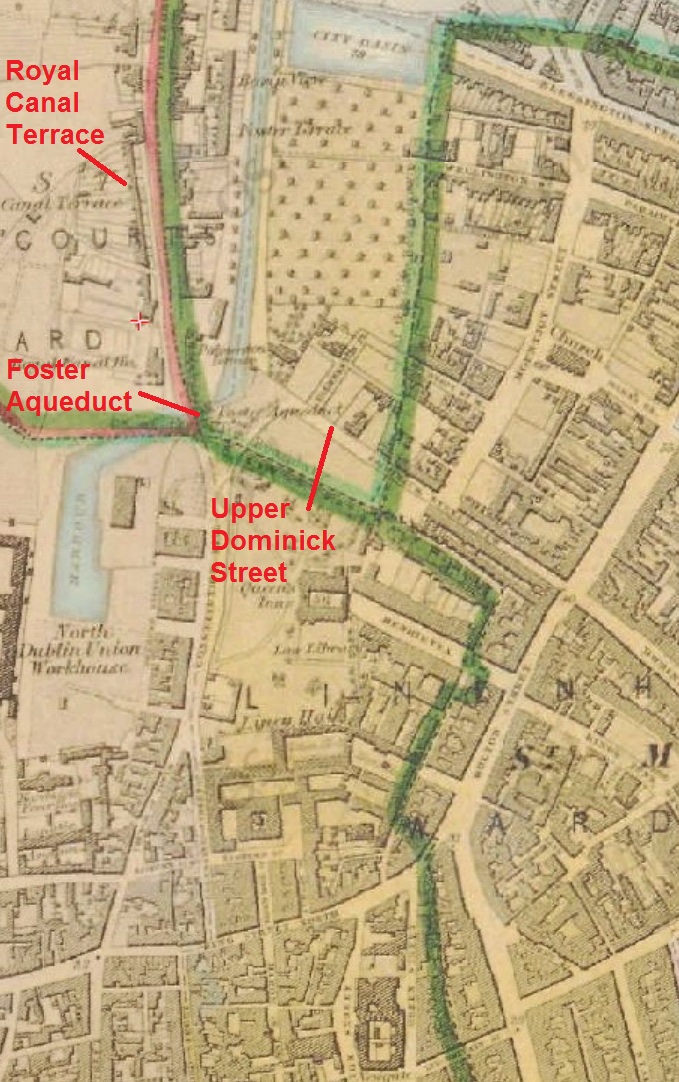
Their offices were in Sackville Street. On Sunday 2 April 1837 Mr Garnett had been on his way home to [Royal] Canal Terrace when

as he ascended the hill at the bend of Upper Dominick-street he met a man habited in a dark cloak, and having a cap on his head, who, after looking him steadfastly in the face, opened the cloak, and fired at him.

The man was not more than a yard away, so close that the powder scorched Garnett’s hand, but the bullet struck a suspender button, wounding but not killing the victim.

The scene of the crime

The scene of the crime [OSI ~1840]

William Cagburn heard the shot and also heard Garnett calling out

I am shot — stop the murderer, he has run in the direction of the aqueduct.

Cagburn gave chase:

He instantly pursued, crossed the draw-bridge, and came under the aqueduct, when he saw the prisoner running along the Phibsborough road.

Cagburn and the watchman seized the man; the watchman took two pistols from him and another witness found a third, discharged, pistol nearby on the pathway.

The prisoner, Christopher Clanchy, had been a road maker for eight years. The Freeman’s Journal said:

While a contractor for repairing part of the Ashbourne road, in the employment of Messrs Bourne, he [Clanchy] was allowed to travel free by Mr Purcell’s coaches, and Mr Garnett in the discharge of his duty having occasion to withdraw this privilege, hence proceeding his desire to be revenged. […] We are happy to state Mr Garnett is not likely to suffer any inconvenience from the injury.

But of more interest for this site is the route taken by William Cagburn. What or where was the drawbridge he crossed?

Foster Aqueduct

Upper Dominick Street and the Foster Aqueduct [OSI ~1840]

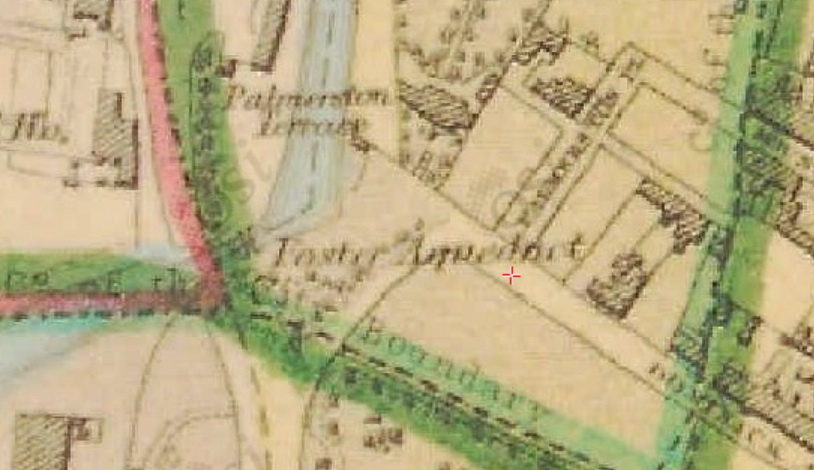
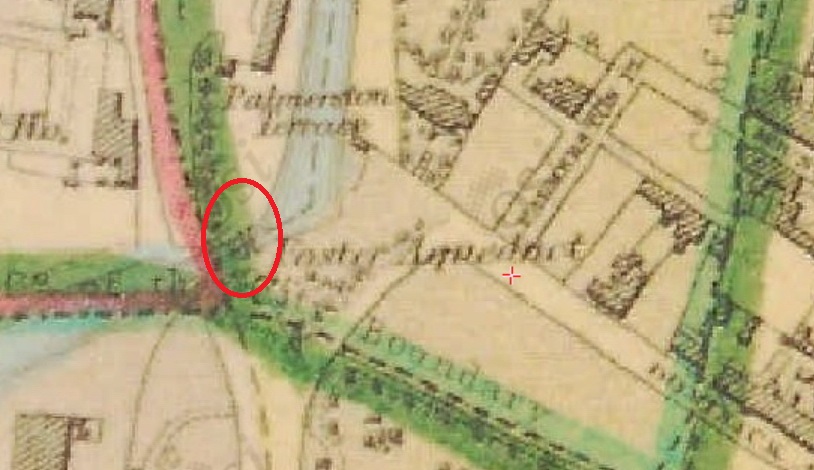
I haven’t come across [or at least I haven’t noticed] any previous mention of a drawbridge in this area. I presume that it was across the canal. And, looking closely at the map extract above …

Possible site of drawbridge

Possible drawbridge [OSI ~1840]

… I see what might be a bridge just to the left of the F of Foster. It shows up more clearly on the black and white OSI map. At Clanchy’s trial before the Commission of Oyer and Terminer, reported in the Freeman’s Journal of Monday 26 June 1837, the bridge was said to be a wooden bridge; George Cayburn [probably the William Cagburn named in the earlier report] described it as “the swinging bridge”.

Perhaps Mallet’s Insistent Pontoon merely replaced an old nuisance with a new.

Clanchy, incidentally, was found guilty: there were suggestions that he was insane, but the jury rejected them. Baron Richards said [Freeman’s Journal 1 July 1837]

The court had no discretion but to pass the extreme sentence of the law, that he should be hanged by the neck […].

Purcell, Garnett’s employer, had requested a commutation of his sentence; Richards said that it was open to Clanchy to memorial for a commutation, and the court would put no obstacle in his way; indeed it hoped he would meet the mercy “which he would have denied his intended victim”. I do not know what happened to Clanchy.

Update December 2016

The Warder and Dublin Weekly Mail of 26 September 1835 mentions the bridge:

Monday night a respectable looking elderly man fell into the Royal Canal Basin, at the Broadstone, on the Dominick-street side, within a few yards of the draw bridge.

A canal employee called Keybourne hauled Mr White out within a few minutes, but he was DOA at the Richmond Hospital.

This seems to confirm that the bridge was moveable and was where the OSI map suggests.

From the BNA

My OSI logo and permit number for website

The Black Bridge at Plassey

I am repeating here a point I made in response to a comment on this page. I do so because the point is, I think, an important one: some readers don’t check the comments and might miss this.

I have an imperfect copy [with some lines missing] of an indenture made on 8 July 1949 between the Minister for Finance and Limerick County Council under which the Council leased from the Minister

… all that those parts of the lands of Garraun and Sreelane on which Plassey Bridge abuts on both banks of the River Shannon and the site and piles of said Plassey Bridge together with said Plassey Bridge […].

I am not a lawyer, so my interpretation may be misleading, but I think that there are two points of interest.

The first is that, under the indenture, the Council is obliged to “well and sufficiently repair cleanse maintain amend and keep the hereby demised premises”, which includes the bridge. The Council is also required to “use the said demised premises as a public highway”.

The second is that, if the Council fails to do so, the Minister, and his agents the Commissioners of Public Works in Ireland, are entitled (after giving due notice) “to enter upon the hereby demised premises and to execute and to do the necessary repairs and works and the Lessees [ie Limerick Councy Council] shall repay the expenses of such repairs to the Lessor on demand […]“.

As far as I can see, Limerick County Council is in breach of its agreement with the Minister for Finance, and that Minister is entitled to repair the bridge and charge the Council for the cost.

If only there were a Minister for Finance who had an interest in Limerick (or in bridges) ….

Fuel consumption

The Dublin Monitor of 3 December 1839 quoted the celebrated Dublin-born adulterer and polymath Dionysius Lardner [who said that Victorians were prudish?] as saying

A train of coaches, about eighty tons, and transporting 230 passengers, with their luggage, has been taken from Liverpool to Birmingham, and from Birmingham to Liverpool, the trip each way taking about four hours, stoppages included. The distance between these places by the railway is ninety-five miles.

This double journey of 190 miles is effected by the mechanical force produced in the combustion of a quarter of a ton of coke, the value of which is 6s.

To carry the same number of passengers daily between the same places by stage coaches, on a common road, would require twenty coaches, and an establishment of 3,800 horses, with which the journey in each direction would be performed in about twelve hours, stoppages included.

Dr Lardner on the Steam Engine

The fuel consumption figure seemed odd to me, because I had recently read about the fuel consumed by a steamer on the Shannon in 1851. This was evidently one of the two screw steamers put to work by the Grand Canal Company in 1851, on which Sir John MacNeill conducted the experiments described here.

A luggage boat propelled by steam, on the screw principle, has been for the first time placed on the waters of the Shannon between Shannon Harbour and Limerick, taking in Portumna, Dromineer, Williamstown [probably Hollands], Killaloe, and the river and canal, to the terminus lock at Limerick.

As a specimen of aquatic architecture, the boat presents no very peculiar or striking features; it is built of iron, with a flush deck; it is capable of carrying about thirty tons, and the rate at which it goes on the canal, is about three and a half miles an hour, whether singly, or as a tug boat with two or three heavy lighters after it; whilst on the broader waters of the river, it is capable of going at a rate of seven and a half miles an hour!

This phenomenon may be explained by the fact that on the canal, which is comparatively narrow, there is no expansion of the waters displaced by the boat, whilst there is always a considerable swell raised about the prow, causes which conspire to retard her speed, and which do not operate when she is on the river.

The expense of working this boat is considerably less than that of the ordinary boat drawn by horses. A ton of coal supplies the engine between Limerick and Shannon Harbour; whereas the horsing alone of a boat between Limerick and Killaloe amounts to something about ten shillings.

The experiment, however, has not been sufficiently tested; and there is some doubt that it may succeed according to the expectations of its projectors. Just now several industrious persons with horses are employed on the canal: and it is to be hoped that in this season of dearth and destitution, no hasty means will be adopted to force them for subsistence on overgrown poor rates.

Limerick Reporter 27 May 1851

The Limerick Reporter article does not say, and I cannot determine, whether this was  Towing steamer No 2 [Appendix 3 in Ruth Delany The Grand Canal of Ireland David and Charles, Newton Abbot 1973], the twin-screw vessel which MacNeill, confusingly, called the No 1 Boat, or the single-screw Towing steamer No 1, which MacNeill called the No 2 Boat.

But I was surprised that the railway train could do 190 miles on a quarter ton of coke while the steamer required a ton for the (roughly) 54 miles from Shannon Harbour to Limerick.

On consulting the online Gutenberg version of the seventh edition of Dionysius Lardner The Steam Engine explained and illustrated; with an account of its invention and progressive improvement, and its application to navigation and railways; including also A Memoir of Watt Taylor and Walton, London 1840, I found that there were some differences between that and the Dublin Monitor‘s version:

A train of coaches weighing about eighty tons, and transporting two hundred and forty passengers with their luggage, has been taken from Liverpool to Birmingham, and back from Birmingham to Liverpool, the trip each way taking about four hours and a quarter, stoppages included. The distance between these places by the railway is ninety-five miles.

This double journey of one hundred and ninety miles is effected by the mechanical force produced in the combustion of four tons of coke, the value of which is about five pounds.

To carry the same number of passengers daily between the same places by stage-coaches on a common road, would require twenty coaches and an establishment of three thousand eight hundred horses, with which the journey in each direction would be performed in about twelve hours, stoppages included.

So 240 passengers, not 230; 4¼ rather than 4 hours — and most significantly 4 tons of coke, costing about £5, rather than ¼ ton costing 6s [£0.3].

Did the Dublin Monitor get it wrong — and, if so, why and how? Or were the lower figures in some earlier edition of Lardner’s work?