Category Archives: Industrial heritage

WI down wid da kidz

I have recently written, for publication elsewhere, an article comparing Waterways Ireland’s online presence unfavourably with that of the Canal & River Trust, which manages many waterways in England and Wales. WI clearly listened, because it has completely revamped its website.

Actually, that’s my little joke, because WI has clearly had folk working hard on this for some time. Its home page address remains as it was with (as I write) a clock ticking down to the official launch on 18 April 2013, but you can bypass that. Clearly not all the pages have yet been populated, but the overall design can be seen and it is several leagues ahead of the previous version.

It promotes a wider range of activities: walking, cycling, angling, boating, rowing, canoeing, sailing and power sports (but not, alas, campervanning). It has an events section, with events listed in chronological order by starting date; you can shorten the list by selecting a waterway, an activity or a date. This online listing is far more user-friendly than WI’s print equivalent. Sensibly, information on planning events is in the same section as the events listing.

The Clones Sheugh is listed amongst the waterways under Events, but no activities are planned there. However, the sheugh is not amongst the seven waterways listed under Our Waterways.

There’s a useful Do it Online section, with subsections called Register it, Pay for it, Apply for it and Report it. The last of those is rather disappointing, suggesting off-line communication; it would be more useful to have this sort of discussion between WI and its customers conducted in public. The promised form for online compliments and complaints isn’t there, but presumably will be added soon. Apply for it includes a procedure for applying for permission to film on WI property; this is something that BW (C&RT’s predecessor) had years ago.

The Learning section includes online games, the teachers’ resource pack and, encouragingly, information on arranging group tours of WI facilities and on accessing the archives; we are promised that some archive material will appear online.

The Corporate section includes About UsFAQs, Public Consultation, Research, Careers, Partner Information, Policies and Plans & Reports. There is little that was not on the previous version of the site. There are sections for the Media and on Commercial Activity; Visitors Centre leads to the existing pages on the Box in the Docks; there is a much better Contact Us page, with a classified list so that you can find the office you need.

The down-wid-da-kidz bit is that there are links to WI Facebook, Twitter and YouTube pages. There is nothing on the YouTube page yet; perhaps the first video will show Jimmy Deenihan cutting the ribbon on the new website tomorrow. The Twitter page — joy! — includes the marine notices, which makes this the first good reason I’ve come across for taking an interest in Twitter. The Facebook page seems to be no better or worse than other FB pages I’ve seen.

The new website does not seem to have anything about Nuttall’s Pondweed, which was the only thing on the old site that might attract nature-lovers. I see nothing on the new site to interest such folk; apart from the archives bit, WI’s wealth of industrial heritage is not represented. So, despite the much improved appearance and organisation, there are constituencies, or potential constituencies, that are not being addressed.

However, on the whole the new site does seem to fit in with and promote WI’s Marketing Strategy 2012–2017:

4.1 Marketing Mission

Essentially the marketing mission of Waterways Ireland is unchanged and is defined as increase awareness and promote greater use of Ireland’s 
Inland Waterways.

4.2 Strategic Marketing Objectives

Within the period 2012–2017, Waterways Ireland wishes to build on the success and achievements of the previous Strategy taking a more proactive approach in achieving the following strategic marketing objectives:

– promoting increased use of the Waterways including promoting the range of uses;

– creating awareness of the waterways including the commercial potential of thewaterways; and

– creating working relationships with other state and semi state, tourism, trade, recreational organisations and users.

What is not entirely clear to me, though, is whether this new and much-improved website is to continue the one-way communication process or whether WI will use the new media to their full potential, encouraging two-way communication (even if it includes criticism) and building a real waterways community. It will be interesting to see.

For far too long, the IWAI website was streets ahead of WI’s. The shoe is now on the other foot. Congratulations and best wishes to all involved in this major improvement to WI’s online presence.


Sinn Féin wants taxpayers’ money for Clones sheugh

The Impartial Reporter reports (impartially) that “Councillors press for Ulster Canal funding to be released”. The two councillors quoted are Thomas O’Reilly of Fermanagh District Council and Pat Treanor of Monaghan County Council. Both are members of Sinn Féin.

Cllr Treanor is quoted as saying “Once the Government release the funding ….” Cllr Treanor seems to have missed the point that “the funding” does not exist: the [RoI] government has not got the money and, as I have pointed out here many times, no money was set aside for the Ulster Canal. He says that …

… we would in the interim call upon all living in the local community, from Derrykerrib to Clones to begin to think about taking advantage of the obvious business opportunities that this reopening will bring.

If the members of the local community have any money, they might be better advised to invest it in Swiss bank accounts. Or even Bitcoins.

Raising the Royal

I have remarked before that …

Ewan Duffy of IndustrialHeritageIreland and I have both, in recent times, uncovered new information about the history of the Royal Canal after it was taken over by the Midland Great Western Railway in 1845: a period that, because (I think) of the absence of company archives, is not well covered in published histories of the Royal.

Ewan has now published a splendid piece of research showing that the Dublin end of the Royal Canal, from Newcomen Bridge (Lock 1) to Cross Guns Bridge (Lock 5), was extensively rebuilt during the second half of the nineteenth century. This is, as far as I know, entirely new information. It gains further interest from the interaction between different concerns — canal, railway, tramway, drainage — all contending for the same small space in Dublin.

I have no doubt that there is yet more to be discovered about the Royal’s lost century.

The Charles Wye Williams bridge campaign

Dublin City Council has published its call for proposals for naming the new bridge across the Liffey. According to RTE, various bolshies and literary types have been suggested, as though we didn’t have enough of them (and of politicians too). Accordingly, I have submitted an application suggesting that the bridge be named after a successful entrepreneur who understood technology and created employment: Charles Wye Williams, the Father of the Shannon, whose fleet of nine steamers and fifty-two barges gave us the Shannon as we know it today.

I will be happy to send a copy (PDF) of my application to anyone who is willing to support it.

Lock sizes on the Shannon Navigation

Some figures.

The Limerick Navigation: lock sizes

Here is a table showing the sizes of the locks on the (now abandoned) Limerick Navigation.

Sailing in the Lowtown high

WI & L&MK at Lowtown, with pics and map, here.

Mark Twain and the Cammoge drownings of 1849

Mark Twain wrote:

There is something fascinating about science. One gets such wholesale returns of conjecture out of such a trifling investment of fact.

I have indulged in just such conjecture about the design of the ferry boat in use at Cammoge in 1849, crossing the outlet from Poulnasherry Bay, west of Kilrush on the Shannon estuary. The news reports of the time give very little information about the design of the boat, and the reliability of that information is questionable, which makes my speculation even more dangerous. Nonetheless, I thought it might be useful to set out some thoughts on the subject in the hope that other folk, who know more about the background, the location or naval architecture than I do, might be able to help to clarify the design.

Myths and legends of the Shannon

I feel it necessary to point out that Thomas Rhodes (1789–1868), engineer to the Shannon Commissioners, whose name is on a plaque on Athlone bridge, was not a brother of Cecil Rhodes. Thomas was born near Bradford, the son of a carpenter called James Rhodes; Cecil was born in Bishop’s Stortford, the son of a clergyperson.

On wires and worked with steam*

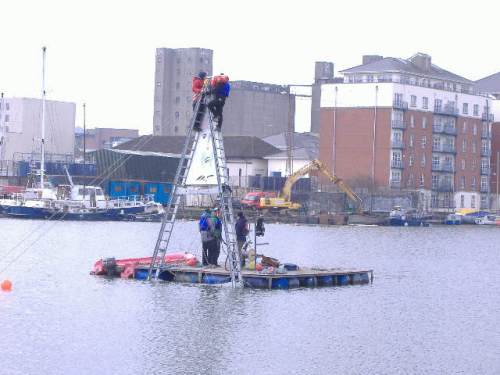
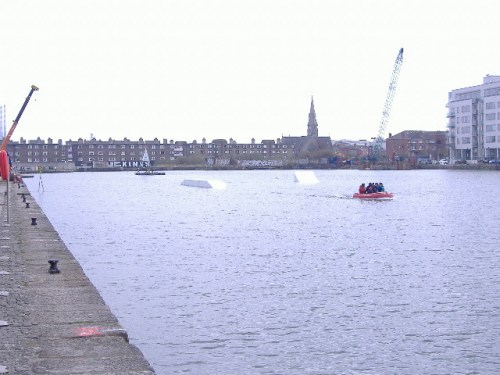
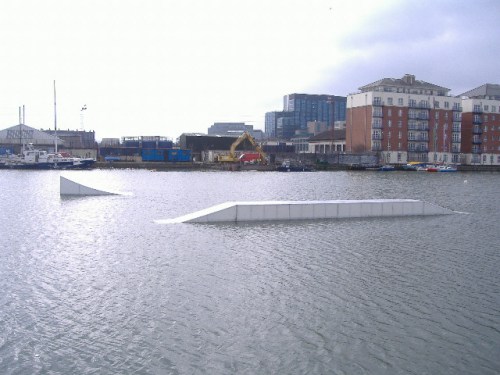
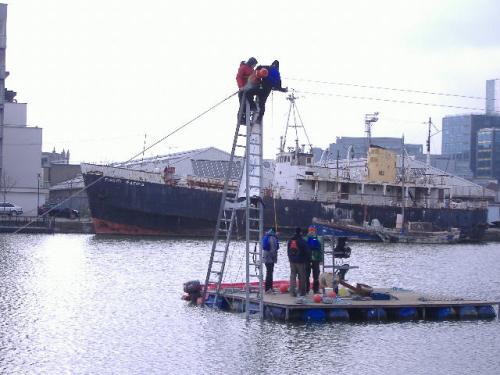
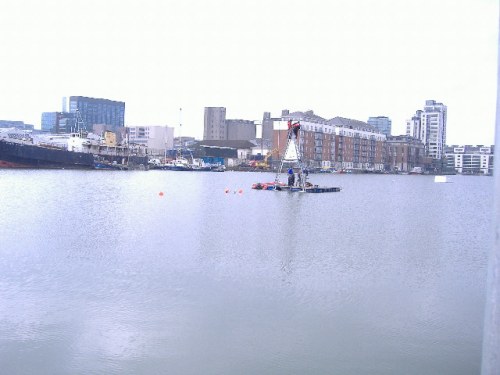
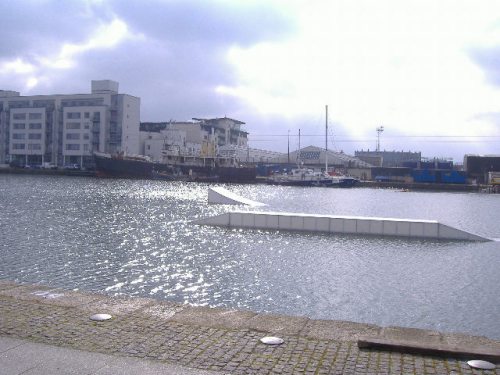
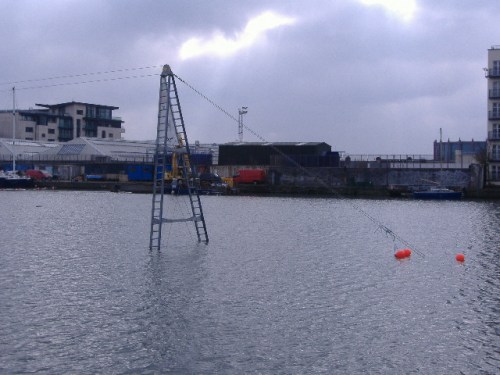
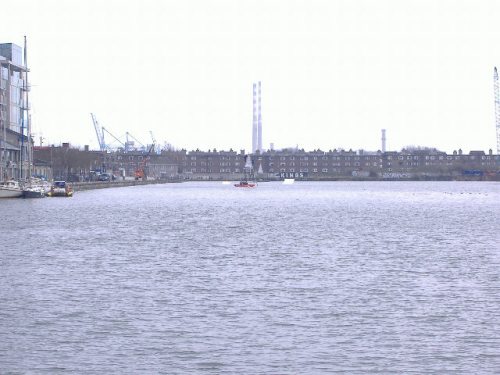
Thanks again to Paul Quinn for another set of photographs, this time of the newly-installed wakeboarding system thingie in Grand Canal Dock, Dublin, which is to be opened on 9 March 2013.

Wakeboarding, as I understand it, involves dressing up in brightly coloured plastics, standing on a plank and being towed around behind a boat. I don’t myself see the appeal, being more the sedentary sort, but chacun a son gout, as the French don’t say, apparently, although why they’re supposed to know anything about it I don’t … but I digress. The wakeboarding system thingie seems to allow wakeboarding without a boat; it might also require less sea room.

A system was installed temporarily last year; there is information about it here. I don’t know whether that is the same system as has now been installed. You can read the environmental report here [PDF]. Waterways Ireland tells me that

Waterways Ireland has entered into a three year commercial operating licence agreement with Colin Harris T/A Wakedock Ltd., to place and operate a mobile wakeboarding system in Grand Canal Dock.

There seems to be an association between Wakedock and the Surfdock business in the Naomh Éanna, although Wakedock also has its own website.

I asked Waterways Ireland how much it was earning from this; it refused to tell me:

Waterways Ireland do not release license fees charged to individual commercial licence holders as this would be detrimental to our business interest in future license fee valuations.

DSCF0958

A tower tower

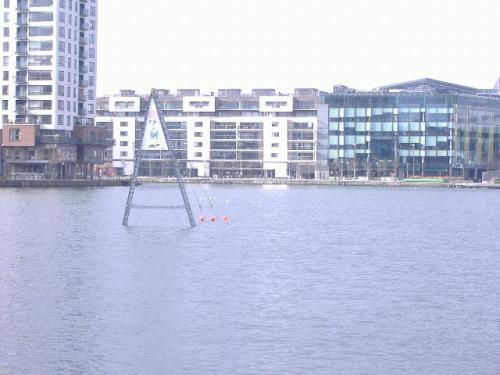
from grand canal theatre.

Looking from Grand Canal Theatre: note the white ramps

from hanover quay.

Seen from Hanover Quay

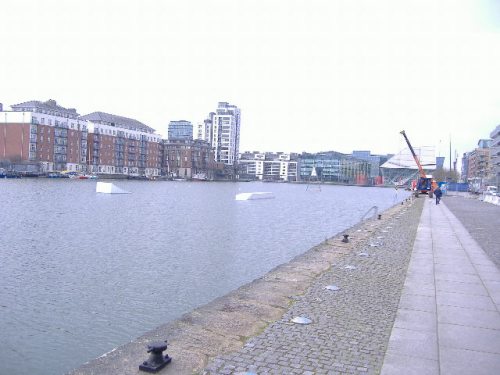
looking east towards ringsend

The ramps (looking east towards Ringsend)

looking south from hanover quay at ramps.

A close-up from Hanover Quay

looking south from hanover quay.approx.25 meters

The Naomh Éanna in the background

looking south from sea locks.aprox 50 meters

About 50m from the sea locks

looking west to gallery quay.

Looking west to Gallery Quay

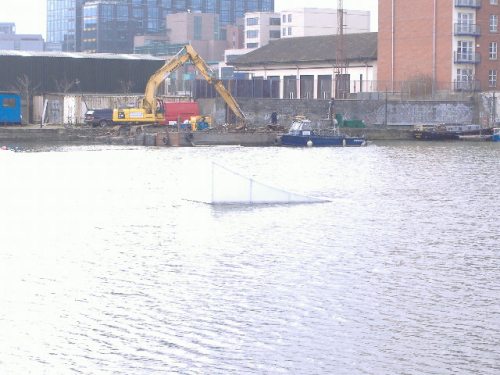
ramp with dredger at charlotte quay.

Ramp in the foreground; excavator at Charlotte Quay in the background

ramps and far  line support

Ramps and western line support

ramps and new position of naomh eanna.

Naomh Éanne in its new position

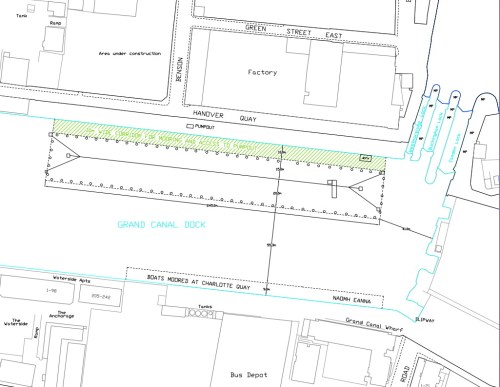
Waterways Ireland tells me that:

When agreeing the location, consideration was given to maintaining access to the pump-out on Hanover Quay and also access to vessels wishing to enter via the lock gates. No detrimental impact on navigation for other users is anticipated.

WI kindly provided this map.

GCD wakeboarding map

GCD wakeboarding map

Semper aliquid novi Africam adferre, as my old grandmother used to say.


* see The Third Policeman