
The Irish Independent has a sane and realistic article about living on a barge on Irish inland waterways. I can’t recall seeing such a thing before.
The book Reedbound, mentioned in the article, is available here; it is highly recommended.
On 22 September 2015 Eric Byrne [Labour, Dublin South Central] put a written question to the Minister for Fairytales:
To ask the Minister for Arts, Heritage and the Gaeltacht her plans to review the no swimming in locks and harbours under the by-law within the Canals Act by-laws of 1988 in view of the fact that there is no penalty for ignoring such signs; and if she will make a statement on the matter.
The minister replied:
I have been informed by Waterways Ireland that while it has not determined a need for an associated penalty with this by-law at this time, the matter is being kept under review. I am advised also that the locks, docks and harbours are manned and/or frequently visited by Waterways Ireland Operations and Inspectorate Authorised Officers. Where swimmers are encountered, they are made aware of the by-law provision and the dangers of swimming in or near canal infrastructure and they are requested to remove themselves from the navigation. Such requests are normally acceded to. In the event of persistent offender(s) unwilling to obey direction from Waterways Ireland Authorised Officers, the assistance of An Garda Síochána is sought to remedy the situation.
Sometimes I wonder whether politicians have any grasp on reality. Swimmers in the Naller are a force of nature and are as far beyond the control of Waterways Ireland, the police and indeed politicians as hurricanes, the economy or Mick Wallace. People have been swimming in the canals, in Dublin and no doubt elsewhere, for generations, and nothing or nobody has been able to stop them.
I suspect that more people have swum in the canals than have ever boated on them; swimming is therefore a legitimate topic for waterways studies. Here is a preliminary contribution to the field.
Posted in Built heritage, Canals, Extant waterways, Historical matters, Ireland, Irish waterways general, Modern matters, Operations, People, Politics, Safety, Sources, Water sports activities, waterways, Waterways management
Tagged bridge, Dublin, Grand Canal, lock, Naller, Royal Canal, swimming, Waterways Ireland
Budget documents [available here] include the Part IV Estimates for Public Services 2016 [PDF]. The Summary of Gross Expenditure (Capital and Current) by Ministerial Vote Group shows that the Department of Fairytales [aka Arts, Heritage and the Gaeltacht], RoI parent of Waterways Ireland, is to get an increase in its budget.
Its forecast outturn for 2015 matches its estimate for the year at €277,434,000, of which €215,854,000 is current and €61,580,000 is capital spending. However, the estimates for 2016 show €234,430,000 current + €76,000,000 capital = €310,430,000 total, an increase of €32,996,000. Current spending is up 8.6% and capital by 23.4%; total spending is up by 11.9%. Perhaps the extra €14,420,000 in capital spending is to extend Saunderson’s Sheugh to Clones?
Skipping the numerous tables that repeat more or less the same gen in different ways, and skipping too the unimportant government departments, we zoom forward to the details of the Department of Fairytales estimates.
But there we find, alas, that while the department as a whole has secured lots of extra lolly — and it’s going to be shovelling 18% more to the luvvies [Arts, Culture and Film], 11% more to heritage and 3% more to the BéalBochters — it intends to cut spending on North-South Cooperation, which is where Waterways Ireland gets its money.
The 2015 estimate for NSCoop current expenditure was €35,072,000; the 2016 estimate is €34,925,000, which is a cut of only about half of one per cent. But capital spending on NSCoop is down almost 20%, from €3,487,000 to €2,799,000, and total spending down 2% from €38,559,000 to €37,724,000.
The NSCoop figures are “subject to the North-South Ministerial Council”, which means that the (southern, Fine Gael) Minister for Fairytales has to persuade the (northern, Sinn Féin) Minister for Marching Bands that the cross-border language and waterways bodies aren’t getting any increase in their funding from the Free State, at least not while there is an election to be won. However, HM Devolved Administration didn’t seem too keen on allocating extra money to waterways last time I looked.
Regular readers will not need to be reminded that 85% of WI’s current budget is supplied by the RoI government and 15% by the NI administration, while capital expenditure is paid for by the state in which it occurs.
The estimates figures as shown don’t tell us the precise impact on Waterways Ireland’s current budget: the money is divided between WI and the language shamrock but the document doesn’t tell us which gets how much. [The last time a breakdown was given was in 2011, when WI got roughly 60% of the total.] However, most of the department’s NSCoop capital expenditure is undertaken by WI, and little or none of it by the language shamrock, so we can say that the 20% cut in NSCoop capital spending means a 20% cut in capital spending on waterways in the Free State.
The breakdown of the Multi-Annual Capital Investment Framework confirms that: in 2015 €3,368,000 of the €3,487,000 NSCoop capital budget (96.5%) went to WI, and in 2016 WI will get €2,680,000 of the €2,799,000 NSCoop capital budget (95.7%). I imagine that the language folk prefer sitting i dtóin an tí and don’t want fancy buildings.
WI’s capital budget for RoI is down from €11,000,000 in 2008.
According to the Multi-Annual Capital Investment Framework 2016 to 2021 (Table 1), the Department of Fairytales as a whole is getting an unusually large amount, €76,000,000, of Exchequer Capital Funding in 2016; the total is to fall back to €45 million in 2017 and €43 million in 2018, before rising to €46 million in each of the years 2018, 2020 and 2021. So, in a year in which the department is getting much more money for capital spending, NSCoop and, specifically, waterways are getting significantly less.
Looking at the breakdown (Table 2), it seems that the big changes in the department’s capital spending are:
There are a few other minor changes, but the increased allocation of €15,270,000 to the main Decade of Centenaries item has more than swallowed the extra €14,420,000 allocated to the department. Three other significant items — Teach an Phiarsaigh, the Cork Event Centre and the Built Heritage Jobs Leverage Scheme, which between them have been given an extra €8,150,000 — have been funded by the reduced allocations to the Crawford Gallery, the National Parks and Wildlife Service, Údarás na Gaeltachta and Waterways Ireland.
So there’s no money for Sinn Féin’s beloved Clones Sheugh.
Posted in Built heritage, Canals, Economic activities, Engineering and construction, Extant waterways, Foreign parts, Ireland, Irish waterways general, Modern matters, Operations, Politics, Restoration and rebuilding, Shannon, Sources, Tourism, Ulster Canal, waterways, Waterways management
Tagged budget, capital expenditure, Clones sheugh, department of arts heritage and the gaeltacht, Fine Gaewl, Ireland, North South Ministerial Council, Saunderson's Sheugh, shinners, Sinn Fein, Ulster Canal, Waterways Ireland
I still have no idea why Sinn Féin thinks the Clones Sheugh would cause any significant increase in tourism, or any other economic benefit.
Thanks to Brian Simpson for this update on the continuing resurrection of St John’s Pill [river] in Waterford.
Waterford Council had new fencing erected by Fairybush Landscaping Ltd around Cherrymount bridge and around the slip area. The Council also recently opened a beautiful greenway for pedestrians and cyclists along the St John’s river right into Waterford City Centre.
Our slipway at Cherrymount bridge was being eroded by heavy rainfall and
strong currents when the canal was swollen.

The slipway
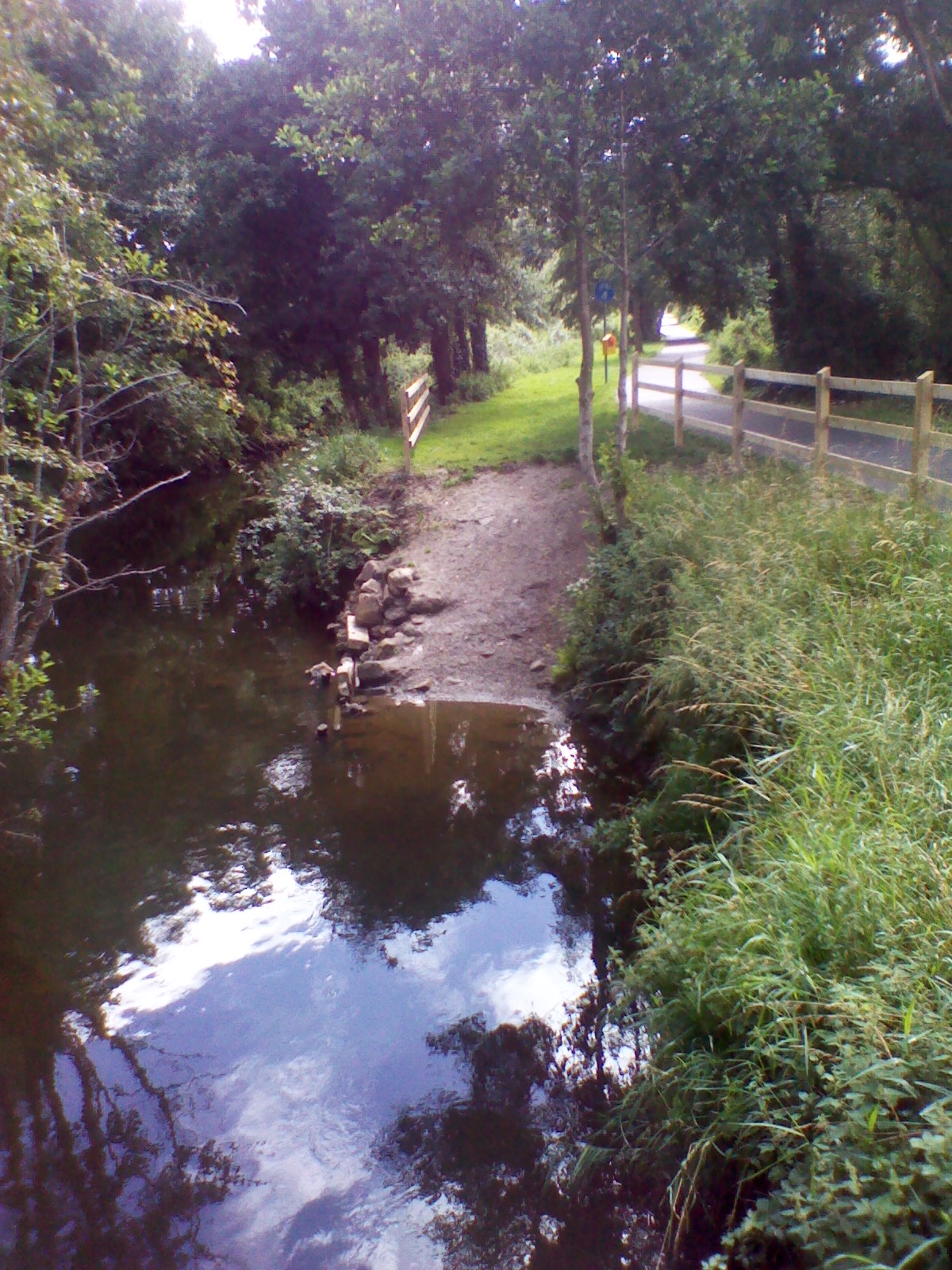
The slipway fenced (but eroded)
In order to prevent further damage with the approach of autumn and winter, improvement works had to be carried out. With a low tide window for much of the day and a couple of dry days beforehand, Saturday 29 August 2015 was our perfect opportunity.
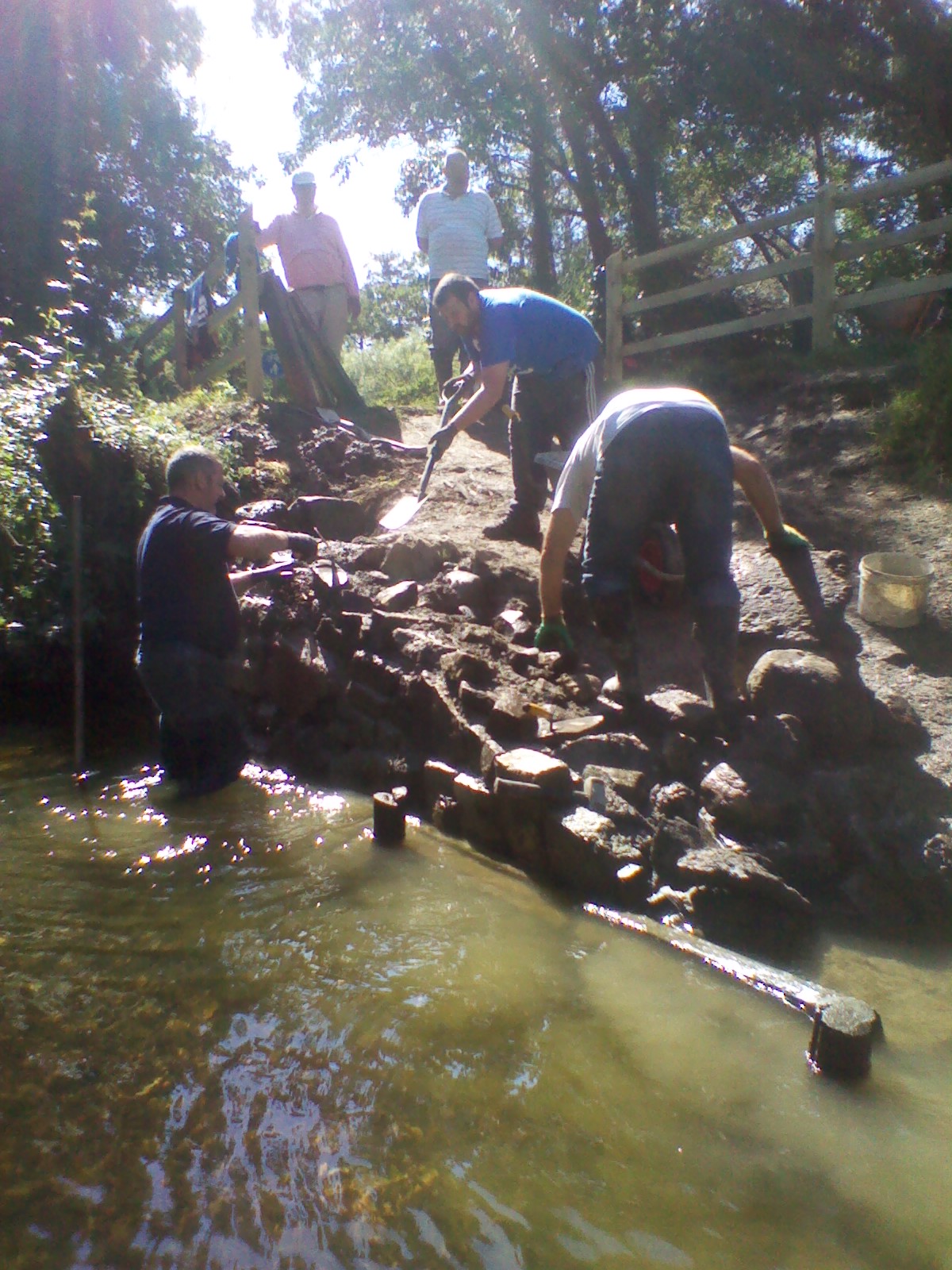
Men at work
We would like to take this opportunity to thank our Chairman David Hayes [of David Hayes Engineering, Waterford] for organising the mixer, sand/gravel cement from Doyle Concrete …
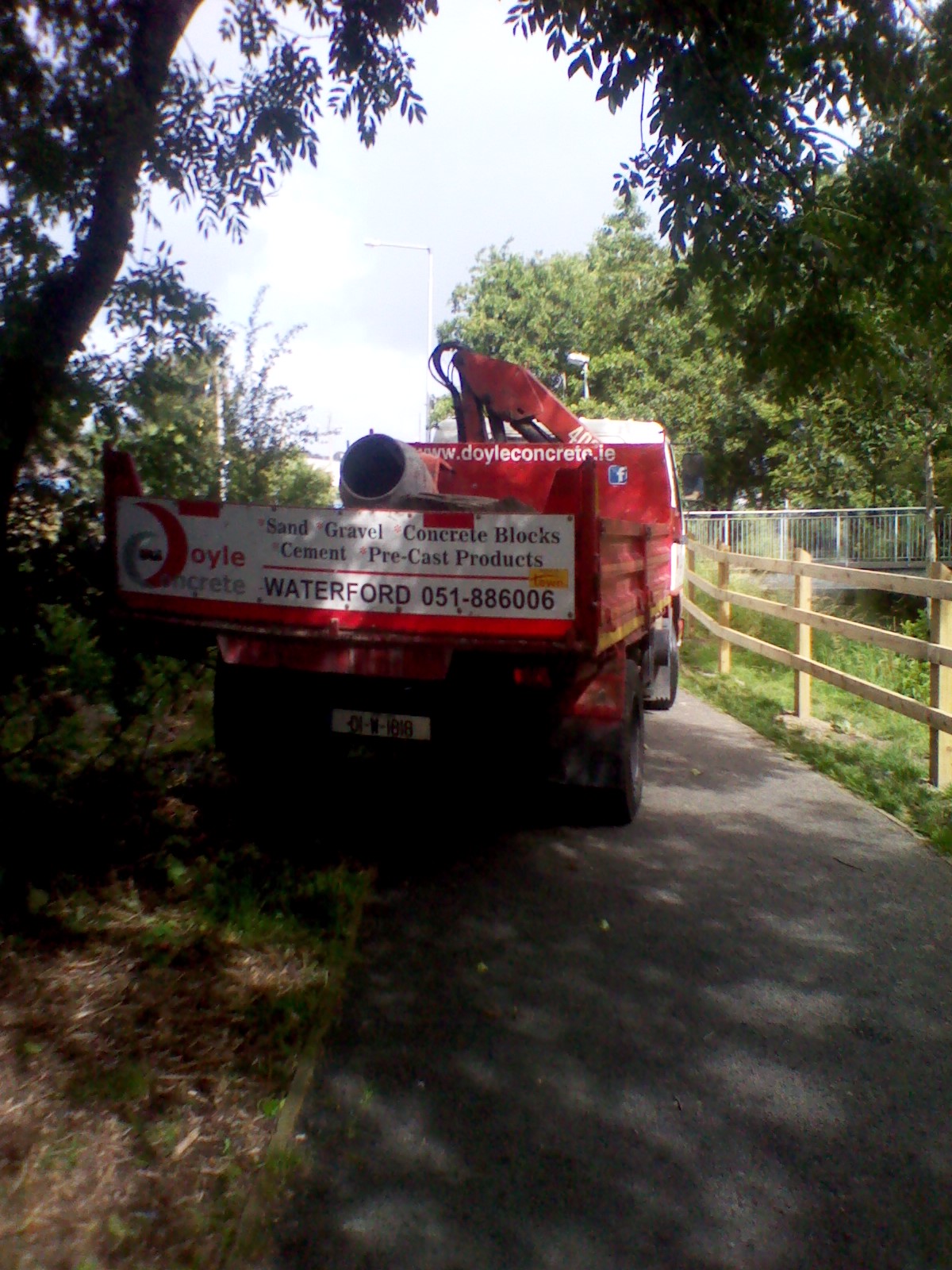
Doyle Concrete
… and the concrete slabs and capping from Boyce Mulrooney, scrap merchant, Tramore Road, Waterford.
All the committee members who donated bags of cement, tools, ideas, labour and teamwork.
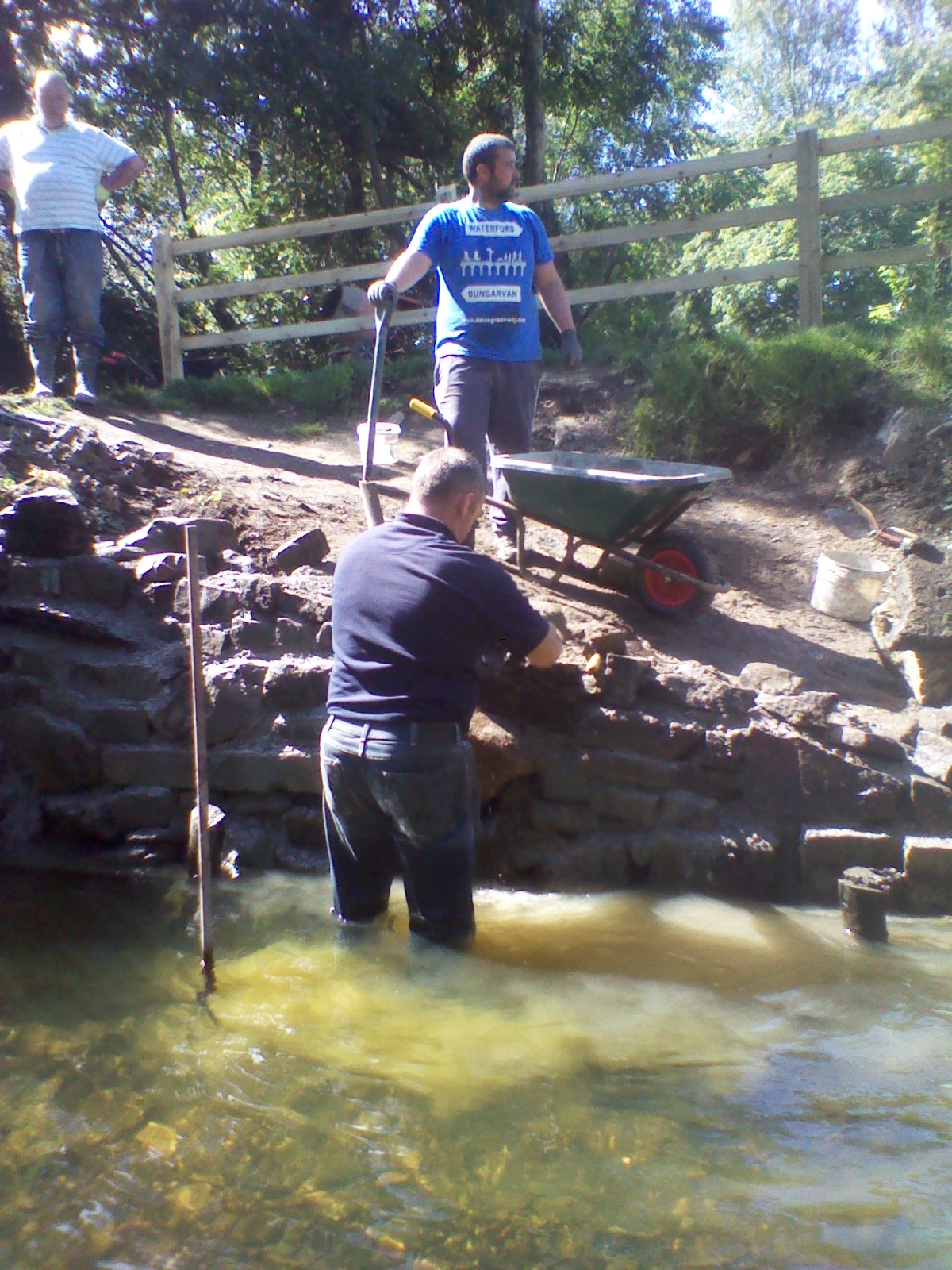
Wade in the water
A great day was had and most importantly the slip is now much secure and pleasing to look at too.
Posted in Ashore, Built heritage, Canals, Economic activities, Engineering and construction, Extant waterways, Forgotten navigations, Ireland, Operations, People, Restoration and rebuilding, Suir, waterways, Waterways management
Tagged canal, fencing, greenway, river, slipway, St John's Pill, Suir, Waterford

 Irish waterways history