Category Archives: Natural heritage

News from the Suir

Some chap from Limerick has been quoted in the Nationalist (Clonmel) as supporting South Tipperary County Council’s proposed taking in charge of the towing-path between Carrick-on-Suir and Clonmel.

And Carrick-on-Suir River Rescue needs help raising funds to buy a premises.

Mystery solved

Nobody tried the Spot the canal I set the other day, so I must now reveal that the eel weir shown is at the upper end of the Cong Canal. There are many photos and maps on that page.

The corncrake and the decline of religion

On 13 February 2013 the Irish Times reported that a farmers’ representative had told politicians that

Farmers in the Shannon callows are facing extinction along with the corncrake and wading birds […].

He wanted taxpayers’ money to be spent on stopping the river flooding its flood plain.

Back in the days when people believed in gods, they would have known what a flood meant: it was a message from a deity, telling them to stop whatever they were doing. On the Shannon, either people have stopped believing in gods or they are having some difficulty in interpreting the message, despite its having been delivered over and over again for hundreds of years. If it were interpreted properly, or even if landowners had a modicum of common sense, they would realise that they should either cease trying to earn a living along the banks of a river that floods regularly or adapt their expectations or their activities to take account of the floods (one thinks of rice paddies …).

In the years 2009–2011 net subsidies to agriculture in the Midland region were 114.4% of the operating surplus. For the Border, Midland and Western region as a whole, the figure was 110.4%. In other words, agriculture in those regions is, on balance, a form of outdoor therapy for landowners: it is not an economic activity, and there is no point in taxpayers’ spending any more money on it.


Wexford

Here is a great account of the development of Wexford Harbour, with a history of its shipping here.

The glory that was Greese

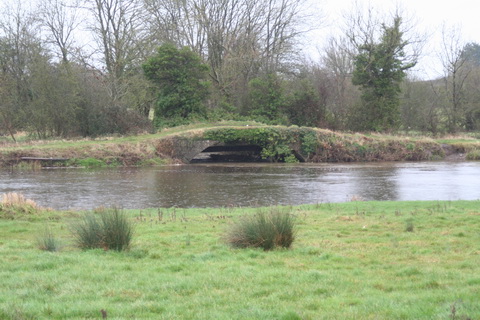
The River Greese is a tributary of the River Barrow, joining it below Maganey Lock. The photo is taken from the road on the west bank of the Barrow.

River Greese joins the Barrow 01_resize

The Greese joins the Barrow: the trackway passes over it on a bridge

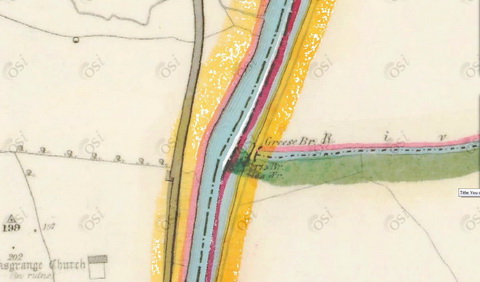
You can locate it on the OSI map by zooming out from here; the extract below shows the confluence.

Greese_resize

The confluence

My OSI logo and permit number for website

What are they?

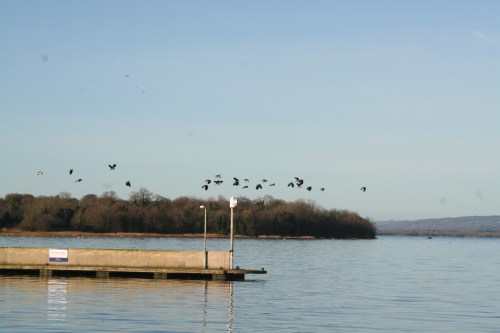
Dromineer February 2013.

Unidentified birds (click for much larger image)

Unidentified birds (click for much larger image)

Yes, I know they’re birds, but what class or type or breed or model?

The fear of Baal’s Bridge

In May 1895 the fear induced by the prospect of a passage under Baal’s Bridge, on the Abbey River in Limerick, as revealed in the commercial court in London before Mr Justice Mathew and reported by the Freeman’s Journal of 20 May 1895.

Arthur George Mumford of Colchester, Essex, was described as an agent, but was actually a marine engineer and manufacturer of steam engines. He owned a 25-ton steam yacht called Gipsy, which he decided to sell through Messrs Cox & King, the well-known yachting agents (their 1913 catalogue is here).

The buyer was Ambrose Hall, the man responsible for the statue of Patrick Sarsfield. A former mayor of Limerick, he was an alderman and a “house and land commission agent”; his address was given as Mignon House, Limerick, which I have not so far found.

Hall bought the boat for £500; it was to be delivered to him at Limerick. The original plan was to sail it around the coast of Ireland and up the Shannon estuary, but bad weather in late 1894 caused Cox & King to suggest taking it to Dublin and then down the Grand Canal and the Shannon to Limerick. Hall agreed; the boat left Dublin in January 1895. It reached Killaloe on 19 January and Limerick “a day or two afterwards”, where it was moored in the canal harbour.
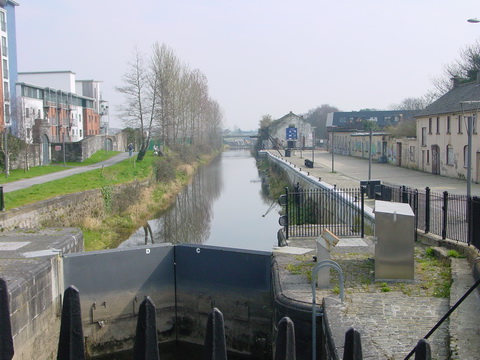
25 Grand Canal Harbour Limerick March 2007 01_resize

Canal harbour, Limerick in March 2007

Hall refused to accept the boat in the canal, saying that it should have been delivered to Limerick dock, a short distance downstream. Mumford and Cox & King sued him and the National Bank.
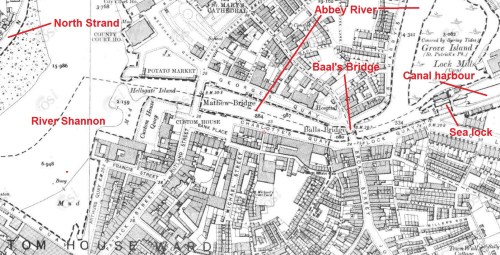
Hall and Baal

Ordnance Survey ~1900

Hall, an alderman and a former mayor, who had lived at North Strand, presumably knew the river and its difficulties.
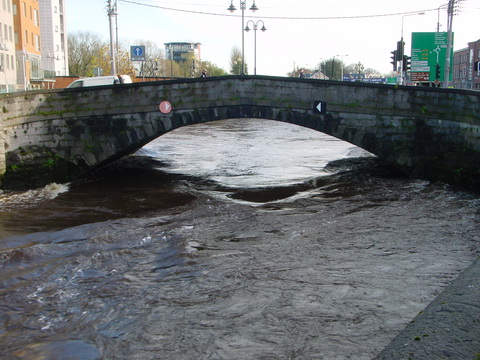
Baal's Bridge 20091128 1_resize

Baal’s Bridge looking upstream towards the canal harbour in the floods of 2009
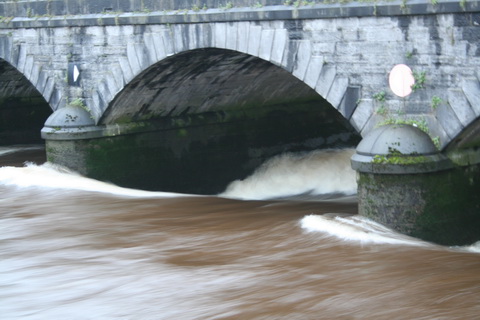
Navigation arch at Mathew Bridge 20091122_resize

The navigation arch at Mathew Bridge looking downstream in the floods of 2009

It was contended by the defendant that to get the vessel from the canal into the estuary of the Shannon there was a considerable risk involved. The passage was only a few hundred yards, but it was stated it could only be effected at certain states of the tide when it would be possible to get through Ballsbridge.

The judge sensibly suggested that it should be possible to insure the boat for the journey; the plaintiffs agreed to deliver it; Hall agreed to accept delivery and to pay £15 for the cost of the caretaker who had been looking after the boat since 23 January; the case was settled.

Clearly Ambrose Hall didn’t know Pat Lysaght.

My OSI logo and permit number for website

The Fergus estuary

I have a page about the Fergus estuary here with links from that page to others about places on the estuary (including Paradise).

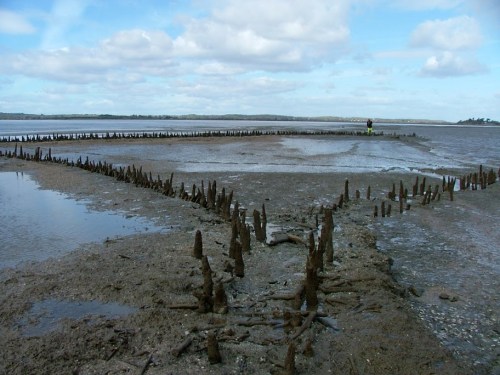
Mediaeval fishweir at the Boarland Rock in the Fergus Estuary © Dr Aidan O’Sullivan, UCD 2008

Mediaeval fishweir at the Boarland Rock in the Fergus Estuary © Dr Aidan O’Sullivan, UCD 2008

The UCD School of Archaeology has, for many years, been investigating the Fergus estuary and has found remarkable evidence of settlement and activities on the estuary stretching back to the Iron Age (about 100 BCE) and the Bronze Age (almost 800 BCE). Read about the project here and see more photos of mediaeval fishweirs and earlier artefacts here.

The photo above is used in accordance with the terms set out here.

Mountshannon

In the Foreword to his latest book, Portraits of Mountshannon (East Clare Heritage, Tuamgraney 2012), Ger Madden writes of the changes to Mountshannon since 1993:

The Aistear, the children’s playground, the pre-school building, the floating jetties at the harbour, additional restaurants and shops have been hugely positive and successful. The same cannot be said for housing. Ten years of reasonable prosperity for some, has resulted in new private holiday homes built on the fringes of the village and others planned. They are not associated with the needs of the community. The majority of the owners have not the slightest interest in the history, culture or welfare of the community they have chosen to display their wealth.

Any such owners wishing to develop an interest in the history of Mountshannon could not do better than to start with Ger’s book. It’s A4 landscape, with an aerial colour photo of Mountshannon on the front and a map on the back. Inside, the foreword gives a brief overview of Mountshannon’s history. Then follow 52 pages, each with a black and white photo and each covering a building, a tree or a place of interest in and around Mountshannon. Their locations are shown on the map on the back cover.

But, although architectural information is provided, the book is not about the buildings per se. Each page is a window into Mountshannon’s history and, together, they provide a rich account of the place and its people over the centuries. Part of the interest is in the fact that buildings you might pass by without noticing turn out to have interesting stories attached to them. Nor are they all about the distant past: I was glad to see that Mountshannon’s more recent claim to fame, as the last telephone exchange in the country to be automated, was recognised here (although I suppose that too may seem like the distant past to younger readers).

I highly recommend the book. If you’re in the area, you’ll probably know better than I where to get copies; if you’re not, you might ask East Clare Heritage.

Ger runs boat trips to Holy Island during the summer.


The end of an era

Ger Reid, the Ardnacrusha lockkeeper, retired at the end of December 2012. Ger has guided many boats through the locks over the years and has always been cheerful and reassuring as well as informative, helpful, reliable and competent. He will be sadly missed but I wish him well in his retirement.

Meanwhile, I have heard that Limerick City Council has decided not to renew Pat Lysaght’s contract for work on the river and has suggested that Waterways Ireland should retain him. Pat’s most important role, though, in assisting boats passing through Limerick (220 in 2012), has always been voluntary. Were Pat to cease to provide that service, I think the number of boats visiting Limerick would be greatly reduced.